



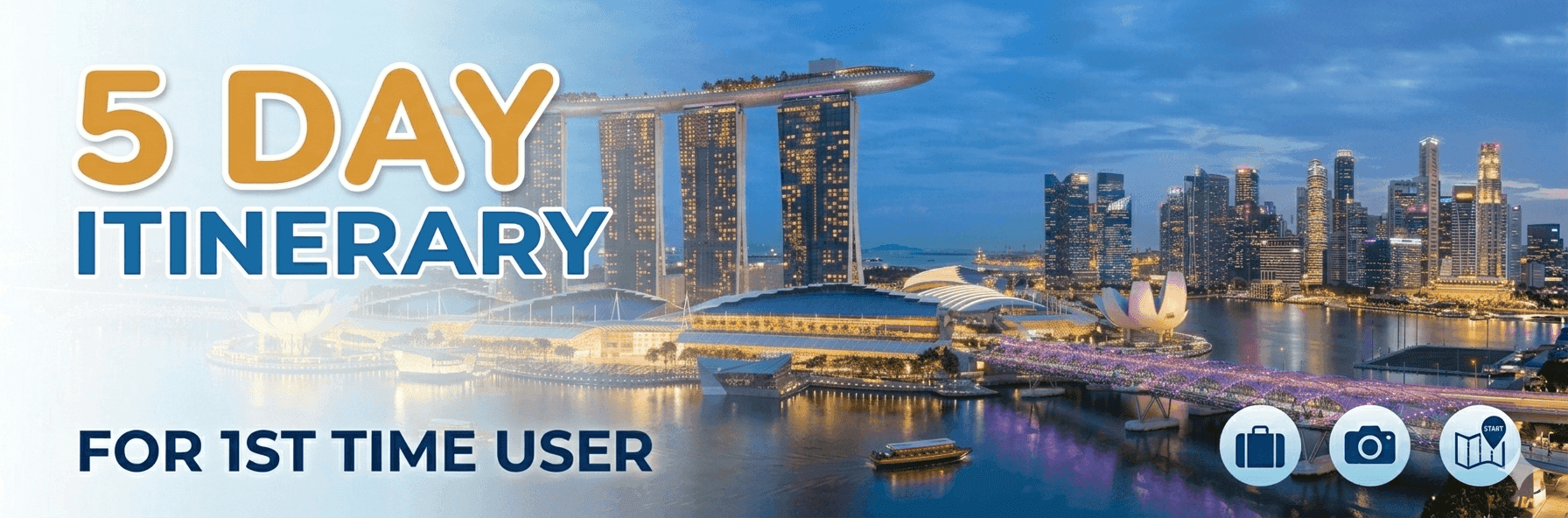
Ultimate 5-Day Singapore Itinerary for First-Time Visitors
17 min read

Author
SHARE BLOG
TABLE OF CONTENTS
- Five full days is the minimum to cover Singapore's key neighbourhoods, nature parks, and iconic skyline without feeling rushed.
- Group your days by geography — Marina Bay, cultural quarters, wildlife, Sentosa, and city flex — to cut travel time between sights.
- Book Gardens by the Bay conservatories, the Night Safari tram, and Universal Studios in advance; queues for walk-ins can add an hour to your day.
- The MRT reaches almost every attraction on this itinerary. A Singapore Tourist Pass (SGD 10–22 for 1–3 days) makes transport effortless.
- Hawker centres are not a budget compromise — they're the main event. Budget SGD 4–12 per meal and you'll eat better than most restaurants back home.
Five days in Singapore gives you enough time to stop rushing and start noticing — the iced kopi sweating in the humidity, the call to prayer floating over Kampong Glam, the moment the Supertrees light up after dark. This 5-day Singapore itinerary for first-time visitors is built around that kind of clarity: each day has a geographic anchor so you're not crisscrossing the island, each night has a reason to stay out, and every section ends with a practical note on what to book ahead and what you can leave to chance. Singapore rewards preparation, but it punishes over-scheduling — this itinerary builds in breathing room.
Day 1: Marina Bay and the City Skyline
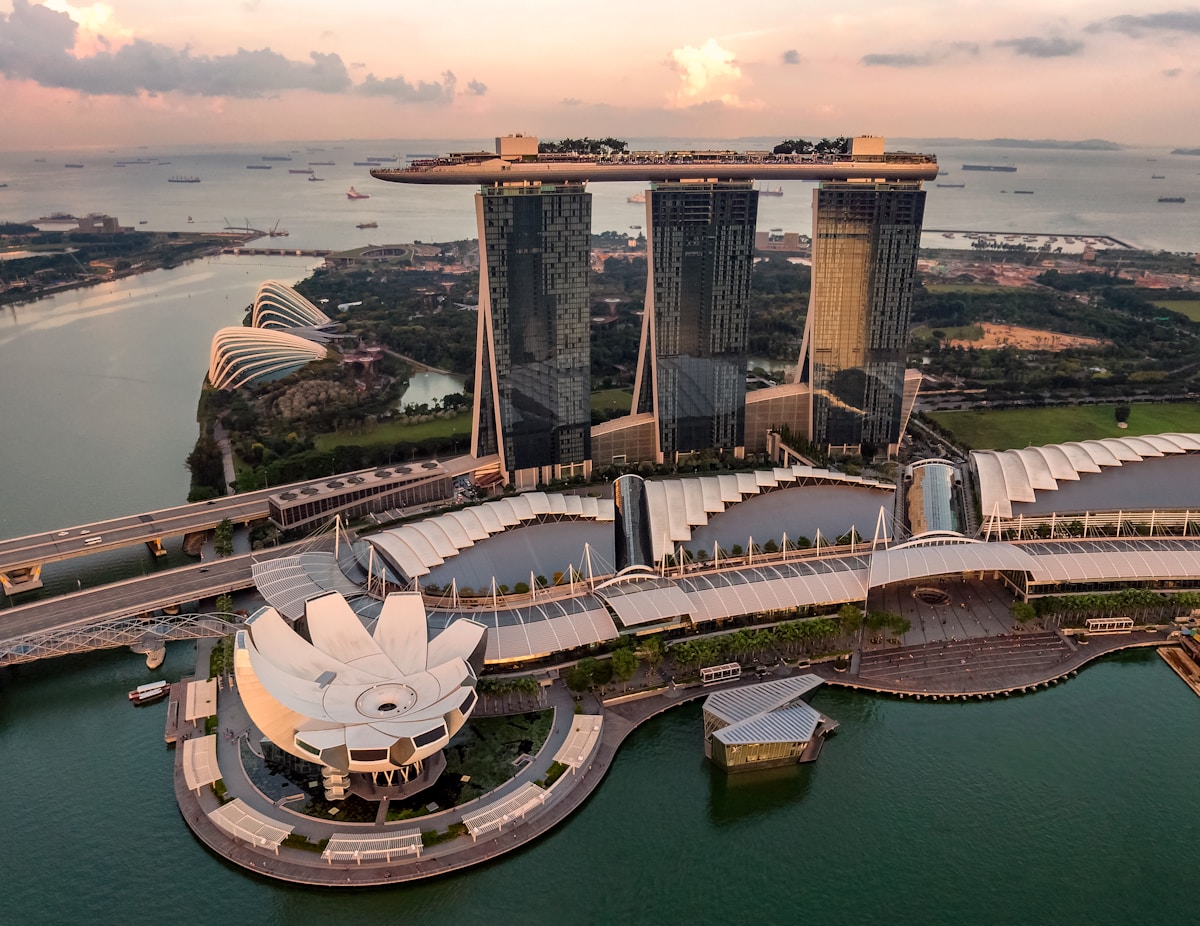
Start where most first-timers fall in love with Singapore: the waterfront. Marina Bay packs more visual drama per square kilometre than almost anywhere in Southeast Asia — a glass-and-steel skyline reflected in the bay, with green towers and futuristic domes softening the edges. The sequence below moves you from indoor cool to outdoor heat to evening light in a logical loop, keeping transit minimal.
Morning: ArtScience Museum and Gardens by the Bay
Begin at ArtScience Museum, the lotus-shaped building at Marina Bay Sands. It opens at 10am and its permanent digital art installations — including a long-running Future World collaboration with teamLab — are cooled, immersive, and genuinely different from anything you'll see elsewhere in Singapore. Allow 90 minutes.
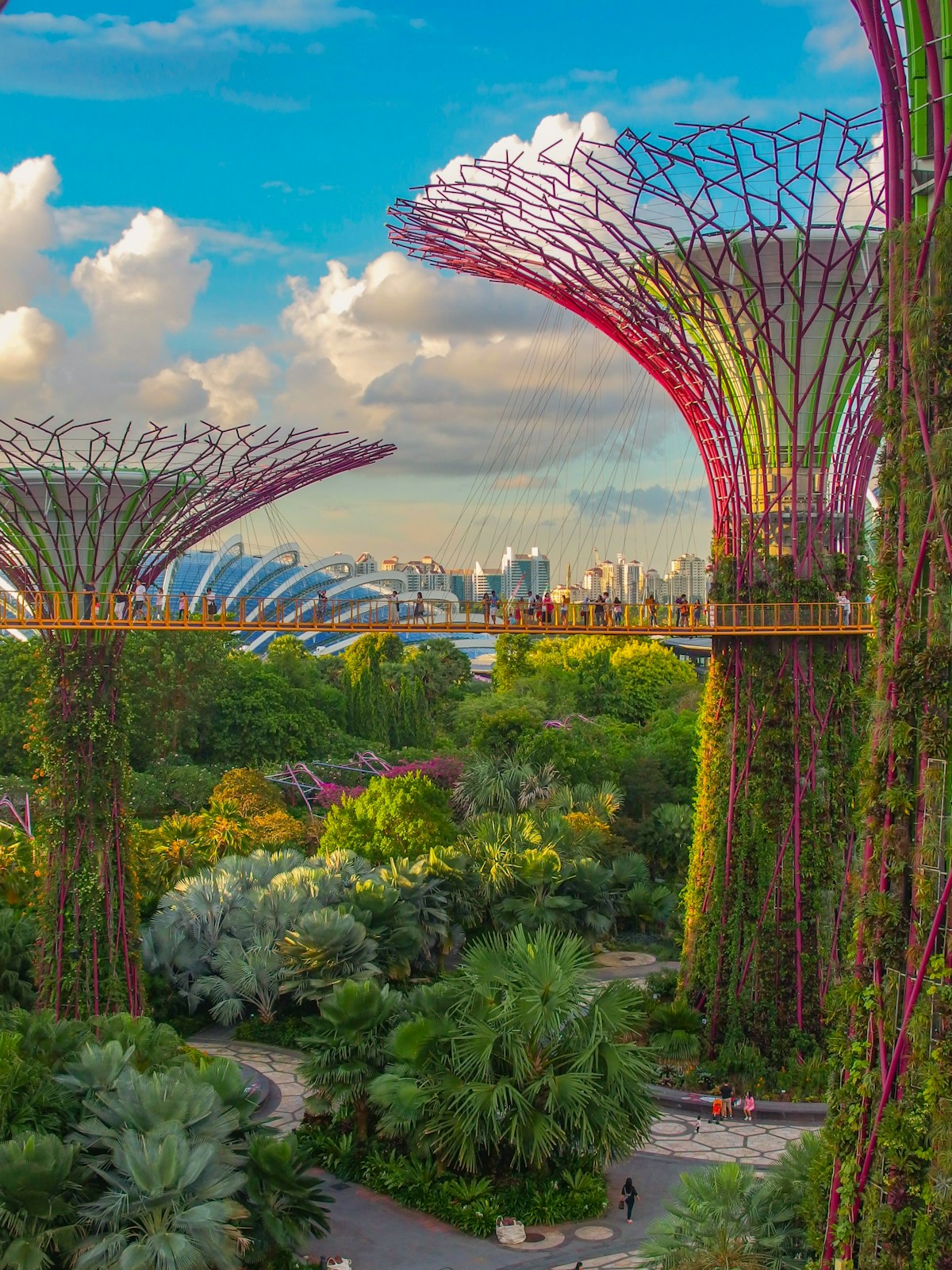
From the museum, walk the covered bridge along the waterfront to Gardens by the Bay. The Supertree Grove and outdoor gardens are free. If you want to go inside the conservatories, the Cloud Forest and Flower Dome combo ticket costs SGD 32 per adult (SGD 18 for children). The Cloud Forest is the one to prioritise: a 30m indoor waterfall, a mountain clad in 72,000 plants, and a walkway that spirals you from treetop level down to the forest floor. Allow two hours for both domes, or 45 minutes if you're sticking to the free outdoor areas.
- Gardens by the Bay opening hours: Outdoor gardens 5am–2am daily; Cloud Forest and Flower Dome 9am–9pm (last admission 8:30pm)
- Cloud Forest + Flower Dome: SGD 32/adult, SGD 18/child (2025 rate)
- Floral Fantasy add-on: SGD 20/adult — skip if time is tight; the two conservatories are the essential experience
- Getting there: Take the MRT to Bayfront station (Circle or Downtown Line), Exit B
Afternoon: Merlion Park and the Singapore Flyer
Walk along the waterfront to Merlion Park. The statue itself takes about ten minutes to photograph; what keeps you there longer is the view back across Marina Bay to the ArtScience Museum and the three towers of Marina Bay Sands. It's one of Singapore's most photographed angles, and it earns it.
From Merlion Park, a 15-minute walk brings you to the Singapore Flyer, a 165m observation wheel that gives you a full 360-degree view of the city, the harbour, and on clear days, the Riau Islands of Indonesia. Tickets cost around SGD 40 for adults. If the Singapore Flyer feels like a lot for one rotation, skip it on Day 1 and revisit on Day 5 if you have leftover time — the view at golden hour is better than midday anyway.
Evening: Garden Rhapsody and a hawker dinner
Return to Gardens by the Bay for the free Garden Rhapsody light and sound show at the Supertree Grove — nightly at 7:45pm and 8:45pm. The 15-minute show synchronises coloured lights across the Supertrees to a live orchestral soundtrack. It's the most photogenic 15 minutes of any first-timer's trip.
For dinner, walk to Satay by the Bay (inside Gardens by the Bay) for outdoor satay stalls with Marina Bay as the backdrop, or take the MRT one stop to Lau Pa Sat, a Victorian cast-iron hawker centre from 1894 where you can eat your way through chilli crab, laksa, and char kway teow at a single table.
Day 1 Planning Notes
- Book conservatory tickets online in advance — weekend walk-in queues can be 30–45 minutes
- Wear comfortable shoes; the loop from MRT to museum to Gardens is about 3km on foot
- The MBS SkyPark Observation Deck (SGD 26/adult) is a solid alternative to the Singapore Flyer — better views of the Gardens by the Bay from above
- The free outdoor Supertree Grove is just as photogenic as the paid domes — don't feel obliged to buy every ticket on Day 1
Day 2: Cultural Quarters — Chinatown, Little India, and Kampong Glam
Singapore's three main cultural districts sit within two MRT stops of each other, which sounds like it should feel rushed but doesn't. Each has its own microclimate of smells, sounds, and architecture. The key is to move through them slowly enough to eat and look, not just tick boxes.
Morning: Chinatown
Start at Chinatown Street Market before 10am, when the stalls are setting up and the crowds are thin. The pastel-coloured shophouses along Pagoda and Temple Streets date to the 1840s; many have been restored to the point of looking slightly too clean, but the Buddha Tooth Relic Temple on South Bridge Road is the genuine centrepiece — a five-storey Tang-dynasty-style complex completed in 2007, housing what is believed to be a tooth relic of the Buddha. Entry is free. Dress respectfully (no shorts above the knee).
Breakfast or second breakfast at Chinatown Complex Food Centre on Smith Street: the largest hawker centre in Chinatown, with around 260 stalls. Arrive before 9am to get a seat and order Hainanese chicken rice or kaya toast with soft-boiled eggs. The stall on Level 2 serving chicken rice has held a Michelin Bib Gourmand for several consecutive years.
Midday: Little India
Take the MRT from Chinatown station to Little India (two stops on the North East Line). The streets around Serangoon Road are colour-saturated and loud in a way that feels completely different from Chinatown's quieter lanes. Visit Sri Veeramakaliamman Temple on Serangoon Road — built in 1881, it's dedicated to Kali and covered in hundreds of hand-painted deity sculptures. If you arrive during morning prayers (between 8am and 11am), the rhythmic chanting carries into the street.
Then walk around the corner to Tekka Centre for a late morning snack. The wet market downstairs sells jasmine garlands and fresh seafood; the hawker level upstairs has South Indian banana-leaf rice from around SGD 6.
Afternoon: Kampong Glam
A short walk or one MRT stop brings you to Kampong Glam, Singapore's Malay-Arab quarter. Sultan Mosque on North Bridge Road is the defining landmark — a gold-domed mosque built in 1928, visible from most of the neighbourhood. Peer in from the entrance hall if visiting outside prayer times; the interior holds up to 5,000 worshippers.
The streets around the mosque, particularly Haji Lane, have morphed into one of Singapore's best independent shopping and café strips: narrow two-storey shophouses painted in pastels, selling batik fabric, vintage clothing, and specialty coffee. The street art on the back lanes is worth a slow wander.

Evening: Clarke Quay
End the day at Clarke Quay along the Singapore River. The converted 19th-century warehouses now house bars, restaurants, and nightclubs. It gets loud after 9pm; if you want a quieter dinner with river views, the stretch of restaurants between Clarke Quay and Boat Quay is less frenetic and the views are the same.
Day 3: Wildlife at Mandai — Zoo, Night Safari, and Beyond
The Mandai Wildlife Reserve in northern Singapore contains five wildlife parks on a single forested site. You won't need all five — one full day gives you time for the Singapore Zoo in the morning and the Night Safari in the evening, with a break in between. The Night Safari alone justifies the entire day trip.
Morning: Singapore Zoo
The Singapore Zoo is best known for its open-concept design — most animals are separated from visitors by natural barriers like water moats and vegetation rather than bars. Get there when it opens at 8:30am to catch the Jungle Breakfast with Wildlife (book ahead; it sells out), which lets you eat surrounded by free-roaming orangutans. Standard zoo admission is SGD 48 for adults, SGD 33 for children (2025 rate).
Key zones: the Fragile Forest biodome (free-ranging fruit bats, ring-tailed lemurs), the Frozen Tundra (polar bears), and the Primate Kingdom. Allow a minimum of three hours.
Afternoon: River Wonders or a break at Mandai
Singapore River Wonders (formerly River Safari) is five minutes' walk from the zoo and worth an extra SGD 40 if your group includes children or if you're interested in freshwater ecosystems. The Amazon Flooded Forest exhibit and the giant panda enclosure are the standouts.
If you've had enough of walking by midday, take a break at the resort café near the Mandai Wildlife Bridge. The bridge itself — opened in 2023 — is a 137m wildlife crossing that spans the road between wildlife zones and lets animals move between forest patches. It's a good spot to stop and watch for birds and monitor lizards.
Evening: Night Safari
The Night Safari opens at 7:15pm. It was the world's first nocturnal wildlife park when it opened in 1994, and the experience remains unlike any other. The 35-minute tram ride covers six geographical zones, with a live commentary track. After the tram, the four walking trails — particularly Leopard Trail and Fishing Cat Trail — let you get closer to Malayan tigers, Asian elephants, and pangolins in near-darkness. Tickets cost SGD 55 for adults, SGD 38 for children. Book the tram slot online; the 8pm and 8:30pm slots fill up quickly on weekends.
Mandai Practical Notes
- Getting there: Take the MRT to Khatib (North South Line), then bus 927 to Mandai Wildlife Reserve — approximately 50 minutes from the city centre
- The Mandai Shuttle runs from Ang Mo Kio MRT on weekends (SGD 1 each way)
- Multi-park bundles (Zoo + Night Safari) save around SGD 15–20 per adult vs. buying separately
- Wear mosquito repellent for the Night Safari evening trails
- The tram is the most efficient way to cover the Night Safari — don't skip it
Day 4: Sentosa Island — Beaches, Thrills, and Universal Studios
Sentosa is Singapore's leisure island: 500 hectares of beaches, theme parks, cable car stations, and resort hotels connected to the mainland by road, cable car, and a walking boardwalk. You can do it in a half-day if you're only going for one attraction, or fill a full day if you're combining Universal Studios with the beach. The two aren't always compatible in one visit — pick a lane.
Option A: Universal Studios Singapore
Universal Studios Singapore occupies the northern end of Sentosa and operates seven themed zones. The major rides — Battlestar Galactica roller coasters, Transformers: The Ride, and Revenge of the Mummy — are compact but well-executed. The Jurassic World: Raptor Encounter and the WaterWorld stunt show are popular with families. Tickets cost around SGD 88 for adults and SGD 78 for children (2025 day pass rate). Arrive at the 10am opening to cover the big rides before midday crowds build. Allow six to eight hours for a full visit.
Option B: Sentosa Beaches and Coastal Activities
If theme parks aren't your preference, Sentosa's three beaches — Siloso Beach, Palawan Beach, and Tanjung Beach — run across the island's southern shore. The water is calm rather than dramatic (you're looking at tanker anchorages rather than open ocean), but the beaches are well-maintained, backed by coconut palms, and far less crowded than the theme park zones. Tanjung is the quietest. Siloso has the most activity — iFly Singapore (indoor skydiving, from SGD 119) and Skyline Luge (gravity karts, from SGD 16) are both a five-minute walk from the beach.
Evening: Wings of Time
End the day at Wings of Time, a 20-minute outdoor light, laser, and water show on the waterfront at Siloso Beach. Shows run at 7:40pm and 8:40pm daily. Standard tickets are SGD 23 for adults. It's deliberately theatrical — best watched from the terraced seating at the back for the full view.
Getting to and Around Sentosa
- Sentosa Express monorail from VivoCity MRT (HarbourFront station): SGD 4 return for visitors, free for residents
- Cable car from Mount Faber or HarbourFront Tower 2: SGD 35–45 return — scenic approach, not faster
- Walk via Sentosa Boardwalk from HarbourFront: free, 15 minutes on foot
- Within Sentosa, the Beach Tram (free) connects all three beaches
Day 5: Orchard Road, Local Neighbourhoods, and a Final Hawker Dinner
Day 5 is the day to slow down: shop if you want to, explore a neighbourhood that didn't make the first four days, and end with the kind of meal that makes you want to book a return flight. Use the morning for Orchard Road, the afternoon for a neighbourhood detour, and the evening for one last great hawker dinner before the airport.
Morning: Orchard Road and the Botanic Gardens
Orchard Road is Singapore's main shopping belt — 2.2km of malls, department stores, and flagship boutiques running from Dhoby Ghaut MRT to Newton. ION Orchard, Paragon, and Ngee Ann City anchor the strip. If you're done with shopping by 11am, take the MRT to Botanic Gardens station and walk into the Singapore Botanic Gardens, a UNESCO World Heritage Site. The National Orchid Garden within — with 1,000 species and 2,000 hybrids — is the paid section (SGD 15/adult). The rest of the 82-hectare park is free and the most pleasant place in Singapore to walk slowly before noon.
Afternoon: Tiong Bahru or Pulau Ubin
Two neighbourhood options for the afternoon, depending on your pace:
Tiong Bahru (30 minutes from the city centre by MRT) is Singapore's oldest public housing estate, now a mix of heritage 1930s walk-up apartments, independent bakeries, bookshops, and specialty coffee. The Tiong Bahru Market on Seng Poh Road has a hawker floor worth visiting for lunch — the popiah stall and the char siu wonton noodle stalls are particularly well-regarded.
Pulau Ubin is a small island off Singapore's northeast coast, accessible by a 10-minute bumboat ride from Changi Point Ferry Terminal (SGD 4 each way). The island has no ATMs, limited mobile signal, and a main village that looks like Singapore did in the 1960s. Rent a bicycle (SGD 8–12/day) and cycle to Chek Jawa Wetlands, a 100-hectare coastal ecosystem. It's only worth doing if you have most of the afternoon free — the ferry, cycling, and return trip takes at least four hours.
Evening: Newton Food Centre and a final Singapore send-off
End your five days at Newton Food Centre, a 24-hour hawker centre near Newton MRT. It's touristy by Singapore standards but delivers: excellent chilli crab, barbecued stingray, and satay under fluorescent lights on plastic chairs. Order by pointing. The prices are slightly higher than off-the-beaten-path hawker centres, but the quality holds up.
If you have time before the airport, the Jewel at Changi Airport is worth factoring in even if you're not flying until late. The indoor Jewel Changi Airport HSBC Rain Vortex — the world's tallest indoor waterfall at 40m — can be viewed from the free entry ground level. Allow an hour for Jewel if your flight is in the evening.
Singapore Itinerary: Practical Tips for First-Timers
A few things the top SERP articles mention but rarely explain well enough:
Getting around Singapore
The MRT is the default for any journey over 15 minutes. It covers all five days of this itinerary except Pulau Ubin and the Mandai wildlife parks (both require a short bus or shuttle connection). The Singapore Tourist Pass costs SGD 10 for one day, SGD 16 for two days, and SGD 22 for three days — it covers unlimited MRT and bus travel and is worth buying if you're making more than four journeys per day. Otherwise, an EZ-Link card (SGD 12, including SGD 7 stored value) works across the same network on a pay-per-ride basis.
Grab (Singapore's ride-hailing app) is reliable and often faster than taxis for short trips. Download it before you arrive. Airport taxis are metered plus surcharges; expect SGD 25–45 from Changi to the city centre depending on time of day.
Best time to visit Singapore
Singapore sits 1° north of the equator — the weather is hot and humid year-round. The coolest and driest stretch runs from February to April, with average highs around 31°C. Heavy rain is possible in any month, but the worst downpours concentrate in the Northeast Monsoon season (November to January). Rain in Singapore is usually brief and intense rather than all-day: carry a compact umbrella and wait it out in a hawker centre.
What to book in advance
- Gardens by the Bay conservatory tickets — particularly on weekends
- Night Safari tram (popular time slots fill 48–72 hours ahead)
- Universal Studios Singapore — day passes sell out on school holidays
- Singapore Zoo Jungle Breakfast with Wildlife — seats are limited and often sold out a week in advance
- Wings of Time — small venue; evening slots go fast
Travjoy's curated Singapore experiences have been selected after extensive research and reviewed by local experts — so when you book through the platform, you're not choosing blind from a list of thousands. You're choosing from what's actually worth your time.
Budget guide for 5 days in Singapore (2025)
- Budget: SGD 100–130/day — hostels or budget hotels, hawker meals (SGD 5–12/meal), free attractions, MRT transport
- Mid-range: SGD 200–350/day — boutique hotel, mix of hawker and casual restaurants, two to three paid attractions per day
- Premium: SGD 500+/day — Marina Bay Sands or equivalent, fine dining, private transfers, all paid attractions
- Attraction costs to budget for: Night Safari SGD 55, Universal Studios SGD 88, Gardens by the Bay domes SGD 32, Singapore Zoo SGD 48, Singapore Flyer SGD 40
Conclusion
Singapore rewards first-time visitors who slow down enough to eat well, get off the main drag into the cultural quarters, and stay out past dark for the light shows and the Night Safari. Five days is enough to see the headline attractions without sacrificing the moments that make a city memorable — a kaya toast breakfast before the heat builds, the sharp cold of stepping into the Cloud Forest, the darkness of the Night Safari broken only by a sleeping tapir three metres away.
Ready to start planning? Browse Travjoy's full Singapore guide and our curated Top 20 Singapore experiences to find the best tours, activities, and experiences for your trip — selected by local experts and ready to book directly.

.svg&w=1920&q=75)