




Currency in Bali: Cash vs Card, ATMs & Money-Saving Tips
10 min read
Key Takeaways
- The Indonesian rupiah (IDR) is the only legal currency in Bali — shops, drivers, and temples will not accept US dollars, euros, or other foreign notes.
- Carry cash for warungs, traditional markets, smaller hotels, temple entries, drivers, and almost everything on Nusa Penida and Nusa Lembongan.
- Use cards at international-brand hotels, larger restaurants, supermarkets like Pepito and Coco Mart, shopping malls, and most beach clubs in Seminyak and Canggu.
- BCA and BNI bank-branch ATMs remain the safest and cheapest in 2026; Bank Mandiri added a Rp 50,000 access fee for foreign cards on 22 February 2026.
- Always pick IDR — not your home currency — when an ATM or card machine offers Dynamic Currency Conversion. DCC quietly costs you 4–8% on every transaction.
The currency in Bali is the Indonesian rupiah (IDR), and you will need cash for most day-to-day spending. Cards work well at hotels, larger restaurants, supermarkets, and malls, but warungs, drivers, traditional markets, and temple entries are cash-only. Use BCA or BNI bank-branch ATMs for the fairest fees, refuse Dynamic Currency Conversion every time, and budget roughly Rp 700,000–1,500,000 (USD 40–90) per person per day depending on travel style.
The first thing the rupiah does in Bali is make you misread prices. A bowl of nasi campur costs Rp 35,000 — you see the number and brace for impact, then realise it is about USD 2.10. A spa massage at Rp 350,000 sounds wrong until you mentally drop a zero and a half. Getting comfortable with the currency in Bali is half a numbers game and half a cash-or-card decision that changes from one street to the next.
2026 also brought a small but real shift. Bank Mandiri began charging a Rp 50,000 access fee for foreign cards on 22 February, which moves it from "default safe ATM" to "use only if BCA or BNI is unavailable." Standalone tourist ATMs are still the easiest way to lose money to skimmers or DCC tricks. And on Nusa Penida, more than one traveller has had to ferry back to Sanur because every ATM on the island was empty by Sunday afternoon.
This guide covers what you will actually pay with, where, how much, and how to keep more of it. Plan your timing with the best time to visit Bali first, then work through this one for the money side.

Understanding the Indonesian Rupiah: Why Bali Runs on Big Numbers
The Indonesian rupiah is one of the world's higher-denomination currencies — 1 USD trades around Rp 16,800–17,500 in mid-2026, which means even a coffee costs five figures and a hotel night runs into the millions. There is nothing complicated about it, but the volume of zeros catches almost every first-time visitor off-guard for a day or two.
Notes, coins, and what Rp 100,000 actually buys you
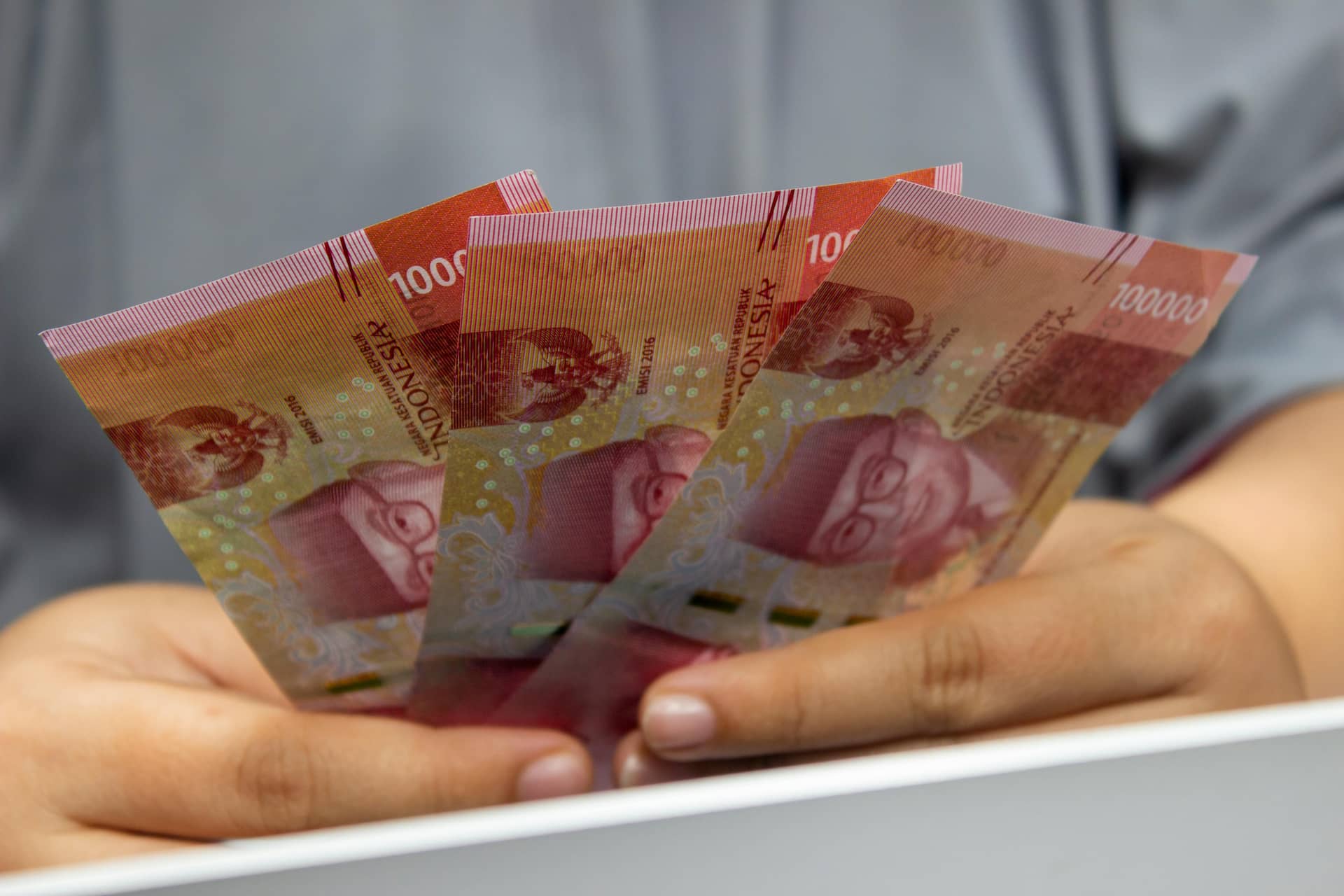
Rupiah notes are colour-coded and come in seven denominations. You will see all of them, but only three or four daily.
- Rp 100,000 (red) — the largest note, roughly USD 6. The ATM workhorse and the bill drivers prefer.
- Rp 50,000 (blue) — USD 3. Common at restaurants and mid-range shops.
- Rp 20,000 (green), Rp 10,000 (purple), Rp 5,000 (brown) — small-spend territory. You will burn through these at warungs, parking attendants, temple entries, and tip jars.
- Rp 2,000 and Rp 1,000 — handed back as change. Worth keeping a few for road-side parking (usually Rp 2,000–5,000).
- Coins exist (Rp 100, 200, 500, 1,000) but most travellers ignore them — small vendors round to the nearest thousand.
A rough sense of value at mid-2026 rates: an iced kopi at a warung is Rp 15,000–25,000, a full nasi campur lunch is Rp 35,000–60,000, a Bintang at a beach club is Rp 75,000–110,000, and an hour-long massage at a non-hotel spa is Rp 150,000–300,000. Once those anchors are in your head, the price-shock period lasts about two days.
Reading prices without dropping a zero
The classic Bali money mistake is misreading a price by an order of magnitude — paying Rp 5,000,000 (USD 295) when you meant to pay Rp 500,000 (USD 30). Two habits make it almost impossible to slip up:
- Count zeros, not commas. "Rp 50.000" and "Rp 50,000" mean the same thing. The number of trailing zeros tells you the scale.
- Mentally chop two zeros and divide by 1.5–1.7. Rp 50,000 → 500 → about USD 3. Slightly slower than dropping zeros and dividing by 17, but easier to do at a market stall.
Cash vs Card in Bali: When to Use Each
The short answer: Bali still runs on cash for everyday spending, but cards work for almost any transaction over about Rp 250,000 at an established business. Most travellers underwithdraw on the cash side and overuse cards at the bigger venues, where 3% surcharges quietly add up.
Where cash is non-negotiable
You will need rupiah in hand for:
- Warungs and street food — the family-run eateries that serve the best food on the island take cash only.
- Drivers and scooter rentals — most private drivers and rental shops want cash when they drop you off, even if you booked online.
- Temple entries and donation boxes — Rp 50,000–100,000 entry plus Rp 5,000–10,000 sarong or sash hire at most major temples.
- Traditional markets — Ubud Art Market, Sukawati, Pasar Badung, Sindhu Night Market. Vendors do not carry card machines and rarely have change for a Rp 100,000 note.
- Nusa Penida, Nusa Lembongan, and northern Bali — ATM coverage is patchy and weekend stocks run dry. Carry what you will need before you board the fast boat.
- Parking attendants and small toll points — Rp 2,000–5,000 each, but they add up over a driving day.
If you are planning a day around Bali's warungs and food tours, plan to spend in cash from the moment you leave the hotel.
Where cards work well
Visa and Mastercard are accepted at most established businesses. American Express is hit-and-miss — chain hotels yes, smaller restaurants rarely. Cards are the easier choice at:
- Four- and five-star hotels and larger boutique villas
- Restaurants in the Rp 300,000+ per-head range
- Supermarkets — Pepito, Coco Mart, Bali Buda. Note: Pepito enforces a minimum spend of around Rp 100,000 for card payments at some branches.
- Beach clubs in Seminyak, Canggu, and the Bukit (Potato Head, La Brisa, Single Fin, Sundays)
- Malls — Beachwalk Kuta, Seminyak Village, Samasta Lifestyle Village, Mal Bali Galeria
- Larger spas, dive shops, and surf schools
Two surcharge traps to watch for: many smaller venues add 3% to card payments without mentioning it (it will appear on the receipt), and some boutiques load 2–3% on Amex specifically. If the surcharge is going to be more than Rp 10,000, paying cash is the better call.
Cash vs card by situation: quick reference
| Situation | Best payment | Why |
|---|---|---|
| Warung lunch (Rp 30k–80k) | Cash | No card machine; small notes preferred |
| Five-star hotel bill | Card | No surcharge; safer for a large spend |
| Driver day-hire (Rp 600k–900k) | Cash | Standard practice; small notes for tip |
| Beach club tab | Card | Bills go large fast; card is faster |
| Traditional market shopping | Cash | Vendors give better prices for cash |
| Temple entry plus sarong | Cash | No card option at any major temple |
| Nusa Penida day or stay | Cash (loaded before ferry) | ATM coverage thin and unreliable |
| Activity booked online | Card (prepaid) | Operator confirms slot; no on-day fuss |
ATMs in Bali: Which to Use and Which to Avoid
The right ATM saves you Rp 50,000–100,000 every withdrawal, and the wrong one can swallow your card or drop a skimmer overlay on it. The rules are simple: use bank-branch ATMs from BCA or BNI, withdraw the maximum in one go, and never use a standalone machine inside a small shop or alleyway.
Best banks for foreign cards in 2026
Three Indonesian banks dominate the foreign-card-friendly ATM map:
- BCA (Bank Central Asia) — withdrawal limit up to Rp 3,000,000 per transaction. No machine-side access fee for foreign Visa or Mastercard. Easy to find in Seminyak, Sanur, Ubud, Canggu, and Kuta.
- BNI (Bank Negara Indonesia) — limit around Rp 2,000,000 per transaction. Generally no access fee. Slightly less common than BCA but reliable when you find one.
- Mandiri — limit Rp 1,250,000–2,500,000 depending on the machine, but now charges Rp 50,000 per foreign-card withdrawal since 22 February 2026. Skip unless BCA and BNI are not around.
Two banks to avoid where possible: BRI applies a roughly 3% surcharge on foreign-card withdrawals at many machines, and CIMB Niaga charges around 2.5%. Both are easy to spot because the fee shows on screen before you confirm — cancel and walk to BCA or BNI.
The withdrawal-fee maths
The total cost of a Bali ATM withdrawal usually has three layers:
- Local ATM access fee — Rp 0 at BCA and BNI, Rp 50,000 at Mandiri (from February 2026).
- Your home bank's foreign-withdrawal fee — typically USD 3–5 per transaction, plus 2–3% on the converted amount. A travel-friendly card (Wise, Revolut, YouTrip, Indian forex cards, US Charles Schwab) removes most of this.
- Dynamic Currency Conversion — if you let the ATM convert into your home currency, you will lose another 4–8% silently. Always choose to be charged in IDR.
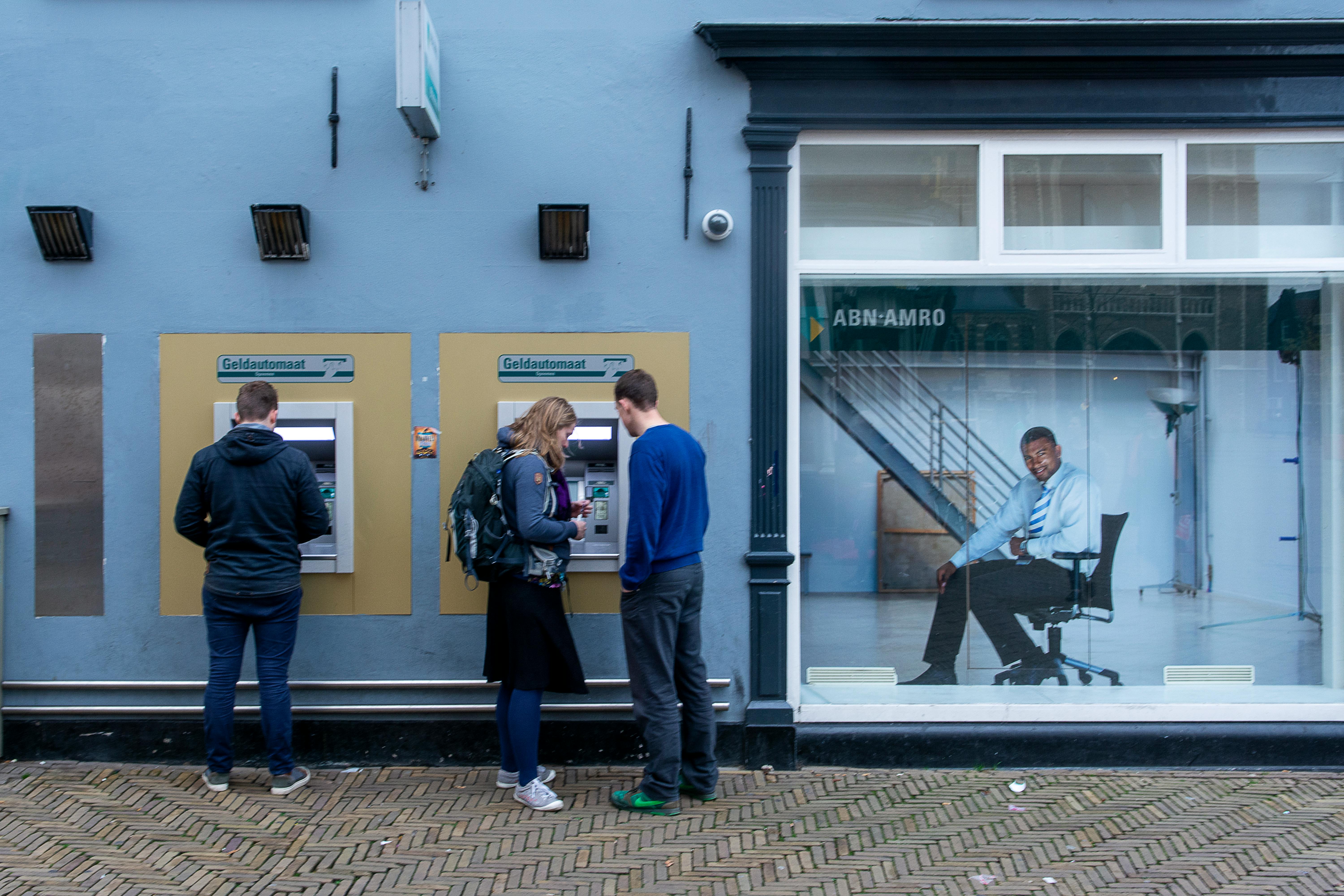

The single biggest saving is withdrawing the maximum every time. Three Rp 3,000,000 withdrawals at BCA cost the same in fees as one — but ten Rp 1,000,000 withdrawals at Mandiri cost you Rp 500,000 (USD 30) in access fees alone.
Skimming, swallowed cards, and Sunday-night empties
Card skimming is rare at bank-branch ATMs and meaningful at standalone tourist machines. Three habits cut your risk to almost nothing:
- Wiggle the card slot before inserting. A skimmer overlay is glued on and will move; a real slot is rigid.
- Cover the keypad with your other hand while entering your PIN — works against pinhole cameras above the screen.
- Take the card before the cash. Many Bali ATMs dispense cash first and the card second, which is the opposite of most countries. Wait for both, every time.
The Sunday empty-ATM problem
- Tourist-area ATMs run dry from Saturday evening to Monday morning, particularly in Canggu and Ubud.
- Withdraw on Friday or Saturday morning rather than Sunday evening.
- On Nusa Penida and Nusa Lembongan, weekend cash supply is even tighter — load up before the ferry from Sanur.








Money Changers in Bali: Getting a Fair Rate Without Getting Scammed
If you have brought a wad of foreign cash, a licensed Bali money changer gives you a fair rate without ATM fees — but the gap between legitimate operators and clever scams is small enough that getting it wrong can cost 5–10% in a single transaction. The rule that protects you is the PVA Berizin licence.
What PVA Berizin means and why you check for it
PVA Berizin (Pedagang Valuta Asing Berizin) is the official licence issued by Bank Indonesia for non-bank foreign-exchange dealers. Licensed changers must display the certificate prominently, post their rates publicly, and follow set transparency rules — including no surprise commissions and full receipts. Unlicensed sidewalk booths are the ones that pad rates, palm notes during counting, or shortchange by Rp 50,000 hoping you do not recount.
Before you hand over any cash, check that:
- The PVA Berizin logo or framed Bank Indonesia certificate is visible on the wall.
- The exchange rate is posted on an electronic board, not chalked or handwritten.
- The premises are dedicated to currency exchange — not a souvenir shop with a side counter.
Trusted operators with branches across the south
Three operators have held their reputation for two decades or more and have branches in every major tourist hub:
- PT Central Kuta Money Exchange — the largest network on the island. Main office on Sunset Road in Seminyak; branches in Kuta, Legian, Sanur, Ubud, Nusa Dua, and Denpasar.
- BMC (Bali Money Changer / PT Bali Maspintjinra) — branches in Seminyak, Kerobokan, Canggu, Legian, Sanur, and Ubud. Counters are visibly less crowded mid-morning.
- PT Dirgahayu Valuta Prima (Bali Best Rate) — operating since 1984, with branches in Kuta, Sanur, and Ubud. Bring a passport or photo ID for larger exchanges.
Bring clean, unmarked notes — torn, written-on, or pre-2013 USD bills get rejected or quoted at a lower rate. USD 100 notes earn the best rate; smaller denominations get marginally less.
Tricks to watch for at the counter
Even at licensed changers, the responsibility for counting cash sits with you. The three most common counter-side tricks across Bali:
- The fast-count. Staff count the stack quickly in front of you, then "double-check" out of view. Always count the cash yourself, on the counter, before leaving.
- The slow-slide-back. A note or two is pulled back during the recount. Watch hands, not the stack.
- "No commission" overrides. A rate 1,500 IDR above the market average is the bait; the missing 50,000 in your stack is the catch. If a rate looks too good compared with PT Central Kuta or BMC, it usually is.
Money-Saving Tips That Actually Work in Bali
Most "save money in Bali" lists recycle the same generic travel tips. These six are the ones that move the needle by real percentages on a normal trip.
1. Always say no to Dynamic Currency Conversion (DCC)
When an ATM or card terminal asks whether you want to be charged in your home currency or in IDR, always pick IDR. The "convenience" of seeing a USD or AUD figure on screen costs you 4–8% — the ATM or merchant picks the conversion rate, and it is never close to mid-market. Refusing DCC is the single biggest saving most travellers do not make.
2. Bring two cards from two different networks
Visa works almost everywhere; Mastercard works at most ATMs and merchants but occasionally fails at smaller machines. If one card gets blocked for "unusual activity" — common in the first 48 hours — the backup keeps you cash-supplied. Notify both banks of your Indonesia dates before flying.
3. Watch the 21% restaurant gotcha
Mid-range and upmarket restaurants in Bali typically add a 10% service charge and 11% PB1 government tax to the bill. The menu price is rarely the final price. A Rp 200,000 dinner becomes Rp 242,000. Tipping on top is optional — the 10% service is the tip. If service was excellent, Rp 20,000–50,000 in cash, directly to the server, is appreciated. At warungs there is no service charge and no expectation of tipping.
4. Carry small notes for everything outside hotels
A Rp 100,000 note is hard to break at a warung, parking attendant, or beach vendor — and "no change" sometimes becomes an opportunistic overcharge. Withdraw at BCA in Rp 50,000 denominations when offered, or break your Rp 100,000s at a supermarket on the first day. Carry a working float of Rp 200,000–300,000 in 10s, 20s, and 50s.
5. Bargain at markets — politely, and not on food
Bargaining is expected at Bali's traditional markets like Ubud Art Market and Sukawati, where opening prices are typically 2.5–3x the fair price. Start at 40–50% of the asking price, smile, and meet around 60–70%. Walking away politely often pulls a final offer behind you. Do not bargain on food at warungs or at fixed-price shops — that comes across as rude and the margins are already low.
6. Skip airport exchange and skip hotel exchange
Both have a captive audience and rates 4–8% below the city. Take out a small Rp 500,000–1,000,000 at the airport BCA ATM if you need taxi cash, and reload properly at a licensed changer or branch ATM in your first town.
A Realistic Daily Cash Budget for Bali in 2026
Daily budgets in Bali split cleanly into three travel styles. The figures below are per person per day at mid-2026 exchange rates and cover food, transport, one paid activity, and tips — accommodation is separate because it varies far too widely.
Backpacker / shoestring
- Daily spend: Rp 400,000–700,000 (USD 25–40)
- Food: warungs and street stalls (around Rp 150,000)
- Transport: scooter rental (Rp 70,000) plus petrol (Rp 30,000)
- Activity: temple entry, beach day, or self-guided ride
- Cash float to carry: Rp 500,000
Mid-range
- Daily spend: Rp 800,000–1,500,000 (USD 47–90)
- Food: mix of warung lunch and a Rp 200,000–300,000 dinner
- Transport: Grab or Gojek plus a half-day private driver (Rp 300,000–500,000)
- Activity: one paid experience (Rp 400,000–700,000) — cooking class, snorkel trip, spa
- Cash float to carry: Rp 700,000–1,000,000
Premium / boutique
- Daily spend: Rp 1,800,000–3,500,000+ (USD 105–205+)
- Food: hotel breakfast plus a Rp 500,000–800,000 dinner
- Transport: full-day private driver (Rp 700,000–900,000)
- Activity: cliffside dining, sunset cruise, or full-day cultural tour
- Cash float to carry: Rp 1,000,000–1,500,000
How much to withdraw at once
Pull two or three days' worth of cash per ATM visit. For mid-range travellers, that means Rp 2,500,000–3,000,000 (one BCA withdrawal). Keep the bulk in your hotel safe and a working float in your wallet. Split your stash across two locations — a wallet, a money belt, or a zipped jacket pocket — so a snatch theft does not take your whole trip's cash.
Planning Your Bali Trip with Money Sorted
The currency in Bali rewards small habits over big strategies. Carry cash for warungs, drivers, and temples; use cards at hotels and supermarkets; refuse Dynamic Currency Conversion every time; favour BCA and BNI ATMs over Mandiri after the 2026 fee change; and check the PVA Berizin licence before you hand over a USD 100 note at any money changer.
Once the money side is settled, the rest of the trip planning gets a lot easier. Explore Bali experiences on Travjoy — every option on the platform is reviewed by local Bali experts and approved before it reaches the site, so the shortlist you see is already filtered by people who know which beach club is worth the cover charge and which Ubud cooking class is worth the morning.


