



Bali Rice Terraces: The Most Beautiful and How to Visit Them
6 min read

Raj Varma
Author
Travel & Tourism Expert Ex-Thomas Cook, Kuoni, Times of India & Travel Triangle.
SHARE BLOG
TABLE OF CONTENTS
Key Takeaways
- The four Bali rice terraces worth your time are Tegalalang (closest to Ubud), Jatiluwih (the vast UNESCO one), Sidemen (quiet, with Mount Agung behind it), and the Munduk highlands.
- Tegalalang charges IDR 25,000 (about USD 1.50) and Jatiluwih IDR 40,000 (about USD 2.50) in 2026; Sidemen is around IDR 25,000.
- Go between 7am and 9am. The same terrace that feels magical at sunrise feels like a car park by 11am, when the tour buses arrive.
- The fields are greenest from February to April and again in September; harvest leaves them golden or bare in May–June and October–November.
- Tegalalang is the easy photo stop; Jatiluwih and Sidemen reward anyone who wants to actually walk and skip the crowds.
The most beautiful Bali rice terraces are Tegalalang near Ubud for the classic stepped-valley photo, Jatiluwih in Tabanan for sheer 600-hectare scale, and Sidemen in the east for quiet walking with Mount Agung as a backdrop. Entry runs IDR 25,000–40,000 (USD 1.50–2.50) per person in 2026, and the single biggest factor in whether you enjoy any of them is arriving before 9am, before the heat and the tour buses.
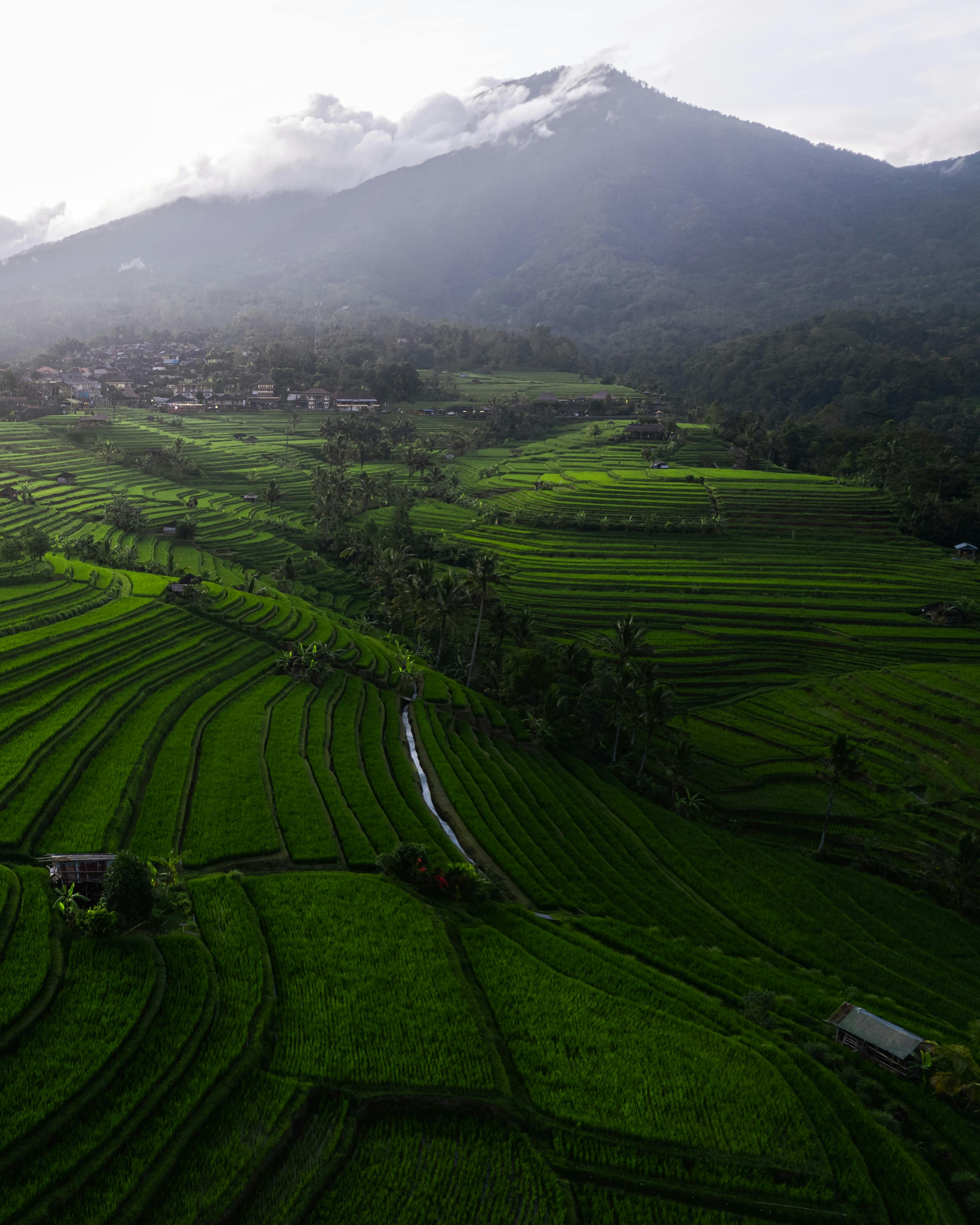
Picture the same rice terrace twice. At 7am, mist sits in the valley, a farmer is already knee-deep in a paddy, and the only sound is water moving between the levels. At 11am, the car park is full, a queue has formed for the swing, and someone is asking you for a donation at the third gate in a row. Both are real. The difference is timing, and which terrace you picked.
Bali has dozens of rice terraces, but only a handful are worth building a morning around. This guide covers the four that are: what each one costs in 2026, how long the drive takes, how crowded it gets, and what to pair it with. By the end you will know which terrace fits your trip and how to visit it without the underwhelming midday version.
What makes Bali's rice terraces special
Bali's rice terraces are not just scenery — they are a thousand-year-old farming system called subak, where whole villages share water through a network of temples and canals. That cooperative water management is why the Jatiluwih terraces and the wider cultural landscape earned a spot on the UNESCO World Heritage list. When you look at a terrace, you are looking at engineering, religion, and community decision-making stacked into a hillside.
How subak actually works
Water flows from mountain temples down through the paddies, and each farming community manages its own section. Planting dates, water allocation, and pest control are decided collectively at the water temple, not by individual farmers. The schedule has been maintained for centuries.
This is also why the terraces look different from week to week. Fields are planted on a rolling basis, so even in one valley you will see flooded mirror-like paddies, bright green shoots, and golden harvest-ready rice all at once. The system is under pressure from higher-yield hybrid rice and modern pesticides, which makes the older, hand-worked terraces feel increasingly rare.
Why this matters for your visit
Knowing the terraces are working farmland changes how you treat them. The paths you walk on are field boundaries that farmers use daily. Staying on marked trails, dressing modestly, and not trampling young rice are basic courtesies. It also explains the small fees and donation gates — the money supports the families who keep the terraces flooded and green for you to photograph.
At a glance
- What they are: working rice paddies farmed under the UNESCO-listed subak water system
- Best light: sunrise to about 9am, or the last hour before sunset
- Greenest months: February–April and September
- Typical fee: IDR 25,000–40,000 (USD 1.50–2.50) per person
Tegalalang: the famous one near Ubud
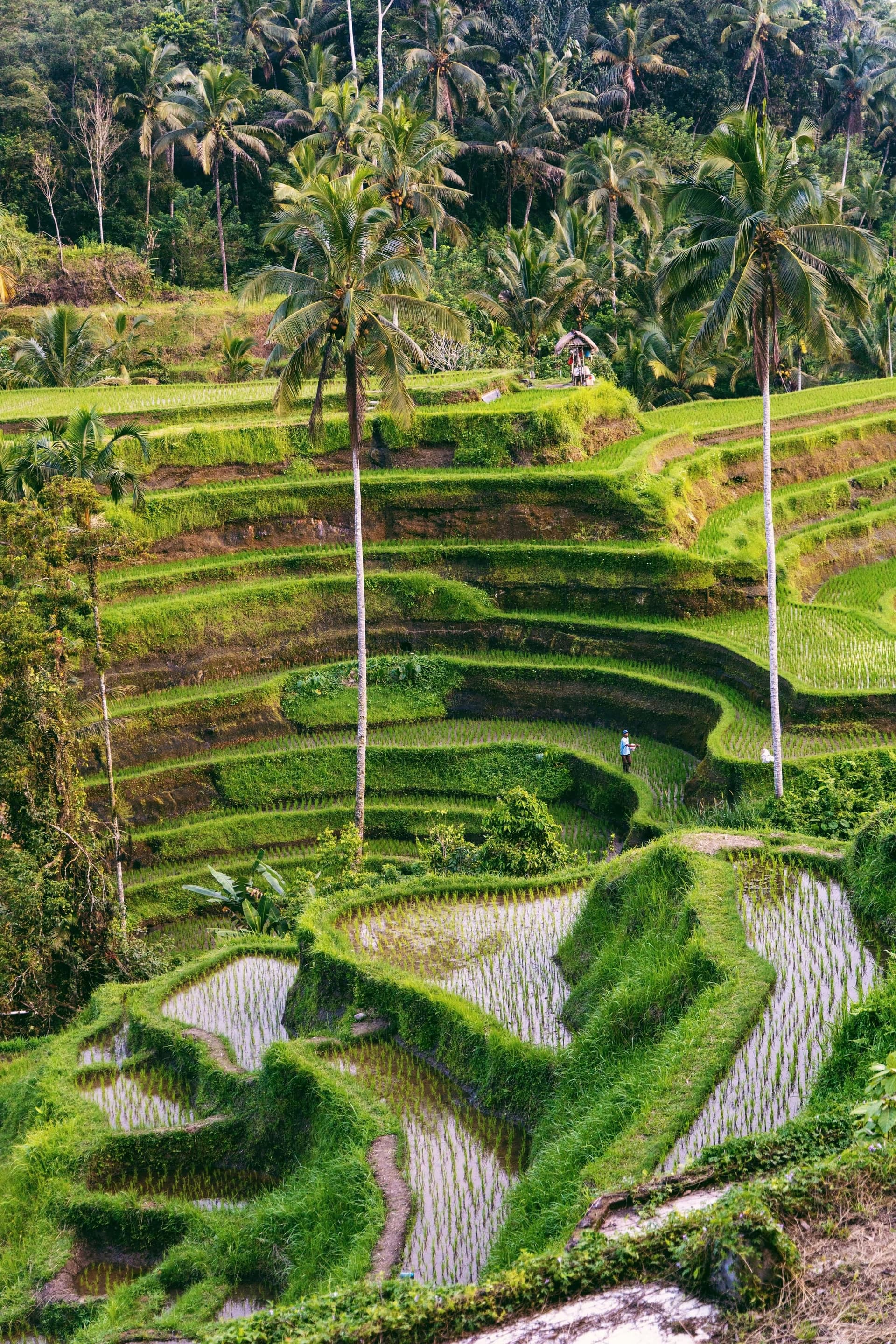
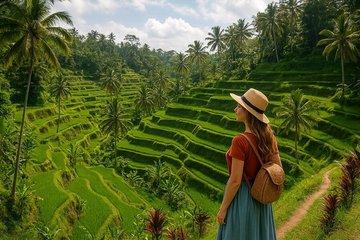
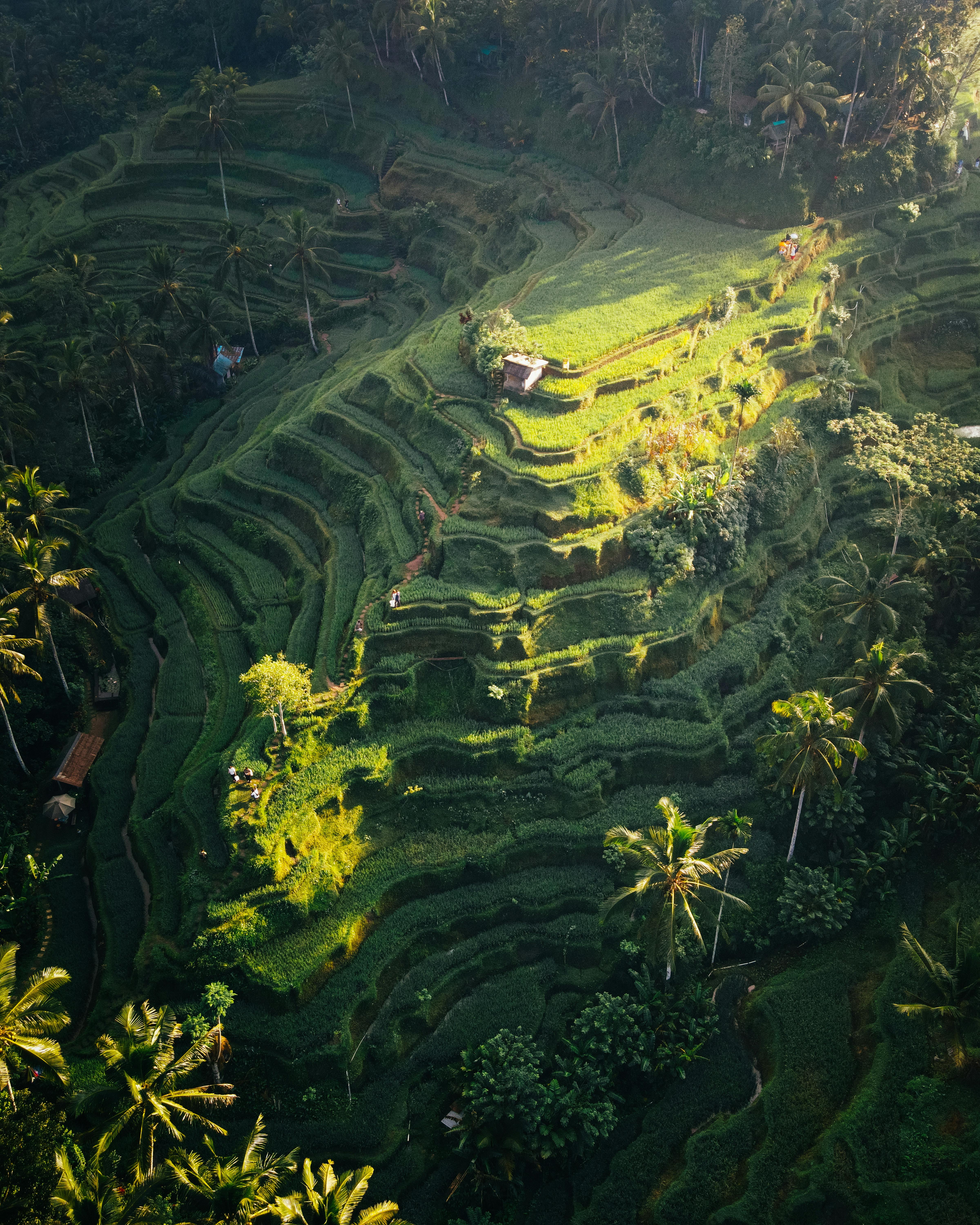
Tegalalang Rice Terrace is the most photographed paddy in Bali and the easiest to reach — about 20 minutes north of central Ubud. It is a steep, narrow valley of stepped fields, signposted locally as Ceking, and it delivers the classic Bali terrace shot. It is also the most commercial of the lot, with swings, photo platforms, cafes, and a series of donation gates as you walk down.
If your time in Bali is short and you are already near Ubud, Tegalalang Rice Terrace is the obvious choice. Go early, walk the full loop down one side and up the other, and you will understand why it became famous before it became crowded.
Fees, hours and what to expect in 2026
- Entry: IDR 25,000 per person (about USD 1.50)
- Hours: daily, roughly 7am to 6pm
- Best time: 7am–9am to beat the tour buses and midday heat
- Swings: typically IDR 100,000–300,000 (USD 6–18) depending on the spot and whether photos are included
- Donation gates: small boxes (IDR 5,000–10,000) appear at points along the trail; these are optional but expected
Doing Tegalalang as a half-day
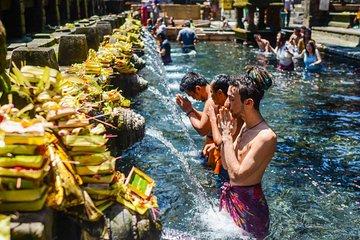
Tegalalang pairs naturally with the rest of the Ubud area. A common, sensible loop is the terrace at sunrise, then the purification springs at Tirta Empul Temple, and the Sacred Monkey Forest Sanctuary back in town before lunch. With a driver this is an easy four to five hours; on a scooter, allow more time and ride the Tegalalang road carefully — it is narrow and busy with tour traffic by mid-morning.
Jatiluwih: the UNESCO one most people skip
Jatiluwih is the terrace to choose when you want scale and quiet rather than a quick photo. It covers around 600 hectares of working fields in Tabanan, in west-central Bali, and it is the postcard image of the subak system that won UNESCO recognition. Where Tegalalang is a dramatic narrow valley, Jatiluwih is a landscape — wide trails, distant ridgelines, and farmers working fields that run to the horizon.
The trade-off is the drive. Jatiluwih sits about 1.5 hours from Ubud and roughly 1 hour 15 from Canggu, so it works best as its own half-day rather than a casual add-on. In return you get marked walking and cycling loops, far fewer people, and none of the swing-and-selfie circus.
Fees, hours and getting there
- Entry: IDR 40,000 per person (about USD 2.50)
- Hours: daily, roughly 8am to 6pm
- From Ubud: about 1.5 hours by car
- From Canggu/Pererenan: about 1 hour 15 minutes
- Walking loops: several colour-coded trails, from a 45-minute stroll to a two-hour circuit
What to do once you're there
Pick one of the marked loops and actually walk it — this is the point of Jatiluwih. The longer circuits take you well past the entrance crowd and into fields where you will mostly meet farmers. There is one reliable viewpoint restaurant, Warung Jatiluwih, doing nasi campur and cold drinks; the view is the draw more than the food. Mornings are clearest, as mist often rolls in over the higher fields by early afternoon.





Sidemen and the quieter rice terraces
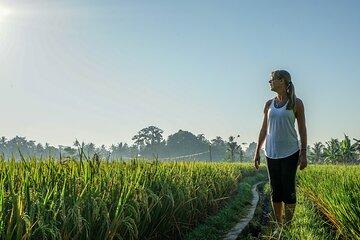
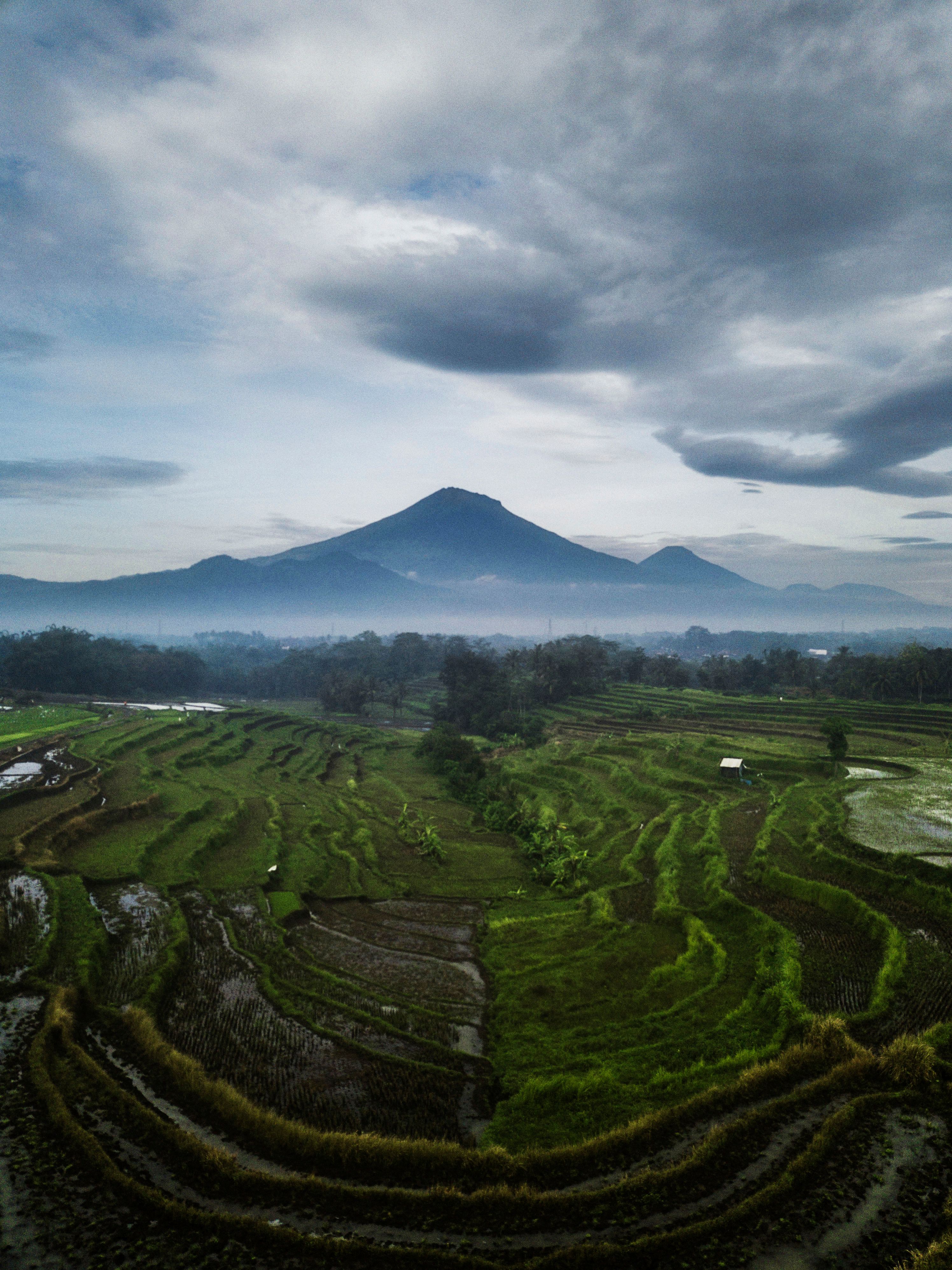
If you want rice terraces without the crowds, head east to Sidemen or north to the Munduk highlands. Sidemen, about an hour from Ubud in Karangasem, gets a fraction of Tegalalang's visitors and has some of the best terrace walking in Bali. The valley floor is flat enough to cross on foot, flanked by terraced slopes, with Mount Agung rising behind it on clear mornings. Locals describe it as Ubud before the tourists arrived.
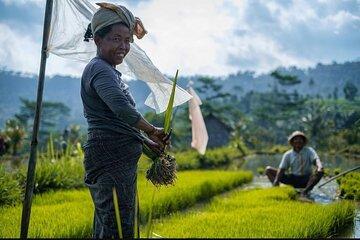
This is the side of the island most day-trippers never see, and it rewards a slower pace. You can walk the fields solo for a small fee, or hire a local guide who will explain the planting and harvest cycle and take you onto paths you would not find alone.
Sidemen: fees and walking
- Entry: around IDR 25,000 per person to access the field paths
- Hours: sunrise to sunset, no fixed gate times
- From Ubud: about 1 hour by car
- Footwear: trainers, not flip-flops — paths follow narrow walls above running water and get slippery after rain
- Best view: early morning, before cloud builds over Mount Agung
Munduk and the highland terraces
Up in North Bali, Munduk sits in cooler, mistier highland air, with terraces that fold into hillsides between waterfalls and clove plantations. It is a longer drive and better as part of a North Bali loop than a standalone terrace trip, but it pairs rice fields with a completely different climate and far fewer people. For the truly wild fields, the Pupuan and Belimbing areas in west Bali see almost no tourists at all.
Quiet-terrace tips
- Sidemen and Munduk are clearest in the morning — afternoon mist softens the views but hides the mountains
- Bring small cash; rural entry points rarely take cards
- A local guide costs little and turns a walk into an education on subak farming
- Stay overnight in Sidemen if the terraces matter more to you than Ubud's restaurants
Compare the Bali rice terraces at a glance
Here is how the main Bali rice terraces stack up on the things that actually decide your morning — distance, cost, crowds, and who each one suits. Use it to match a terrace to your trip rather than trying to see all of them.
| Terrace | Region | Drive from Ubud | 2026 entry | Crowds | Best for |
|---|---|---|---|---|---|
| Tegalalang (Ceking) | Near Ubud | ~20 min | IDR 25,000 (USD 1.50) | High by mid-morning | The iconic photo, short visits, first-timers |
| Jatiluwih | Tabanan (west-central) | ~1.5 hr | IDR 40,000 (USD 2.50) | Low | Scale, walking and cycling, UNESCO context |
| Sidemen | Karangasem (east) | ~1 hr | ~IDR 25,000 (USD 1.50) | Very low | Quiet walks, Mount Agung views, slow travel |
| Munduk | North Bali highlands | ~2 hr | Mostly free / small donation | Very low | Cool climate, waterfalls, North Bali loops |
Which terrace should you choose?
- Choose Tegalalang if you are based in Ubud, short on time, and want the classic stepped-valley photo without a long drive.
- Choose Jatiluwih if you want to walk or cycle through genuine scale and care about the UNESCO subak story.
- Choose Sidemen if you want quiet, a Mount Agung backdrop, and a slower side of Bali away from the day-trip circuit.
- Choose Munduk if you are already heading to North Bali and want terraces with a cooler, misty highland feel.
You do not need to see all four. One terrace done well — arrived at early, walked properly — beats three rushed photo stops. The options on Travjoy are researched and approved by local experts, so if you would rather have a driver handle the logistics, you can pick a route with confidence instead of guessing.
How to visit the Bali rice terraces: timing, season and getting around
The best time to visit the Bali rice terraces is early morning, year-round, with February to April and September giving the greenest fields. Because the paddies are planted on a rolling schedule, you will almost always find green somewhere, but timing your trip and your hour of arrival makes the difference between a memorable visit and a hot, crowded one.
Best season and time of day
- Greenest fields: February to April and September, when shoots are lush and bright
- Golden, harvest-ready: May–June and October, beautiful in a different way
- Just after harvest: late April–May and late October–November, when some fields look bare
- Best hour: 7am–9am for light, cool air, and space before the buses
- Rainy season (Nov–Mar): still lush, but paths get slippery and cloud can hide mountain views
Getting there: scooter, driver or tour
For Tegalalang from Ubud, a scooter or a Grab/Gojek ride is quickest. For Jatiluwih, Sidemen, or Munduk, a private driver makes far more sense — the drives are longer, the roads less obvious, and a driver lets you combine the terrace with nearby sights. You can see how a terrace fits into a wider day in Bali's top 20 experiences, which is a useful way to plan around drive times rather than against them.
Etiquette and what to wear
- Wear trainers — terrace paths are uneven, narrow, and often wet
- Dress modestly; these are working farms and sometimes near temples
- Carry small cash for entry fees and donation gates
- Stay on marked paths and avoid stepping on young rice
- Ask before photographing farmers, and tip a small amount if they pose
Plan your rice terrace trip
The most beautiful Bali rice terraces reward planning more than luck. Pick Tegalalang for the easy iconic stop near Ubud, Jatiluwih for UNESCO-scale walking, or Sidemen for quiet fields under Mount Agung — then arrive early, walk properly, and travel in the greenest months. One terrace done right will stay with you longer than a string of rushed photo stops.
When you are ready to build the rest of your itinerary around the terraces, start planning your Bali trip on Travjoy's Bali pages, where every experience is researched and approved by local experts so you can spend less time second-guessing routes and more time in the fields.




.svg&w=1920&q=75)