



Bali Waterfalls You Need to Chase: Tegenungan, Sekumpul & More
10 min read

Pratima Alvares
Author
Leisure Travel Expert Ex- SOTC & Cox & Kings
SHARE BLOG
TABLE OF CONTENTS
Key Takeaways
- Bali has more than 50 waterfalls, but only a handful earn the drive — the rest are either crowded, commercial, or repeats of better falls nearby.
- The falls split cleanly by region: easy stops near Ubud (Tegenungan, Tibumana, Tukad Cepung, Kanto Lampo) and bigger northern falls that need a longer trip (Sekumpul, Banyumala, Aling-Aling).
- 2026 entry fees range from IDR 15,000–30,000 (USD 1–2) at the easy falls to IDR 125,000–250,000 (USD 8–16) at Sekumpul, where a guide is now mandatory beyond the viewpoint.
- Plan around regions, not your bucket list — chaining falls from opposite ends of the island wastes the day in the car.
- Carry cash, wear grippy footwear, and skip canyon falls like Tukad Cepung after heavy rain because of flash-flood risk.
The best Bali waterfalls divide into two groups: easy stops within 30–40 minutes of Ubud that need little more than a short walk, and the bigger northern falls that reward an early start and a real trek. Entry costs IDR 15,000–30,000 (USD 1–2) at the accessible falls and IDR 125,000–250,000 (USD 8–16) at Sekumpul, where a local guide is now required past the viewpoint. The dry season (April–October) gives safer footing; the wet season gives heavier flow but slippery trails.
Bali has more than fifty waterfalls scattered across its volcanic highlands, yet most visitors only ever see one — usually the busy one a short drive from Ubud. That is a missed opportunity, but chasing all of them is its own mistake. The driving distances are deceptive, the access rules have changed at the most famous falls, and a few of the "must-see" names are really just easy car parks with a souvenir row attached.
This guide cuts the list down to the falls actually worth your time, groups them by region so you can route a sensible day, and gives you current 2026 fees and honest access notes — including the guide-and-scam situation at Sekumpul that older articles still get wrong. By the end you'll know which falls suit a relaxed half-day near Ubud, which deserve a committed northern run, and how to fit two or three into a single day without burning it behind a windscreen.
What sets Bali's waterfalls apart
Bali's waterfalls exist because the island is a stack of young volcanoes draped in rainforest — rivers cut fast through soft volcanic rock and drop suddenly off the highland shelf. That geology is why the falls cluster in the cooler interior and north rather than near the southern beach resorts, and why the experience shifts so much from one fall to the next.
The regional split that decides your day
The falls sort into two practical clusters, and understanding this is the single most useful thing for planning. Most travellers ignore it and pay for it in driving time.
- The Ubud and southern cluster — Tegenungan, Tibumana, Tukad Cepung, and Kanto Lampo all sit within 20–40 minutes of Ubud and need only short walks. This is the half-day, low-effort option.
- The northern cluster — Sekumpul, Banyumala, Aling-Aling, and Gitgit lie up around Buleleng and Munduk, roughly 1.5–2.5 hours from south Bali. Bigger, wilder, less crowded, and a full committed day.
The classic error is trying to combine a southern fall with a northern one in the same outing. The drive between them eats three to four hours and leaves you rushing both. Pick a cluster and stay in it. If you're still mapping the wider trip, our top 20 things to do in Bali shows how the falls line up against temples and rice terraces in the same regions.
Dry season versus wet season
Season changes both the look and the safety of every fall. There's no single "best" answer — it depends on what you're optimising for.
- Dry season (April–October): clearer water, safer footing, easier treks. Flow is gentler but the falls still run well. The simpler choice for most visitors.
- Wet season (November–March): two to three times the volume and a more dramatic scene, but slippery steps, murkier water after downpours, and real flash-flood risk in canyon falls. Go early, before the afternoon rain builds.
Whatever the season, mornings win. Arrive by 8–9am for the best light, the thinnest crowds, and — at canyon falls like Tukad Cepung — the sunbeam that filters through the cave roof between roughly 9 and 11am.
The easy Bali waterfalls near Ubud
If you have half a day and don't want a hard hike, the Ubud cluster delivers four very different falls within a short drive of each other. These are the most accessible Bali waterfalls, and you can comfortably pair two or three in a morning.
Tegenungan — the easy crowd-pleaser
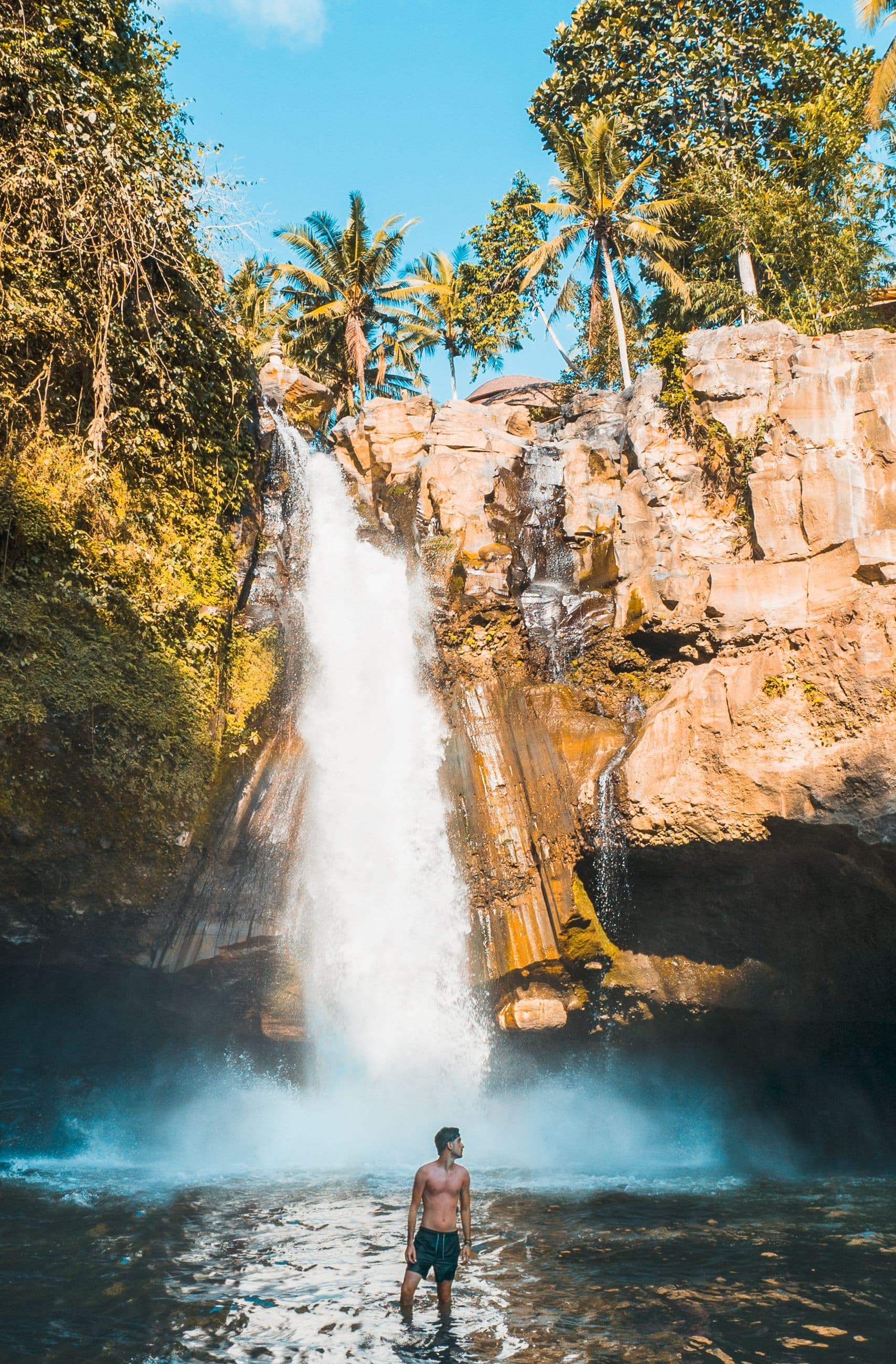
Tegenungan is the most visited fall on the island and the easiest to reach — about 20–30 minutes south of Ubud on paved roads, with a wide swimmable pool at the base. It's a single broad curtain rather than a tall drop, and the area is heavily built up with cafés, a glass viewing bridge, and souvenir stalls. Good for a quick, low-effort stop; less rewarding if you've already seen the bigger falls.
- Entry: IDR 20,000–25,000 (USD 1.50–2), plus around IDR 5,000 parking.
- Effort: easy — a flight of stairs down to the base.
- Best for: first-timers, families, and anyone short on time.
Tibumana — the calm swim
Tibumana is the quieter alternative to Tegenungan, about 30 minutes southeast of Ubud. A single gentle curtain drops into a calm, shallow pool inside a bamboo ravine, and the short flat walk in makes it one of the few falls that suits nervous swimmers and younger kids.
- Entry: IDR 20,000 (USD 1.30).
- Effort: easy — a short, mostly flat walk.
- Best for: a relaxed swim away from the crowds.
Tukad Cepung — the cave of light
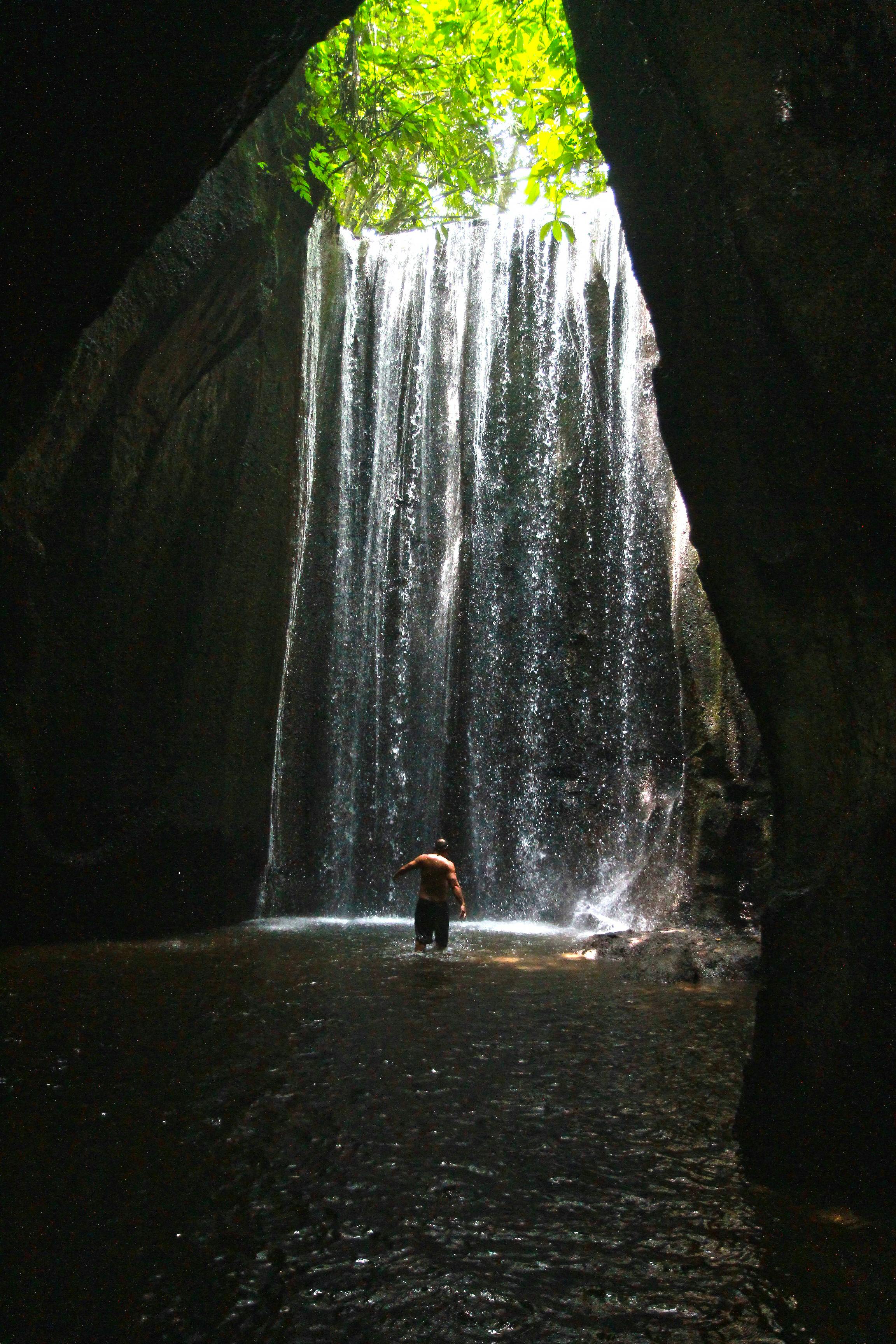
Tukad Cepung is the most distinctive of the easy falls. Instead of dropping into the open, it falls inside a narrow canyon, and on clear mornings a shaft of sunlight pours through the gap in the cliff roof, lighting the mist. The walk in takes around 15–20 minutes through a river gorge, and you wade a little to reach the chamber.
- Entry: IDR 15,000–30,000 (USD 1–2).
- Best time: 9–11am for the light beam; skip entirely after heavy rain due to flash-flood risk in the canyon.
- Best for: photographers and anyone chasing that one shot.
Kanto Lampo — the cascading staircase
Kanto Lampo near Gianyar is a tiered fall that fans down a wide rock face like a staircase, which makes it photogenic and easy to clamber onto for photos. It's an easy add-on close to Ubud and sits only about 15 minutes from Tukad Cepung, so the two pair naturally. Many visitors fold both into a temple day around Tirta Empul, which lies in the same Bangli–Tampaksiring direction.
- Entry: IDR 25,000 (USD 1.60).
- Effort: easy — short walk, then some rock scrambling for photos.
- Best for: photos and a quick, easy waterfall hop.

The big northern Bali waterfalls worth the drive
The northern falls are taller, wilder, and far less crowded than the Ubud cluster, but they demand a longer drive and, in places, a real trek. If you only have energy for one serious waterfall day, this is where it should go. These are the Bali waterfalls that reward the effort with scale you won't find near Ubud.
Sekumpul — the most dramatic, and the most changed
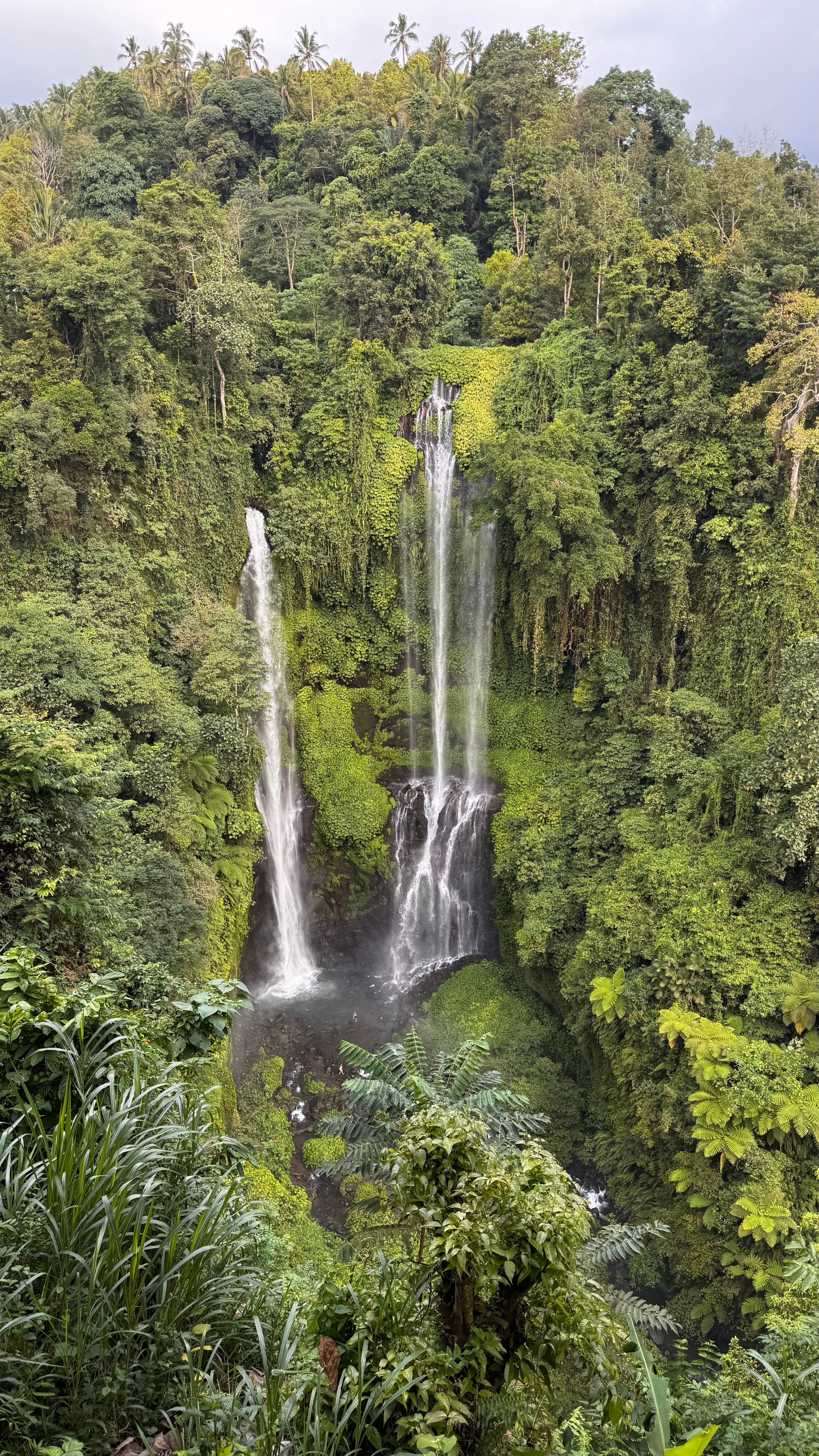
Sekumpul, in the Buleleng hills of north Bali, is widely rated the most impressive fall on the island — a cluster of cascades around 80 metres tall dropping into a jungle valley, often visited alongside the neighbouring Hidden and Fiji falls. The reach is the catch: a steep descent of concrete steps and dirt trail, a river crossing, and a tiring climb back. Reaching the falls is well worth it, but the access system has changed sharply, and most older guides are out of date.
The Sekumpul reality check (2026)
- A guide is now mandatory past the viewpoint. The old "pay 20k and walk down yourself" route is largely closed off.
- Three fee tiers: view-only IDR 20,000 (USD 1.30); medium trek IDR 125,000–150,000 (USD 8–10) with guide, covering Sekumpul and Hidden falls; long trek IDR 200,000–250,000 (USD 13–16) adding the Fiji falls.
- Watch for fake checkpoints. Touts set up "registration" signs on the approach road and pressure visitors into inflated fees. Only pay at the official entrance by the "Welcome to Sekumpul" sign.
- Not accessible: the steep steps and river crossing rule it out for limited mobility or very young children.
Despite the cost creep, the medium trek is the sweet spot — a guide, both main falls, and a fair contribution to the village. You can book the visit with a verified driver and guide through Travjoy's Sekumpul Waterfall experience, which sidesteps the checkpoint haggling because the access is arranged in advance.
Banyumala — the twin-fall swim
Banyumala Twin Waterfall, up in the Wanagiri highlands near Munduk, drops in two parallel curtains into a wide, clear pool that's excellent for swimming. It's quieter than Sekumpul and far less commercial, with a steep but short walk down from the car park. It pairs naturally with Sekumpul on a northern day, since both sit in the same Buleleng–Munduk zone.
- Entry: IDR 30,000 (USD 2).
- Effort: moderate — steep descent and climb back, but short.
- Best for: swimming and photographers who want a fall to themselves.
Aling-Aling — the adventure fall
Aling-Aling in Sambangan village is the one for adrenaline. Beyond the main split cascade, a guided package opens up natural rock slides and cliff jumps of varying heights into deep pools. A guide is mandatory for the jumps and slides, both for safety and route-finding.
- Entry: IDR 30,000 (USD 2) view-only; guided jump-and-slide packages cost more.
- Effort: moderate to high if you do the jumps.
- Best for: confident swimmers and thrill-seekers.
Gitgit and Nungnung — the classics
Gitgit near Singaraja is one of Bali's tallest single drops and among its most established falls, with easy access but a heavily touristed surround. Nungnung, roughly an hour north of Ubud, is a powerful 50–70 metre fall reached by a punishing flight of 500-plus steps — the most demanding climb back of the popular falls, and quieter for it.
- Gitgit entry: around IDR 20,000 (USD 1.30); easy access.
- Nungnung entry: IDR 20,000 (USD 1.30); 500+ steps each way.
- Best for: Gitgit for an easy classic; Nungnung for raw power if your legs are willing.










Which Bali waterfall should you chase?
If you only have time for one or two, match the fall to your appetite for effort and crowds. The easy Ubud falls suit relaxed half-days; the northern falls reward an early start and stronger legs. The table below compares the main Bali waterfalls at a glance, with 2026 fees.
| Waterfall | Region | Effort | Swimmable | Crowd level | 2026 fee (IDR / USD) | Best for |
|---|---|---|---|---|---|---|
| Tegenungan | Ubud / south | Easy | Yes | High | 20,000–25,000 / 1.50–2 | First-timers, families |
| Tibumana | Ubud / south | Easy | Yes (calm) | Low–medium | 20,000 / 1.30 | Quiet swims |
| Tukad Cepung | Bangli / south | Easy–moderate | Shallow only | Medium–high | 15,000–30,000 / 1–2 | Photographers |
| Kanto Lampo | Gianyar / south | Easy | Shallow only | Medium | 25,000 / 1.60 | Quick photo hop |
| Sekumpul | North (Buleleng) | Hard | Limited | Low–medium | 125,000–250,000 / 8–16 | The one big fall |
| Banyumala | North (Munduk) | Moderate | Yes | Low | 30,000 / 2 | Swimming, photos |
| Aling-Aling | North (Sambangan) | Moderate–high | Yes (jumps) | Low–medium | 30,000+ / 2+ | Thrill-seekers |
| Nungnung | Central north | Hard (500+ steps) | Yes | Low | 20,000 / 1.30 | Raw power, solitude |
Pick by what you want from the day
Use these if/then shortcuts to settle the choice quickly.
- If you want easy and close to Ubud: Tegenungan or Tibumana. Minimal walking, quick to reach, good for a half-day.
- If you want the best photo: Tukad Cepung for the cave light, or Kanto Lampo for the tiered rock face.
- If you want one big, memorable fall: Sekumpul, on a dedicated northern day with the medium trek.
- If you want to swim somewhere quiet: Banyumala or Tibumana.
- If you want adventure: Aling-Aling's guided jumps and slides.
- If you have limited mobility or young kids: stick to Tegenungan or Tibumana and skip the northern falls and Nungnung's steps.
Planning a Bali waterfall day that works
A good waterfall day covers two or three falls in one region with an early start and a private driver — not a scramble across the island. Trying to chain falls from opposite ends is the classic mistake, because the driving swallows the day. Here are two routes that actually flow.
The easy Ubud route
Low effort, short drives, and a swim or two — comfortable as a half- or full day from an Ubud base.
- 08:00 — Tibumana for an early, quiet swim.
- 09:30 — Tukad Cepung, timed for the light beam through the cave.
- 11:30 — Kanto Lampo for photos, then lunch at a nearby warung.
- Optional add-on: Tirta Empul Temple sits in the same direction for an afternoon.
The committed northern route
A longer, more demanding day covering Bali's biggest falls. Leave south Bali early — the drive up is the limiting factor.
- 07:00 — depart south Bali or Ubud.
- 09:30 — Sekumpul medium trek (allow 2–3 hours including the climb back).
- 13:00 — Banyumala for a swim and a slower pace.
- 15:00 — Aling-Aling if you still have energy for the jumps.
What to bring
- Cash in small notes — card payment is patchy at every fall; you'll need it for entry, parking, and warungs.
- Grippy footwear — trail sandals or trainers with tread. The rocks and steps stay slick even in dry season.
- A dry bag for phone and camera, plus swimwear and a quick-dry towel.
- Water and insect repellent — jungle trails attract mosquitoes, and the climbs are sweaty work.
Because so many falls cluster near Ubud and the highlands, basing yourself in the interior makes the routing easier. Booking your driver and any guided falls in advance through a platform that vets its operators — every Travjoy experience is reviewed by local experts before it's listed — takes the guesswork out of the day and, at Sekumpul especially, sidesteps the roadside fee haggling.
Staying safe at Bali's waterfalls
The biggest risks at Bali's waterfalls are slippery rock, flash floods, and strong currents — all manageable with a little caution. None of these falls is dangerous in normal conditions, but the wet-to-dry transition and sudden downpours are worth respecting.
- Slippery surfaces: wet rock and concrete steps are the most common cause of injury. Move slowly on descents and use handrails where they exist.
- Flash floods: canyon falls like Tukad Cepung can flood fast after heavy rain upstream. If it's been pouring, switch to an open fall like Tegenungan or skip the day.
- Currents and depth: plunge pools vary — some are calm, others have strong undertow near the base. Don't swim directly under a heavy fall.
- Scam checkpoints: at Sekumpul, ignore unofficial "registration" signs on the approach road and only pay at the official entrance.
Plan your Bali waterfall trip
The waterfalls worth chasing in Bali come down to a simple split: the easy falls near Ubud for a relaxed half-day, and the bigger northern falls — led by Sekumpul — for one committed run. Group them by region, start early, carry cash, and respect the rock and the rain, and you'll see the best of them without losing the day to driving.
The most rewarding trips skip the guesswork and book the driver and guided falls in advance. Start planning your waterfall days, and the temples and rice terraces that pair with them, on our Bali destination guide.







.svg&w=1920&q=75)