



Bali Temple Etiquette: What to Wear and How to Behave
10 min read

Raj Varma
Author
Travel & Tourism Expert Ex-Thomas Cook, Kuoni, Times of India & Travel Triangle.
SHARE BLOG
TABLE OF CONTENTS
Key Takeaways
- A sarong and sash are required at almost every Balinese temple — most are rented or included for IDR 10,000–20,000 (USD 0.65–1.30) at the gate.
- Shoulders, midriff, and knees must be covered for both men and women. Tank tops, crop tops, and short shorts will get you turned away.
- Never step on or over a canang sari — the small palm-leaf offerings you'll see on every doorstep, statue, and temple step.
- Menstruating women, women in the third trimester of pregnancy, and anyone within six weeks of giving birth or losing a close family member should not enter inner temple courtyards.
- Donations of IDR 10,000–20,000 (USD 0.65–1.30) at the peturunan box are standard. No need to match what you see local devotees give.
Visiting a Balinese temple is the closest most travellers come to seeing the island's actual spiritual life rather than its tourist version. The rules around what to wear and how to behave aren't arbitrary — they're tied to a 1,000-year-old framework of sacred space, ritual purity, and respect for active worship. This guide covers the dress code, the entry fees and what each ticket includes, the temple's spatial logic, photography and drone rules, the cuntaka (ritual impurity) tradition, and the small gestures that mark you out as a respectful guest rather than another tourist treating a working temple like a photo set.
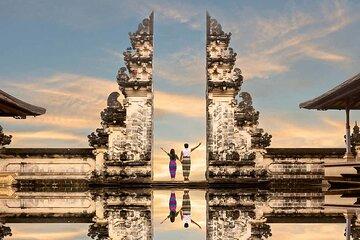
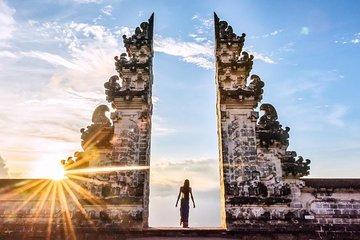
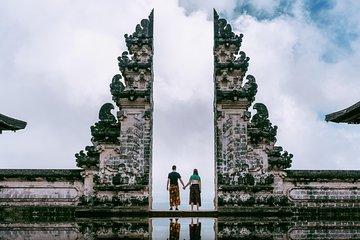
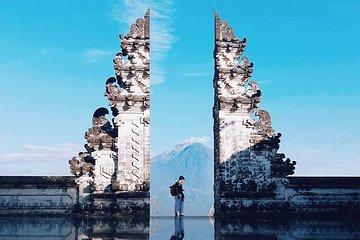
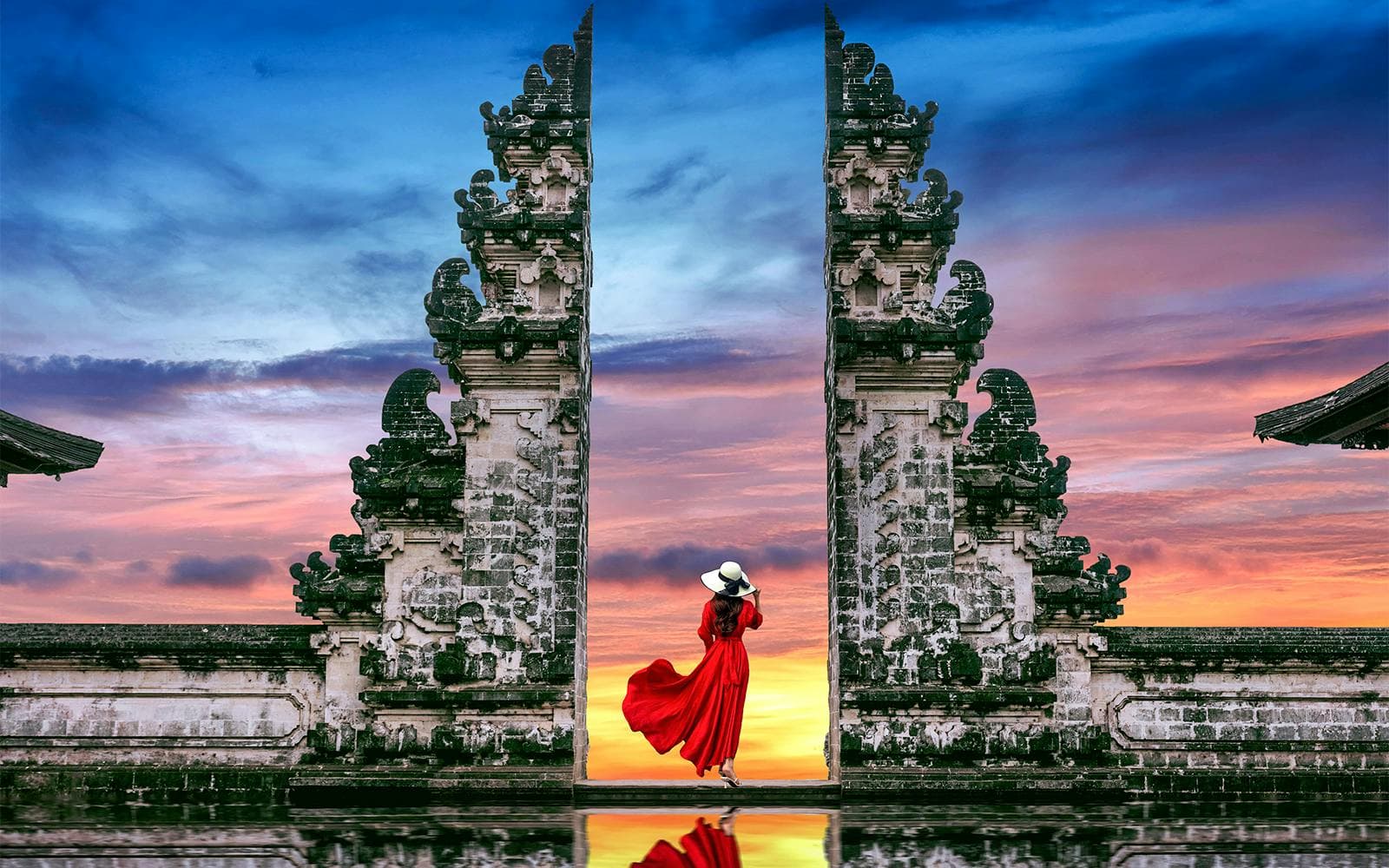
The setup at Pura Lempuyang on a Tuesday morning tells you most of what you need to know about Bali temple etiquette. There's a small queue at the gate. Two attendants are tying borrowed sarongs around tourists in shorts and dresses. A laminated sign at chest height lists six rules in English and Indonesian. And every few minutes, a family in beach clothes is sent back to the car park to find more cover. The rules aren't a suggestion — they're enforced at the gate, and the gatekeepers have heard every excuse.
None of this is complicated once you understand the logic. Balinese temples (pura) aren't museums or attractions designed for visitors. They're active places of worship where someone is praying, leaving an offering, or preparing for a ceremony on most days of the year. The dress code is the basic threshold for being welcomed in. Everything else — where you stand, where you point your feet, where you put your phone — comes from the same underlying idea: don't disturb the people who actually came to pray.

What to wear: the Bali temple dress code
The Bali temple dress code is simpler than the SERP suggests. You need three things: a sarong, a sash, and a top that covers your shoulders and midriff. Men and women follow the same rules. Children are usually given more leeway in the outer courtyards but are expected to wear sarongs in the inner prayer areas.
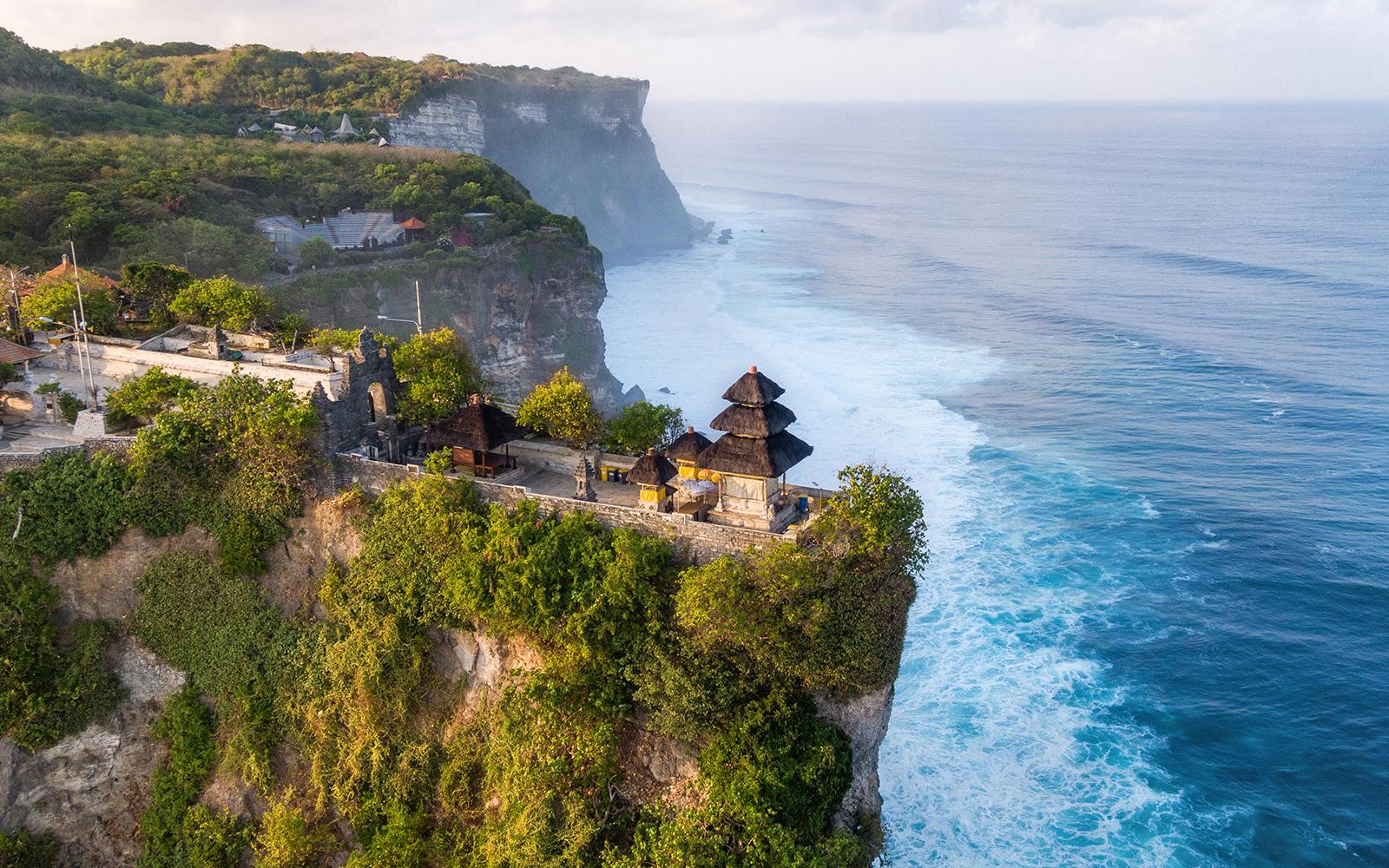
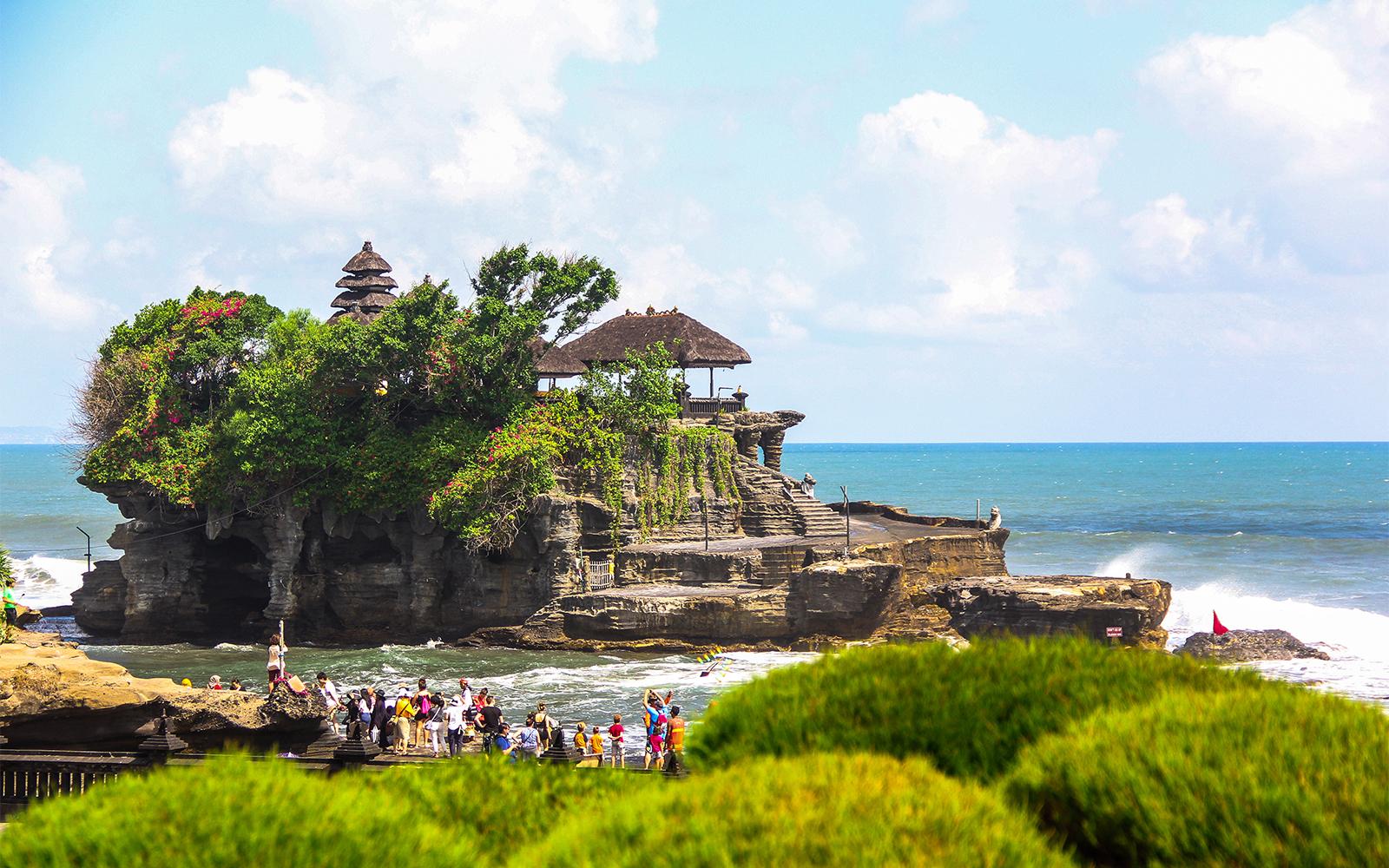
Most major temples — Uluwatu, Tirta Empul, Taman Ayun, Lempuyang, Besakih — provide or rent sarongs at the entrance. The exceptions are Tanah Lot (no sarong required because visitors only access the outer viewing platforms) and the small village temples you'll pass on day trips, where you should be carrying your own anyway.
The sarong and the sash
The sarong is a long piece of fabric wrapped around the waist and falling below the knees. The sash (called a selendang) is a narrower length of cloth tied over the sarong at the waist. Both are required. Even if you arrive in long pants or a maxi dress, you still need a sarong wrapped over them and a sash tied above. The pair is symbolic — the sarong covers the lower, less-sacred half of the body; the sash marks the boundary between the spiritual and physical self.
Sarong specifics:
- Length: Must fall below the knees. Mid-calf is the safe standard.
- Fabric: Cotton, batik, or a light synthetic weave. Beach-style rayon sarongs are accepted at most temples but can look casual at the stricter sites like Besakih.
- Colour: Anything modest. White, navy, and earth tones are common; flashy prints or offensive graphics will draw attention.
- Where to get one: Almost every major temple rents or includes one. Markets sell decent sarongs for IDR 50,000–100,000 (USD 3.25–6.50) and boutique batik or songket pieces run IDR 300,000–1,000,000+ (USD 19.50–65.00+).
What goes on top
Tops must cover the shoulders, upper arms, and midriff. The full list of what gets turned away:
- Tank tops, singlets, spaghetti straps
- Crop tops and anything that exposes the midriff
- Tube tops and strapless dresses
- Sheer or mesh tops worn without a layer underneath
- Bikinis (this shouldn't need saying, but staff at Uluwatu deal with it weekly)
A plain T-shirt is the safest baseline. If the day is hot, carry a light cotton scarf or a second sarong as a wrap — you can throw it over your shoulders at the gate and remove it once you're walking back to the car.
Below the sarong
The sarong handles modesty on its own, so what you wear underneath is mostly a comfort question. Long pants and leggings are fine. Knee-length skirts and dresses are fine. Shorts are acceptable only if the sarong fully covers them — most temples will hand you a sarong on top regardless. Tight-fitting cycling shorts or compression leggings worn alone (without a sarong) won't pass at the gate.
Footwear, hats, and accessories
Closed or open shoes are both accepted in the outer courtyards. You may be asked to remove shoes before entering certain inner pavilions — follow the locals' lead and look for piles of sandals near a threshold. Hats, sunglasses, and small day bags are all fine. Avoid wearing anything overly flashy in the inner zones, and never wear a hat indoors during a ceremony.
Entry fees, sarong rentals, and what each temple expects in 2026
Knowing exactly what your ticket covers saves a small panic at the gate. Sarong inclusion varies by temple, and some sites have separate fees for shuttles, ceremony sarongs, or dance performances. The table below covers the major temples most visitors include on a Bali trip, with international visitor pricing for 2026.
| Temple | Entry fee (adult) | USD equivalent | Sarong & sash | Notes |
|---|---|---|---|---|
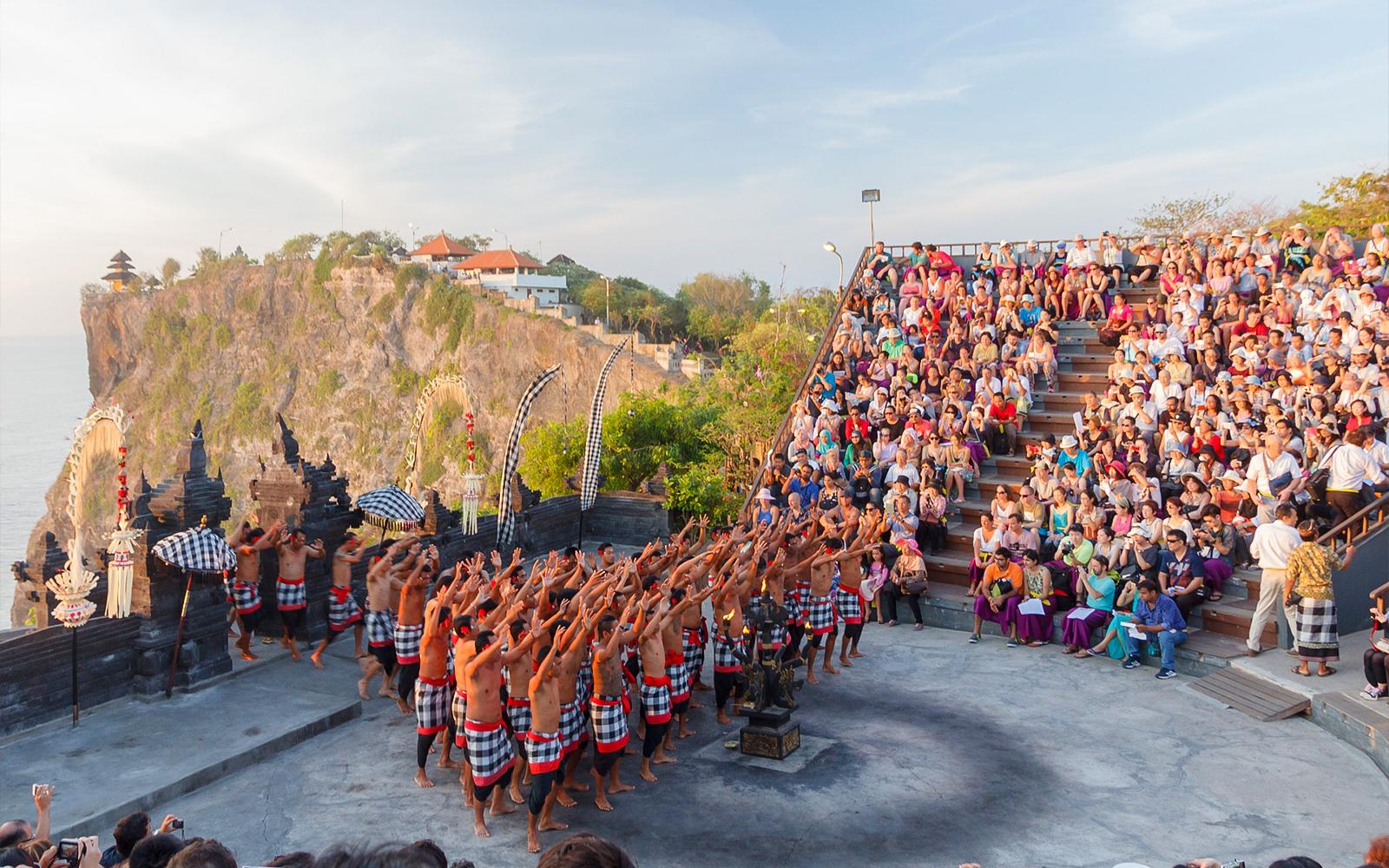
| Uluwatu Temple | IDR 75,000 | USD 4.85 | Included | Kecak dance ticket separate (IDR 150,000 / USD 9.75) |
| Tanah Lot Temple | IDR 75,000 | USD 4.85 | Not required | Visitors access only the outer cliff viewpoints; the temple itself is reserved for worshippers. Modest dress still expected. |
| Pura Lempuyang Luhur (Gate of Heaven) | IDR 100,000 | USD 6.50 | Included | Shuttle bus to upper temple: IDR 50,000 (USD 3.25) extra, round trip |
| Tirta Empul Temple | IDR 75,000 | USD 4.85 | Basic included | A separate green ceremony sarong is required for the melukat purification ritual (rental + locker fee extra) |
| Taman Ayun Temple | IDR 50,000 | USD 3.25 | Included | Cash only; card terminals unreliable |
| Pura Besakih (Mother Temple) | IDR 150,000 | USD 9.75 | Included | Largest temple complex on Mount Agung; allow 2 hours minimum |
| Sacred Monkey Forest (Pura Dalem Agung) | IDR 80,000 | USD 5.20 | Not required | Modest dress only; sarongs needed if you enter the inner shrine area during ceremonies |
A few practical notes on the table above:
- Cash is safer than card. Most temple ticket booths take cash in Indonesian rupiah only. ATM machines outside the gates often run out during peak season.
- Bring your own sarong if you're squeamish. Rental sarongs at popular temples like Besakih and Uluwatu are washed regularly, but during the July–August and December peak, they cycle through visitors quickly. A IDR 50,000–100,000 (USD 3.25–6.50) sarong from a market becomes a useful keepsake.
- Children pay roughly half. Most temples list a separate child rate around IDR 40,000–50,000 (USD 2.60–3.25). Under-fives are usually free.
- Bali Tourist Levy is separate. All international visitors pay a one-time IDR 150,000 (USD 9.75) levy on arrival, which is independent of temple entry fees.
If you're planning a temple-heavy day, three sites is the comfortable maximum. The drive between Lempuyang and Besakih alone takes 90 minutes, and each temple deserves an hour or more if you're not just queuing for the photo.
The Tri Mandala: why some areas are off-limits
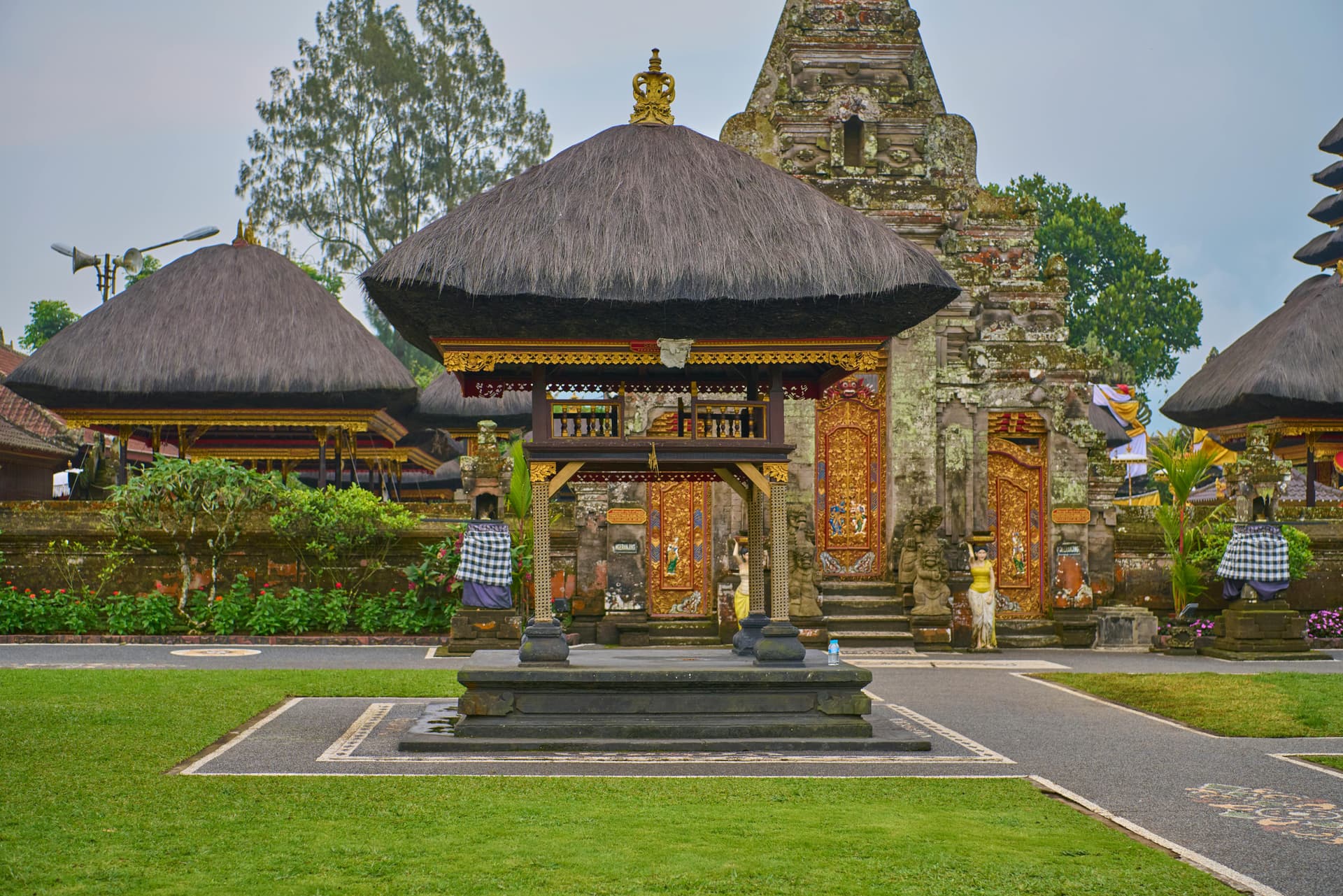
Every Balinese temple is built on a three-zone spatial system called the Tri Mandala. Understanding this — even loosely — explains most of the rules you'll encounter once you're inside. It tells you why some courtyards are roped off, why the inner sanctum is empty unless a ceremony is in progress, and why a sign halfway in says "tamu tidak boleh masuk" (visitors not allowed).
The three zones progress from outer (less sacred, more public) to inner (most sacred, restricted to active worshippers). Each is separated by a gate — usually a split candi bentar for the outer transition and a roofed kori agung for the inner one.
Nista Mandala (the outer courtyard)
This is where you enter, where the ticket booth and sarong rental sit, and where the temple meets the surrounding world. It's a public-facing space — usually a garden, an open field, or a paved courtyard with a community pavilion (wantilan). You can walk freely here, take photos, sit on benches, and watch dance performances during festivals. Most casual tourist visits never go beyond this zone.
Madya Mandala (the middle courtyard)
You enter the Madya Mandala through a split gate, and the atmosphere shifts. This is where offerings are prepared, where the gamelan pavilion (bale gong) sits, and where the wooden slit-drum tower (bale kulkul) is used to summon worshippers. Visitors are welcome but expected to keep to the edges. Photography is fine for architecture and general shots but should pause when ceremonial activity is underway.
Utama Mandala (the inner sanctum)
The Utama Mandala is the holiest zone and is largely off-limits to non-Hindus during ordinary visits. This is where the padmasana (lotus-throne shrine to the supreme deity Sang Hyang Widhi Wasa) and the multi-tiered meru towers stand. At smaller temples you can sometimes peer in from the threshold of the inner gate; at major sites like Besakih, the inner courtyard is roped off entirely. During festivals, only worshippers in white ceremonial dress enter. Photographing this zone is acceptable from the gate but should never disrupt anyone praying.
The Tri Mandala mirrors Bali's wider spatial cosmology — the mountain (where gods live, sacred), the agricultural plains (where humans live, neutral), and the sea (where demons live, less sacred). It's the same logic that explains why Balinese houses are oriented with shrines toward the mountains, and why a deeply respected Bali temple etiquette habit is to walk clockwise around shrines rather than cutting across the central axis.







How to behave inside a Bali temple
Dressing correctly gets you through the gate. How you behave once you're inside is what marks you out as a respectful visitor rather than a tourist filling a slot in an itinerary. The behavioural rules are clearer than the dress code and break down into five categories: how you move, how you treat offerings, what you photograph, drones, and noise.
Walking, standing, and not climbing things
Walk slowly, walk to the side, and never climb on shrines or sacred structures for a photo. The two rules tourists most often break:
- Don't sit higher than the priest. If a ceremony is in progress, the priest (pemangku) sits on a raised pavilion. Worshippers sit on the ground or on lower benches. Visitors should sit at the back, on the ground or on the lowest available level. Standing tall while everyone else is seated reads as disrespect.
- Don't climb shrines or statues. This includes the candi bentar split gates, the meru towers, and any small stone shrine in a courtyard. A tourist family was famously turned away from Pura Besakih in 2024 after a child climbed onto a shrine for a photo. The rule is enforced and the fines, when applied, are not small.
Move clockwise around the inner courtyard if you're walking through. This is called pradaksina — the same circumambulation pattern used in Hindu temples elsewhere. It's not strictly enforced, but locals will notice, and noticing it is part of Bali temple etiquette.
Canang sari: don't step over, don't kick, don't pick up
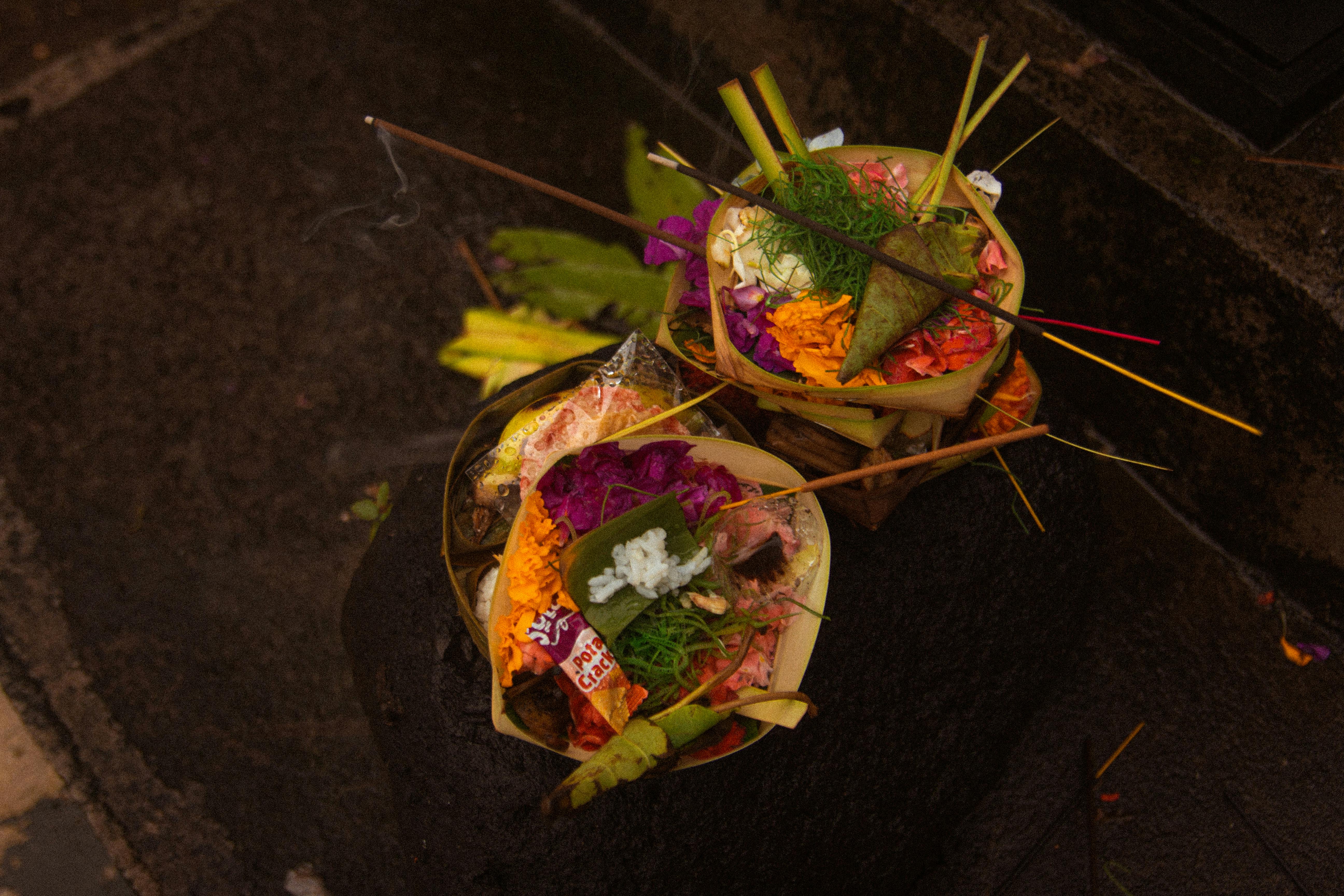
Canang sari are the small palm-leaf trays you'll see everywhere in Bali — on doorsteps, motorbike seats, statues, temple steps, and sometimes in the middle of a footpath. Each holds flowers, rice, a smoking incense stick, and sometimes a sweet or a coin. They're made fresh every morning and left as a gesture of gratitude to the gods (and a small offering to the lower spirits at ground level).
Three rules:
- Don't step on them. If you see one in your path, walk around it. If the path is narrow and you have to step over, do so with the canang to your right side, not under you.
- Don't kick them. Even accidentally. If you've kicked or stepped on one, a quiet "maaf" (sorry) and a moment of acknowledgement is enough. No need to dramatise the apology.
- Don't pick them up. They look like the perfect Bali photo prop. They aren't. Picking up a canang for a flat-lay shot is the equivalent of taking a flower arrangement off an altar in a church.
Photography and phones
Photography is allowed at almost every Bali temple, with three exceptions worth knowing:
- No flash photography during prayers or ceremonies
- No close-up shots of worshippers mid-prayer without asking first
- No photos of the inner sanctum during active ritual unless invited
General architecture, courtyards, gates, statues, gardens, and dance performances are fine. If you want a portrait shot with a Balinese person — including the temple gate-keepers — ask first. The answer is usually yes. Keep your phone on silent inside the temple grounds. A ringtone interrupting a ceremony is the fastest way to lose the goodwill you came in with.
Drones: assume no, even when no sign is up
Drones are banned at every major Bali temple. Signs are now posted at Tanah Lot, Uluwatu, Tirta Empul, Besakih, Lempuyang, and most regional temples. The reasons: the noise disrupts ceremonies, the visual intrusion on worshippers, and the safety risk to the temple structures and to other visitors. Even at smaller village temples where there's no sign, assume drones aren't welcome and don't fly. Confiscations happen, and the appeals process is slow.
Voices, PDA, and behaviour around ceremonies
Keep voices low — temple grounds aren't libraries, but conversations should sit at conversational volume, not group-chat volume. Public displays of affection (kissing, prolonged hugging) are not appropriate inside the temple compound, especially in the inner courtyards. Hand-holding is fine.
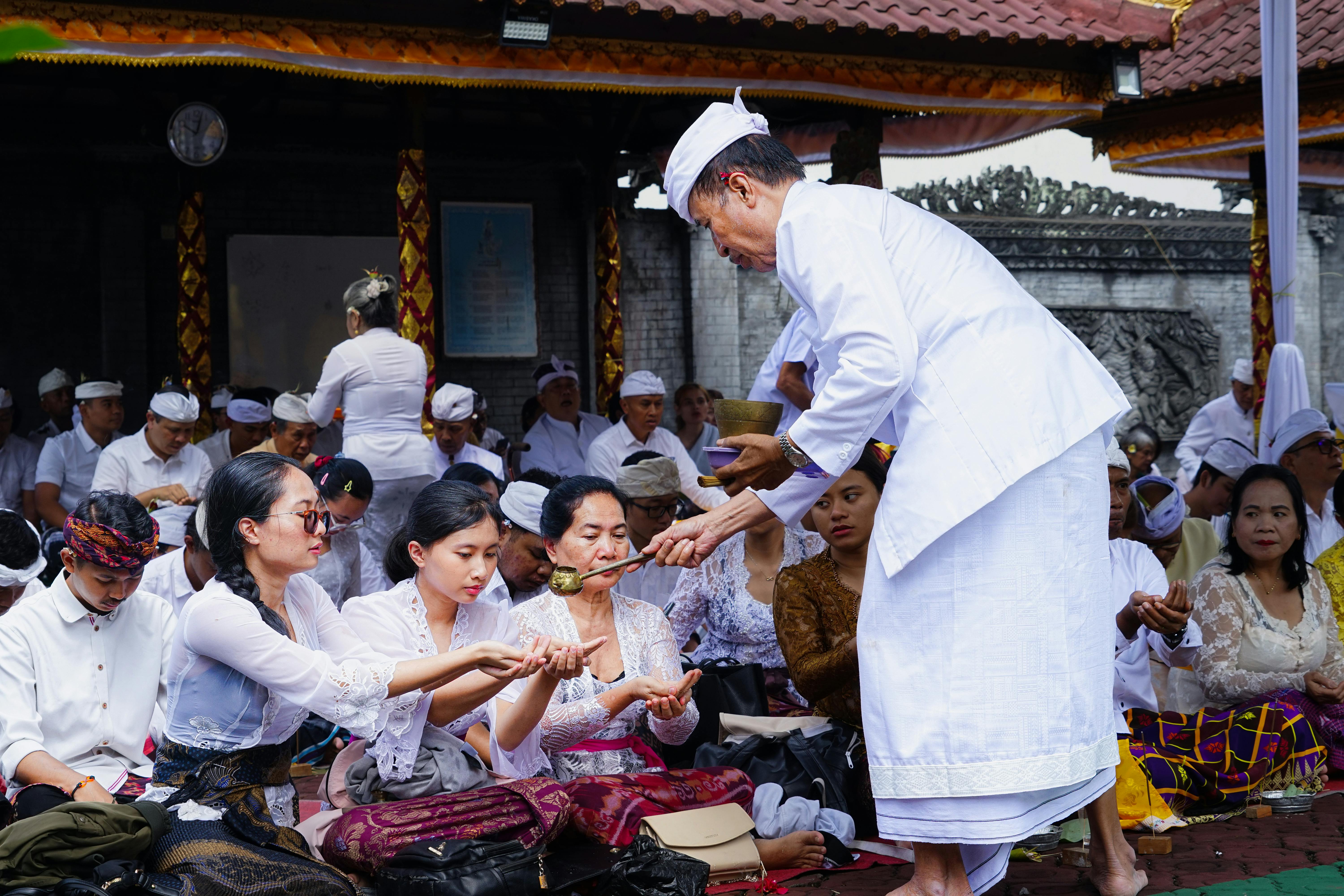
If you arrive in the middle of a ceremony (called an odalan, or temple anniversary, every 210 days), don't panic. Stay at the back of the outer courtyard, sit cross-legged if seated, keep your head below the priest's, watch what locals do, and leave quietly if asked. Most Balinese are welcoming to respectful observers — being there is fine. Filming the entire thing on your phone is not.
The cuntaka rule: menstruation, pregnancy, and bereavement
The rule on the entry sign at most major temples reads: "Women on their period are not permitted to enter." It catches international visitors off guard. The rule isn't about hygiene or biological cleanliness in the modern sense — it's tied to a concept called cuntaka, which translates roughly as "ritual impurity" or "spiritual imbalance." It applies to anyone (not only menstruating women) considered to be in a state where active blood or recent contact with birth or death disrupts the temple's spiritual energy.
Who the rule applies to:
- Women currently menstruating
- Women in the third trimester of pregnancy (typically from around 7 months)
- Women within six weeks of giving birth
- Anyone with an open, actively bleeding wound (men included)
- Anyone within a defined mourning period after a death in the immediate family (usually 12 days; longer for closer relatives)
Practical notes for international visitors:
- You may be asked directly. Most Balinese are respectful about privacy, but at stricter sites — especially Besakih — a gate-keeper may ask quietly whether a female visitor is menstruating. Honesty is expected; lying and entering is considered worse than declining.
- Most temples will refund the ticket if you mention the issue before passing the inner gate.
- The Uluwatu Kecak workaround: the outdoor amphitheatre where the Kecak fire dance is performed sits in the outer courtyard, technically outside the inner temple. Menstruating women can watch the dance without entering the restricted zone. This is the standard interpretation and is followed by local guides.
- At Tanah Lot, the temple itself is reserved for worshippers anyway, so the rule rarely affects tourists, who only access the outer cliff viewpoints.
The cultural framing matters. Cuntaka is not a judgement on the person — it's a temporary state of imbalance that affects whether the temple's spiritual energy stays in equilibrium. Treating the rule as a colonial-era curiosity to push back against is the wrong approach. Following it is part of respecting the framework that makes the temple sacred in the first place.
Donations, greetings, and the small gestures that go a long way
Beyond the rules at the gate, a handful of small habits separate a respectful visitor from one going through the motions. None of them are required. All of them are noticed.
How much to donate
Most temples have a wooden donation box near the inner courtyard called the peturunan or kotak dana punia. Tourists often hover, unsure whether to drop in IDR 5,000 or IDR 100,000. The standard, useful answer:
- IDR 10,000–20,000 (USD 0.65–1.30) is the typical visitor donation at major temples where you've already paid an entrance fee.
- IDR 20,000–50,000 (USD 1.30–3.25) if you've used facilities, taken extensive photos, or were guided by a temple attendant.
- No need to match what locals give. A devout Balinese family may give IDR 100,000–500,000 (USD 6.50–32.50) at their family temple's annual odalan, but this reflects their personal relationship with the site, not a tourist baseline.
If you didn't pay an entry fee (smaller village temples often have no formal ticket), the donation becomes more important — IDR 20,000–50,000 (USD 1.30–3.25) is appropriate.
Greetings worth knowing
Three phrases will cover almost every situation inside a Balinese temple:
- Om Swastiastu — the standard Balinese Hindu greeting, used both as "hello" and as a respectful acknowledgement when entering a temple or greeting a priest. Pronounced "ohm swah-stee-ah-stoo."
- Suksma — "thank you." Use it after a sarong is tied for you, after a gate-keeper waves you through, or to a stallholder selling offerings outside.
- Maaf — "sorry." Useful if you've stepped on a canang, bumped into someone in a narrow gateway, or accidentally photographed someone praying.
Hands, feet, and the small body-language rules
The Balinese view the body in three layers — the head as sacred, the torso as neutral, the feet as the lowest and least clean. This shapes a handful of habits worth adopting:
- Right hand for giving and receiving. Pass money, offerings, or anything else with your right hand, or both hands. The left hand is considered unclean and is used for personal hygiene.
- Don't touch anyone's head — including children's. Even a friendly head pat is considered an overstep, because the head holds the soul.
- Don't point your feet at a shrine, at the priest, or at another person. Sit cross-legged if seated on the ground. If you must stretch your legs, point them to the side or away from the inner sanctum.
- Don't point with a single finger. Use an open hand or the right thumb when indicating direction or people.
If you stumble into a ceremony
Bali has somewhere between 10,000 and 20,000 active temples and a calendar that schedules an odalan (temple anniversary) at each one every 210 days. The odds of arriving during an active ceremony at one of the bigger sites — Lempuyang, Besakih, Uluwatu, Tirta Empul — are higher than you'd expect. If it happens:
- Stay at the back of the outer courtyard. Don't push toward the priest for a closer view.
- Sit if locals are seated, stand if locals are standing.
- Keep your phone away unless other visitors are clearly photographing.
- Don't accept holy water (tirta) or rice unless you understand the ritual context — it's not a souvenir.
- If you're offered a seat or a sarong, accept with both hands and a small bow of the head.
- Leave quietly when the ceremony moves to the inner sanctum.
A respectful observer in the right place is welcome. A confused tourist trying to film the priest is not. The difference is mostly about where you stand and how loud you are.
Five rules that matter most
- Sarong + sash + covered shoulders, every time, no exceptions
- Never step over a canang sari — walk around it
- Keep your head below the priest's during a ceremony
- If you're in cuntaka (menstruating, late pregnancy, recent loss), don't enter the inner courtyards
- Right hand for giving and receiving; never point feet at shrines
Bringing it all together
Bali temple etiquette comes down to one principle: treat each temple as the active spiritual space it is, not as a backdrop. Dress for the gate, not the photo. Watch where you walk so you don't step on the offerings that locals laid out at sunrise. Keep your head below the priest's when a ceremony is in progress. If you're in cuntaka, sit it out — there are enough open-courtyard sites and outer viewpoints that you won't miss anything important. None of these rules are difficult, and following them changes the experience from a checklist visit into something more layered.
For specific temple recommendations, dance performances, and pre-booked experiences vetted by local experts, plan your Bali trip on Travjoy or browse the top things to do in Bali.




.svg&w=1920&q=75)