


Pak Khlong Talat Flower Market: A Complete Guide to Tickets, Tours and the Best Time to Go
8 min read
Key Highlights
- There is no admission ticket and no gate — the market is a working wholesale trading floor, open around the clock, every day of the year.
- The wholesale rhythm peaks between 2am and 6am, when trucks arrive from Chiang Mai, Nakhon Pathom and Udon Thani; 4am to 8am is the busiest window of all.
- Guided visits run from THB 1,800 per person on a shared night tuk-tuk route to THB 9,000 for a private group evening with transfers and a guide.
- On most tuk-tuk itineraries the market is a 15–25 minute stop, not the main event — book a private or photography-led format if you want longer.
- MRT Sanam Chai, Exit 4 or 5, puts you roughly 400 metres from the flower aisles; Yodpiman pier is a three-minute walk.
You do not need a ticket to visit the Pak Khlong Talat flower market in Bangkok. It is a free-to-enter wholesale market on Chak Phet Road that trades 24 hours a day, so what you are actually choosing between is a guided tour with transfers and interpretation — typically THB 1,800–9,000 (USD 55–275) in 2026 — or arriving independently by MRT for the price of a metro fare. The most rewarding window is between 2am and 8am, when the delivery trucks unload and the garland-makers begin work.
Search for tickets to Bangkok's flower market and you will find a page of booking sites offering to sell you one. None of them will mention that the place has no gate, no turnstile and no admission desk. The Pak Khlong Talat flower market is a commercial wholesale market that has supplied the city's florists, hotels and temples since the 1950s, and the only thing standing between you and the aisles is the walk from the metro.
That does not make guides pointless here. Quite the opposite. This is one of the few places in Bangkok where a good guide changes what you actually see — the difference between photographing buckets of orchids and understanding why a taxi driver hangs a jasmine garland from his mirror, or why a cone of folded banana leaf sits on a hotel reception desk.
This guide covers what a ticket to Pak Khlong Talat flower market really means, the four ways to visit and what each costs in 2026, which format suits which traveller, and how to read the market once you are inside it.
Do you need a ticket for the Pak Khlong Talat flower market?
No. There is no ticket, no entry fee and no booking requirement for the market itself. Every product sold online under the phrase "Pak Khlong Talat tickets" is in fact a tour — a tuk-tuk route, a private city itinerary or a river excursion that includes the market as one stop among several. You are paying for transport, a guide and a schedule, not for the right to walk in.
That distinction matters, because it reframes the decision. The question is not whether the market is worth the entry price. It is whether the interpretation, the door-to-door transfer and the company of someone who can talk to the vendors are worth the fare — and whether you want the market slotted into a wider evening or handed to you on its own terms.
A guided visit is worth it if…
- You want the cultural layer — the meaning of the garlands, the offerings, the flowers chosen for particular temples and occasions — rather than a colourful half-hour.
- You are visiting between midnight and 5am and would rather not navigate the Old City at that hour alone.
- You want the market folded into a wider evening that also takes in lit temples, Sampeng Lane and Chinatown, with the driving handled.
- You are travelling with someone who tires easily and needs a vehicle waiting rather than a walk to the metro.
- You are photographing the market and want a fixer who can ask permission on your behalf.
Going in on your own suits you if…
- You are already staying in Rattanakosin or Chinatown and can walk or take a five-minute taxi.
- You want to move at your own pace, sit down with a coffee at Yodpiman River Walk and go back into the aisles twice.
- You are combining the market with Wat Pho or the Grand Palace on the same morning and want to control the timing.
- You have been to Bangkok before, know the Old City and are here for the trade rather than the orientation.
The market hour by hour: when to go and what each window gives you
Pak Khlong Talat is not one experience at four different times of day — it is four different markets. The trading cycle is built around overnight deliveries and dawn wholesale, so the hour you arrive determines almost everything about what you see. Pak Khlong Talat flower market runs 24 hours a day, but the atmosphere between 3am and 3pm could not be more different.
Before dawn: 2am to 6am
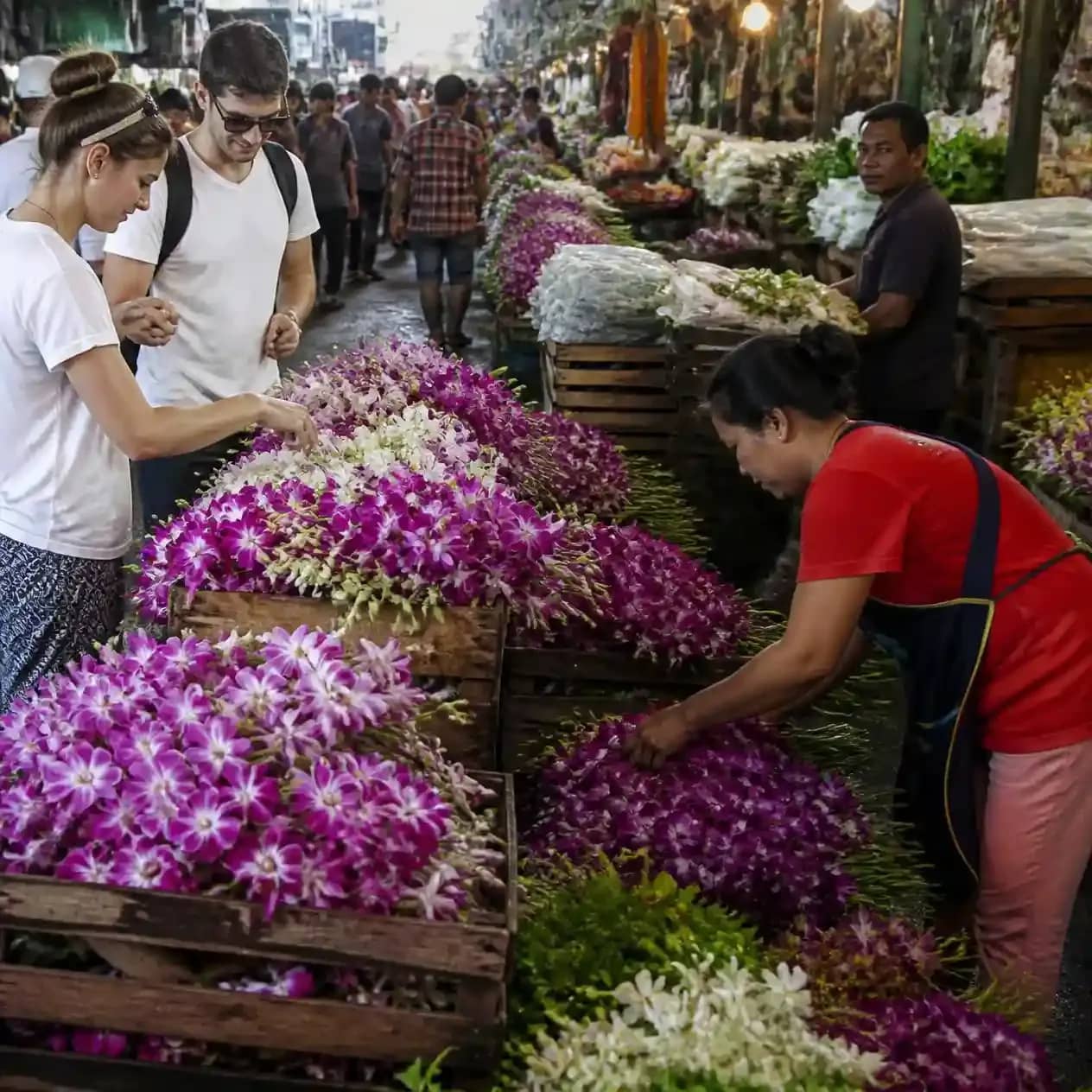
This is the market at full working pace. Trucks back up onto Chak Phet Road and unload flowers grown in Chiang Mai, Nakhon Pathom and Udon Thani; porters move stacked crates on trolleys through aisles barely wide enough for them; buyers from hotels and florists inspect and haggle in fast Thai. Colour is everywhere and so is movement. It is loud, wet underfoot and completely unstaged.
Early morning: 6am to 9am
The wholesale rush eases and the craft begins. Vendors sit cross-legged threading jasmine and marigold into garlands, folding banana leaf into offering cones, trimming lotus buds for temple stalls. Cafés along the surrounding lanes and at Yodpiman River Walk open for breakfast. For most travellers this is the best balance of activity and comfort.
Midday to late afternoon
The quietest stretch. Many stalls are restocking or shuttered, the heat sits heavily under the covered sections, and the aisles feel more like a warehouse than a market. Worth a pass only if it is the sole window you have.
Evening and night: 7pm onwards
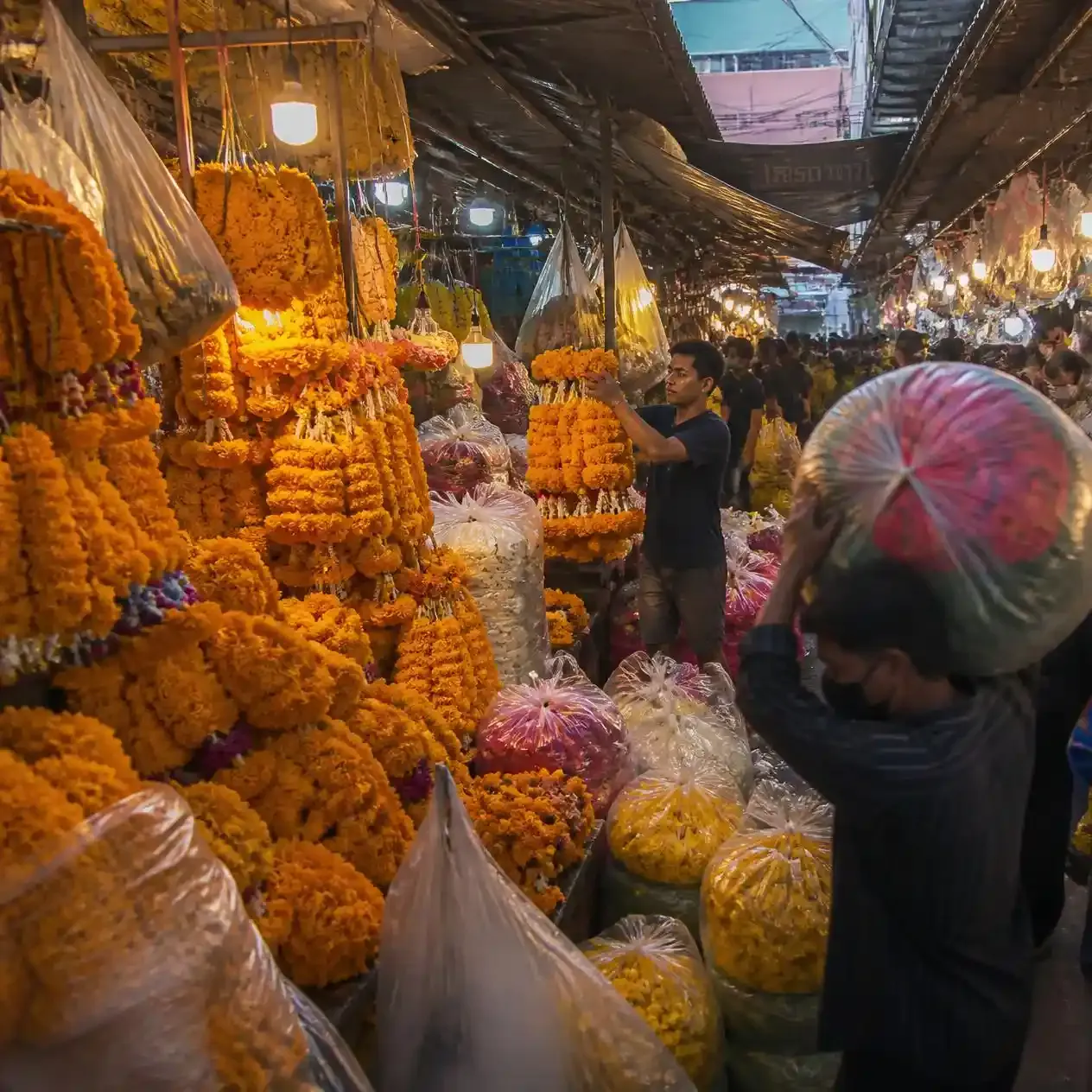
Trade picks up again as city florists restock for the next day. Strip lighting over the flower stacks makes for some of the strongest photography in Bangkok, and this is when almost every tuk-tuk tour passes through. Cooler, easier to walk and lively without the pre-dawn crush.
Reality check: ignore the opening hours you see online
- Google Maps commonly lists the market as 9am to 5pm. Those hours belong to one indoor section, not to the market as a whole.
- The street trading and the wholesale halls do not close — vendors rotate in shifts across the 24-hour cycle.
- Tour operators schedule around this: night routes arrive between 8pm and 10pm, private early-morning walks start at 5am or 6am.
Guided tour or arriving on your own: the four ways to visit
There are four practical formats for visiting the Pak Khlong Talat flower market, and they differ far more in how long you spend inside than in price. The shared night tuk-tuk routes are the cheapest and by far the most common, but they give you the shortest visit. Private and photography-led formats cost more and hand you an hour or more inside the aisles.
What a guide actually adds here
Language, first. The vendors are traders, not hosts, and almost none of the signage is in English. A guide can ask what a particular arrangement is for, which flowers go to which temple, and whether the cone of folded leaves on the counter is a baisri for a wedding or a blessing. Second, access — a guide can ask permission before you photograph someone's stall, which changes how the morning goes. Travjoy's Bangkok tour options are researched and approved by local experts, so the guiding standard is consistent rather than a lottery.
The formats compared
| Format | Time at the market | Price (2026) | Best for |
|---|---|---|---|
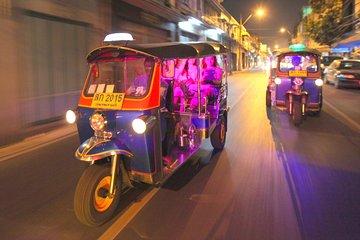
| Shared night tuk-tuk route (3–4 hrs), also taking in Wat Arun and Chinatown | 15–25 minutes | THB 1,800–2,800 pp (USD 55–85) | First evening in the city; sightseeing breadth |
| Private evening city tour with transfers | 40–60 minutes | THB 5,000–9,000 per group (USD 150–275) | Couples and families wanting a fixed, comfortable plan |
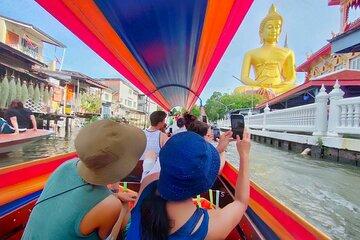
| River and canal route by longtail, arriving at Yodpiman pier — see Chao Phraya boat tours | 30–45 minutes | THB 1,500–3,000 pp (USD 45–90) | Repeat visitors who want the waterway approach |
| Private early-morning or photography-led walk | 90 minutes to 3 hours | THB 3,000–6,000 per group (USD 90–180) | Photographers and anyone here for the market itself |
| Independent visit via MRT Sanam Chai | As long as you like | THB 20–45 metro fare (USD 0.60–1.40) | Anyone staying in the Old City or Chinatown |
Reality check: the market is a stop, not a destination, on most tours
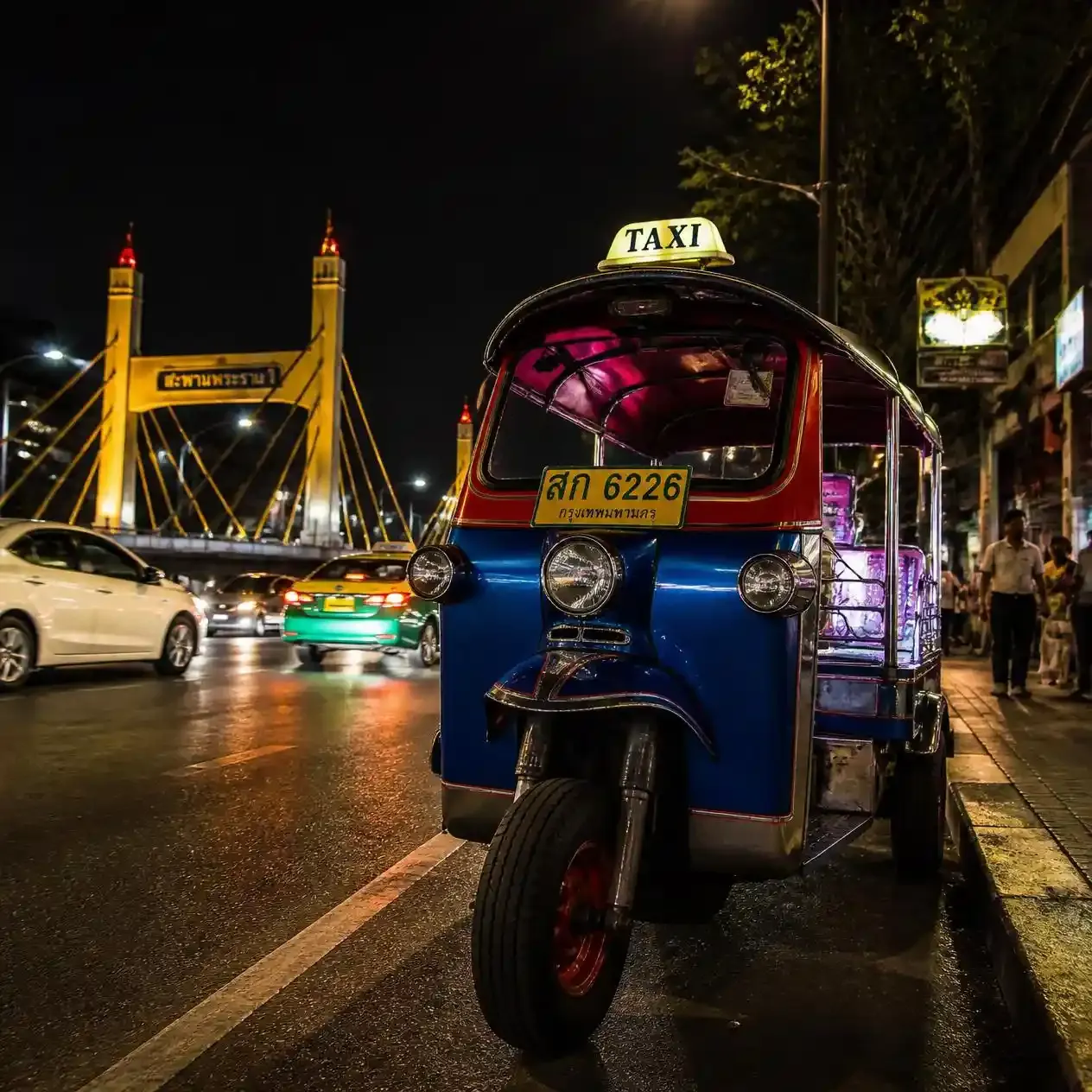
- Standard night tuk-tuk itineraries allow 15–25 minutes here, usually as a photo stop between a lit temple and Yaowarat.
- If the flower market is your reason for booking, check the itinerary for a stated dwell time before you commit.
- Private and photography formats are the only ones that reliably give you an hour or more.





What Pak Khlong Talat flower market tours cost in 2026
Expect to pay between THB 1,800 and THB 9,000 for a guided visit in 2026, with the spread driven by whether you are sharing a tuk-tuk or hiring one, and how many other stops the itinerary carries. Nothing in that figure is admission — every baht goes on transport, guiding and inclusions. Prices below are indicative ranges for the 2026 season and shift with group size and hotel pickup zone.
Price by format
- Shared night tuk-tuk tour, 3–4 hours: THB 1,800–2,800 per person (USD 55–85). Usually four to six stops, two passengers per tuk-tuk, groups capped around 10–12.
- Private evening tuk-tuk or vehicle tour, 3–4 hours: THB 5,000–9,000 per group (USD 150–275), typically for up to four or five people.
- Private half-day Old City tour with guide and vehicle, 4–5 hours: THB 4,500–8,000 per group (USD 135–245).
- River and canal route with market stop, 2–3 hours: THB 1,500–3,000 per person (USD 45–90).
- Private early-morning or photography walk, 2–3 hours: THB 3,000–6,000 per group (USD 90–180).
- Independent: MRT fare THB 20–45 (USD 0.60–1.40); metered taxi from Sukhumvit THB 120–200 (USD 4–6) outside peak traffic.
What is included, and what is not
- Usually included: hotel pickup within central zones, English-speaking guide, tuk-tuk or vehicle, bottled water, and on food-led routes several tastings.
- Usually extra: temple entry where the itinerary includes a daytime temple, meals on sightseeing-only routes, anything you buy at the market, and tips.
- Worth confirming before booking: pickup zone limits — hotels beyond Sukhumvit, Silom and the riverside often attract a surcharge or a meeting-point arrangement.
Reality check: the Monday substitution
- Much of Yaowarat's street-food trade closes on Mondays, and several night tuk-tuk operators swap Chinatown for a longer flower market stop that day.
- If you want the market rather than Chinatown, a Monday departure can quietly give you more time in the aisles.
- If you specifically want Yaowarat, avoid Monday and check the operator's substitution policy.
Which option should you choose?
Choose by how much time you want inside the market and how much else you are trying to see in the same evening. The decision is rarely about money — the price gap between formats is small relative to what each one gives you.
- If this is your first evening in Bangkok and you want your bearings, take the shared night tuk-tuk route. You will see the market briefly alongside Wat Arun, the Grand Palace lit from outside and Chinatown, which is good value in orientation terms.
- If you have been to Bangkok before and already know those sights, skip the circuit entirely and book a private early-morning walk. Arriving at 5.30am to watch the trucks unload is a completely different city from the one you saw on your first trip.
- If you are a couple wanting a settled evening rather than a convoy, take the private tuk-tuk. You set the pace, you stay where you want to stay, and the drive between stops becomes part of it.
- If you are photographing seriously, book the photography-led format and go before dawn. Nothing else buys you the light, the working atmosphere and a guide who can secure permission at a stall.
- If you are travelling with children or older parents, take a private vehicle tour in the early evening rather than a pre-dawn visit. The aisles are narrow, the floors are wet and the 4am crush is not the version to introduce them to.
- If you have a single free morning and are staying anywhere near Rattanakosin Island, go independently at 7am, then walk 10 minutes to Wat Pho. It is the most efficient pairing in the Old City.
Getting there, what to buy, and how to read the market
The Pak Khlong Talat flower market sits on Chak Phet Road in Phra Nakhon, at the mouth of Khlong Ong Ang and one block back from the Chao Phraya — roughly a kilometre south of the Grand Palace. Since the MRT Blue Line extension opened, it is one of the easiest places in the Old City to reach without a car.
Getting there
- MRT: Sanam Chai station, Exit 4 or 5, then about 400 metres on foot — five minutes. The fastest option from Silom or Sukhumvit.
- River boat: Yodpiman pier (N6/1) is a three-minute walk; Rajinee pier about four minutes; Memorial Bridge pier roughly ten.
- By car or taxi: Chak Phet Road congests badly around delivery hours. Park at the Yodpiman River Walk garage and walk in rather than trying to reach the aisles by vehicle.
- On foot: ten minutes from Wat Pho, fifteen from the Grand Palace, and about the same from the Khlong Ong Ang walking street.
What is actually on sale
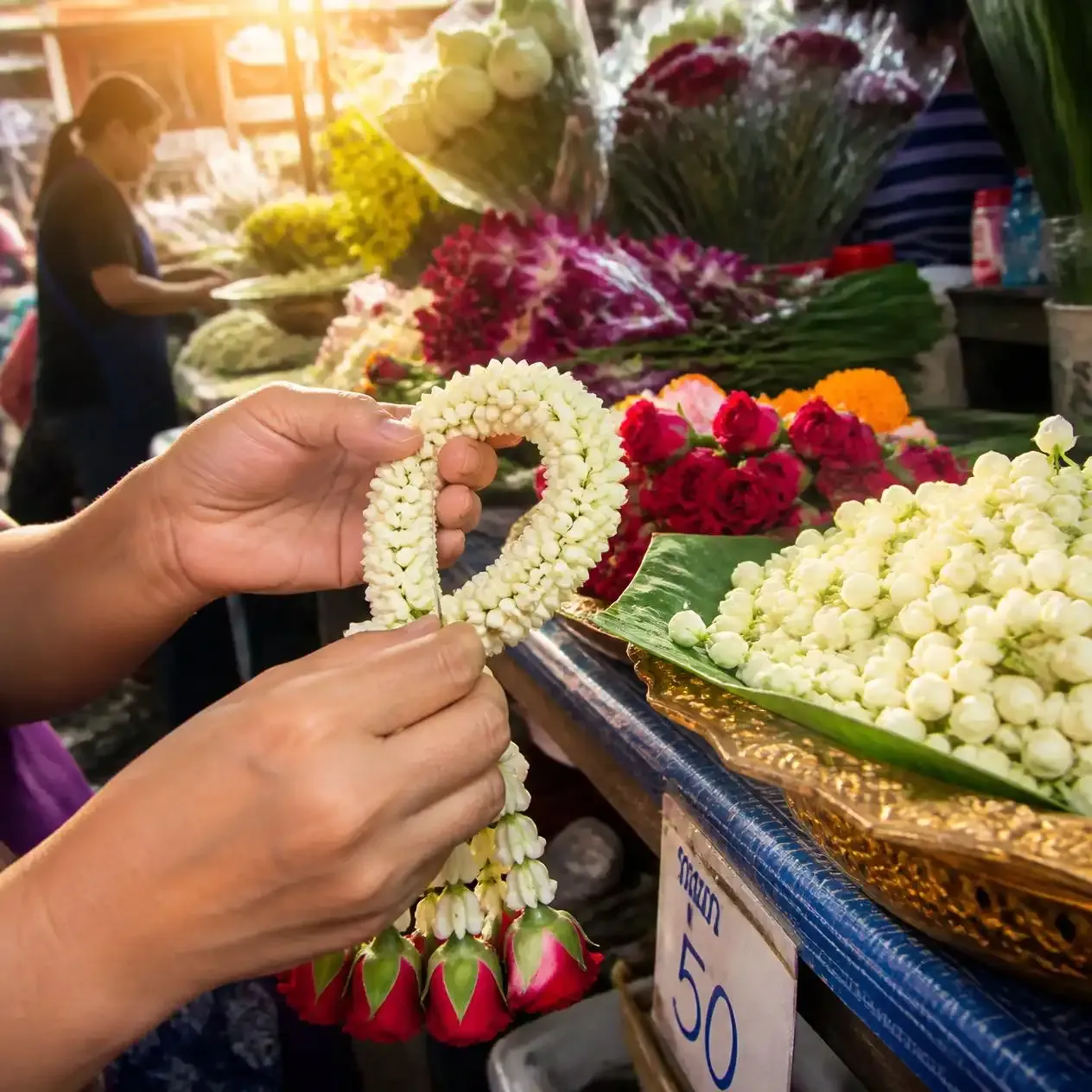
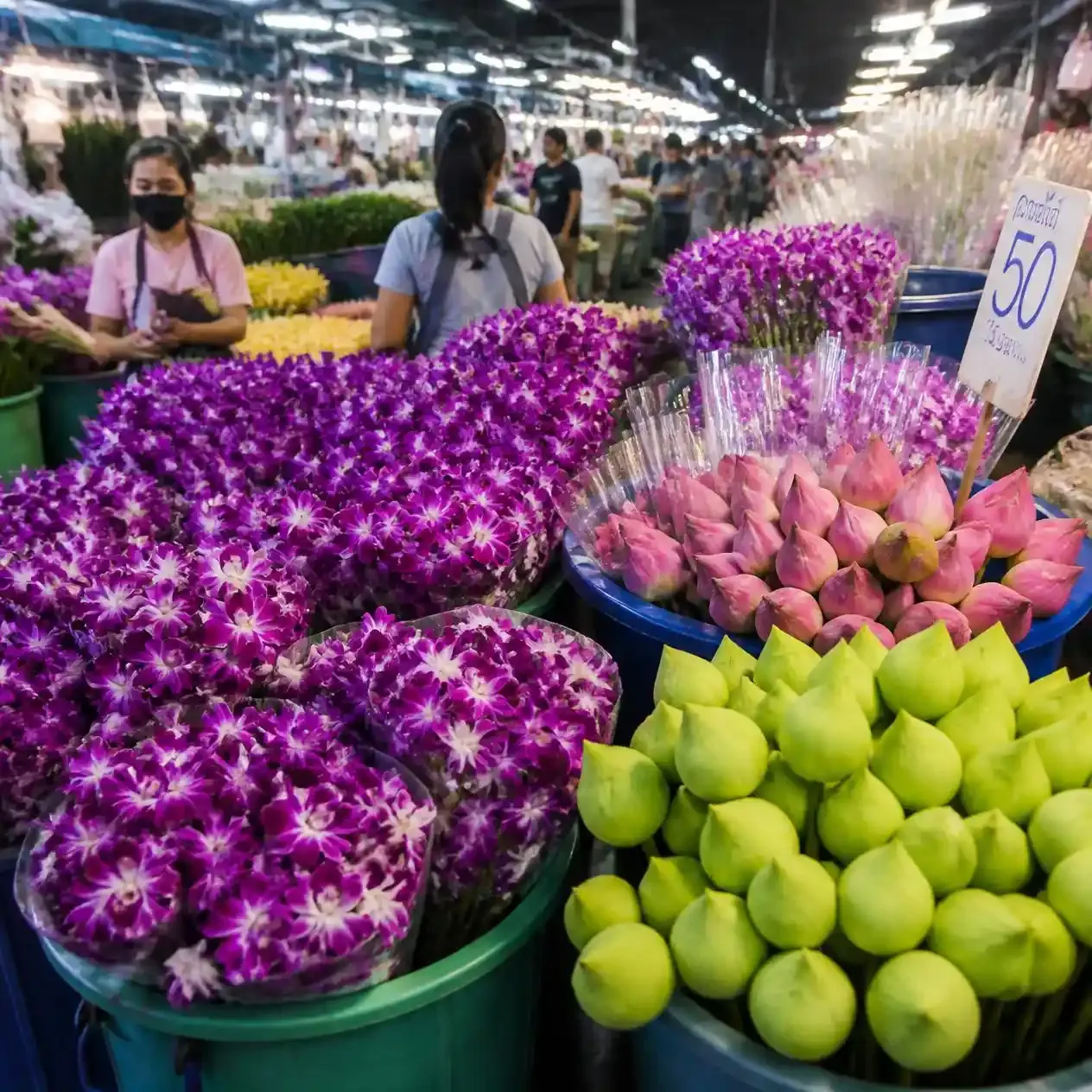
Flowers dominate — orchids, roses, lotus buds, marigolds, jasmine, chrysanthemums, gerbera — but the trade around them is the more interesting half. Stalls sell finished phuang malai, the strung garlands of jasmine and marigold used as temple offerings, hung on Buddha images and shrines, and dangled from taxi mirrors. Others make baisri, cones of rolled banana and pandan leaf built up with chrysanthemum buds, shaped to represent Mount Meru. You will also find incense, candles, offering trays, and, in the surrounding lanes, fruit and vegetable wholesalers who were here long before the flowers arrived.
Reality check: prices are per bundle, not per stem
- This is a wholesale floor. Roses, marigolds and chrysanthemums are typically priced in bundles of around 50 stems — expect roughly THB 100–250 (USD 3–8) a bundle depending on season and quality.
- A finished jasmine phuang malai runs about THB 20–50 (USD 0.60–1.50); a lotus bud for temple offering, THB 10–20.
- Retail-sized single stems are the exception here, not the rule. If you want one arrangement rather than fifty, ask for a garland or a made-up offering rather than loose flowers.
Moving through the market well
Treat it as a workplace, because it is one. Keep to the edges of the aisles when trolleys come through, and step aside for porters rather than expecting them to go around you. Ask before photographing a vendor or their stall — a gesture at the camera is usually enough, and it is almost always answered warmly. Buying something small before you shoot at length is good manners rather than obligation.
Flowers here carry religious weight rather than decorative meaning. Garlands destined for shrines and Buddha images are handled with care and should be too. Cover your shoulders and knees if you are pairing the market with a temple visit the same morning — Wat Pho and the Grand Palace enforce dress codes at the gate, and there is nowhere convenient nearby to change.
Reality check: the busiest night of the year is 25 November 2026
- Loy Krathong falls on 25 November in 2026, and demand for banana leaf, marigold and lotus sends the market into its heaviest trading of the calendar.
- Krathong sellers set up along Khlong Ong Ang and the riverbanks, typically THB 30–100 each.
- Book any guided visit for that night several weeks out — Old City evening tours fill earlier than almost anything else in the Bangkok calendar.
Planning your visit
Three things to carry away. There is no ticket to buy for the Pak Khlong Talat flower market — the money goes on transport, guiding and time, so decide how long you actually want in the aisles before you book anything. The hour matters more than the format: 2am to 8am is the working market, evening is the photogenic one, and midday is neither. And if you have seen the Old City before, the pre-dawn visit is the version worth returning for.
Pair it with a temple morning at Wat Pho, a river approach by longtail, or an evening that runs on into Chinatown. Start planning your Bangkok trip on Travjoy's Bangkok destination page, or see what else makes the cut in our top 20 experiences in Bangkok.



.svg&w=1920&q=75)