


Wat Pho Bangkok: A Complete Guide to the Temple of the Reclining Buddha — Tickets, Timing and What to See
9 min read
Key Highlights
- Entry in 2026 is THB 300 (USD 8.50) per person, cash only at the booth, with children under 120cm admitted free — guides still printing 100 or 200 baht are out of date.
- The grounds open 08:00–19:30, but the Reclining Buddha hall and the inner buildings shut earlier, so a 6pm arrival can mean seeing the courtyards and nothing else.
- The temple sells tickets through its own booking site a minimum of 24 hours ahead, which is the way past the cash-only queue at the gate.
- The massage pavilion inside the grounds and the school on Maharat Road are two separate venues; official rates run THB 340–1,040 depending on treatment and length.
- Sanam Chai MRT Exit 1 delivers you to the quieter Chetuphon Road gate, while the pier at Tha Tien funnels arrivals into the busier northwest entrance.
Wat Pho Bangkok is the Temple of the Reclining Buddha, open daily from 08:00 to 19:30, with a 2026 entrance fee of THB 300 (USD 8.50) for foreign visitors. Most people spend forty-five minutes on the 46-metre gilded Buddha and leave, but the 80,000-square-metre complex — four royal chedis, more than a thousand Buddha images, UNESCO-listed stone inscriptions and Thailand's original massage school — repays closer to two hours.
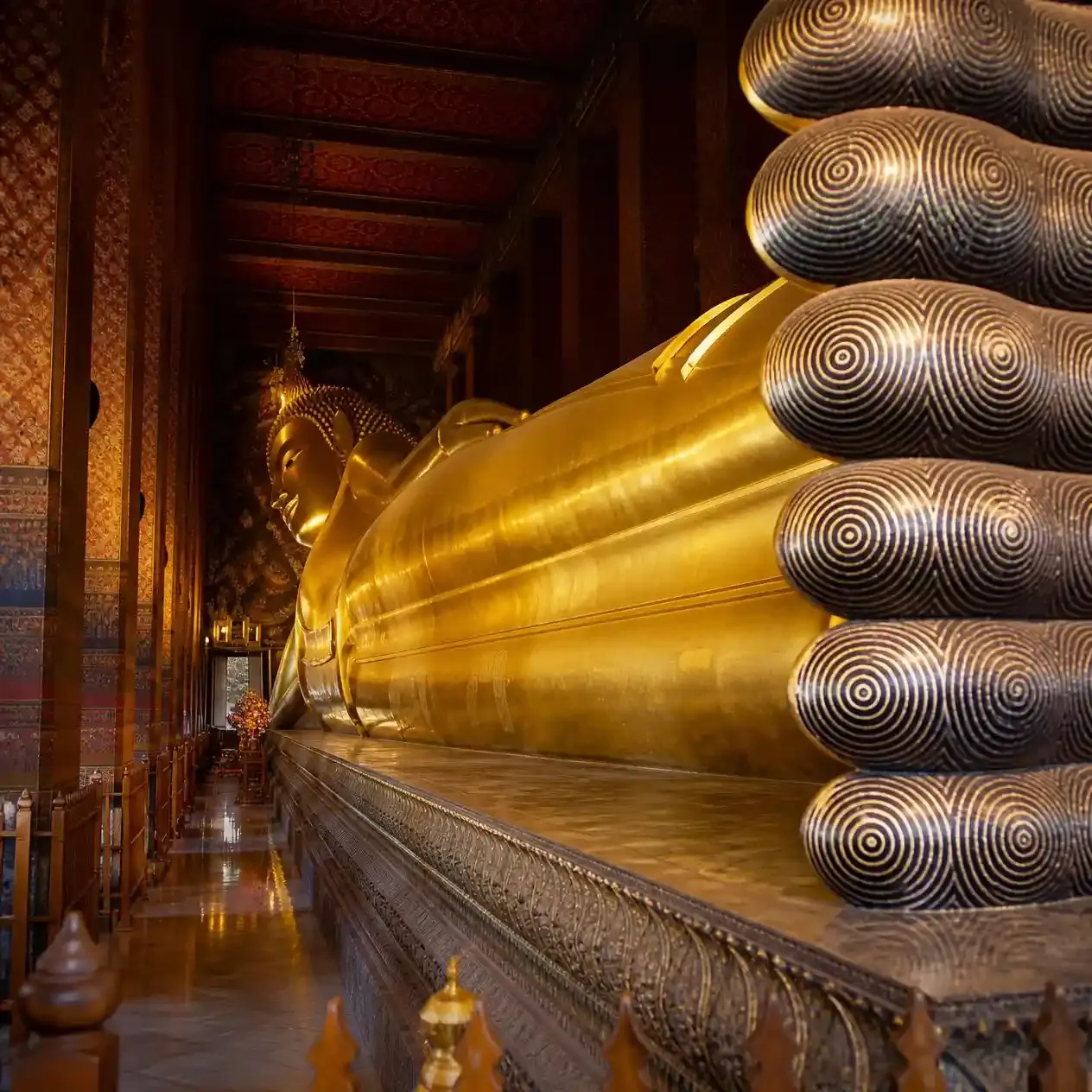
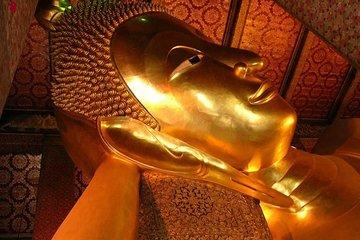
The strangest thing about the Reclining Buddha is that you never see it whole. The hall was built around the figure with barely a metre to spare, so you take it in sections — the head first, then the shoulder, then a long gold flank, and finally the soles of the feet, five metres of mother-of-pearl inlay set into black lacquer.
That compression is the point. It also explains why so many visitors are back on the street in half an hour, convinced they have seen the temple. They have seen one building of roughly a dozen worth entering, in a walled complex that predates Bangkok itself and was, for a period in the nineteenth century, the closest thing Thailand had to a public university.
This guide covers what a visit to Wat Pho Bangkok actually costs in 2026, when the halls close as opposed to when the gates do, which of the two entrances to use, what to look for once you are past the Buddha, and how the massage school works — including which of its two addresses you want.
Is Wat Pho Bangkok Worth Your Morning?
Yes — and unusually among Bangkok's headline sights, it is worth a second visit. Wat Pho Bangkok is the rare temple where the famous object is the least interesting thing on the grounds. The Reclining Buddha takes twenty minutes; the cloisters, the chedi field, the inscribed tablets and the garden of contorted hermit statues are what make the ticket good value, and they are precisely what a first-time run-through misses.
Worth it if…
- You want depth rather than a photograph — the temple rewards slow, unhurried movement between buildings more than any other site in the Old City.
- You have been to Bangkok before and want the layer under the postcard: the epigraphic archives, the Ramakian reliefs, the Ayutthaya-era Buddha images rescued from the sacked capital.
- Heat and stairs are a consideration. The grounds are flat, generously shaded, and there is nothing here to climb.
- You want a traditional Thai massage at the institution that codified the practice, rather than at a spa that borrowed the name.
Not ideal if…
- You have a single half-day in Bangkok and the Grand Palace is already on it. Two royal complexes back to back is a lot of gold leaf, and the second one tends to blur.
- You are arriving after 17:30 — you will get the grounds at their most atmospheric and the main halls closed.
- You want quiet contemplation without company. The temple takes 10,000 to 15,000 visitors on a busy day, and the Buddha hall in particular is shoulder to shoulder from mid-morning.
Reality check: the temple is smaller on a map than in person
- Chetuphon Road cuts the complex in two. The northern half holds everything on the ticket; the southern half is the working monastery and the monks' quarters, and is not a visitor area.
- Allow 90 minutes minimum. An hour covers the Buddha and the ordination hall and nothing else.
- There is no loop route — the layout is a series of walled courtyards, and the way back out is not the way you came in.
Wat Pho Bangkok Entrance Fee, Opening Hours and Tickets in 2026
Entry is THB 300 (USD 8.50) per person for foreign visitors as of 2026, and the ticket booth takes cash only. This is the single most misreported detail about the temple: three different prices are circulating on page one of most search results, because the fee has risen twice in recent years and a great deal of published advice has not caught up.
What the ticket costs and what it covers
- Entry: THB 300 / USD 8.50 per person, 2026 rate
- Children: free under 120cm in height
- Included: all visitor areas of the northern complex, including the Reclining Buddha hall and the ordination hall, plus a bottle of water
- Not included: massage treatments, the 108-coin bowl offering (a further THB 20), and any guide you engage at the gate
- Payment: cash only at the booth — there is no card lane
Opening hours and the closing-time trap
The grounds are open 08:00 to 19:30 daily, but that figure describes the gates, not the buildings. The Reclining Buddha hall and the other interior halls begin closing in the early evening, and staff start clearing them before the gates shut. If the Buddha is the reason you came, treat 17:30 as your practical latest arrival.
- Grounds: 08:00–19:30 daily
- Interior halls: close earlier in the evening — do not plan around the 19:30 figure
- Quietest windows: 08:00–09:30, before the first coaches, and after 16:00 once the group tours have moved on
- Busiest: 10:00–14:00, when Grand Palace visitors arrive en masse having finished there
Buying tickets: the gate or the temple's own site
You can buy at the gate, or through the temple's official booking site at least 24 hours in advance and arrive with a voucher to scan. The online route is the better one if you are visiting in the hot months or during a holiday period, when the cash queue at the northwest booth can absorb twenty minutes you would rather spend inside. It also removes the need to have exact baht on you.
Reality check: the "temple is closed today" line
- Wat Pho keeps its gates open every day of the year. A driver who tells you it is shut for a ceremony, a holiday or a Buddhist observance is steering you towards a gem shop or a tailor.
- The same applies to anyone offering to take you to a "government tourist office" first.
- Book transport through your hotel or a ride-hailing app rather than the tuk-tuks idling at the exit, which is where the sharpest pricing happens.
What to See at Wat Pho Bangkok Beyond the Reclining Buddha
The rest of Wat Pho Bangkok holds over a thousand Buddha images, ninety-one chedis, four royal stupas and the largest surviving collection of inscribed stone teaching tablets anywhere. Give yourself an hour after the Buddha hall and work anticlockwise from it; the four things below are what reward the extra time, and they are where a return visitor should start.
The Reclining Buddha and the 108 bowls
Forty-six metres long and fifteen high, built of brick and plaster over a gold-leafed surface, the figure depicts the Buddha entering final nirvana. Walk up the right-hand side for the head, then continue round the back to the feet, where 108 panels of mother-of-pearl set out the auspicious marks by which a Buddha is identified. Along the rear wall stand 108 bronze alms bowls; a small bag of coins costs THB 20, and the sound of the whole hall dropping them in sequence is the closest thing the temple has to music.
Phra Ubosot and the cloisters
The ordination hall is the most sacred building on the grounds and the one most people walk past. Inside sits Phra Buddha Theva Patimakorn on a tiered gilded altar; outside, a double cloister rings the courtyard, lined with several hundred bronze Buddha images brought down from the ruins of Ayutthaya and Sukhothai after those capitals fell. Around the base of the hall, marble panels carry scenes from the Ramakian, the Thai telling of the Ramayana.
The four royal chedis
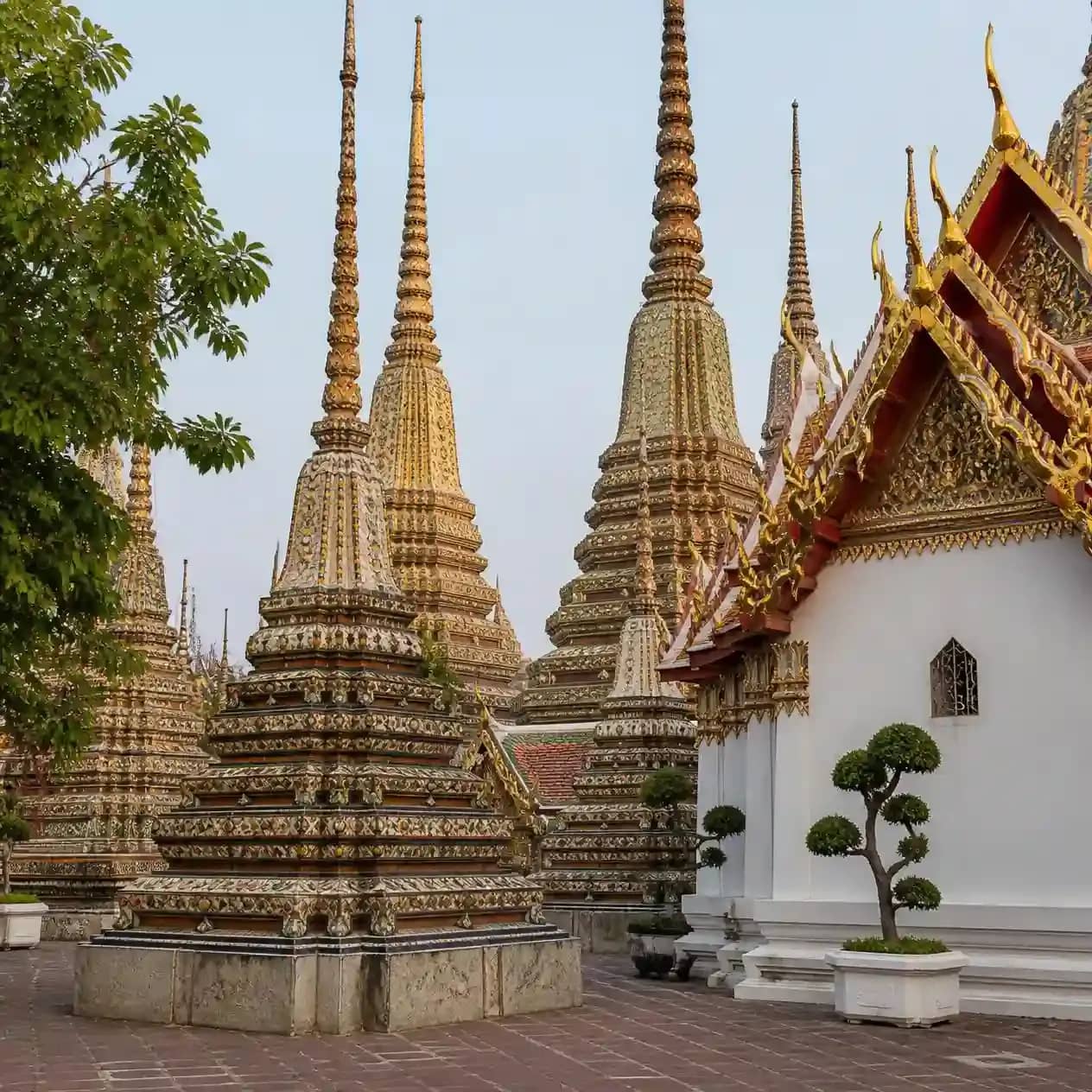
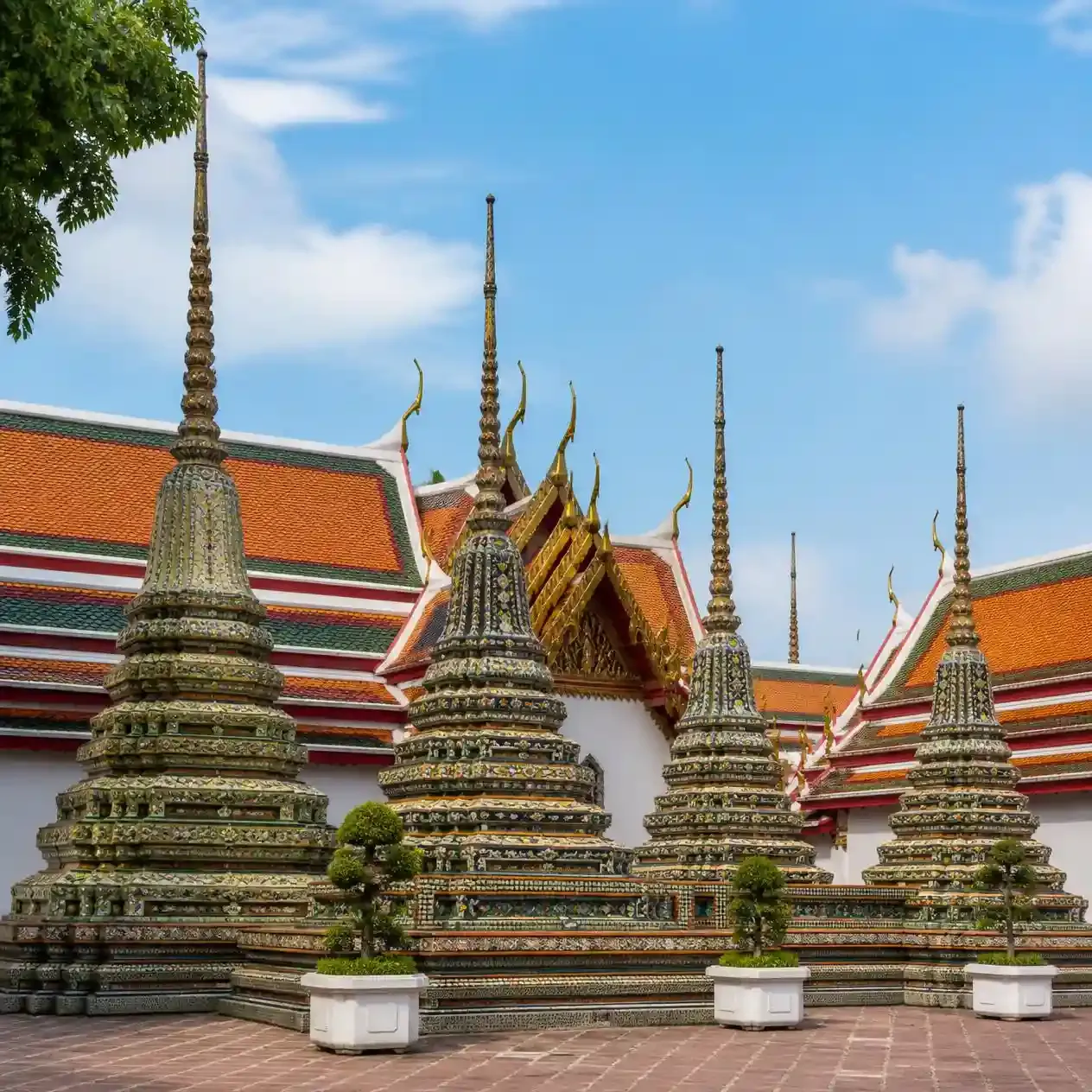
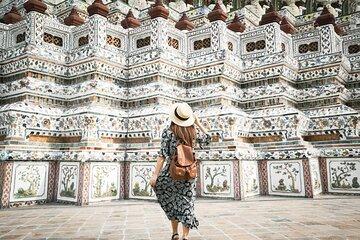
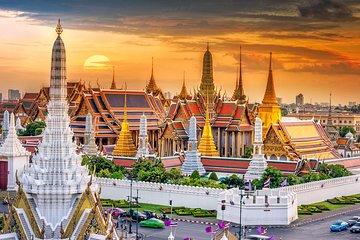
South-west of the ordination hall, four stupas of about forty-two metres each stand for the first four kings of the Chakri dynasty, tiled in green, white, yellow and blue. The Rama I chedi encases a sixteen-metre standing Buddha carried from Ayutthaya. The square-shouldered bell shape is Rattanakosin style at its most confident, and the courtyard around them is usually far emptier than the one you have just left.
The epigraphic archives and the hermit statues
This is the part almost no guide covers properly. In the 1830s, King Rama III had 1,431 stone tablets cut and mounted across the temple's buildings, recording medicine, astrology, literature, history and massage theory — an attempt to fix in stone the knowledge that was then held only in oral tradition. UNESCO added the collection to its Memory of the World register in 2011. Scattered through the gardens you will also find the Ruesi Dat Ton figures: small statues of hermits twisted into self-stretching postures, which are the source material for what the world now calls Thai yoga.
Reality check: what to do about a guide
- Nothing at Wat Pho is captioned in a way that makes the inscriptions or the reliefs legible to a visitor. Without a guide, the tablets read as decorative stonework.
- Freelance guides wait near both gates and will quote roughly THB 300–800 for 45–60 minutes. Agree the figure and the duration before you start walking.
- If you want the version that comes with context rather than a headcount, the guided temple tours on Travjoy are researched and approved by local experts, which spares you the gate negotiation entirely.




The Wat Pho Massage School: Which One, What It Costs, When to Go
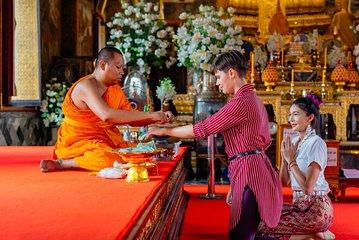
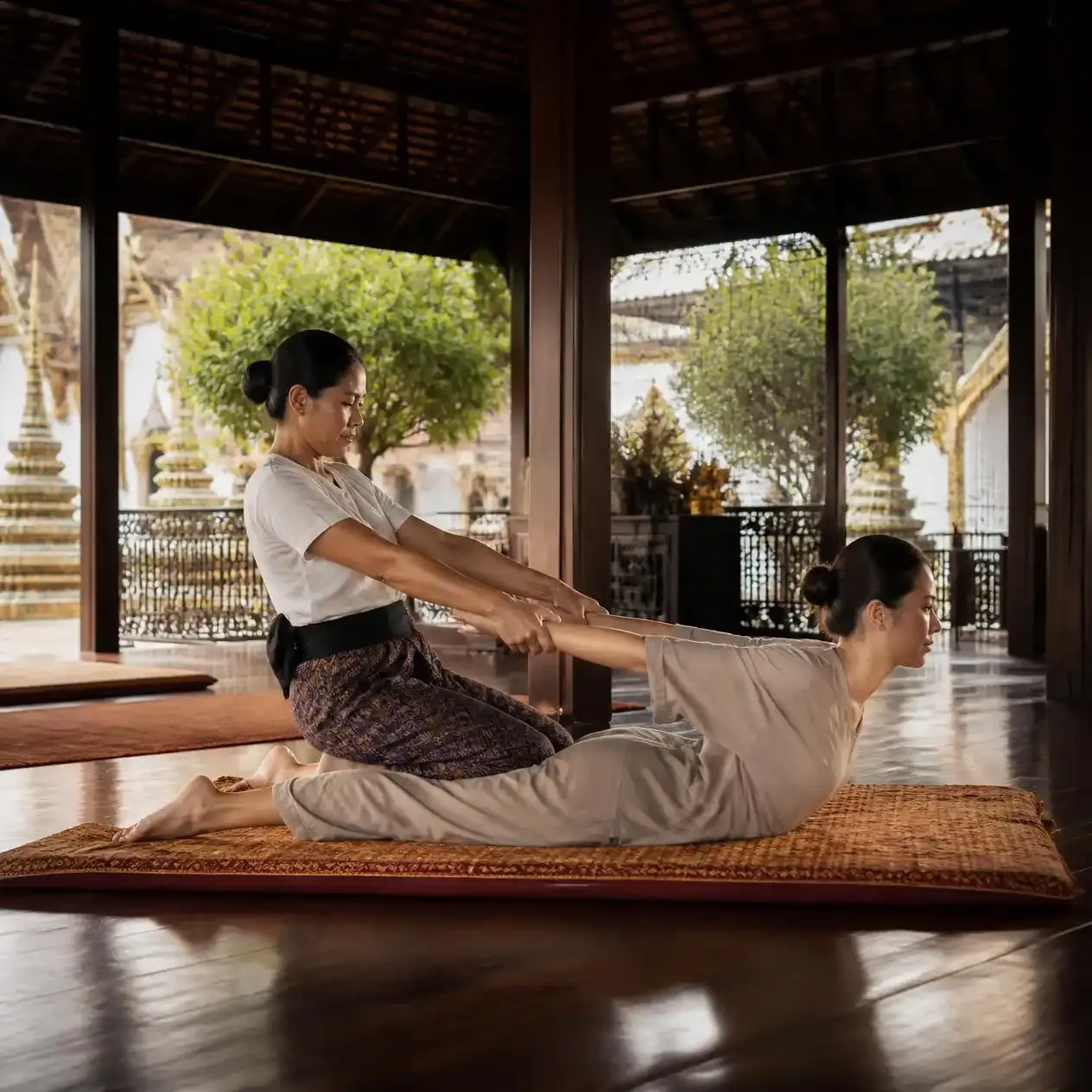
The massage school inside Wat Pho Bangkok is the reason a large share of visitors come, and it is also the source of the most common mix-up at the temple: there are two venues trading under the same name, a few minutes apart, and they are not interchangeable. The one on the temple grounds is a pavilion at the rear of the eastern compound. The other is the school proper, at 392 Maharat Road, just outside the walls.
Two addresses, one institution
The Wat Pho Thai Traditional Medical and Massage School opened in 1955 as the first massage school licensed by Thailand's Ministry of Education, continuing a teaching line that runs back to the 1830s tablets still mounted around the temple. The pavilion inside the grounds handles walk-in treatments and is where the queue forms. The Maharat Road building is the teaching campus, takes longer bookings, and is generally the calmer room of the two.
- Inside the grounds: short treatments, no appointment, longest waits between 11:00 and 15:00
- Maharat Road branch: a few minutes' walk from the temple's western side, quieter, better for a full hour or longer
- Either way: you are paying for therapeutic technique, not spa ambience — the rooms are plain and the pressure is firm
What a treatment costs
The school publishes a fixed price list, which is worth knowing because the ranges quoted around the internet are consistently vague. Rates below are the 2026 published figures.
- Thai massage: THB 340 / 520 / 1,040 (USD 9.70 / 14.85 / 29.70) for 30 / 60 / 120 minutes
- Foot massage: THB 340 / 520 / 1,040 (USD 9.70 / 14.85 / 29.70) for 30 / 60 / 120 minutes
- Thai massage with herbal balm: THB 680 / 1,360 (USD 19.40 / 38.85) for 60 / 120 minutes
- Thai massage with plai oil: THB 620 / 1,240 (USD 17.70 / 35.40) for 60 / 120 minutes
- Note: treatments are separate from the THB 300 temple entry, and the massage counters keep shorter hours than the grounds
When to book it into your day
Put the massage at the end, not the beginning. An hour of firm, joint-by-joint Thai stretching does not set you up well for another two hours of walking on stone, and the queue is at its shortest late in the afternoon once the group tours have cleared. If you want something softer and more polished afterwards, the city's wider spa and wellness options sit at the other end of the spectrum entirely.
Reality check: this is a therapeutic massage, not a relaxing one
- Traditional Thai technique involves deep compression along pressure lines and assisted stretching. It can be uncomfortable, and reviews from people expecting an oil massage say so bluntly.
- Say "bao bao" (light) at the start if you want the pressure eased — therapists adjust without fuss when asked.
- Wear or bring loose clothing. You stay dressed throughout, and stiff trousers make the stretches awkward.
Getting to Wat Pho and Which Gate to Use
The nearest station to Wat Pho Bangkok is Sanam Chai on the MRT Blue Line, five to seven minutes' flat walk from the southern gate; there is no BTS station in the Old City. Arriving by river at Tha Tien pier puts you at the northwest gate instead. Which one you use changes your queue and the order in which you see the complex.
By MRT
- MRT Blue Line to Sanam Chai, Exit 1 — the station itself is worth thirty seconds of your attention, finished in Rattanakosin-period style
- Five to seven minutes north on foot to the Chetuphon Road gate
- Lifts at every Blue Line station, which makes this the easiest approach with luggage, a pushchair or limited mobility
By river
- BTS Silom Line to Saphan Taksin, Exit 2, then the Chao Phraya Express Boat from Sathorn Pier north to Tha Tien (N8)
- Roughly THB 16–20 (USD 0.45–0.60) on the orange-flag service; five minutes' walk from the pier through the amulet and dried-fish stalls
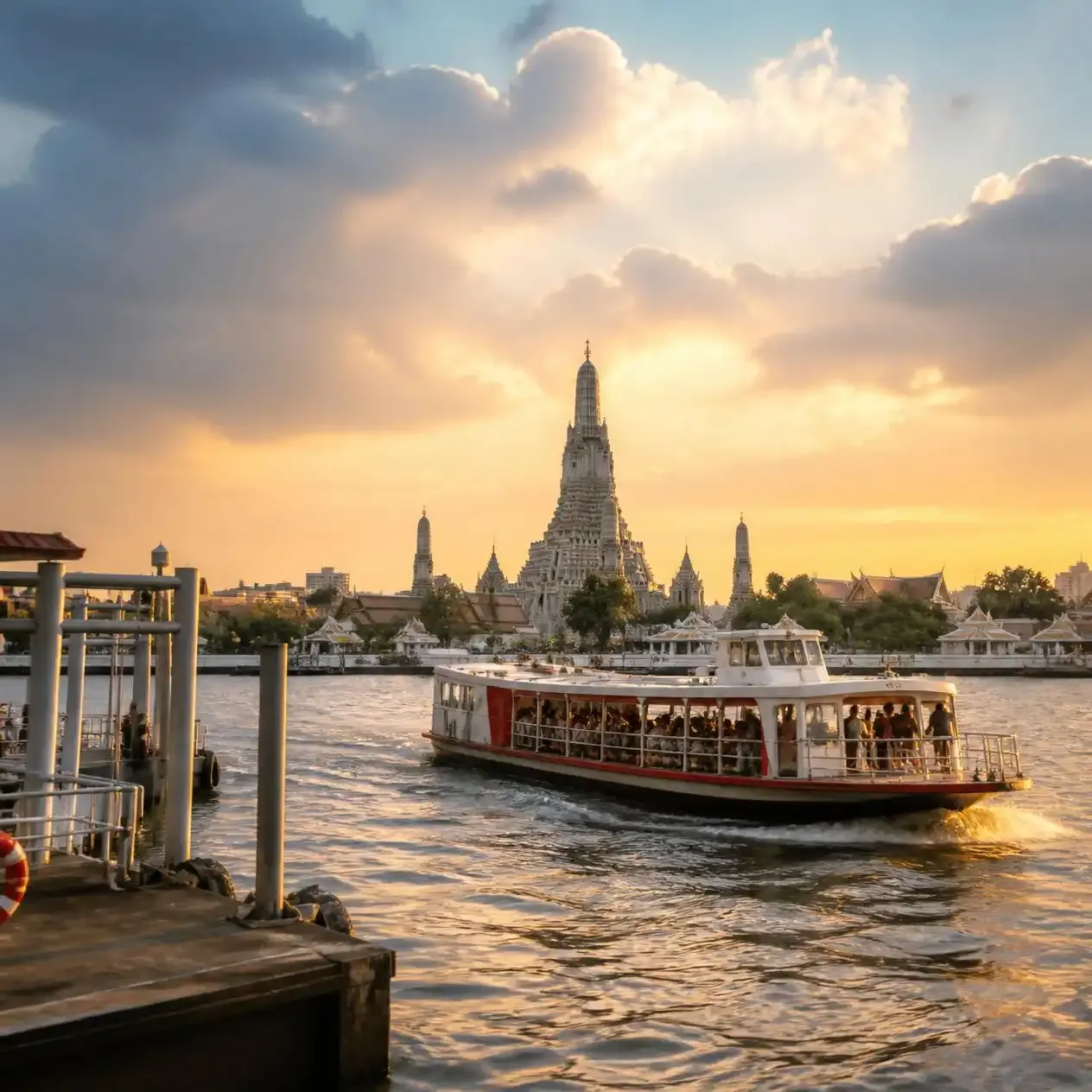
- The slower, better-looking arrival, and the one that sets you up for the ferry across to Wat Arun afterwards
Which gate
The northwest entrance closest to the Grand Palace absorbs both the coach traffic and the boat arrivals, and puts you into the Reclining Buddha hall almost immediately. The Chetuphon Road gate on the southern side rarely queues at all. If you arrive to find one entrance backed up, walking round to the other takes about five minutes and usually costs you less time than standing still.
What to combine it with
The temple sits between two other major sites, and the sequencing matters more than the distance. The Grand Palace is a ten-minute walk north and closes at 15:30, so it has to come first in any combined morning. Wat Arun is a three-minute ferry from Tha Tien, costs a few baht in coins, and looks its best in the last hour of light — so it goes last.
Reality check: do not stack all three in one day in April
- Grand Palace, Wat Pho and Wat Arun in a single push is roughly five hours of walking on unshaded stone. In the hot season it is a bad trade.
- Two sites per day is the pace that lets you actually look at anything. Wat Pho and Wat Arun pair better than Wat Pho and the Grand Palace, which cover similar ground.
- The dress code is enforced at all three: shoulders and knees covered, shoes off inside the halls. Sarongs are available at the gate, but arriving already dressed for it saves the interruption.
Which Wat Pho Bangkok Visit Should You Choose?
There are four sensible ways to do it, and they separate cleanly by how much context you want and how much of the Old City you are covering. Choose the walk-in if the temple is one stop in a loose day; choose a guided format if the inscriptions, the reliefs and the history are the reason you came, because none of it is self-explanatory on the ground.
| Option | Duration | Price range (2026) | Best for |
|---|---|---|---|
| Walk-in ticket at the gate | 1.5–2 hrs | THB 300 / USD 8.50 | Independent visitors with cash and a flexible morning |
| Temple-issued online ticket | 1.5–2 hrs | THB 300 / USD 8.50 | Hot-season and holiday visits, when the cash queue bites |
| Guided Wat Pho and Wat Arun walk | 3–4 hrs | THB 1,200–2,500 / USD 34–71 | Returning visitors who want the river crossing and the context |
| Private half-day with the Grand Palace | 4–5 hrs | THB 3,500–7,000 / USD 100–200 | First visits to the Old City, and anyone travelling with children |
Choose by what you want out of it
- If you have been to Bangkok before — go independently, late in the afternoon, and spend your time in the chedi courtyard and among the inscriptions rather than the Buddha hall.
- If this is your first Old City morning — take a guided format that starts at the Grand Palace, because the two complexes make far more sense explained together than seen in sequence.
- If you are travelling with older parents — arrive by MRT at Sanam Chai, use the southern gate, and finish with an hour at the massage pavilion. Nothing on this itinerary involves a stair.
- If the massage is the priority — book the Maharat Road branch for a full hour and treat the temple itself as the warm-up.
- If you have half a day and one temple in it — this is the better choice over the Grand Palace for anyone who prefers atmosphere and detail to scale and ceremony.
Planning Your Visit
Three things carry most of the weight when you are planning a visit to Wat Pho Bangkok. The entrance fee is THB 300 in 2026 and the booth takes cash, so do not arrive relying on the older figures still in circulation or on a card. The gates stay open until 19:30 but the halls do not, which makes anything after 17:30 a grounds-only visit. And the hour you spend past the Reclining Buddha — in the cloisters, among the four royal chedis, reading the tablets that made this Thailand's first public university — is the hour that separates a stop from a visit.
Start planning your time in the Old City on Travjoy's Bangkok pages, or see how the temple sits alongside the rest of the city in our top 20 experiences in Bangkok.


.svg&w=1920&q=75)