



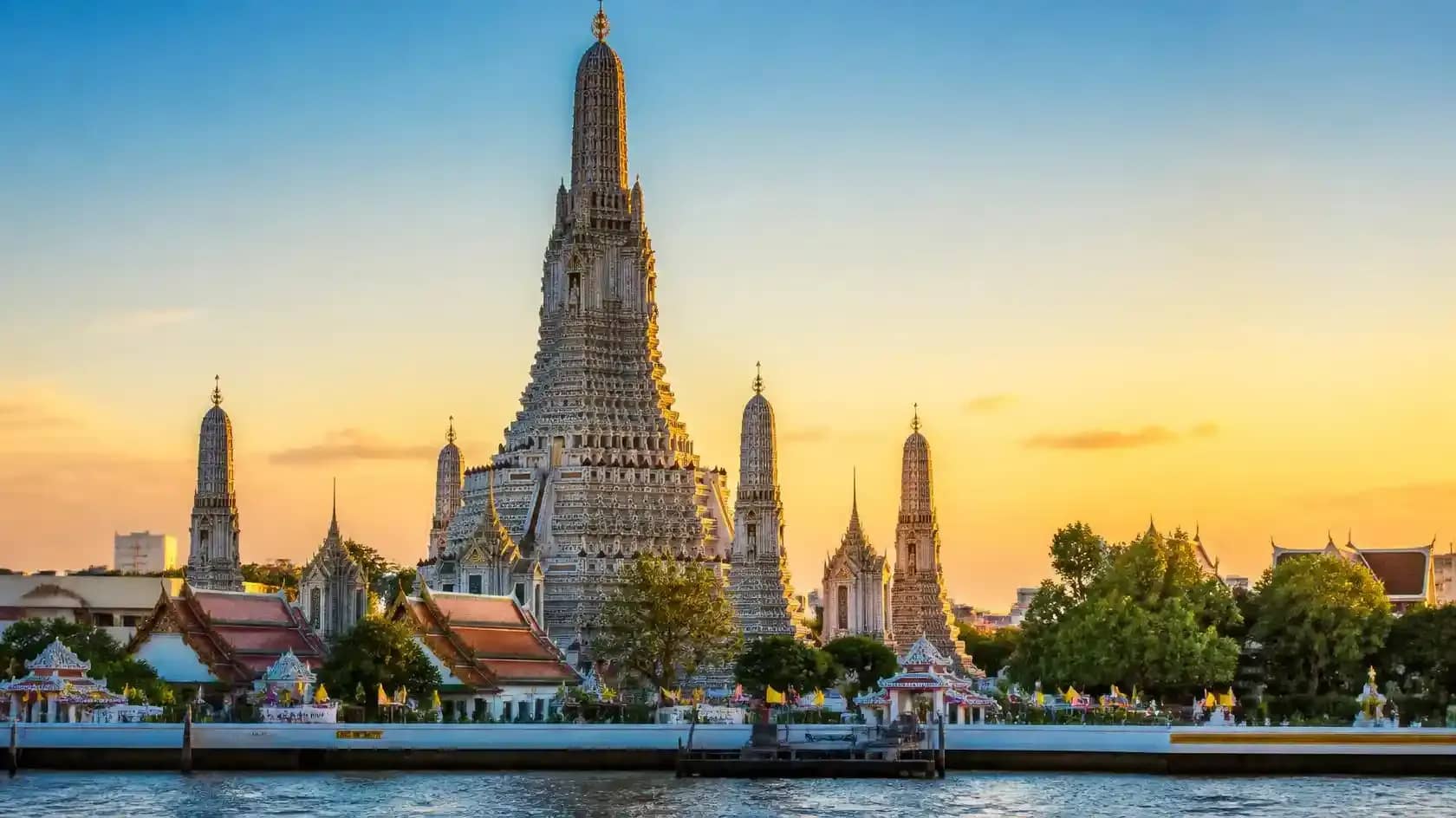
Wat Arun Bangkok: A Complete Guide to the Temple of Dawn for Discerning Travellers
9 min read
Key Highlights
- Wat Arun Bangkok sits on the Thonburi bank of the Chao Phraya, directly across the water from the Grand Palace and Wat Pho, reached by a three-minute cross-river ferry from Tha Tien pier.
- Entry in 2026 is quoted at between 100 and 200 THB (roughly USD 3–6), paid in cash at the gate — sources disagree, and the gate price is the one that counts.
- The central prang stands around 70–80 metres and is faced entirely in broken Chinese porcelain, much of it ballast salvaged from trading ships.
- The finest view of the temple is not from inside it — it is from the east bank at dusk, which makes the visit and the photograph two separate outings.
- Professional photo sessions on the grounds require a temple-certified photographer and carry a 1,000 THB maintenance fee; phone and personal cameras are exempt.
Wat Arun Bangkok — the Temple of Dawn — is open daily from around 08:00 to 18:00, with entry quoted between 100 and 200 THB (about USD 3–6) in cash at the gate in 2026. The central prang can be climbed to the terrace level for river views, though upper access has been restricted since the 2013–17 restoration and is worth confirming on arrival. Allow one to two hours inside, and plan the classic photograph separately, from the east bank at sunset.
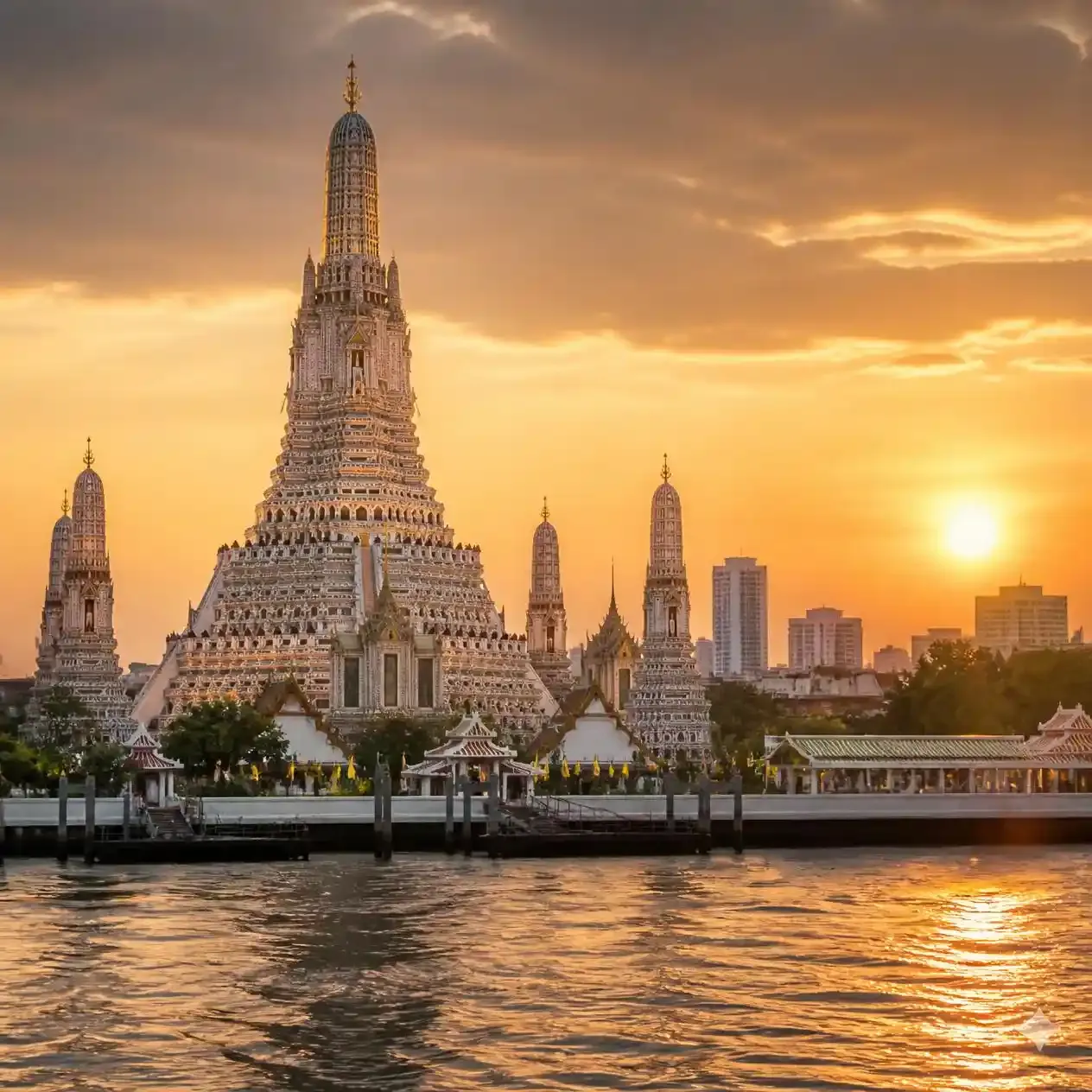
Most people arrive at Wat Arun Bangkok already knowing what it looks like. It is the spire on the poster, the silhouette on the tourism board's cover, the thing you have seen a hundred times before you ever stand in front of it. What almost nobody arrives knowing is that the postcard was taken from the other side of the river — and that standing at the base of the prang gives you a completely different building.
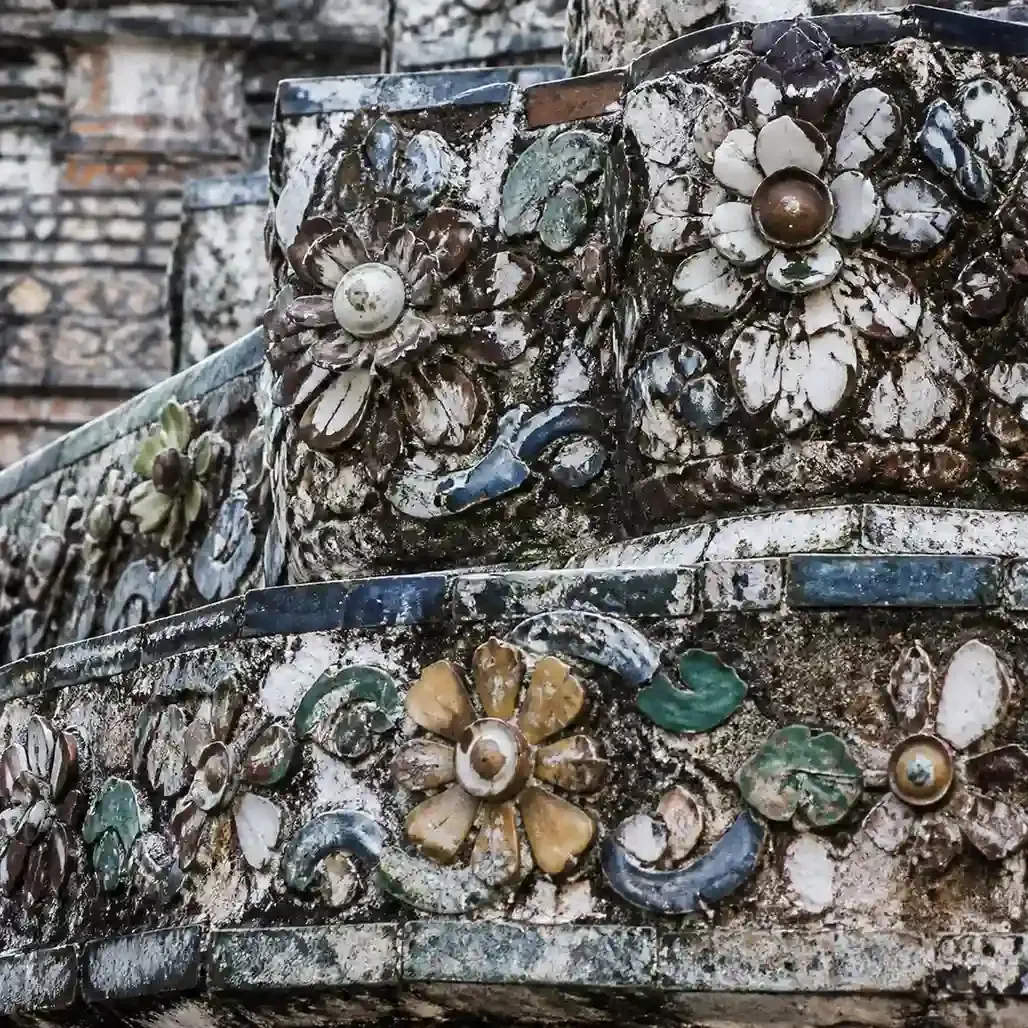
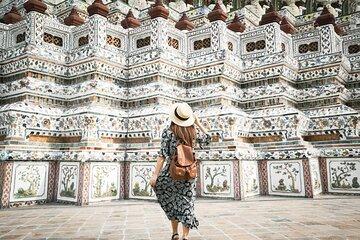
Up close, the porcelain stops being a shimmer and becomes what it actually is: tens of thousands of broken plates, bowls and tiles, pressed into plaster by hand, arranged into flowers and celestial figures across every surface of an 80-metre tower. It is a mosaic you can put your face to. That shift — from distant silhouette to close-up craft — is the whole reason to cross the river rather than simply photograph it from a terrace bar.
This guide covers what the temple is and where it came from, what is worth your attention once you are through the gate, the 2026 fees and hours with the discrepancies stated plainly, how to time your visit around the light, and which format of visit suits which kind of traveller.
Is Wat Arun Bangkok worth visiting?
Yes — but for reasons that are different from the ones that put it on your list. Wat Arun Bangkok earns the crossing on the strength of its close-up detail, its ordination hall, and the fact that it is the one major Bangkok temple whose defining feature you climb rather than walk past. If you only want the famous silhouette, you do not need to enter at all; you need a table on the opposite bank at six in the evening.
Worth it if
- You are interested in craft and material — the porcelain work rewards close looking in a way that gold leaf and lacquer do not.
- You want elevation. The terrace gives you the Grand Palace, Wat Pho and the river bend in one frame, which no ground-level viewpoint in the old city offers.
- You have been to Bangkok before and already have the Grand Palace and the reclining Buddha behind you. Wat Arun is the site that most repays a second, slower visit.
- You are drawn to the history. This was the royal chapel of a capital that lasted fifteen years, and it briefly housed the most sacred object in Thai Buddhism.
Not ideal if
- Steep stairs are a problem. The prang staircases run at something close to 70 degrees with rope handrails, and the descent is harder than the ascent.
- You are visiting between 11:00 and 15:00 in hot season. The complex is largely unshaded and the stone holds heat.
- You want a quiet, contemplative temple. Wat Arun is compact, busy, and heavily photographed. Wat Benchamabophit is the calmer choice.
- Your only interest is the photograph. Save the entry and the crossing, and take a riverside table instead.
Reality check: the view and the visit are two different trips
- The temple faces east, so the sun sets behind it. From inside, you are standing in the shadow of the thing you came to photograph.
- The image everyone recognises is shot from the east bank around Tha Tien — from the pier itself, or from the terraces above it.
- Practical sequence: cross for the visit in the late afternoon, then cross back and take a table facing the water for the light.
- Budget both. Trying to do the visit and the photograph in one crossing is how people end up with neither.
The temple behind the postcard
Wat Arun is older than Bangkok. The site was a modest local temple, Wat Makok, in a riverside village on the Thonburi bank, documented from the Ayutthaya period and therefore standing for well over three centuries. Everything that makes it famous was added later, by three kings, over roughly eighty years.
From Wat Makok to Wat Chaeng
When Ayutthaya fell to the Burmese in 1767, General Taksin regrouped the Thai forces, drove the invaders out and established a new capital at Thonburi — on the same west bank, with this small temple standing beside his palace. The accounts hold that he reached the site at first light, and the temple was renamed Wat Chaeng, the temple of dawn, for that arrival. The current name comes from Aruna, the Vedic god of the dawn, and it is that Indic root, not a Buddhist one, that the English name translates.
The Emerald Buddha years
Between roughly 1778 and 1782, this temple served as the royal chapel housing the Emerald Buddha, the most venerated image in Thai Buddhism, brought to Thonburi from Vientiane. When Rama I moved the capital across the river to Rattanakosin, the image went with him to Wat Phra Kaew inside the Grand Palace, where it remains. Wat Arun lost its royal-chapel status and, for a time, its upkeep — the prang that defines it today did not yet exist.
What the prang encodes
The tower was Rama II's project and Rama III's completion, raised in the early nineteenth century over the older structure. It is Khmer in form and Buddhist-Hindu in meaning: the central prang is Mount Meru, the axis of the cosmos, with the four surrounding satellite prangs standing for the winds and the subordinate peaks. Read it from the ground up and the hierarchy is legible — yaksha demons bearing the lower tiers, celestial figures above them, and at the summit a seven-pronged trident associated with Shiva.
The porcelain came from the river trade. Chinese vessels calling at the port carried ceramics as ballast, and broken pieces were set into plaster to clad the entire structure — floral patterns, foliage, whole figures, assembled from what was effectively cargo waste. It is the largest and most intricately surfaced temple exterior in Thailand, and the reason the tower changes character completely between overcast light and direct sun.
What to see once you are inside Wat Arun
The complex at Wat Arun Bangkok is small enough to walk in twenty minutes and detailed enough to hold you for two hours. Three things deserve deliberate attention: the guardians at the gate, the ordination hall most visitors skip, and the riverside promenade that gives you the tower at the angle it was built to be seen from.
The Yaksha at the gate
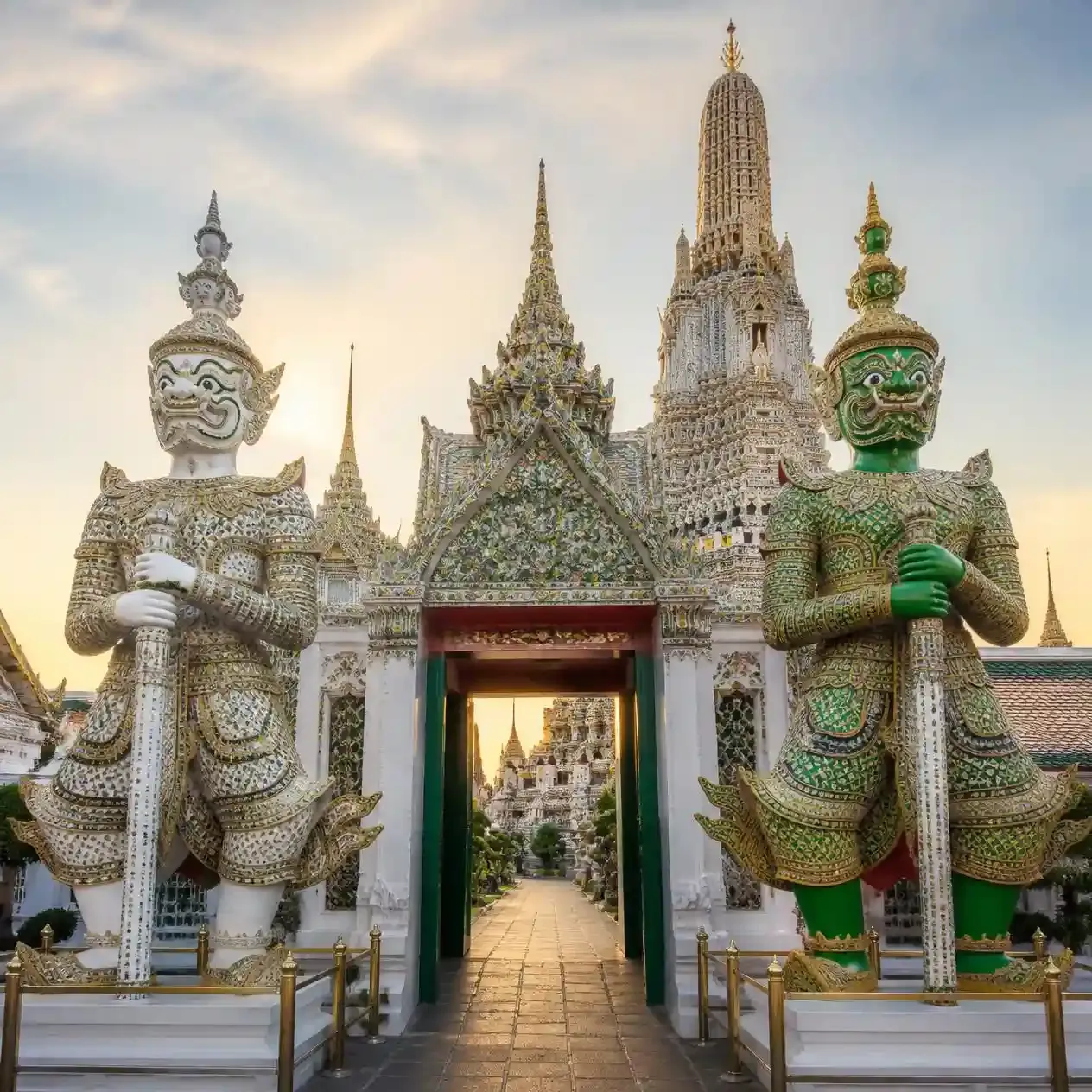
Two towering guardian figures flank the entrance to the inner precinct — one white, Sahassa Deja, and one green, Thotsakan. Both are drawn from the Ramakien, the Thai telling of the Ramayana, and Thotsakan is the figure Indian visitors will recognise as Ravana. Their function is protective; they face outward. The detail in the armour, crowns and expressions is worth more than the thirty seconds most people give them on the way past.
The ordination hall
The ubosot is the most-skipped and most rewarding building on the site. Inside sits the presiding golden Niramitr Buddha, credited to Rama II, whose ashes are interred in the base of the image — which makes this, in practical terms, a royal funerary space as well as a working hall. The murals lining the walls date from Rama V's reign and run through episodes from the life of the Buddha and Thai folklore. The hall is still used for ceremonies; when one is in progress, wait rather than enter.
The riverside promenade
Turn right along the water after entering and you get the prang from below with the river behind you — the composition that shows scale properly. This is also where the Chinese stone figures stand: ancient soldiers and officials, brought over as ballast in the same ships that supplied the porcelain, now serving as grounds guardians. Early morning gives this stretch its softest light and its lowest foot traffic.
Reality check: give the ordination hall fifteen minutes
- Most visitors climb the prang, photograph it, and leave without going inside the ubosot at all.
- It is the coolest, quietest and most atmospheric interior on the site — shaded, and considerably less crowded than the tower.
- Shoes off at the door, and sit rather than stand if you want to look at the murals properly.
- Photography inside is generally permitted but read the room; if monks are present or a ceremony is running, put the camera away.




Wat Arun Bangkok entrance fee, opening hours and the climb
Entry to Wat Arun Bangkok is quoted at between 100 and 200 THB per foreign visitor in 2026, paid in cash at the ticket office on arrival. There is no advance ticketing and none is needed. The temple opens daily at 08:00 and closes at 18:00, with the last ticket sold and the prang staircases closed earlier than the gate.
Costs and timings at a glance (2026)
- Entry: 100–200 THB per adult (approximately USD 3–6), cash only, paid at the gate
- Children under 120 cm: generally admitted free
- Thai nationals: free or reduced with national ID
- Opening hours: 08:00–18:00 daily; last entry around 17:30
- Prang climb: closes ahead of the gate, from roughly 17:30
- Cross-river ferry from Tha Tien: a few baht, running every few minutes, three-minute crossing
- Chao Phraya Express Boat from Sathorn/Saphan Taksin to Tha Tien: 20–40 THB (about USD 0.60–1.25)
- Suggested time inside: one hour for the grounds and hall, two if you climb and linger
The climb, honestly
Four staircases rise the prang, one on each face. Access above the first terrace has been restricted since the major restoration completed in 2017, and sources published this year still contradict each other on how far up you can currently go. Assume the terrace level and treat anything beyond it as a bonus. The terrace alone delivers the view worth having: the Grand Palace complex, Wat Pho's roofline, the river bend and the skyline behind. The steps are steep and shallow-treaded, with rope handrails; closed shoes with grip are the sensible choice, and the descent deserves more caution than the way up.
Dress code as cultural fluency
This is an active royal temple, and the dress standard is enforced at the gate rather than suggested. Shoulders and knees covered, nothing sheer, no exposed midriff. Cover-ups are available near the entrance if you arrive short, but turning up already dressed correctly reads as respect rather than compliance — and spares you a queue in the heat. Remove shoes before entering the ordination hall, and avoid pointing your feet toward any Buddha image when seated.
Reality check: two things the gate does not tell you
- The fee is contested. Live 2026 sources quote 100 THB, 200 THB and an outdated 50 THB, each stated as settled fact, and none of them flags the disagreement. Carry 200 THB per person in cash — card is not accepted at the ticket office.
- Prang access is contested too. Some sources describe a full ascent, others first-terrace-only. Ask at the ticket window how far the staircases are open that day before you commit to the climb; the answer changes with conservation work and weather.
- Commercial photo sessions on the grounds may only be run by photographers who have completed the temple's own certification programme.
- A maintenance fee of around 1,000 THB (roughly USD 31) applies per professional session, separate from entry and from any studio package. Visitors shooting on phones or personal cameras are unaffected.
- If you are booking a Thai-costume shoot here, confirm the operator's photographer is certified and ask whether the temple fee sits inside the quoted price or outside it.
Timing and the light at Wat Arun Bangkok
Wat Arun Bangkok rewards two windows and punishes the one in between. Early morning gives you cool air, thin crowds and soft light on the porcelain; late afternoon gives you warm, raking light and the option of crossing back for the sunset silhouette. Between roughly 11:00 and 15:00 the complex is hot, unshaded, crowded and lit flat from directly overhead — the worst version of the site on every measure.
Morning, from 08:00
The gate opens at eight and the first hour is the quietest of the day. The east-facing prang takes the morning sun directly, which is the light the temple was named for and the only window where the porcelain reads as bright rather than golden. It is also the sensible choice in hot season, when the climb becomes uncomfortable by mid-morning. Pair it with Wat Pho across the water and you have a full morning done before the heat arrives.
Late afternoon, from 15:30
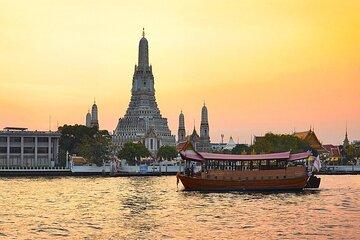
The better window if you want the temple and the photograph in one outing. Arrive around half past three, climb while the light is still on the tower, and be back on the ferry by half past five. The sun then drops behind the prang and backlights it — which is precisely why you want to be on the east bank rather than under it.
After dark
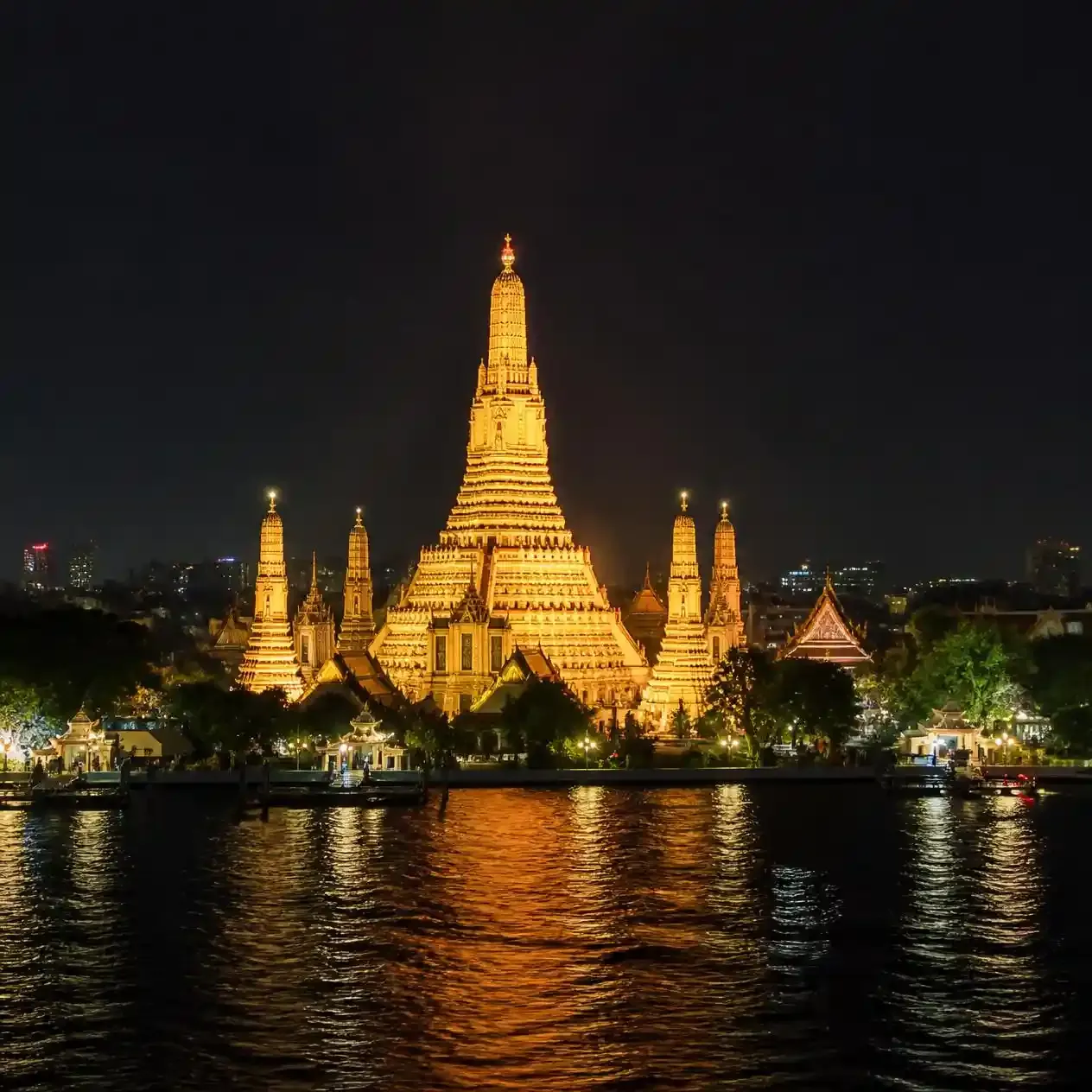
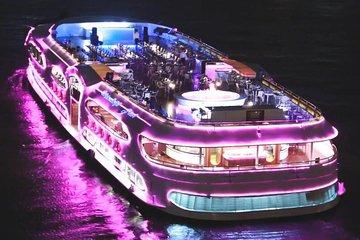
Wat Arun Bangkok closes at six, but the prang is floodlit through the evening and the illuminated prang against black water is the version most people remember. You do not need a ticket for it. The two ways to see it well are a table on the east bank facing across, or from the water itself on a Chao Phraya dinner cruise, which passes directly in front of the temple as part of the standard evening route.
Reality check: you cannot be inside Wat Arun at sunset
- Bangkok's sun sets between roughly 18:15 and 18:45 depending on the month. The temple closes at 18:00 and the staircases close earlier.
- Anyone planning to watch the sunset from the terrace is planning something that is not possible.
- The workable version: temple from 15:30 to 17:15, ferry back, table on the east bank by 17:45.
- Book a riverside table in advance for the good months, November through February — the terraces facing the temple fill early and the ones with an unobstructed sightline fill first.
How to visit Wat Arun Bangkok
There are four realistic formats for visiting Wat Arun Bangkok, and they answer different questions. Independent entry costs almost nothing and gives you the building. A guided visit gives you the iconography, which is most of what the building means. A river approach gives you the temple in its setting. A costume session gives you the photographs. They are not mutually exclusive, but they are priced very differently.
| Format | Duration | Price (2026) | Best for |
|---|---|---|---|
| Independent visit to Wat Arun | 1–2 hours | 100–200 THB (USD 3–6) plus ferry | Repeat visitors and anyone who has already had the history elsewhere |
| Guided visit with a licensed guide, often paired with Wat Pho | Half day | 1,000–2,500 THB (USD 31–78) per person | First visits, and anyone who wants the iconography read to them |
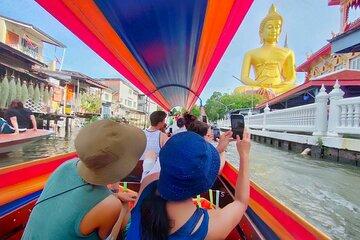
| Private longtail via the Thonburi canals, arriving by water | 1.5–2 hours | 1,500–2,500 THB (USD 47–78) per boat, per hour | Small groups and second visits wanting the west bank beyond the temple |
| Evening Chao Phraya boat tour or dinner cruise passing the lit prang | 2–3 hours | 1,100–3,500 THB (USD 34–110) per person | Couples, and anyone who wants the illuminated view without the climb |
| Thai costume rental with styling and photographer | 1–2 hours | From 600 THB rental; full packages 2,000–6,000 THB (USD 19–190) | Couples, families and anyone treating the visit as a shoot |
Which should you choose?
- If this is your first time in Bangkok, take the guided half day that pairs the temple with Wat Pho. The porcelain, the Yaksha and the prang tiers all mean something specific, and without a guide you will photograph them without knowing what you are looking at.
- If you have been before, go independently in the early morning, then spend the rest of it on the Thonburi side. The canal network, the Khlong Bang Luang artist house and the Royal Barges are the layer most people never reach.
- If you are travelling as a couple, do the temple in the late afternoon and the illuminated view from the water in the evening. It is the same landmark twice, in two entirely different registers.
- If mobility or heat is a concern, skip the climb entirely and give the time to the ordination hall and the promenade, then take the river view from a terrace. You lose the elevation and very little else.
- If photographs are the point, book the costume session for the morning light and confirm the temple's photography fee is included before you pay.
Every experience on Travjoy is researched and approved by local experts before it appears, which is worth knowing here specifically — the guided and river formats around this temple vary enormously in quality, and the difference between a licensed guide and a rushed circuit is the whole value of paying for one. Browsing the Bangkok Top 20 is the fastest way to see how a visit here fits alongside the rest of the city.
Reality check: the Thonburi bank is the second-visit reward
- Almost every itinerary treats Wat Arun as a river crossing that ends the moment you re-board the ferry.
- The west bank around the temple is old Thonburi — narrow lanes, riverside cafés, small working temples and the entrance to the canal network.
- Longtail routes through Khlong Bangkok Noi and Khlong Bangkok Yai run past stilt houses and canal-side orchards fifteen minutes from the temple gate.
- Canal tours run best early, between 07:30 and 09:30, when the water traffic is working rather than touring. During the wet months, high water can close the locks — check on the day.
Planning your visit
Three things decide whether a visit to Wat Arun Bangkok lands. Go early or late, never in the middle of the day. Carry cash, because the gate takes nothing else and the fee is still quoted at two different figures across 2026 sources. And separate the visit from the photograph — cross for the building, cross back for the light, and give yourself the hour in between rather than trying to compress both into one crossing.
Beyond that, decide how much of the meaning you want handed to you. The prang is legible if someone reads it for you and largely decorative if not. Start planning your Bangkok trip on Travjoy's Bangkok destination page, where the temple visits, river routes and canal tours around the Temple of Dawn sit alongside everything else worth booking ahead.


.svg&w=1920&q=75)