



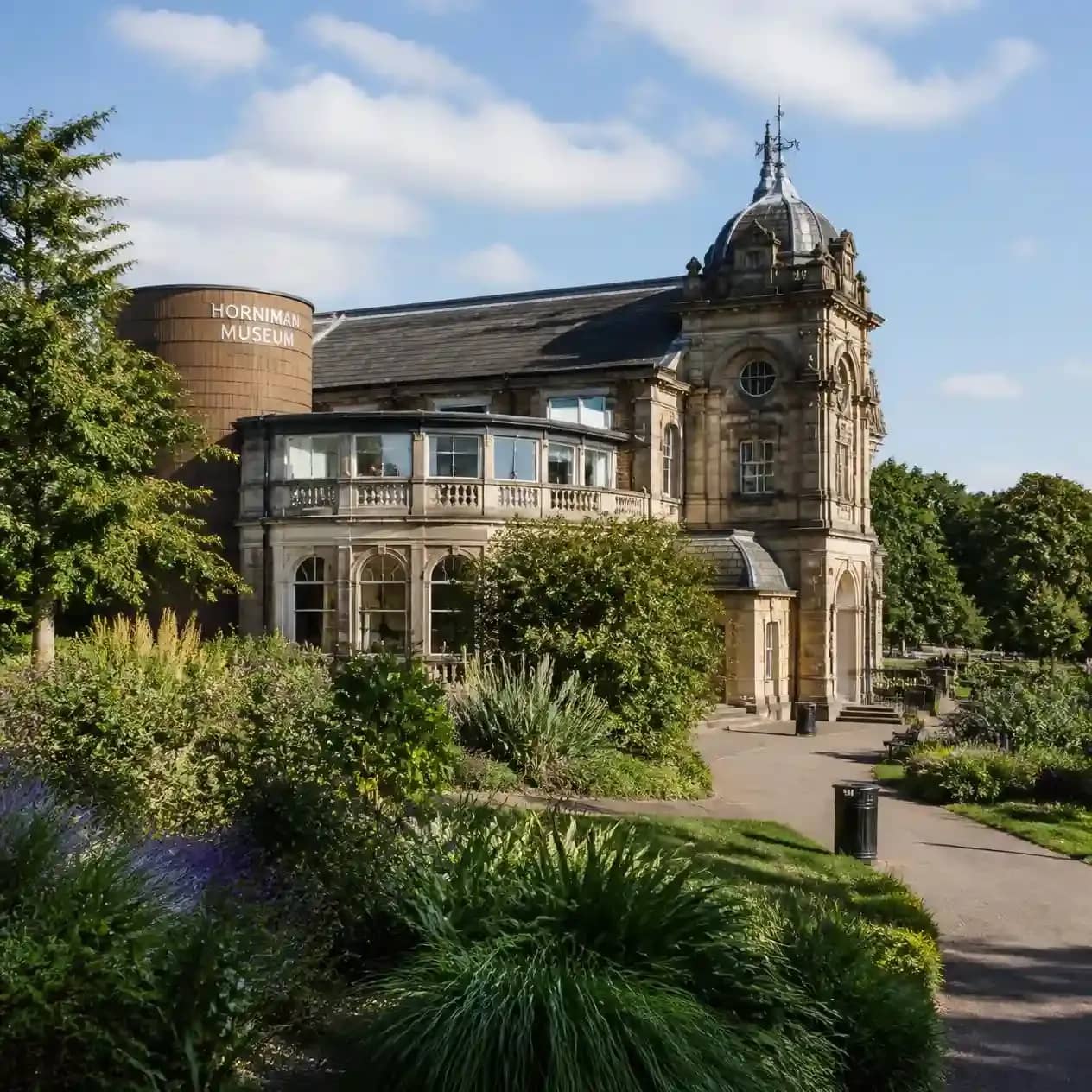
Horniman Museum and Gardens: A Complete Guide for Discerning London Visitors
6 min read
Key Highlights
- Entry to the museum, all permanent galleries and the 16 acres of gardens is free
- Founded by Victorian tea trader Frederick Horniman and open since 1901, in a landmark Arts and Crafts building
- The famous overstuffed walrus and the Natural History Gallery are closed for refurbishment until early 2027
- Ticketed add-ons: an acclaimed Aquarium and a tropical Butterfly House — book ahead online
- New for 2026: Kusuma Nature Play and an augmented-reality garden trail, marking the museum's 125th year
The Horniman Museum and Gardens is a free museum in Forest Hill, South-East London, with world-culture, music and natural history collections plus 16 acres of gardens and a skyline view. Entry to the museum and gardens is free; the Aquarium and Butterfly House are ticketed add-ons. The Natural History Gallery and its famous walrus are closed for refurbishment until early 2027.
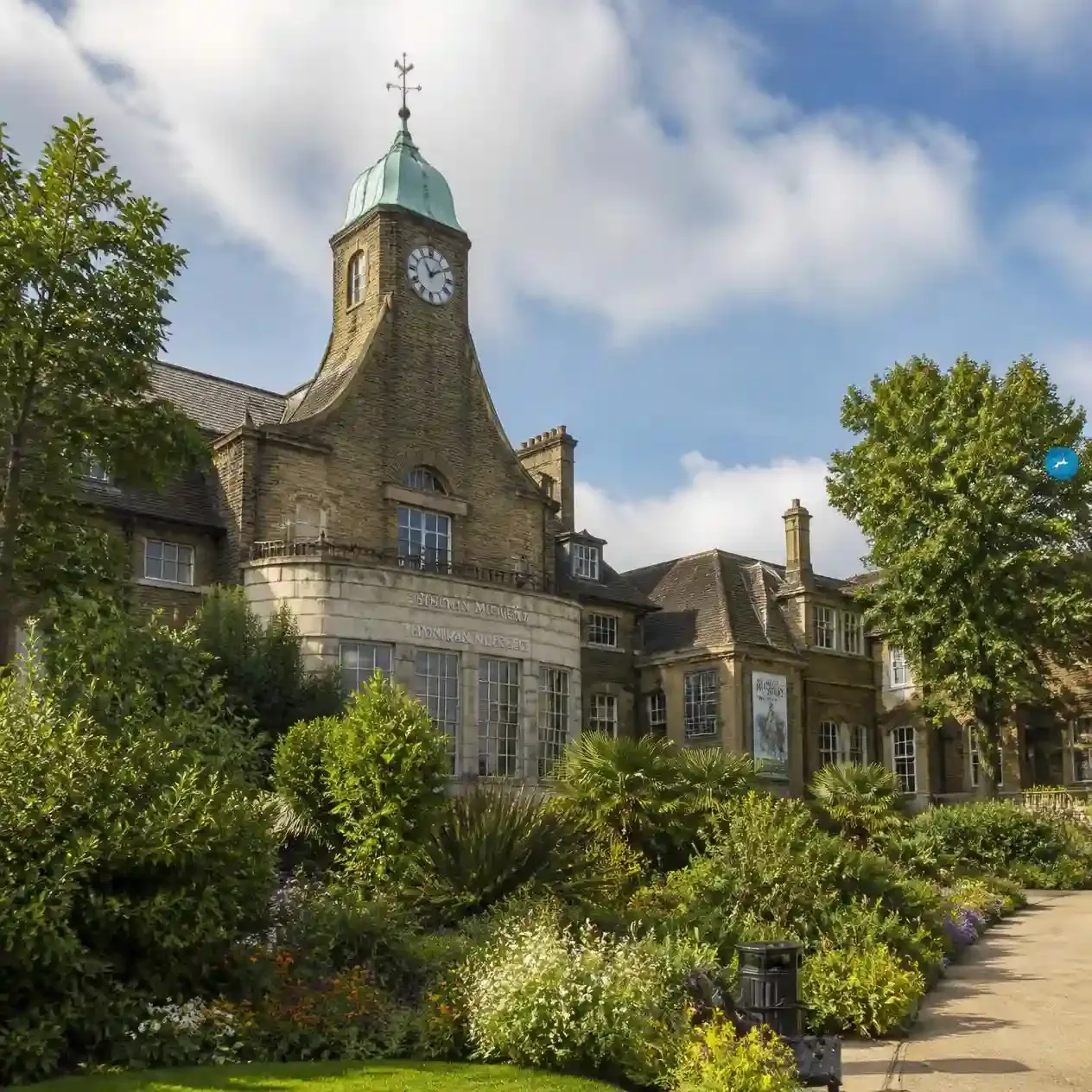
On a hilltop in Forest Hill, a fifteen-minute train ride south of London Bridge, sits one of the city's most characterful museums — and one most visitors never reach. The Horniman Museum and Gardens was built to bring the world to a South-East London suburb, and more than a century on it still does exactly that: African masks and a merman under one roof, a walrus overstuffed by Victorians who had never seen one, and 16 acres of gardens with a view back across the skyline you just left.
This guide covers what to see across the free galleries, whether the ticketed Aquarium and Butterfly House earn their price, and how the gardens are changing in 2026 as the museum marks its 125th year. It also covers the practical side — how to get to Forest Hill, how long to allow, and how to fold the Horniman into a wider day in South-East London.
If you have already done the big South Kensington museums and want something quieter and stranger, this is the trip to make.
What Is the Horniman Museum and Gardens?
The Horniman Museum and Gardens is a free museum and public garden in Forest Hill, South-East London, holding more than 350,000 objects across anthropology, natural history and musical instruments. It opened in 1901 and remains one of the few places in the city where a world-culture collection, a natural history hall and 16 acres of landscaped grounds share a single site — all free to enter.
The museum reads less like a national institution and more like a private collection that outgrew its house, because that is precisely what it is.
The story of Frederick Horniman
Frederick John Horniman was a Victorian tea trader who used the family fortune — and his travels — to amass objects from around the world. His stated aim was to bring the world to Forest Hill and educate the community around him. The collection grew so large that, by one well-worn account, his wife issued an ultimatum: the collection goes, or we do.
Horniman kept the collection. He moved the family out, opened the house to the public in 1890, added the gardens in 1895, and by 1901 had commissioned a purpose-built museum. He then gave the building, the collections and the gardens to the people of London — a gift the museum still honours by charging nothing at the door.
The building and the clock tower
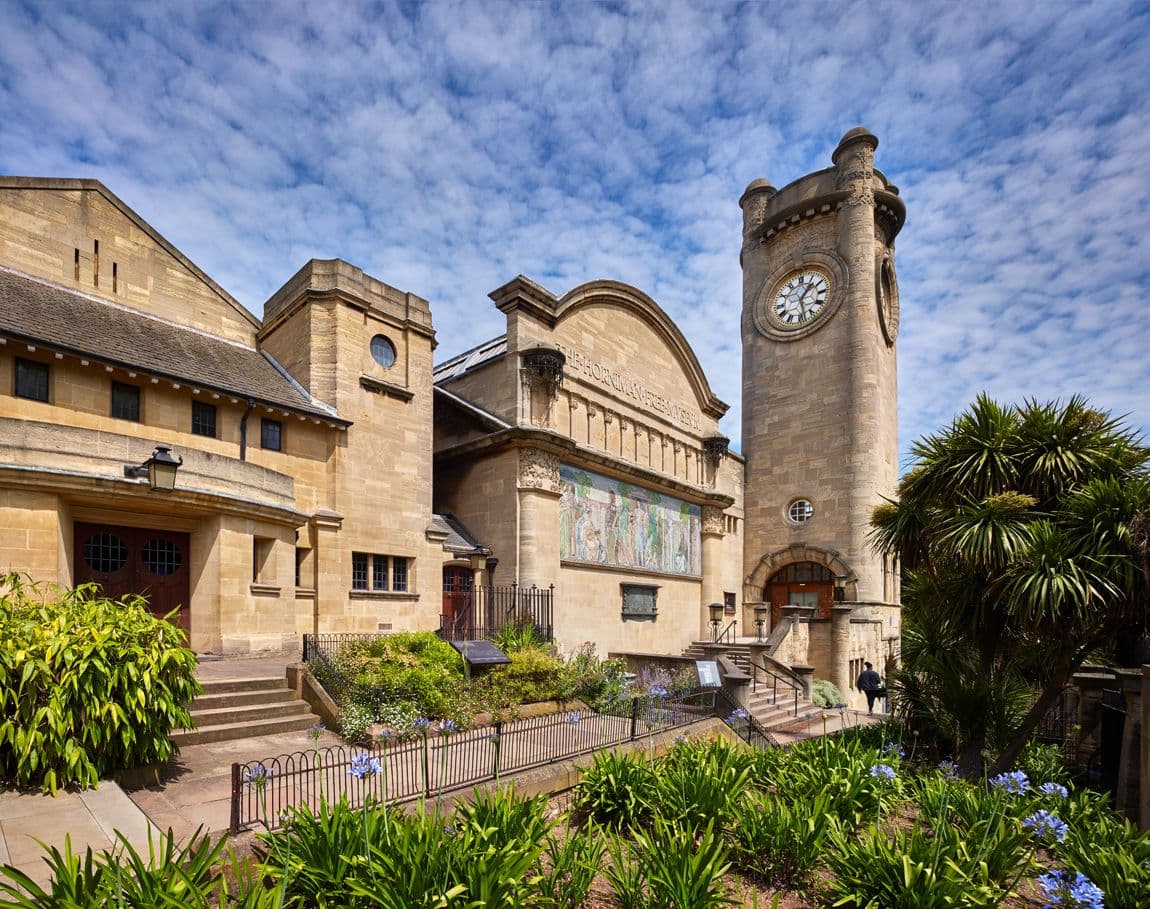
The museum sits in an Arts and Crafts building designed by Charles Harrison Townsend, the architect behind the Whitechapel Gallery. Its curved clock tower is visible from the gardens and has become the Horniman's signature. The building is Grade II listed, and much of its early-twentieth-century character survives inside — original showcases, tiled floors, and galleries that feel closer to 1901 than to a modern refit.
2026 is the museum's 125th anniversary, marked with three days of events at the end of June and a run of garden improvements covered below.
The Collections at the Horniman Museum and Gardens: What to See Inside
Inside, the permanent galleries of the Horniman Museum and Gardens are free and cover three big themes: world cultures, music, and natural history. You can move through the lot in ninety minutes, or slow down and give it half a day. Below is what each holds, and which is currently open. Among London's museums, few pack this much variety into one free site.
The World Gallery: anthropology
The World Gallery is the anthropology heart of the museum and holds more than 3,000 objects from across the globe, drawn from one of the most significant ethnography collections in the UK. Masks, textiles, ritual objects and everyday tools are grouped to show how people around the world have made sense of belief, work and belonging. It sits within London's wider art and heritage scene, but its focus on world cultures makes it unlike the city's fine-art collections.
It is also where you meet the museum's oddest resident — a merman, a Victorian curiosity stitched together from fish and other parts and displayed with a straight face. It sets the tone: this is a museum that never quite lost its cabinet-of-curiosities roots.
The Music Gallery
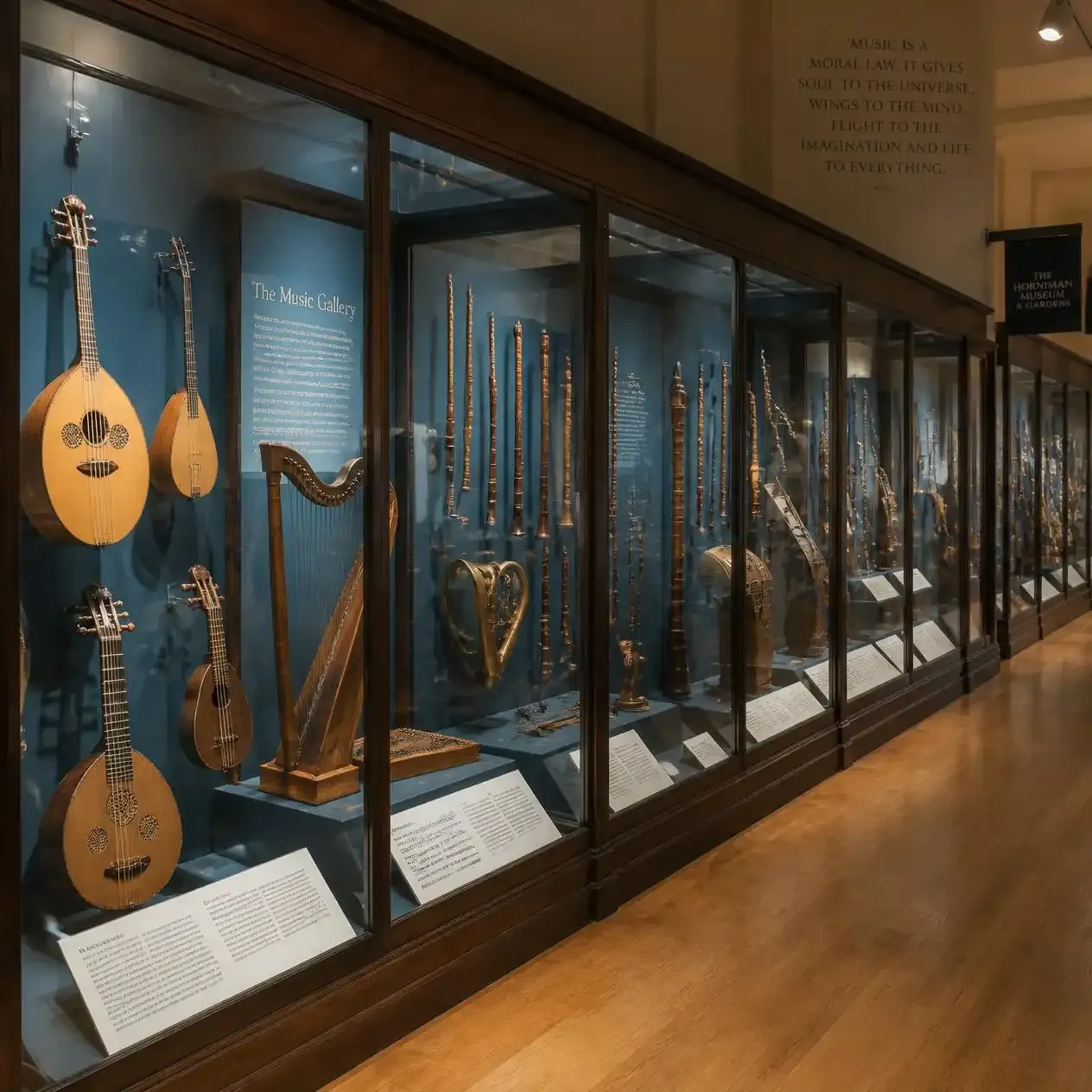
The Music Gallery is one of the museum's quiet highlights and holds around 1,600 instruments, including the Boosey and Hawkes archive from what was once Britain's largest instrument maker. Cases run from concert brass to instruments from cultures across the world.
Interactive tablets let you hear many of the instruments played, which makes the gallery genuinely engaging rather than a row of silent objects behind glass. It is the section most likely to hold a restless child — and most adults linger longer than they expect.
The Natural History Gallery and the famous walrus
Here is the one thing to know before you travel: the Natural History Gallery is closed for a major refurbishment and will not reopen until early 2027. That means the museum's most famous object — an enormous walrus, overstuffed by Victorian taxidermists who had never seen a live one and did not know the animal should have wrinkles — is off display until then.
The gallery, open since 1901, is being redisplayed as part of the museum's Nature + Love project, covered below. In the meantime, a Natural History Pop-up in The Studio shows a rotating handful of specimens, and songbirds and shells appear over in the Music Gallery — but if you are making the trip mainly for the walrus, wait until 2027.
The free permanent galleries, at a glance:
- World Gallery (anthropology) — open
- Music Gallery — open
- Natural History Gallery — closed until early 2027; Natural History Pop-up on display in the meantime
- The Gardens (16 acres) — open daily, free


The Aquarium, Butterfly House and Paid Experiences: Is It Worth It?
Most of the Horniman Museum and Gardens is free, but three things are ticketed: the Aquarium, the Butterfly House, and any temporary exhibition. None is expensive, and each takes well under an hour, so the real question is which one suits your visit rather than whether to spend at all. Book ahead online — during school holidays the timed slots fill, and pre-booking lets you walk straight in.
The Aquarium
The Horniman's Aquarium is small but well put together, with 15 displays running from a British pond to a Fijian coral reef. Highlights include the live coral of Project Coral — the museum's pioneering coral-breeding research — plus poison dart frogs, seahorses and a mangrove tank of South American fish.
- Roughly £6 adult / £3 child for the Aquarium alone; bundled tickets with a temporary exhibition run higher
- Allow 30–45 minutes
- Best for families, and anyone curious about marine conservation
Prices and bundles change, and seasonal family offers appear over summer — confirm the current rate when you book.
The Butterfly House
The Butterfly House is a heated tropical glasshouse of free-flying butterflies and moths, best appreciated slowly on a cold London day when the warmth alone is worth the ticket. It is a strong photo stop and a reliable hit with children.
- Roughly £6–£9 adult and £6 child, with family tickets available
- Open 10.30am–4pm (last entry 3.30pm); may close at short notice in hot weather
- Best for families, photographers, and anyone visiting in winter
How the three paid options compare:
| Experience | Rough price | Time needed | Best for |
|---|---|---|---|
| Aquarium | ~£6 adult / £3 child | 30–45 min | Families, marine-life interest |
| Butterfly House | ~£6–£9 adult / £6 child | 20–30 min | Winter visits, photography |
| Temporary exhibition | Varies by show | 30–60 min | Repeat visitors wanting something new |
Which paid add-on to choose
- Visiting with young children: the Aquarium, every time — the tanks hold attention and the pace suits small legs.
- Visiting in winter: the Butterfly House, for the tropical warmth as much as the butterflies.
- On a return visit: skip both and book the current temporary exhibition instead.
- Short on time: the free galleries and gardens stand on their own — the add-ons are a bonus, not the point.
The 16-Acre Gardens and What's New for 2026
The gardens are free, open daily, and reason enough to visit on their own. Spread over 16 acres on the hillside, they hold a Victorian conservatory, a bandstand, an Animal Walk, themed planting and one of the best free views in South London — the city skyline laid out from the top of the slope.
The conservatory, bandstand and views
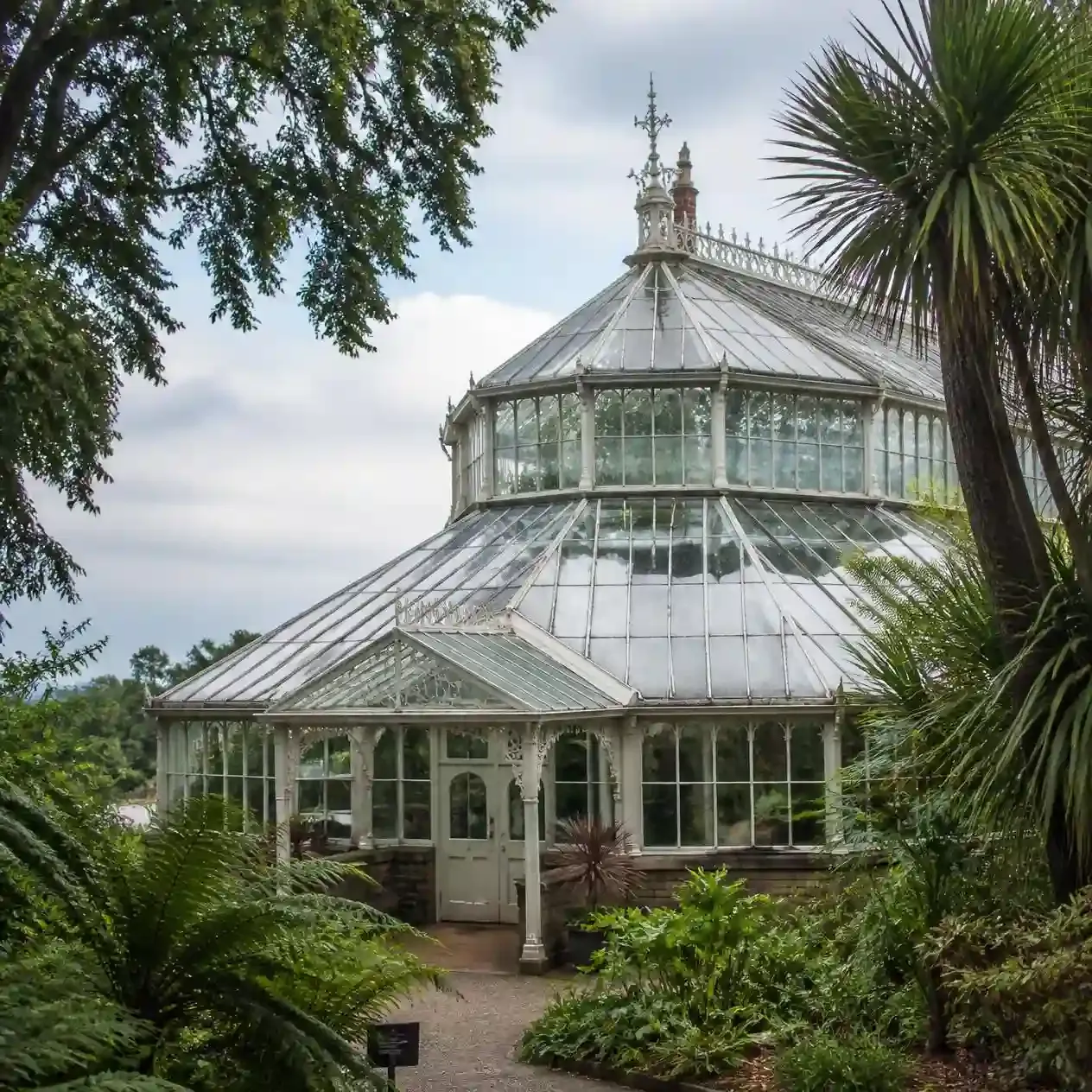
The centrepiece is a Victorian glasshouse from 1894, a Grade II listed conservatory that was rescued from a site in Croydon and rebuilt behind the museum, where it now hosts performances and events. Nearby, a 1903 bandstand sits at the top of the slope, with the panorama across central London opening up behind it — a favourite picnic spot for local families and a good place to end a visit.
The Animal Walk, Sound Garden and Nature Trail
The gardens reward wandering. Along the way you will find an Animal Walk with alpacas, goats and rabbits, a Sound Garden of outdoor instruments, and themed plots including sunken, medicinal and food gardens. The Nature Trail — laid out in 1972 on the bed of a long-closed railway — is the oldest surviving nature trail in London, a strip of managed woodland threaded through the site. These green spaces sit within London's wider network of parks and gardens, but few combine planting, animals and a museum this way.
Nature + Love: what's new for 2026
The gardens are mid-way through a roughly £10 million transformation called Nature + Love, backed by the National Lottery Heritage Fund. From early summer 2026 a new destination called Kusuma Nature Play opens: a children's play area inspired by local wildlife, a family café, and — for the first time — step-free access along the historic Nature Trail. An augmented-reality trail with animated animals and games is launching across the grounds too.
To mark the museum's 125th birthday, the Horniman is holding three days of celebrations from 27 to 29 June 2026. Opening dates for the new attractions can shift, so check what's open before you travel if the gardens are your main reason for going.

Planning Your Visit to the Horniman Museum and Gardens
The Horniman is straightforward to reach and easy to fit into a wider South-East London day. Here is what to know before you go.
Getting to Forest Hill
The museum is in Forest Hill (Zone 3), a short walk from Forest Hill station. The station is now on the Windrush line — the London Overground route renamed in late 2024 — and is about 15 minutes from London Bridge by train.
- From the station it is a 5–10 minute walk, signposted from the platform 1 exit towards London Road — note it is uphill
- Several buses stop at both the station and the museum if you would rather not walk the hill
- Parking nearby is very limited; public transport is the easier choice
Opening hours and how long to allow
- Museum: 10am–5.30pm daily (closed 24–26 December)
- Gardens: from 7.15am (8am on Sundays and Bank Holidays) until dusk, seasonally
- Butterfly House: 10.30am–4pm, last entry 3.30pm
- How long to allow: 1.5–2 hours for the galleries, or half a day with the gardens and a paid add-on
Hours shift seasonally and around the Nature + Love works — confirm on the day if your timing is tight.
Making a day of it in South-East London
The Horniman pairs well with the neighbourhood around it. Forest Hill sits beside the villagey stretch of Dulwich, Blackheath and Barnes, with the Dulwich Picture Gallery and good pubs a short hop away. Push a little further and you reach Greenwich Park and the maritime quarter for a fuller day out.
If you would rather have the routes and bookings sorted in advance, the London experiences on Travjoy are researched and approved by local experts, so you can line up the right add-ons and nearby stops without second-guessing.
At a glance
- Free: the museum, all permanent galleries, and the gardens
- Ticketed: Aquarium, Butterfly House, temporary exhibitions
- Closed until early 2027: the Natural History Gallery and the walrus
- Nearest station: Forest Hill (Windrush line, Zone 3), 15 minutes from London Bridge
- Time needed: 1.5 hours to half a day
Why the Horniman Is Worth the Trip
The Horniman Museum and Gardens is one of London's most rewarding trips off the standard tourist track — a free museum of world culture and music, a well-regarded little aquarium, a tropical butterfly house, and 16 acres of gardens with a skyline view, all on one Forest Hill hilltop. Go now for the collections and the gardens, return in 2026 for the new nature play areas, and again in 2027 when the walrus is back in his refurbished hall. Whether it is your first visit or a return for what has changed, start planning your day in the capital on Travjoy's London page.


.svg&w=1920&q=75)