


London: Natural History Museum
Operating Hours:Daily: 10:00 - 17:50 (last entry 17:30). Closed: 24 - 26 December
The Vibe:Dinosaurs and a blue whale under Gothic terracotta.
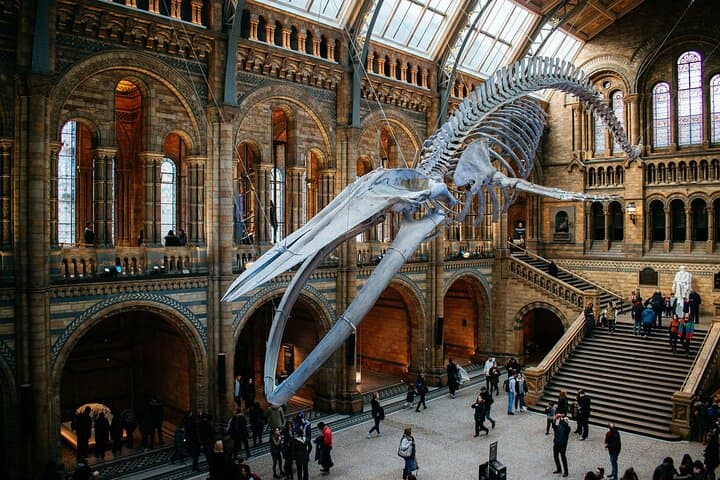
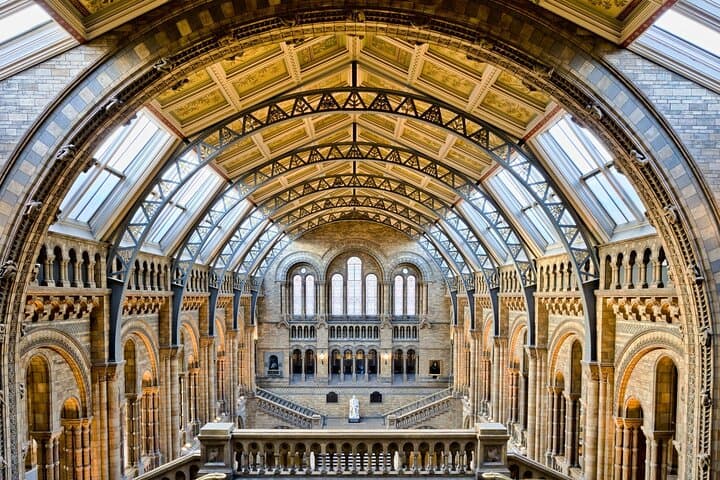
Alfred Waterhouse's 1881 Romanesque Revival cathedral holds 80 million specimens across zoology, botany, palaeontology, entomology and mineralogy. The central Hintze Hall — presided over by the blue-whale skeleton Hope — draws crowds with its Victorian grandeur.
Children squeal at the animatronic T-Rex; Hope the blue whale sweeps overhead in Hintze Hall. Stained glass filters light onto terracotta columns; behind each doorway, glass cases reveal specimens by the thousand.
- • Holds 80 million specimens — one of the world's largest natural history collections
- • Alfred Waterhouse's 1881 Romanesque Revival building is a London landmark in its own right
- • Free admission to permanent galleries, funded by government and private donations
- • Home to Hope, the 25-metre blue whale skeleton suspended in Hintze Hall since 2017
Persona Fit
- 👨👩👧 Families: The Dinosaurs gallery and animatronic T-Rex are essential for kids
- 💕 Couples: Friday late openings with live music in Hintze Hall
- 👵 Seniors: Full step-free access; seated benches in most galleries
- 📸 Photographers: Hope the blue whale beneath the Romanesque arches is the signature shot
Highlights
- Hope — 25-metre blue whale skeleton, suspended in Hintze Hall since 2017
- Dinosaurs gallery — animatronic Tyrannosaurus rex and full skeleton casts
- Darwin Centre — behind-the-scenes glimpse of the museum's research collections
- Earth Sciences Hall — earthquake simulator, volcano geology, precious gems
- Wildlife Photographer of the Year exhibition — annual competition (seasonal)
- Treasures Gallery — the museum's ten most important objects in one room — Hidden Gem
2 Curated Booking Options
Starts From
(Per Person)

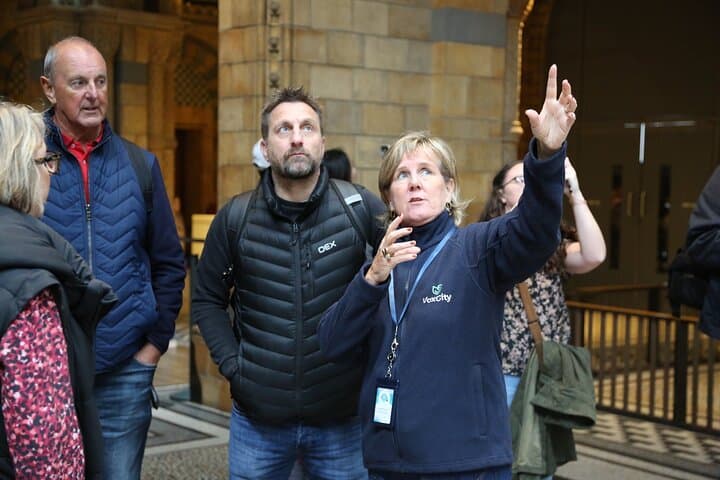
Sarah Riches
Our London Local Expert
Table of Contents
Things To Do Nearby
Victoria and Albert Museum — immediately adjacent on Exhibition Road
Science Museum — next door, with interactive technology exhibits
Hyde Park — royal park 10 minutes north for green space and a picnic
Kensington High Street — shopping and cafés west of the museums
Victoria and Albert Museum — immediately adjacent on Exhibition Road
Science Museum — next door, with interactive technology exhibits
Hyde Park — royal park 10 minutes north for green space and a picnic
Kensington High Street — shopping and cafés west of the museums
TJ's Guide - Natural History Museum
Know Before You Go
Insider Tips
Best Time: First hour after opening to see Dinosaurs before queues form
Hack: Friday Lates give adult-only evening access with live music and cocktails in Hintze Hall
Hidden Gem: The Treasures Gallery houses the museum's ten most important objects
Pre-book timed entry — walk-ups can queue for 30 minutes at peak
The free behind-the-scenes tours of the Darwin Centre book out weeks ahead
Best Time: First hour after opening to see Dinosaurs before queues form
Hack: Friday Lates give adult-only evening access with live music and cocktails in Hintze Hall
Hidden Gem: The Treasures Gallery houses the museum's ten most important objects
Pre-book timed entry — walk-ups can queue for 30 minutes at peak
The free behind-the-scenes tours of the Darwin Centre book out weeks ahead
Know Your Facts
- Closest Tube: South Kensington (District, Circle, Piccadilly), connected by pedestrian subway
- Main entrance: Cromwell Road (grand façade)
- Alternative entrance: Exhibition Road (side), usually with shorter queues
- First-time tip: Pick up a free floor plan at the entrance — the museum has 10 floors
Once You Reach
Internal Navigation
Four colour-coded zones: Blue (mammals, Dinosaurs), Green (birds, fossils), Red (Earth Sciences), Orange (Darwin Centre)
Venue map: Free paper plan; the museum app offers gallery-level guidance
Signage: Colour-coded corridors match the four zone colours
Accessibility: Lifts to all floors; step-free throughout
Efficient route: Hintze Hall then Dinosaurs then Mammals then pick one colour zone
Food & Coffee Shops
T-Rex Grill: Family-friendly lunches beside the Dinosaurs gallery
Central Hall Café: Casual bites with Hintze Hall views
Exhibition Road Culture Quarter: Wider lunch options at the V&A and Science Museum cafés
T-Rex Grill: Family-friendly lunches beside the Dinosaurs gallery
Central Hall Café: Casual bites with Hintze Hall views
Exhibition Road Culture Quarter: Wider lunch options at the V&A and Science Museum cafés
Photography Tips
Photography permitted in permanent galleries; no flash or tripods
Temporary exhibitions often prohibit photography — check signage at entry
Hope the blue whale needs a wide-angle lens from the main door
Friday late openings give uncrowded compositions under dimmer lighting
Photography permitted in permanent galleries; no flash or tripods
Temporary exhibitions often prohibit photography — check signage at entry
Hope the blue whale needs a wide-angle lens from the main door
Friday late openings give uncrowded compositions under dimmer lighting
Explore Deeper
Originally part of the British Museum, the Natural History collection grew too large and moved to its own building on Cromwell Road in 1881. Alfred Waterhouse designed the Romanesque Revival structure with terracotta cladding chosen for its resistance to London soot.
The 300-plus carved animals on the façade represent the distinction between 'living' creatures on the east wing and 'extinct' on the west — Richard Owen's Victorian design brief
Hope the blue whale replaced Dippy the diplodocus in Hintze Hall in 2017; Dippy was a plaster cast, while Hope is a real skeleton from an 1891 beaching in Ireland
The Darwin Centre holds the museum's working research collections, including 28 million insects and Darwin's own specimens from the Beagle voyage
The Wildlife Photographer of the Year has run since 1965 and is the world's most prestigious nature photography competition
The 300-plus carved animals on the façade represent the distinction between 'living' creatures on the east wing and 'extinct' on the west — Richard Owen's Victorian design brief
Hope the blue whale replaced Dippy the diplodocus in Hintze Hall in 2017; Dippy was a plaster cast, while Hope is a real skeleton from an 1891 beaching in Ireland
The Darwin Centre holds the museum's working research collections, including 28 million insects and Darwin's own specimens from the Beagle voyage
The Wildlife Photographer of the Year has run since 1965 and is the world's most prestigious nature photography competition
Did You Know?
Founding collection — The museum began with Sir Hans Sloane's private natural history collection, transferred from the British Museum
Termite mound — A real termite mound removed from Africa in one piece stands in the Insects gallery
Wartime specimens — Many delicate specimens were moved to rural Wales during WWII to escape the Blitz
New species — The museum continues to describe hundreds of new species every year from its research collections