



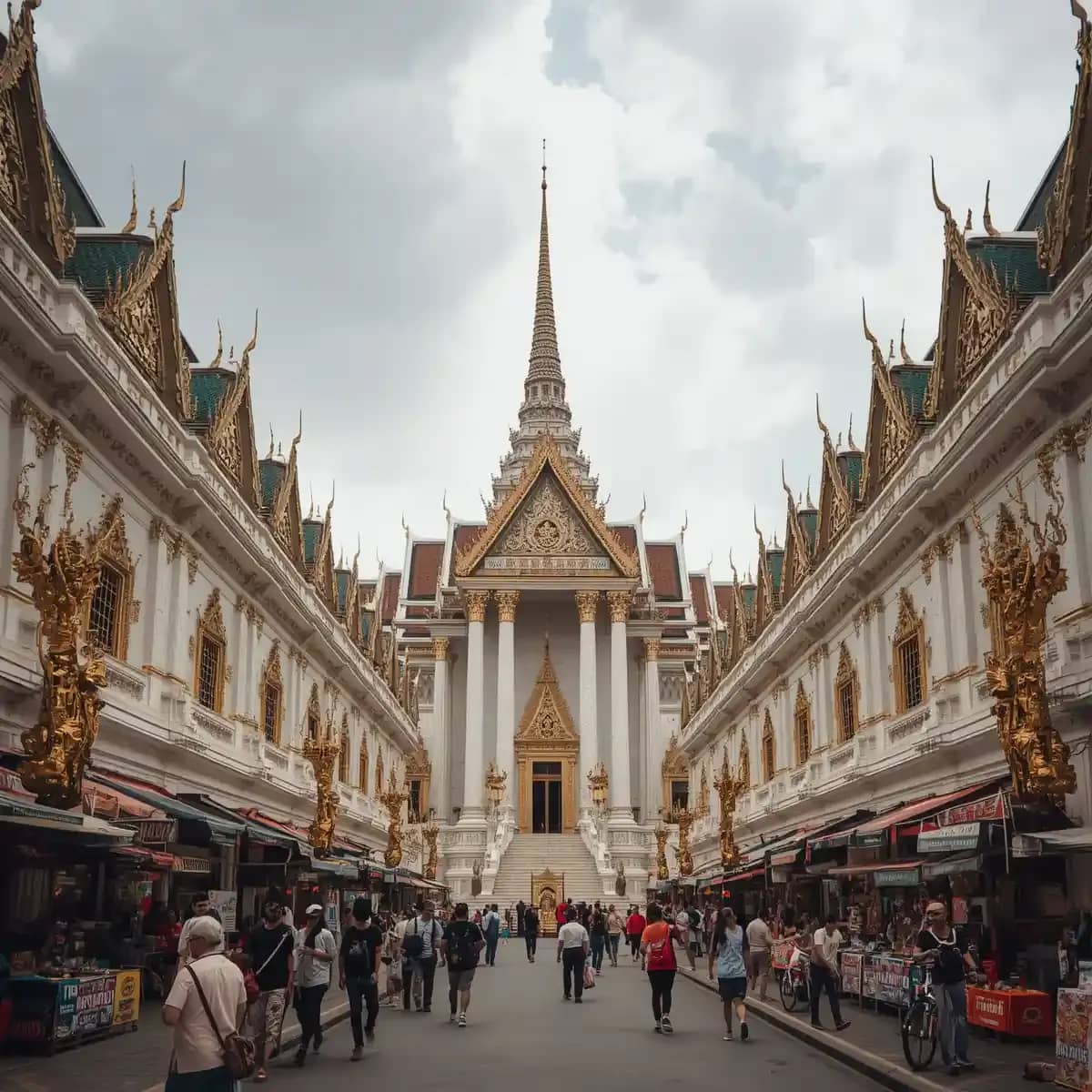
Grand Palace Half Day Tour: A Complete Guide to the Royal Grand Palace and Bangkok Temples Route
9 min read
Key Highlights
- Two different routes are sold under almost the same name — confirm whether your third stop is Wat Arun or Wat Traimit before you book.
- Entry fees are excluded from many listings, a swing of roughly THB 1,000 (USD 28) per person.
- The Grand Palace stops selling tickets around 15:00 and closes at 15:30, which rules out most afternoon starts.
- 2026 entry: Grand Palace THB 500, Wat Pho THB 300, Wat Arun THB 200, Wat Traimit THB 100.
- Wat Pho and Wat Arun take cash only. The Grand Palace accepts cards at the West Gate.
A Grand Palace half day tour runs four to five hours and covers the Grand Palace and Wat Phra Kaew plus two further temples — almost always Wat Pho, then either Wat Arun across the river or Wat Traimit in Chinatown. Expect THB 1,200–3,500 (USD 34–98) per person for a join-in group and THB 4,500–8,000 (USD 126–224) for a private guide with a vehicle, plus about THB 1,000 (USD 28) per person in entry fees unless the listing states they are included.
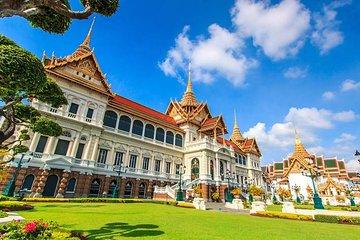
The morning begins the same way for almost everyone: through the West Gate on Na Phra Lan Road, into a walled compound of gilded chedis and mirrored glass, with the Emerald Buddha sitting high above a hall where nobody speaks above a murmur. It is the single most visited half-day in Bangkok, and the one most often booked badly.
The problem is not the sights. It is that the phrase "Royal Grand Palace and Bangkok temples" attaches to at least two distinct itineraries, priced differently, shaped differently, and sold on the same page-one listings. One crosses the Chao Phraya by ferry. One never leaves the road. One usually quotes entry fees as an extra; the other folds them in. On a four-hour clock with a hard 15:30 closing time at the palace, those differences decide the day.
This guide sets out what a Grand Palace half day tour actually covers in 2026, what each version costs in baht and dollars, what each of the four possible stops gives you, and which format suits which traveller — so you can book the right one rather than the first one.
Is a Grand Palace half day tour worth it?
Yes, for most visitors — but for the guiding and the logistics rather than the access. Nothing on this route is skip-the-line; the Grand Palace has no fast-track product for individuals, and queues at the West Gate move steadily. What you are buying is someone who reads the iconography for you, handles the ferry and the walking order, and keeps a four-hour window from collapsing into three sites and a traffic jam.
Worth it if
- You have two or three days in Bangkok and want the old city handled properly in one morning.
- You care about what the murals, the guardian yaksha and the Emerald Buddha's seasonal robes actually mean — the Ramakien cloister alone runs to 178 panels and rewards someone explaining it.
- You are travelling in the hot season, March to May, when a vehicle between stops changes the day entirely.
- You are returning to Bangkok and want the deeper reading rather than the postcard sweep.
Not ideal if
- You have already done the Grand Palace and want only Wat Pho and Wat Arun — those two sit ten minutes apart and work better as a slow independent morning.
- You want to photograph Wat Arun at golden hour. Half-day tours finish around midday or early afternoon, well before the light turns.
- Mobility is a concern. Wat Traimit's Golden Buddha is three flights up, Wat Arun's terrace is reached by steep steps, and the palace compound involves well over a kilometre of walking on hot stone.
- You are in Bangkok on a Monday and specifically want the Wat Traimit museum, which closes that day.
What a guide adds that a guidebook does not
The Grand Palace is not a museum with labels. Most buildings carry no interpretation in English, several are closed to the public entirely, and the ones that matter most look similar to an untrained eye. A licensed guide is the difference between walking past the Phra Siratana Chedi and understanding why it holds a relic, why the Chakri Maha Prasat wears a Thai roof on an Italianate body, and why the Emerald Buddha is dressed three times a year by the king. That context is the product.
The two routes sold under the same name
There are two standard shapes to a Grand Palace half day tour, and the listings rarely make the distinction obvious. Both open with the Grand Palace and Wat Phra Kaew, both continue to Wat Pho, and they part company at the third stop. The river route crosses to Thonburi. The Chinatown route stays on the east bank and drives east. Neither is better in the abstract — they simply produce different mornings.
| Route | Third stop | Shape of the morning | Duration | Price range (per person) | Best for |
|---|---|---|---|---|---|
| River route | Wat Arun | Mostly walking, with a three-minute cross-river ferry from Tha Tien | 4–5 hours | THB 1,200–3,500 (USD 34–98) join-in | Photography, riverside atmosphere, the classic skyline |
| Chinatown route | Wat Traimit | Air-conditioned minivan between all stops, no river crossing | 4–5 hours | THB 2,500–4,000 (USD 70–112) join-in, fees often included | Hot-season comfort, hotel pickup, less walking |
| Private, either route | Your choice, or both | Own vehicle and guide, flexible start and pace | 4–6 hours | THB 4,500–8,000 (USD 126–224) | Couples, families, second visits, anyone on a tight clock |
The river route: Grand Palace, Wat Pho, Wat Arun
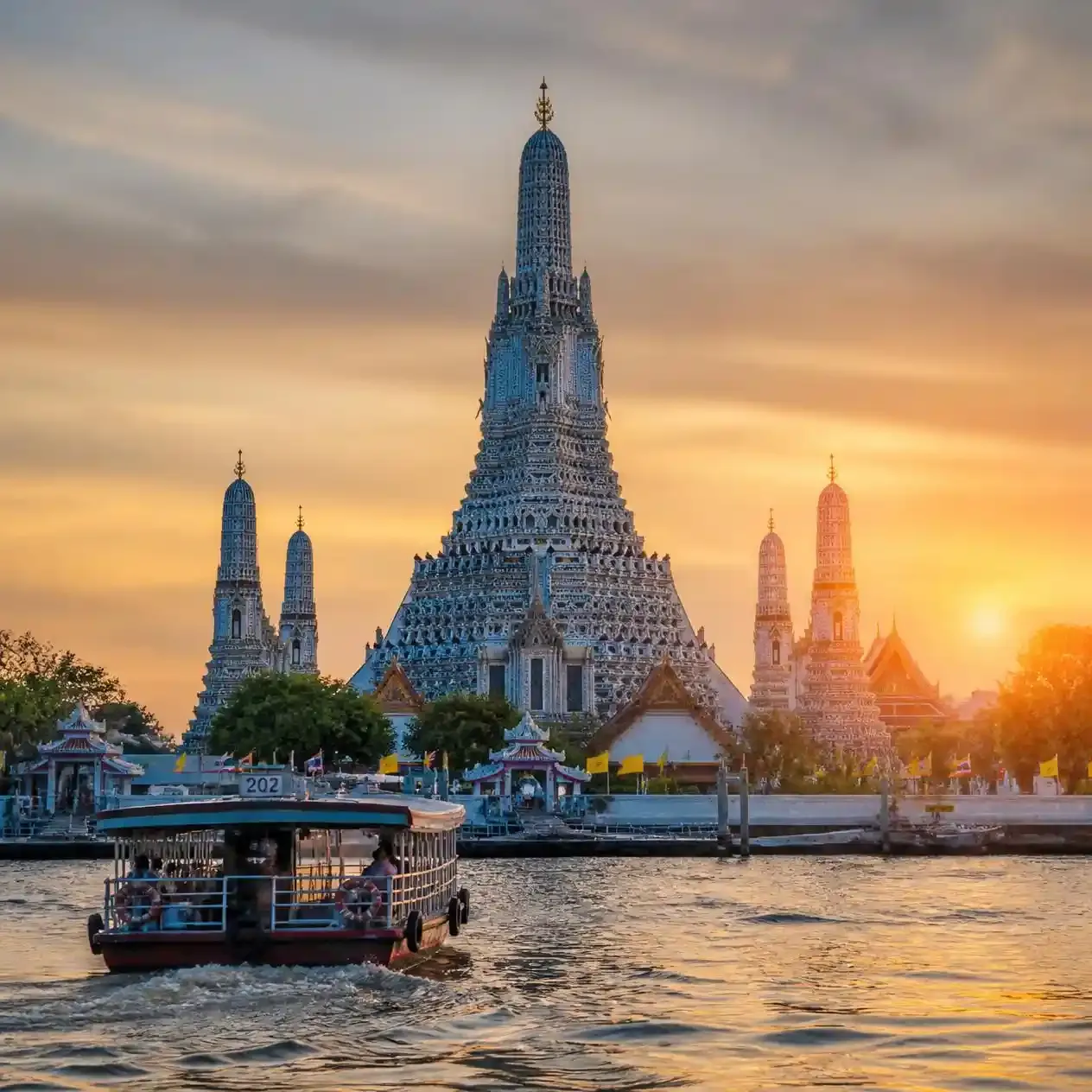
This is the version most people picture. From the palace you walk ten minutes south to Wat Pho, then three minutes further to Tha Tien pier, where a small cross-river ferry runs every ten minutes for a few baht. The approach matters: Wat Arun grows from a spire on the horizon into a seventy-metre prang as the boat crosses, and no arrival by road matches it. The trade-off is exposure — this route puts you on your feet in full sun for most of the morning.
The Chinatown route: Grand Palace, Wat Pho, Wat Traimit
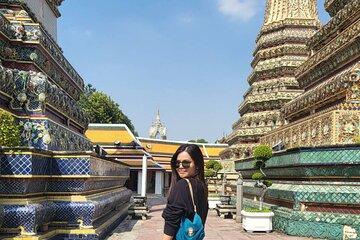
The itinerary sold under the exact phrase "Royal Grand Palace and Bangkok Temples" most often ends at Wat Traimit rather than Wat Arun. It swaps the ferry for a minivan, adds hotel pickup and drop-off, and usually includes all three entry fees in the headline price. You lose the river and gain a temple that holds a five-and-a-half-tonne solid gold Buddha, plus a genuine change of neighbourhood: Yaowarat's shophouses and gold dealers begin at the temple gate.
Reality check: read the third stop before you pay
- Listings with near-identical titles run different routes. Check the itinerary text for "Wat Arun" or "Wat Traimit" specifically.
- If the description mentions a ferry or the Chao Phraya, it is the river route. If it mentions an air-conditioned van and hotel pickup, it is usually the Chinatown route.
- Some operators sell a four-stop version adding Wat Saket. On a half-day clock this is tight — expect twenty minutes per temple.
- Pickup zones matter. Several operators charge a supplement of around THB 320 (USD 9) per adult for hotels outside the central zone.
What each stop gives you
Four sites appear across the two routes, and they are not equivalent. The Grand Palace needs the most time and gives the most back with a guide; Wat Pho is the one people underestimate; Wat Arun is the photograph; Wat Traimit is short, specific and easily the quickest. Budget your attention accordingly.
Grand Palace and Wat Phra Kaew
The Grand Palace covers two hundred thousand square metres of throne halls, cloisters and the royal chapel that holds the Emerald Buddha — a jade figure under a metre tall, seated high on a gilded altar, and the most sacred object in Thailand. Allow at least ninety minutes; three hours if you intend to read the Ramakien murals properly.
- Entry: THB 500 (USD 14) per person, children under 120cm free
- Hours: 08:30–15:30 daily, with ticket sales stopping around 15:00–15:15
- Payment: cards accepted at the West Gate ticket office
- Time needed: 90 minutes minimum, 2–3 hours ideally
- Note: parts of the complex close for royal ceremonies at short notice
Wat Pho
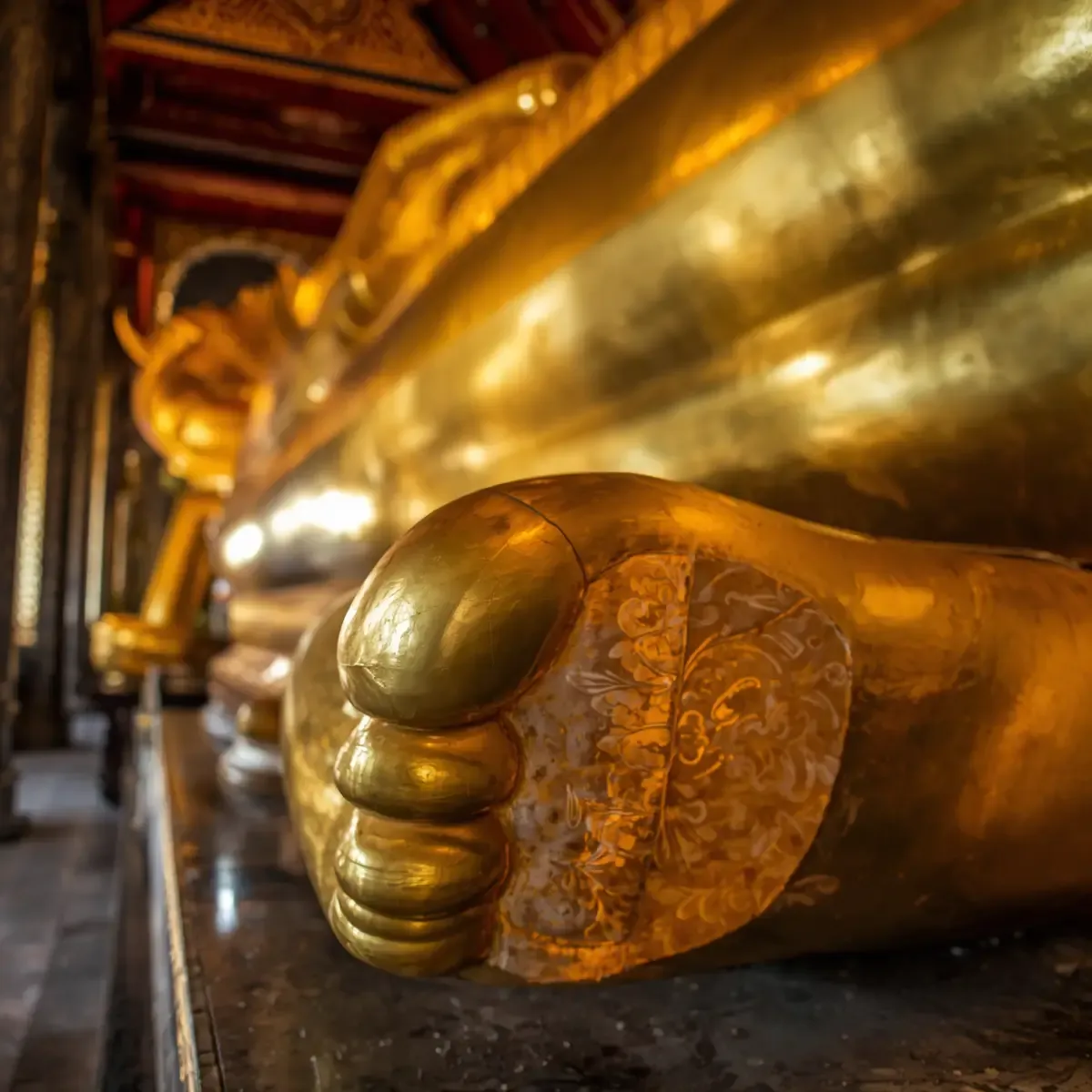
A forty-six-metre reclining Buddha in a hall barely larger than the figure itself, so you never see it whole — only in sections, ending at the mother-of-pearl soles inlaid with 108 auspicious symbols. Beyond it sits the quieter half most tours skip: ninety-one chedis, the inscribed stone tablets that make this Thailand's first public university, and the massage school that still teaches here.
- Entry: THB 300 (USD 8.50) per person — raised from earlier rates, so older guides understate it
- Hours: 08:00–18:30 daily
- Payment: cash only
- Time needed: 45–60 minutes
Wat Arun
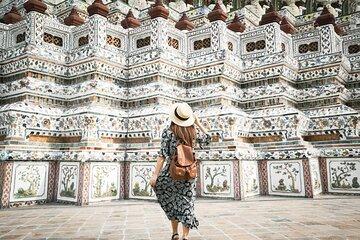
The porcelain prang on the Thonburi bank, encrusted with shards of Chinese ceramic that arrived as ballast in nineteenth-century trading ships. Close up it is stranger than the photographs suggest — floral patterns, demon faces and geometric mosaic assembled from broken dishes.
- Entry: THB 200 (USD 5.50) per person
- Hours: 08:00–18:00 daily
- Payment: cash only, and the cross-river ferry from Tha Tien is a few baht in coins
- Time needed: 45–60 minutes
Wat Traimit
A marble hall in Chinatown holding a three-metre, five-and-a-half-tonne Buddha of solid gold, hidden under plaster for roughly two centuries and revealed in 1955 when the stucco cracked during a move. The upper-floor museum covers both that discovery and the history of Yaowarat itself.
- Entry: THB 100 (USD 3) for the Golden Buddha, THB 100 (USD 3) for the museum
- Hours: 08:00–17:00 daily, museum closed Mondays
- Access: the Buddha hall is three flights up
- Time needed: 30–45 minutes
Reality check: the Wat Arun climb is restricted
- Access up the central prang is limited to the lower terrace as of 2026 — the upper stairs remain closed following the long restoration.
- The lower terrace still gives you the river and a clear line across to the Grand Palace, so the view is not the loss people expect.
- The THB 200 ticket covers the main temple zone; the outer grounds and smaller shrines are open to walk without it.
- The definitive photograph of the prang is taken from the east bank near Tha Tien, not from inside the grounds.




What a Grand Palace half day tour costs in 2026
Budget THB 2,200–4,500 (USD 62–126) per person all-in for a join-in group tour, and THB 5,500–9,000 (USD 154–252) per person for a private guide and vehicle with two travelling. The headline tour price is only part of it — the variable that moves the total most is whether entry fees are included, and that alone is worth about THB 1,000 (USD 28) per person.
Tour prices by format
- Join-in group, river route: THB 1,200–3,500 (USD 34–98) per person, entry fees usually excluded
- Join-in group, Chinatown route with minivan: THB 2,500–4,000 (USD 70–112) per person, entry fees usually included
- Private guide and vehicle: THB 4,500–8,000 (USD 126–224) total for two, falling sharply per head as the group grows
- Licensed guide meeting you at the gate, no vehicle: THB 2,500–4,000 (USD 70–112) for the group, fees and transport your own
- Outer-zone hotel pickup supplement: around THB 320 (USD 9) per adult
Entry fees you pay on the day
These are 2026 published rates for foreign visitors, and they are the same whether you arrive with a guide or alone. There is no group discount at any of the four gates.
- Grand Palace and Wat Phra Kaew: THB 500 (USD 14)
- Wat Pho: THB 300 (USD 8.50)
- Wat Arun: THB 200 (USD 5.50)
- Wat Traimit: THB 100 (USD 3), plus THB 100 (USD 3) for the museum
- River route total: THB 1,000 (USD 28) per person
- Chinatown route total: THB 900–1,000 (USD 25–28) per person
Reality check: the line that decides your real price
- Many listings state that entrance fees are not included and must be paid in cash on the day — often quoted as around THB 1,000 per person.
- A THB 1,400 tour with fees excluded and a THB 2,400 tour with fees included cost the same. Compare totals, never headline rates.
- Carry the fee money in small baht notes. Wat Pho and Wat Arun do not take cards, and QR payment is unreliable at temple counters.
- Where a tour does include fees, it usually also means your guide holds the tickets and you skip the ticket-window queue, though not the security line.
What is usually included, and what is not
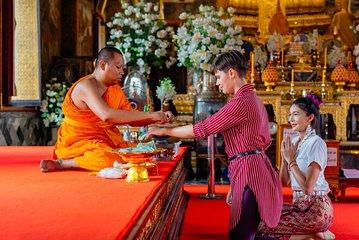
Across both routes, the standard inclusion set is an English-speaking licensed guide, transport between stops, bottled water, and hotel pickup and drop-off on the van-based versions. Consistently excluded: lunch, gratuities, the cross-river ferry fare on the river route, sarong or trouser hire if you arrive dressed wrongly, and Thai costume rental at Wat Arun, which runs THB 200–600 (USD 5.50–17) for a couple of hours. Every option listed on Travjoy has been researched and approved by local experts, so the inclusions are stated plainly rather than buried in the terms.

Which version should you choose?
Choose the private option if your time in Bangkok is short or your group is three or more, and the join-in group if you are two travellers with a flexible afternoon. The route question is separate and simpler: take the river if you want the photograph, the road if you want the comfort.
Couples and returning visitors
Take a private guide on the river route, starting at 08:15. You control the pace inside the palace, which is where a private booking earns its cost, and you can extend the morning at Wat Arun rather than being walked back to a van. If you have already seen the Grand Palace, ask the guide to open at Wat Pho instead and use the saved hour on the massage school or the Ramakien stone inscriptions.
Families with children
The Chinatown route in an air-conditioned van, with an early start. There is less walking, no ferry queue with tired children, and the Golden Buddha holds attention in a way that a third temple courtyard does not. Children under 120cm enter the Grand Palace free. Build in the dress code before you leave the hotel — a child turned away at the gate resets the whole morning.
Travellers with limited mobility
Private, Chinatown route, and be direct with the operator about what is workable. The palace compound is flat but long, Wat Pho is the most accessible of the four, and Wat Traimit's Golden Buddha involves three flights of stairs with no lift on most approaches. A private guide can restructure the order and hold the vehicle close to each gate.
Photographers
A Grand Palace half day tour is the wrong tool for Wat Arun at its best. Take the morning tour for the palace and Wat Pho, then return independently to the east bank near Tha Tien at dusk, when the prang lights and the crowds inside have gone. For broader options across the old city, the Bangkok temple tours page sets out the formats side by side.
Business travellers with one free morning
Private, either route, 08:00 start, back at the hotel by 12:30. This is the single strongest case for paying for a private booking: you are buying certainty of finish time, which no join-in group can offer once traffic is involved.
Timing, dress and the details that decide your morning
Start at 08:15 and the day works; start at 13:00 and it may not exist. The Grand Palace closes at 15:30 with ticket sales ending around 15:00, so an afternoon Grand Palace half day tour has to compress three sites into a window that barely fits two. Almost every operator runs this itinerary in the morning for that reason.
The clock
- Gates open: 08:30 at the Grand Palace; arrive by 08:15 to be through security near the front
- Coach groups arrive: from around 09:30, after which the Emerald Buddha hall queues noticeably
- Last tickets: approximately 15:00–15:15, with the complex closing at 15:30
- Best months: November to February, when the compound is walkable at midday rather than punishing
- Closures: parts of the palace shut for royal ceremonies, sometimes announced at short notice
Dress code, and why it is enforced here
Shoulders and knees covered, for everyone. The Grand Palace applies this more strictly than any other site in the city and turns people away at the gate daily. Sleeveless tops, shorts, ripped jeans, cropped garments and see-through fabric are refused; leggings alone are frequently refused too. Sarongs and trousers can be hired at the entrance, but the queue for them at 09:00 is its own delay. Shoes come off inside ordination halls, so wear something you can slip out of quickly rather than laced boots.
Cash, ferries and the ground between stops
- Grand Palace to Wat Pho: 10 minutes on foot
- Wat Pho to Tha Tien pier: 3 minutes on foot
- Cross-river ferry to Wat Arun: a few baht in coins, departures roughly every 10 minutes, crossing 2–3 minutes
- Wat Pho and Wat Arun: cash only at the ticket counters
- Water: there is nothing to buy inside the palace compound — carry a bottle in
Reality check: tickets, and the approach outside the gate
- There is no official online ticketing system for individual visitors to the Grand Palace in 2026. Tickets are sold at the West Gate on Na Phra Lan Road on the day. Third-party sites advertising pre-booked palace tickets are unofficial.
- The pavement outside is the most persistent approach spot in Bangkok. The standard line is that the palace is closed today for a ceremony or holiday, followed by a tuk-tuk offering an alternative temple tour that ends at a gem shop or tailor.
- The palace does not close mid-day for tourists. Walk to the gate and check for yourself.
- If a booked tour includes fees, your guide carries the tickets — which is the cleanest way to bypass the whole exchange.
Planning your morning in the old city
Three things settle this booking. First, check which third temple your itinerary names — Wat Arun and Wat Traimit produce different mornings under the same title. Second, compare totals rather than headline prices, because the THB 1,000 (USD 28) in entry fees is included on some listings and not others. Third, book the morning slot; the palace's 15:30 close makes afternoon starts a gamble.
Get those right and four hours is enough for the Emerald Buddha, a forty-six-metre reclining Buddha and a third temple with room to breathe. Compare the formats and see what else pairs well with your morning across our top 20 Bangkok experiences, then start planning your trip to Bangkok on Travjoy.


.svg&w=1920&q=75)