


Chinatown Singapore: Best Streets, Temples & Food Spots to Visit
16 min read

Author
SHARE BLOG
TABLE OF CONTENTS
- Chinatown Singapore is best explored on foot over a half-day — temples, hawker centres, and heritage streets are all within a compact, walkable area.
- The Buddha Tooth Relic Temple and Sri Mariamman Temple are the two anchor religious sites; both allow visitors and both are free to enter.
- Maxwell Food Centre and Chinatown Complex Food Centre are your two best hawker stops — arrive before noon to beat the lunch queue at Maxwell's famous Tian Tian stall.
- Pagoda Street is the obvious starting point, but the quieter lanes — Temple Street, Ann Siang Hill, Keong Saik Road — are where Chinatown's character really shows.
- Arrive early (before 10am) or after 5pm; midday crowds on weekends can make the main streets very slow to navigate.
Chinatown Singapore packs more cultural variety into a few city blocks than almost anywhere else in Southeast Asia. Within a ten-minute walk you can move from a gilded Buddhist temple to Singapore's oldest Hindu shrine to a Michelin-starred hawker stall — and that's before you've explored the shophouse laneways, street art murals, and traditional tea shops. This guide covers the streets worth walking, the temples worth stepping inside, and the food spots worth building your visit around.

Best Streets to Walk in Chinatown Singapore
Chinatown Singapore's most rewarding walks happen on the smaller, less photographed streets — though the main drags have their place too. The neighbourhood divides roughly into a tourist-facing core (Pagoda, Temple, and Smith streets) and a quieter, more residential and bar-oriented fringe (Ann Siang Hill, Keong Saik Road, Club Street). Both are worth your time, but for different reasons.
Pagoda Street — The Main Entry Point
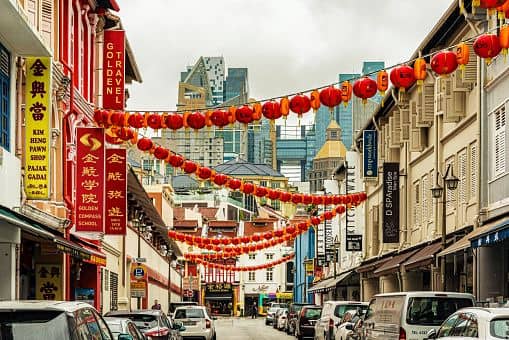
Exit A from Chinatown MRT station deposits you directly onto Pagoda Street, and it earns its status as the neighbourhood's central spine. The street runs between New Bridge Road and South Bridge Road, lined on both sides with two-storey conservation shophouses painted in deep reds, yellows, and greens. Overhead, red lanterns hang in dense clusters — the effect is most dramatic in early morning light or after dark.
The street takes its name not from a Chinese pagoda but from the pagoda-like gopuram of Sri Mariamman Temple, whose tower is visible at the far end. Historically, Pagoda Street was a coolie trade station in the 1850s to 1880s, before reinventing itself as a textile and tailoring hub by the mid-20th century. The Chinatown Heritage Centre, set across three restored 1950s shophouses on this street, tells that story well — the upper floors recreate cramped living quarters, shared kitchens, and the sounds of working-class life in early Singapore.
- Best for: First-time visitors, souvenir shopping, photography
- Quietest window: Before 10am on weekdays
- Crowded from: 11am onwards on weekends
Temple Street and Smith Street — Where the Street Food Lives
Temple Street runs parallel to Pagoda Street and has a slightly more local feel — fewer dedicated souvenir stalls and more old-school trades like watch repair and traditional kitchenware. It's also the best street for heritage murals. Local artist Yip Yew Chong's large-scale works appear on several walls here, depicting scenes of everyday life in mid-century Singapore: roadside barbers, five-foot-way vendors, children playing between shophouse pillars.
Smith Street, once known as Food Street, is lined with restaurants and casual Chinese eateries. It connects Temple Street to South Bridge Road and makes a natural loop back towards the MRT. If you walk both streets in sequence, the round trip from Pagoda Street takes around 30–40 minutes at a relaxed pace.
Ann Siang Hill and Club Street — The Quieter, Cooler End
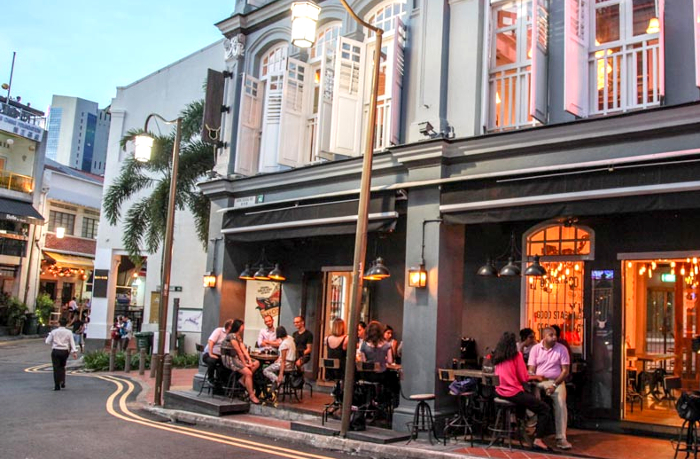
Ann Siang Hill and Club Street sit at the southern edge of Chinatown and feel like a different neighbourhood entirely. The streets are narrower and steeper, the shophouses are better preserved, and the ground floors house boutique wine bars, specialty coffee shops, and design-forward independent stores rather than souvenir stalls. On Friday and Saturday evenings, both roads close to traffic and the atmosphere shifts to something more like a European piazza — tables spill out onto the road, residents join tourists, and the pace slows considerably.
- Best for: Couples, post-dinner drinks, boutique browsing
- Friday and Saturday nights: Roads close to traffic from around 7pm
Keong Saik Road — The Local's Favourite
A ten-minute walk from Chinatown MRT, Keong Saik Road is the kind of street that doesn't make it onto most tourist maps but rewards visitors who find it. The stretch between Cantonment Road and New Bridge Road is lined with restored Peranakan shophouses and contains some of Singapore's most talked-about casual restaurants and bars. It's a useful base for an evening visit — less crowded than Ann Siang Hill, with a more neighbourhood-local feel.
Temples in Chinatown Singapore Worth Stepping Inside
Four places of worship within a short walk of each other make Chinatown Singapore one of the most religiously diverse neighbourhoods in the region. Three of the four are among Singapore's oldest religious buildings, and all four are free to enter. Dress modestly (shoulders and knees covered) for all of them.
Buddha Tooth Relic Temple
The Buddha Tooth Relic Temple on South Bridge Road is the neighbourhood's most architecturally dramatic building — five storeys of gilded halls and sweeping red-tiled roofs, completed in 2007 and styled after the Tang Dynasty. The ground-floor Hundred Dragon Hall is dominated by a 15-foot gold Buddha statue and is the most photographed interior in Chinatown. Most visitors stop there, which means the upper floors are often quieter and worth the climb.
The third floor houses the Nagapuspa Buddhist Culture Museum, which displays an extensive collection of Buddhist art and artefacts from across Asia. The fourth floor is the Sacred Light Hall, where the Buddha Tooth Relic itself is held — photography is not permitted in this room. The rooftop garden offers a calm contrast to the streets below, with a large prayer wheel and views across South Bridge Road.
Buddha Tooth Relic Temple — At a Glance
- Address: 288 South Bridge Road, Singapore 058840
- Opening hours: Daily 7am – 7pm
- Entry: Free
- Photography: Permitted on all floors except the 4th-floor Sacred Light Hall
- Dress code: Shoulders and knees covered; sarongs available at the entrance
Sri Mariamman Temple
Singapore's oldest Hindu temple, Sri Mariamman Temple on South Bridge Road dates to 1827. Its gopuram — the multi-tiered entrance tower — rises in six tiers of hand-sculpted, brightly painted deities: gods, goddesses, animals, and mythological figures layered across the entire face of the structure. The detail is dense enough that you'll still be spotting new figures after ten minutes of looking.
The temple is dedicated to the goddess Mariamman, historically worshipped for protection against disease. It remains an active place of worship for Singapore's Tamil Hindu community, so timing matters: arrive outside of main prayer times (typically early morning and evening) if you want to explore the interior calmly.
- Address: 244 South Bridge Road, Singapore 058793
- Opening hours: Daily 5:30am – 12pm, 6pm – 9pm
- Entry: Free (shoes must be removed at the entrance)
Thian Hock Keng Temple
Singapore's oldest Hokkien temple sits on Telok Ayer Street, a short walk from Chinatown MRT. Built between 1839 and 1842, Thian Hock Keng — which translates as "Temple of Heavenly Happiness" — was originally a joss house where sailors gave thanks for safe passage after crossing the South China Sea. The building combines Confucian, Buddhist, and Taoist iconography, with no nails used in its original construction.
The temple is notably quieter than Buddha Tooth and Sri Mariamman, which makes it one of the better options if you want to experience an active place of worship without the tourist crowds. Along the outer wall, artist Yip Yew Chong's 44-metre mural — completed across ten weekends — depicts the street life and trades that once surrounded the temple. It's worth walking the full length of it.
Masjid Jamae — South Bridge Road's Third Place of Worship
Standing almost directly across South Bridge Road from Sri Mariamman Temple, Masjid Jamae (also called Chulia Mosque) was completed in 1826, making it one year older than its Hindu neighbour. The mosque was built by Tamil Muslim traders from the Chulia community and its architecture is an unusual blend of Indian, Islamic, and European classical styles — two simple minarets, a low-walled entrance courtyard, and a whitewashed facade that looks nothing like the ornate mosques found elsewhere in Singapore.
Visitors are welcome outside of prayer times; modest dress and removed footwear are required.

Best Food Spots in Chinatown Singapore
The food in Chinatown Singapore ranges from Michelin-starred hawker stalls to century-old bakeries to traditional tea houses — and most of it is extraordinarily good value. The neighbourhood has three hawker centres within a five-minute walk of each other, plus a dense concentration of coffee shops, pastry counters, and sit-down restaurants along South Bridge Road and the surrounding streets.
Maxwell Food Centre — The One to Prioritise
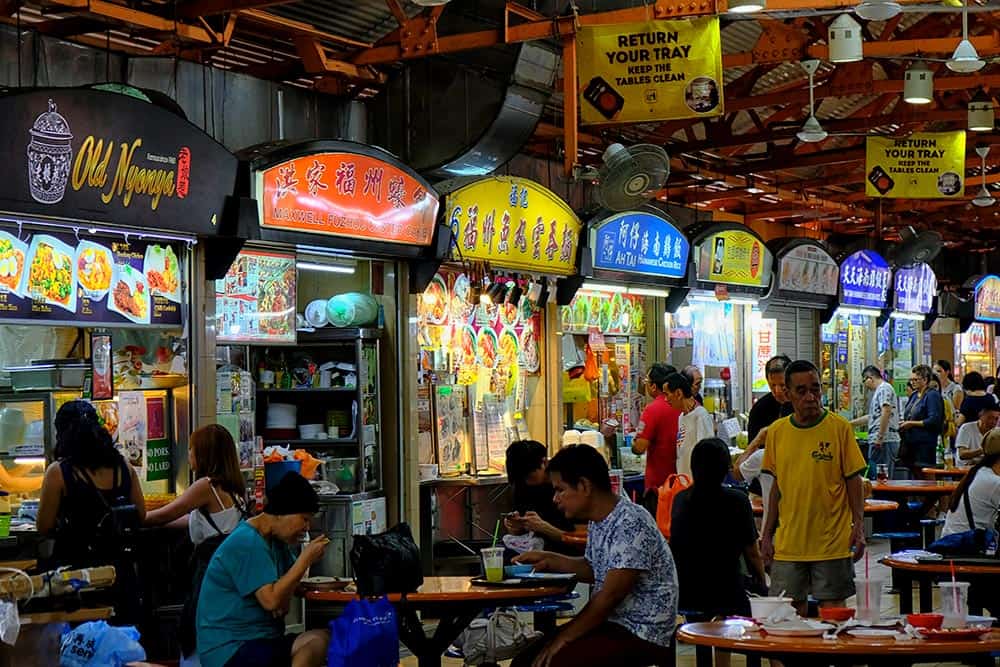
Maxwell Food Centre on Maxwell Road is the hawker centre most visitors build their Chinatown itinerary around, and it earns that status. The stall that draws the longest queues is Tian Tian Hainanese Chicken Rice — poached chicken, fragrant rice cooked in chicken stock, and a sharp chilli sauce that's been cited more often than any other stall in Singapore when the subject of the city's signature dish comes up. Arrive before 11:30am or expect to wait.
Beyond Tian Tian, Maxwell has over 100 stalls covering a wide spread of Singapore's classic dishes: satay, lor mee, ice kachang, fresh fruit juice, Teochew porridge, and popiah. The centre is also well-suited for groups with different preferences — split up, find what you want, and reconvene at a shared table.
- Address: 1 Kadayanallah Rd, Singapore 069184
- Opening hours: Most stalls open 8am – 9pm; some close on Mondays
- Best time to visit: Before noon or after 2pm to avoid the lunch rush
- Price range: SGD 3–8 per dish
Chinatown Complex Food Centre — Singapore's Largest Hawker Hall
The Chinatown Complex Food Centre on New Bridge Road is, by stall count, the biggest hawker centre in Singapore — over 260 food stalls across one sprawling floor. It's noisier and less curated than Maxwell, which is part of its appeal. The atmosphere is genuinely local rather than tourist-facing.
The stall that put this complex on the international map is Liao Fan Hawker Chan, which received a Michelin star in 2016 — making its char siu (barbecued pork) and soy sauce chicken among the cheapest Michelin-starred dishes in the world. Prices have risen slightly since then, but a full plate still comes in well under SGD 15. Outside of Hawker Chan, look for the braised duck rice and wonton noodle stalls, which have their own loyal following among regulars.
- Address: 335 Smith Street, Singapore 050335
- Opening hours: Most stalls open from 6am; centre closes around 11pm
- Hawker Chan queue tip: The queue moves faster than it looks — plan 20–30 minutes
Quick-Reference: Chinatown Food Classics to Try
- Hainanese Chicken Rice — Tian Tian, Maxwell Food Centre (stall 10-01)
- Soy Sauce Chicken / Char Siu — Liao Fan Hawker Chan, Chinatown Complex
- Egg Tarts and Mooncakes — Tong Heng Bakery, 285 South Bridge Road (open since 1943)
- Traditional Kopi — Nanyang Old Coffee, 268 South Bridge Road (small museum upstairs)
- Snow Ice Desserts — Mei Heong Yuen Dessert, Temple Street
- Dim Sum — multiple restaurants along South Bridge Road and Mosque Street
Amoy Street Food Centre — The Quieter Alternative
Amoy Street Food Centre, a short walk east of Chinatown MRT near Telok Ayer Street, draws a strong weekday lunch crowd from the surrounding CBD office buildings — which means it's very busy between noon and 2pm on weekdays, and much quieter on weekends. The food quality is consistently high, the stalls rotate less than at Maxwell, and the covered ground floor stays reasonably cool. Look for the bee hoon mee stalls and the Hokkien prawn mee on the upper level.
Heritage, Art, and Things to See Beyond the Main Streets
The streets and temples cover most of a half-day, but if you have time, Chinatown Singapore has a few additional layers worth exploring — particularly for those interested in heritage architecture, street art, and traditional trades.
Chinatown Heritage Centre
Set in three adjoining shophouses on Pagoda Street, the Chinatown Heritage Centre is the most immersive way to understand why this neighbourhood looks and feels the way it does. The upper floors reconstruct life in a 1950s Chinatown shophouse with near-theatrical detail: the shared cooking area, the cramped multi-family sleeping quarters divided by plywood partitions, the sounds of hawkers calling from the street below. The centre gives context to the five-foot ways (the covered walkways stipulated by Raffles' 1822 town plan), the dialect group divisions, and the waves of immigration that shaped the community.
Street Art and Yip Yew Chong's Murals
The most significant murals in Chinatown are by local artist Yip Yew Chong, who grew up near the area and paints from memory and archive photographs. His works appear on Temple Street, Mohamed Ali Lane, the alley behind Amoy Street Food Centre, and along the outer wall of Thian Hock Keng Temple. The paintings are not signposted — finding them is part of the experience. The Thian Hock Keng mural, at 44 metres long, is the most ambitious single piece: a continuous street scene depicting trades and communities that once operated along Telok Ayer Street.
Traditional Tea Shops on Mosque Street
Mosque Street has a cluster of traditional tea houses that have been operating for generations. Yixing Xuan has been offering tastings since 1989, with over 60 teas available from delicate white teas to aged pu-erh. One-hour guided tasting workshops are bookable in advance. Pek Sin Choon, established in 1925 on nearby Mosque Street, stocks over 80 loose-leaf varieties and makes for a good souvenir stop — the tins are well-packaged and travel well.
When to Visit Chinatown Singapore and Practical Tips
The practical question most visitors face is not whether to visit Chinatown Singapore but when and how to structure the visit to avoid the worst of the crowds without sacrificing the atmosphere that makes the area worth visiting in the first place.
Best Time of Day
Early morning (before 10am) gives you the shophouses and street decorations almost to yourself — the lanterns and facades photograph better in softer morning light anyway, and the hawker centres are open and serving but not yet crowded. Midday on weekends is the busiest window, particularly on Pagoda Street and around Maxwell Food Centre. If you're visiting in the evening, the neighbourhood genuinely transforms: the lanterns illuminate, Ann Siang Hill and Club Street fill with a dinner and drinks crowd, and some of the heritage murals are spotlit.
Best Time of Year
Chinese New Year (typically January or February) turns Chinatown into its most spectacular version — light installations run the full length of South Bridge Road, street food stalls multiply, and the night market runs for weeks before the festival itself. The trade-off is significant crowds and some road closures. The Mid-Autumn Festival (usually September or October) is a quieter alternative, with lantern displays and mooncake stalls adding visual interest without the same volume of visitors.
Getting There
- Chinatown MRT Station (NE4/DT19) — served by the North East Line and Downtown Line; Exit A puts you directly on Pagoda Street
- Maxwell MRT Station (TE18, Thomson-East Coast Line) — convenient if your first stop is Maxwell Food Centre or the Singapore City Gallery
- From Orchard Road: approx. 15 minutes by MRT (change at Dhoby Ghaut or Outram Park)
- From Marina Bay Sands: approx. 10 minutes by MRT via Downtown Line
How Long to Spend
- Quick visit (1.5–2 hours): Pagoda Street walk + Buddha Tooth Relic Temple + Maxwell Food Centre
- Half-day (3–4 hours): Add Sri Mariamman Temple, Thian Hock Keng Temple, Chinatown Heritage Centre, and a wander through Ann Siang Hill
- Full day: All of the above + Keong Saik Road, Amoy Street Food Centre, street art hunting, and evening drinks on Club Street
Dress Code for Temples
Shoulders and knees should be covered when entering any of Chinatown's places of worship. Sarongs are available to borrow at the entrance of the Buddha Tooth Relic Temple and Sri Mariamman Temple. Shoes must be removed at all temple entrances — wear slip-ons or sandals if possible.
Planning Your Chinatown Visit as Part of a Singapore Trip
Chinatown pairs naturally with several nearby neighbourhoods. The CBD and Telok Ayer area (home to Thian Hock Keng and the Fuk Tak Chi Museum) is a short walk east. Little India and Kampong Glam — which together with Chinatown form the three historic ethnic quarters of central Singapore — are both reachable within two MRT stops. If you're building a full-day itinerary, a morning in Chinatown followed by an afternoon in either Kampong Glam (for Haji Lane boutiques and the Sultan Mosque) or along the Singapore River (for the Asian Civilisations Museum and a walk past the colonial district) is a natural combination.
Travjoy's top Singapore picks cover the full spread of the city — from Sentosa's beach clubs to the Botanic Gardens — so if Chinatown is your base and you're planning what to add around it, that's a useful reference for what's worth the journey from this part of town.
For a city that moves as quickly as Singapore, Chinatown is a reminder that the most interesting neighbourhoods are the ones that have managed to stay themselves. The conservation shophouses, the working temples, and the hawker centres that have fed the same regulars for decades — these aren't heritage displays. They're still in use, which is exactly what makes this district worth a half-day of your time in Singapore.
Ready to explore Chinatown and the rest of Singapore? Browse Travjoy's Singapore experiences — curated after extensive research and reviewed by local experts — to find tours, food experiences, and cultural activities that make the most of your time in the city.

.svg&w=1920&q=75)