



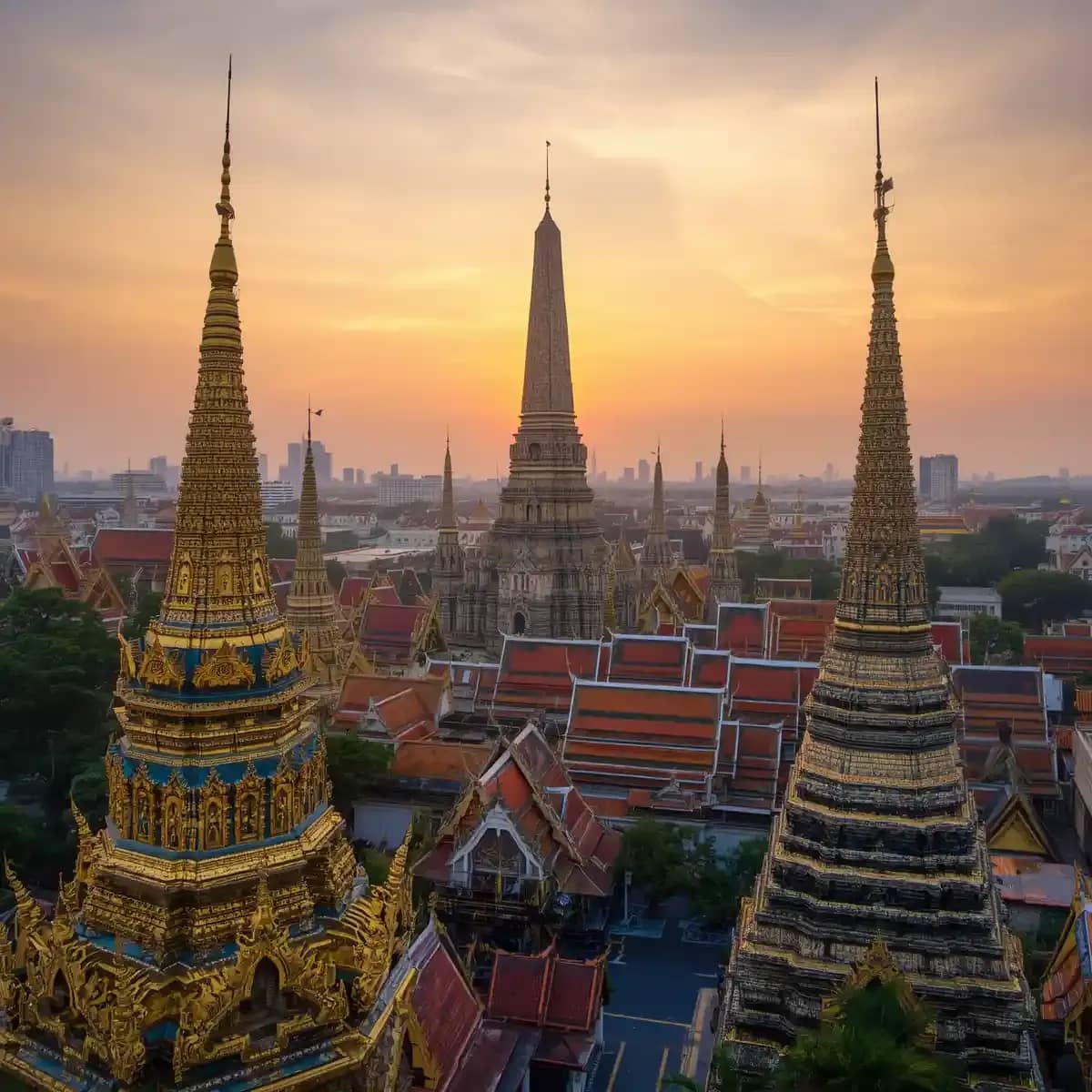
Bangkok Temples Tour: Wat Arun, Wat Pho and Wat Saket — A Complete Guide for Discerning Travellers
10 min read
Key Highlights
- This trio drops the Grand Palace, which removes the 15:30 ticket cut-off and lets the day finish on a sunset terrace instead of starting in a queue.
- Combined 2026 entry is 600 THB (about USD 17) — Wat Pho 300 THB, Wat Arun 200 THB, Wat Saket 100 THB. Wat Pho and Wat Arun take cash only.
- Guided formats run from roughly 900 THB (USD 25) for a shared walking group to 6,400 THB (USD 185) for a private car with a licensed guide.
- Wat Arun's central prang can be climbed to the lower terrace only as of 2026 — the river view is unaffected.
- Wat Saket's 344 steps are gradual rather than steep, but the summit terrace is small, so arrival time matters more than fitness.
A Bangkok temples tour covering Wat Arun, Wat Pho and Wat Saket takes three to five hours and costs roughly 900–6,400 THB (USD 25–185) per person in 2026, depending on whether you book a shared walking group, a private tuk-tuk, or a private car with a licensed guide. Entry fees total 600 THB (about USD 17) and sit outside most tour prices. The route moves west to east across the day: Wat Pho and the cross-river ferry to Wat Arun in the morning, then Wat Saket for the last hour of light.
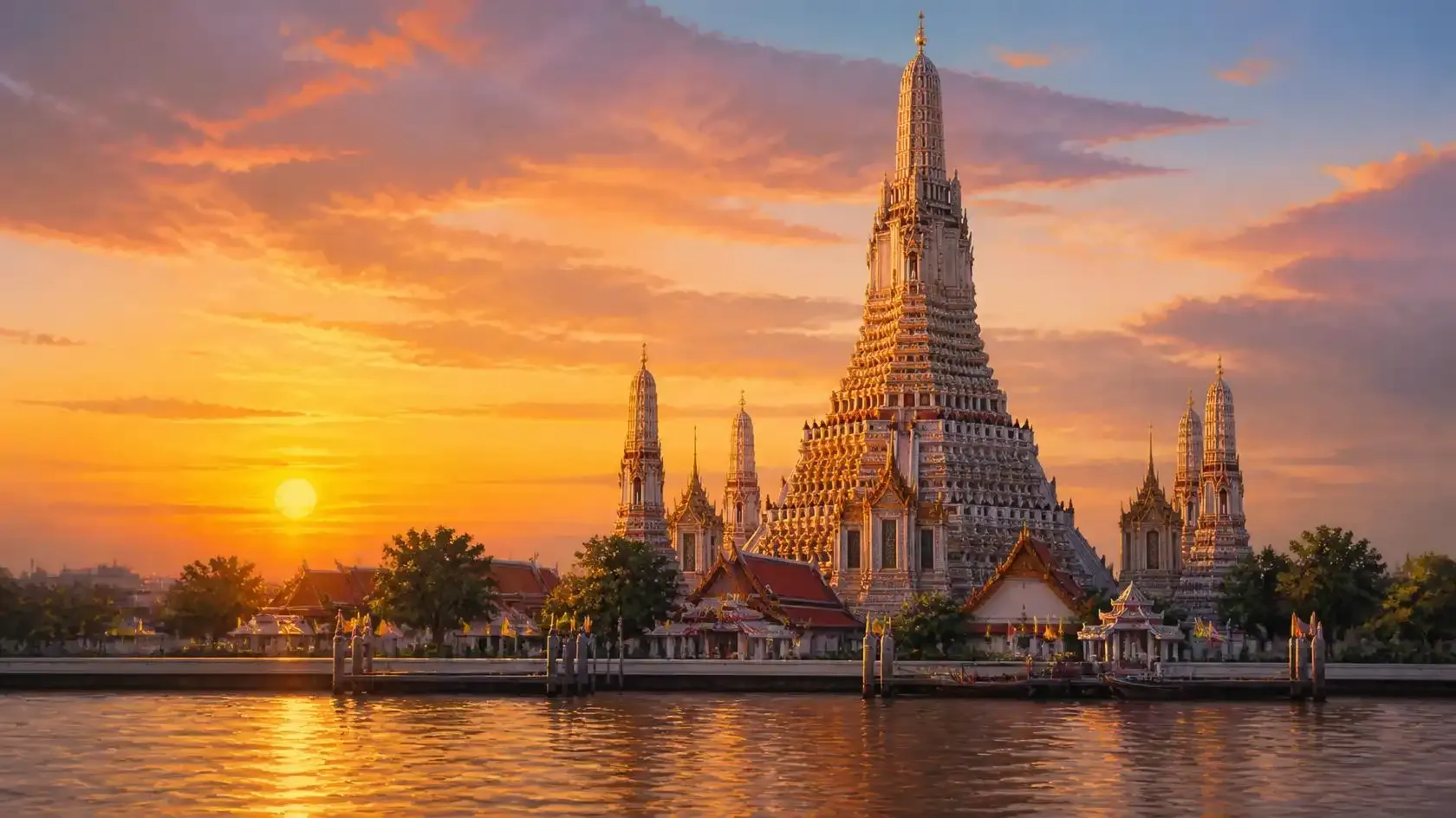
Most Bangkok temple itineraries open at the Grand Palace, and most of them are shaped by it — the 15:30 ticket cut-off, the strictest dress enforcement in the city, and a first courtyard that fills by half past nine. The temple route at Wat Arun, Wat Pho and Wat Saket does something different. It leaves the palace out and picks up a hilltop terrace at dusk instead.
That one swap changes the shape of the day. You are no longer racing a ticket window, so the morning can be slower and the afternoon can hold. You also get three distinct registers rather than three variations on royal gold: a working monastery that doubles as Thailand's oldest teaching institution, a river-facing prang built to be read from the water, and a man-made hill with a 360-degree view over the old city.
This guide covers what each temple actually gives you, current entry fees and hours, how the route sequences, what the guided formats cost in 2026, and which version suits which kind of traveller.
Is a Bangkok temples tour worth it?
Yes, if you want the three temples read rather than photographed. Wat Pho and Wat Arun are dense with iconography that means very little unlabelled, and almost none of it is explained on site in English beyond a name plate. A licensed guide is the difference between forty minutes of walking past gold and forty minutes of understanding what you are looking at. The logistics case is thinner — the route is walkable and the ferry is simple — so the value sits almost entirely in interpretation and in having the timing handled.
Worth it if
- You are on a second or third Bangkok trip and have already done the Grand Palace circuit, so you want depth on fewer sites rather than another sweep of the highlights.
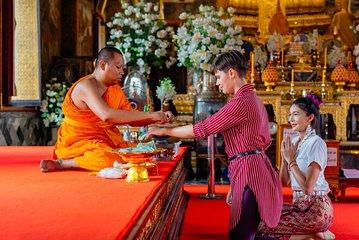
- You want the Buddhist iconography, the Ramakien murals, and the Rama III inscriptions explained by someone who can answer follow-up questions.
- You are travelling in the hot season and would rather have transfers, water, and the sunset timing managed than work it out at street level in 38-degree heat.
- You want a private slot that can be reshaped mid-morning if the light or the crowds change.
Not ideal if
- You have already visited all three and are looking for something further out — Ayutthaya or the Thonburi canal temples serve that better.
- You want unhurried photography time. Group formats hold a pace, and the Wat Saket terrace at sunset gives you perhaps twenty usable minutes.
- Stairs are a problem. Wat Saket's climb has no lift and no alternative route to the chedi.
- You are short on time and the Grand Palace is still unseen — in that case the palace trio is the better first pass, and this route is what you come back for.
Reality check: the fee everyone quotes is out of date
- Wat Pho now charges 300 THB (about USD 8.50) for foreign visitors. A large share of guides still quote 100 or 200 THB — the increase funds ongoing stupa and mural restoration.
- Children under 120 cm enter Wat Pho free.
- Budget 600 THB per adult for all three temples, and carry it in cash.
The three temples, and what each one actually gives you
These three are not interchangeable, and that is the argument for this Bangkok temples tour over a generic three-wat sweep. Each one is the best example in the city of a different thing, which is why the combination holds up better than the temple count suggests.
Wat Pho — the reclining Buddha and Thailand's first open university
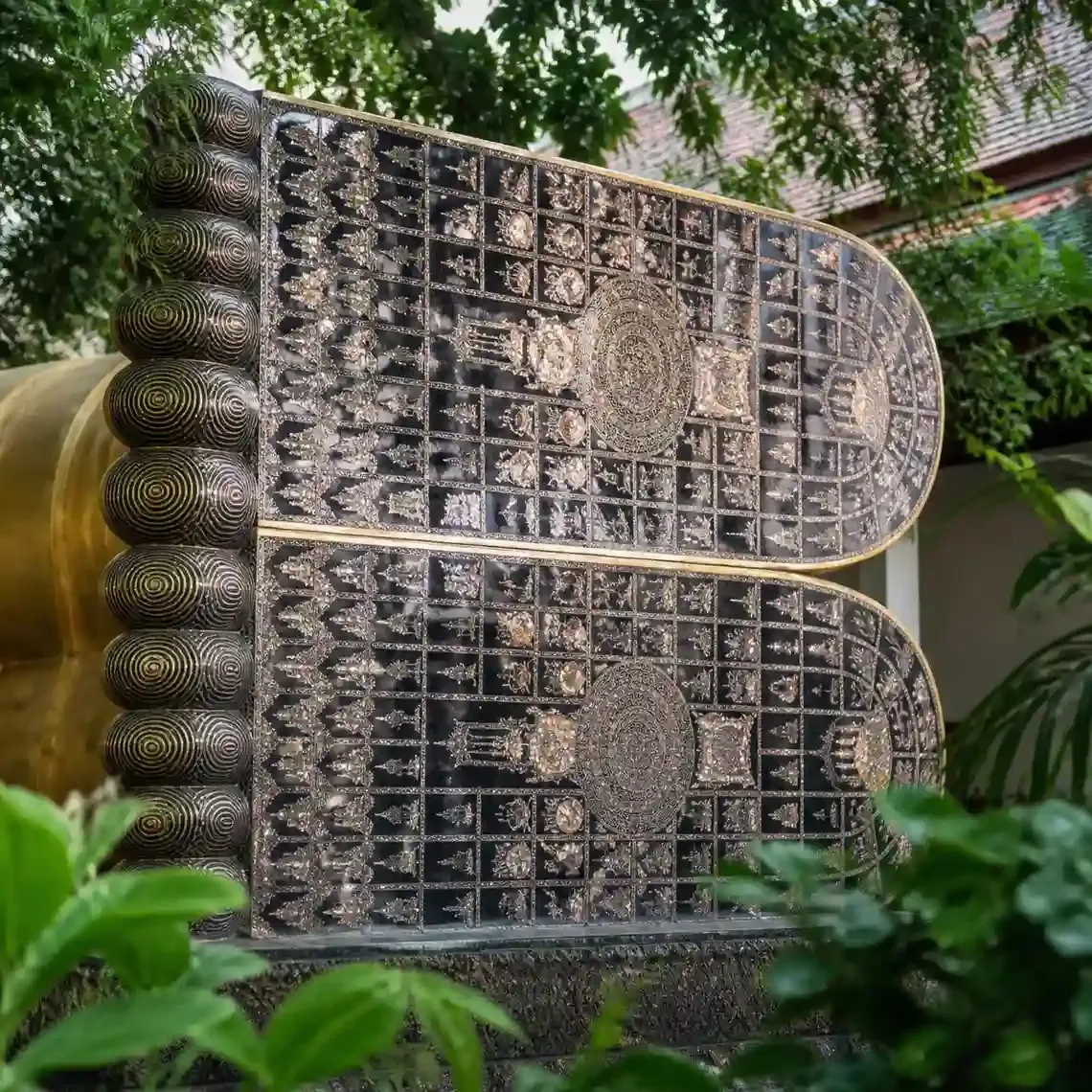
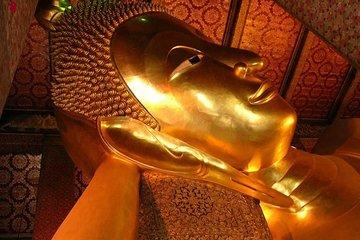
Wat Pho is the oldest and largest temple complex in Bangkok, and the 46-metre gold-leaf reclining Buddha is only its most photographed part. The figure lies in the sihasaiyas or "sleeping lion" posture, marking the Buddha's passage into nirvana, and the soles of its feet — each roughly 4.5 metres high — carry 108 mother-of-pearl panels of the auspicious marks by which he is identified.
The part most visitors walk past is the reason Wat Pho matters historically. King Rama III had more than 1,400 stone tablets inscribed and set into the walls and pavilions in the 1830s, covering medicine, astronomy, literature, warfare and massage, and put them on public display as a form of open education. UNESCO added the collection to its Memory of the World register in 2011. The Thai traditional medicine and massage school that grew out of those inscriptions still operates on the grounds.
- Entry: 300 THB (about USD 8.50), cash only
- Hours: daily 08:00–19:30; the reclining Buddha hall and main buildings usually close around 18:30
- Time needed: 60–90 minutes, or two hours if you add a massage
- Massage on site: from around 260 THB (USD 7.50) for 30 minutes, 420 THB (USD 12) for an hour — walk-in only, no advance booking
- The 108 bowls: a bowl of coins costs about 20 THB inside; dropping one in each bronze bowl along the corridor is a merit-making practice, not a photo stop
Wat Arun — the temple built to be read from the water
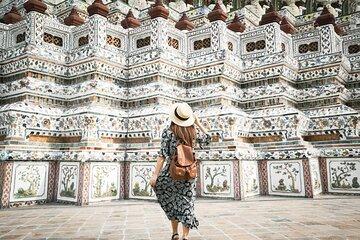
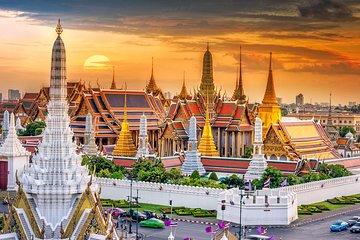
Wat Arun sits on the Thonburi bank, and its 82-metre central prang is clad in millions of fragments of Chinese porcelain and seashell, arranged into floral tiers. Up close the surface reads as broken crockery pressed into mortar, which is exactly what it is — ballast from Chinese trading ships, repurposed. From across the river it reads as mother-of-pearl. The temple was designed with that second view in mind, which is why the standard advice to photograph it from the east bank is not a workaround but the intended angle.
The Temple of Dawn is a slight misnomer for the visitor. The name comes from Aruna, the Hindu deity of dawn, but the west-facing prang takes direct light in the late afternoon, not the morning.
- Entry: 200 THB (about USD 5.70), cash only
- Hours: daily 08:00–18:00
- Time needed: 45–60 minutes
- Getting there: the cross-river ferry from Tha Tien Pier, immediately south of Wat Pho, costs 3–5 THB and runs every few minutes
- Thai costume rental: from around 300 THB for a standard set, 600 THB for silk with accessories, typically covering two to three hours
Reality check: how far up the prang you can actually go
- As of 2026, climbing is limited to the lower terrace. The upper staircases are closed to visitors.
- This has changed before — access was suspended entirely during the 2013–2017 restoration — so confirm on the day.
- The lower terrace still gives you the full river frontage, the Grand Palace skyline opposite, and a close read of the porcelain work. Very little is lost.
Wat Saket — the Golden Mount and the only real view in the old city
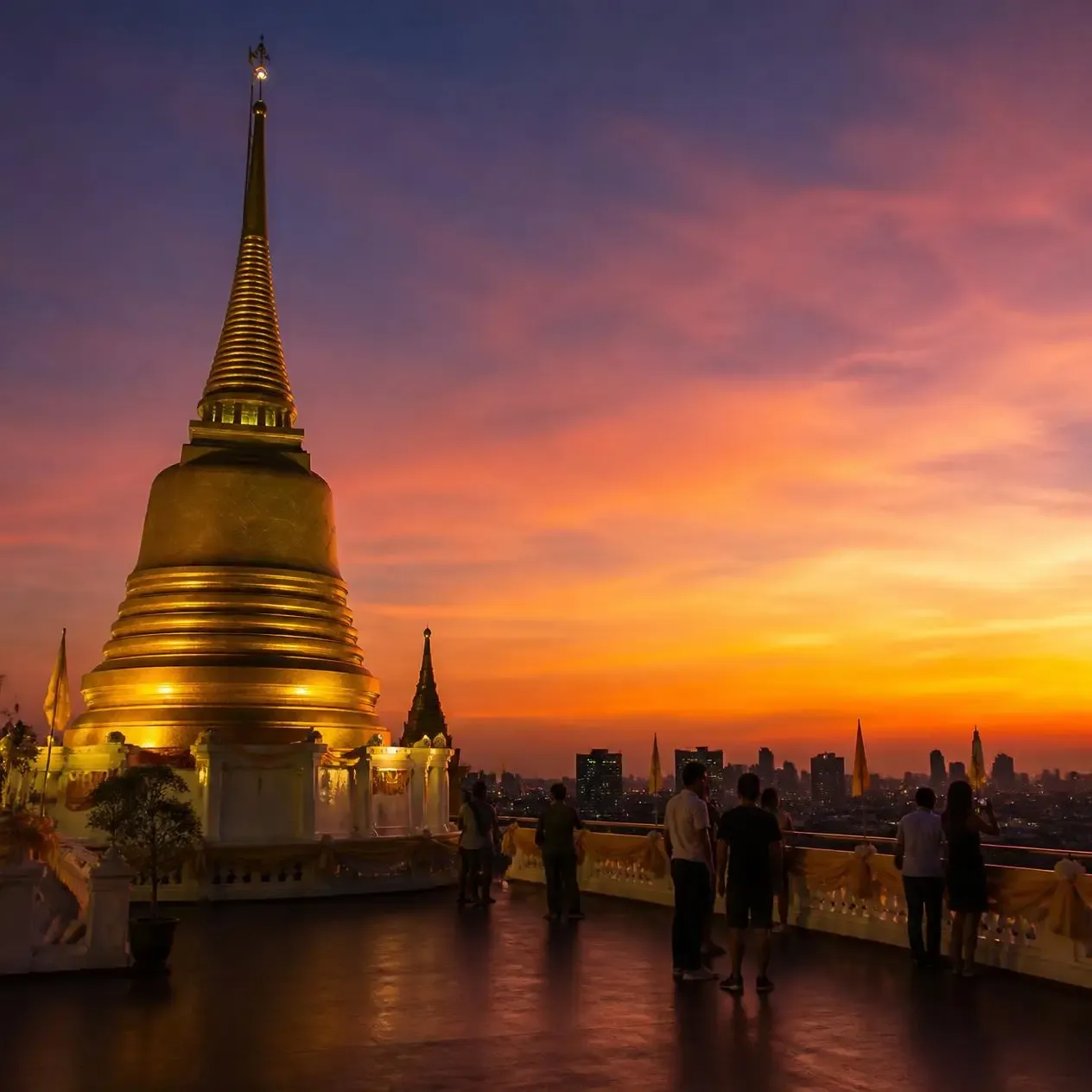
Wat Saket is the one most itineraries leave out, and it is what makes this particular Bangkok temples tour worth doing. The temple itself dates to the Ayutthaya period; the hill under it does not. The Golden Mount is artificial, built up from the collapsed remains of a chedi begun under Rama III, and the gold chedi at the summit holds Buddha relics gifted to Rama V by the British in 1899 after their discovery in India.
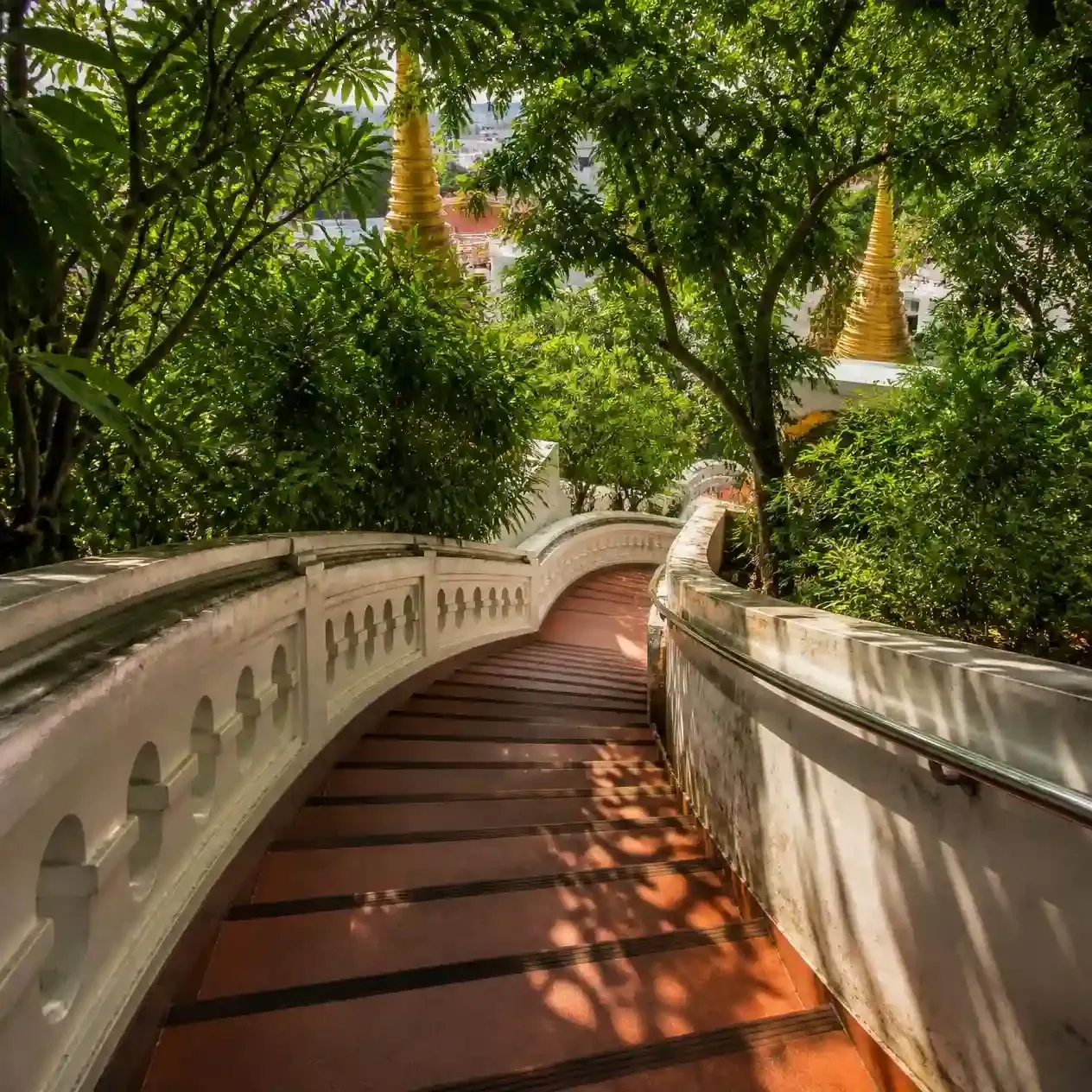
The climb is 344 steps that spiral around the hillside, past bells, Buddha images and shaded rest points. There is a darker layer below: in the late eighteenth and nineteenth centuries Wat Saket served as the city's crematorium and the receiving ground for tens of thousands of plague dead, and the vulture statues near the base commemorate that. Ask a guide about it — most visitors climb straight past.
- Entry: 100 THB (about USD 2.85) for the Golden Mount climb; the ground-level grounds are open without a ticket
- Hours: daily, roughly 07:00–19:00 (some sources list a 09:00 opening — check if you want the early slot)
- The climb: 344 gradual steps with handrails and benches; 15–20 minutes at a comfortable pace
- Time needed: 60–75 minutes including the climb and the terrace
How the route actually works
Run this Bangkok temples tour west to east and the day builds rather than fades. Start at Wat Pho when it opens at 08:00, cross to Wat Arun on the Tha Tien ferry by mid-morning, break for lunch and the worst of the heat, then arrive at Wat Saket in the last ninety minutes of daylight. That sequence tracks the sun, puts the two ticketed river temples behind you before the midday peak, and ends with the view rather than starting with it.
The morning pair
Wat Pho and Wat Arun sit roughly 400 metres apart with a river in between, and the crossing is the most pleasant three minutes of the day. Tha Tien Pier is a short walk south of the Wat Pho exit; the ferry runs continuously and takes cash. Doing Wat Pho first means you enter the reclining Buddha hall before the coach groups, and it puts you on the water at the point when the light on the prang is still soft.
The afternoon gap
Between 11:00 and 15:00 the Rattanakosin temples are hot, unshaded and busy, and the prang staircase in overhead sun is unpleasant. Build the gap in deliberately — a long lunch on the river, a massage at Wat Pho, or an hour in air conditioning. Tours that try to run all three straight through are the ones people remember as exhausting.
Timing the summit
Wat Saket is about 2.5 km east of Wat Pho, which is ten minutes by car with no traffic and thirty with it. Bangkok's evening congestion peaks around 17:00, so leave more margin than the distance suggests, or take the MRT Blue Line to Sam Yot and cover the last stretch on foot or by tuk-tuk.
Reality check: the terrace is smaller than the photographs suggest
- The viewing platform around the chedi is a narrow circular walkway, not a plaza. Thirty people fills it.
- Golden hour runs roughly 16:30–17:30, and that is when everyone arrives. Being there by 16:15 is the difference between a slow circuit and a shuffle.
- The 344 steps take 15–20 minutes, so factor the climb into your arrival time, not your departure.




Tour formats and what they cost in 2026
Four formats cover this Bangkok temples tour, and they differ more in pace and control than in what you see. A shared walking group runs 900–1,400 THB and moves on a fixed clock. A small-group half-day sits around 1,900–2,400 THB and usually adds transfers. A private electric tuk-tuk runs about 3,300 THB and is the most enjoyable way to cover the gap between the river and the Golden Mount. A private car with a licensed guide runs 4,500–6,400 THB and is the version that can be reshaped mid-day. All figures are per adult, current for 2026.
| Format | Duration | Price per adult (2026) | Best for |
|---|---|---|---|
| Shared walking group (Wat Pho + Wat Arun, Wat Saket added or separate) | 2.5–3 hrs | 900–1,400 THB (USD 25–40) | Solo travellers and anyone wanting commentary without a full half-day commitment |
| Small-group half-day with transfers | 4–5 hrs | 1,900–2,400 THB (USD 55–70) | Couples who want all three covered with air-conditioned transfers between them |
| Private electric tuk-tuk with guide | 3.5 hrs | ~3,300 THB (USD 95) | Repeat visitors and photographers — the most flexible way to move through the old city lanes |
| Private car with licensed guide | 5–6 hrs | 4,500–6,400 THB (USD 130–185) | Families, multi-generational groups, and anyone travelling in the hot season |
What is included, and what is not
Read the inclusions line before comparing prices, because the gap between two similar-looking tours is almost always entry fees. Most operators exclude them, which adds 600 THB per adult to the headline figure.
- Usually included: licensed English-speaking guide, the Tha Tien cross-river ferry, bottled water, and hotel pickup within the central districts
- Usually excluded: the 600 THB of temple entry fees, lunch, Thai costume rental at Wat Arun, and the Wat Pho massage
- Sometimes charged extra: hotel pickup outside the central zone, typically around USD 18
- Cover-ups: sarongs and shawls are available at each gate for roughly 20–100 THB if you arrive unprepared, and are returned against a deposit
Reality check: bring cash, and bring more than you think
- Wat Pho and Wat Arun do not take cards at the ticket window. The Grand Palace does, which is where the confusion comes from.
- Carry at least 800 THB per person in small notes — 600 for entry, the rest for the ferry, coin bowls, cover-ups and water.
- On many guided formats your guide buys the tickets with your cash and walks you past the queue, so have it ready at the meeting point rather than hunting an ATM mid-route.
Which Bangkok temples tour should you choose?
The decision comes down to how much control you want over the clock, and how much heat you are willing to walk through. Match the format to the traveller rather than to the price.
- If you have been to Bangkok before and already know the reclining Buddha, choose the private tuk-tuk or private guide and ask specifically for the Rama III inscriptions at Wat Pho and the plague history at Wat Saket. Those two threads are what a second visit adds.
- If this is your first pass at the old city, take the small-group half-day. It covers all three with transfers, holds a sensible pace, and leaves the Grand Palace for a separate morning.
- If you are travelling as a couple and want the sunset, book a private format that starts late — around 13:30 — so the day ends on the Golden Mount rather than beginning there.
- If you are with children or older parents, take the private car. The Wat Saket climb is the constraint, and having a vehicle waiting means anyone who skips it can sit in air conditioning rather than at the base.
- If you are travelling alone and want commentary without a half-day block, the shared walking group covering Wat Pho and Wat Arun is the efficient choice; add Wat Saket independently at 16:15.
- If you are here in April or May, take any format with transfers. Walking between the river temples and the Golden Mount in 38-degree heat is the single most common reason people cut the third temple.
Whichever format you pick, the guided temple tours in Bangkok listed on Travjoy have been researched and approved by local experts, so the guide is licensed and the timings are built around the light rather than around a coach schedule.
Beyond the three temples
Once the core Bangkok temples tour is done, three things extend it well: a fourth temple that fits the sequence without adding distance, a seasonal window that changes Wat Saket completely, and a working knowledge of temple etiquette that makes the whole day move more easily.
What to add
Wat Traimit in Chinatown is the natural fourth. It holds a five-and-a-half-tonne solid gold Buddha that spent roughly two centuries hidden under a layer of stucco, rediscovered only when it was dropped during a move in 1955. Entry is around 100 THB, the visit takes 30 minutes, and it sits between the river temples and the Golden Mount, so it slots into the afternoon gap without a detour.
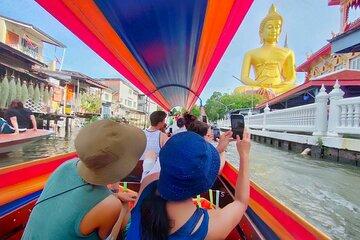
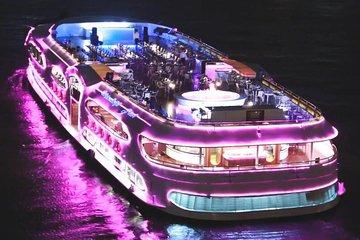
The other extension is the river itself. Seeing Wat Arun from a boat rather than from the pier is a different experience of the same building, and the top experiences in Bangkok include several Chao Phraya options that finish after dark, when the prang is floodlit.
When to go
- November to February — the cool season, and the best conditions for a walking-heavy temple day. Book guides further ahead in this window.
- March to May — hot, often above 35°C by late morning. Transfers stop being a luxury and start being the reason the day works.
- June to October — the wet season brings short afternoon downpours rather than all-day rain. The temples are quieter and the light after a storm is the best of the year.
- Mid-to-late November — the Golden Mount temple fair, held around Loy Krathong, is the oldest temple fair in Bangkok. A red cloth is carried up the 344 steps and wrapped around the chedi, and the lanes fill with lanterns, food stalls and fairground games for around ten days.
Reality check: the fair is worth it, the sunset view is not
- During the November fair the climb becomes a queue and the summit terrace is packed from early evening until midnight. Go for the procession and the atmosphere, not for the panorama.
- The exact dates shift with the lunar calendar and are usually confirmed only weeks ahead — check the current year's programme before building a trip around it.
- If the view is the priority, visit on any other evening and see the fair separately at ground level.
Temple etiquette
All three are active places of worship, and the dress code is enforced at the gate rather than suggested. Shoulders and knees covered, for everyone. Shoes come off before entering the reclining Buddha hall at Wat Pho, so slip-ons save time. Sit with your feet pointing away from any Buddha image, keep your head lower than a seated monk's if you are speaking with one, and step aside for people who are there to pray rather than to look. A guide will brief you on all of this in the first five minutes, which is one of the quieter arguments for booking one. For deeper background on Thai Buddhist practice and the city's religious architecture, the Bangkok culture and heritage guide goes further than a route post can.
Plan your temple day in Bangkok
The case for this particular Bangkok temples tour is that the three sites do different work. Wat Pho gives you the scale and the scholarship, Wat Arun gives you the craft and the river, and Wat Saket gives you the elevation and the quiet that the first two cannot. Run them west to east, keep the middle of the day loose, and be on the Golden Mount steps by 16:15.
Budget 600 THB in cash for entry on top of whatever you pay for the guide, and pick the format by the weather and the company you are keeping rather than by the price. Start planning your temple day in Bangkok on Travjoy, where each experience has been researched and approved by local experts before it reaches the listing.


.svg&w=1920&q=75)