


Bangkok by Bike: A Complete Guide to the City's Backstreet and Green-Lung Cycling Routes
9 min read
Key Highlights
- A Bangkok bike tour covers three distinctly different experiences: the green lung of Bang Krachao, the canal-side backstreets of Thonburi, and the Old City and Chinatown after dark.
- Rides are flat and slow. Most routes cover 12–20km over three to four hours, with frequent stops and at least one ferry crossing of the Chao Phraya.
- Guided small-group tours run THB 1,200–1,800 (USD 36–55) in 2026; private and full-day options with lunch and a canal boat run THB 2,000–4,200 (USD 60–127).
- November to February is the comfortable window, with daytime highs around 28–31°C. March to May regularly pushes 35–40°C, which is when evening rides earn their place.
- Self-riding Bang Krachao is easy to arrange and costs almost nothing; the guided version is what gets you through Thonburi's unmarked lanes without a phone in your hand.
A Bangkok bike tour is a three- to four-hour guided ride, typically 12–20km at walking-conversation pace, through parts of the city that traffic and heat normally keep you out of — the raised paths of Bang Krachao, the canal lanes of Thonburi, or the Old City and Chinatown after dark. Small-group tours cost THB 1,200–1,800 (USD 36–55) in 2026 and almost always include the bike, a helmet, water, and at least one ferry crossing. The routes are flat and beginner-friendly; the real variable is which of the three you pick.
Bangkok is not a city that looks cyclable. From the back of a taxi on Sukhumvit it looks like the opposite — eight lanes of stationary traffic, a motorbike using the pavement, and 34°C outside the window. Which is precisely why the bike routes work: none of them go anywhere near that.
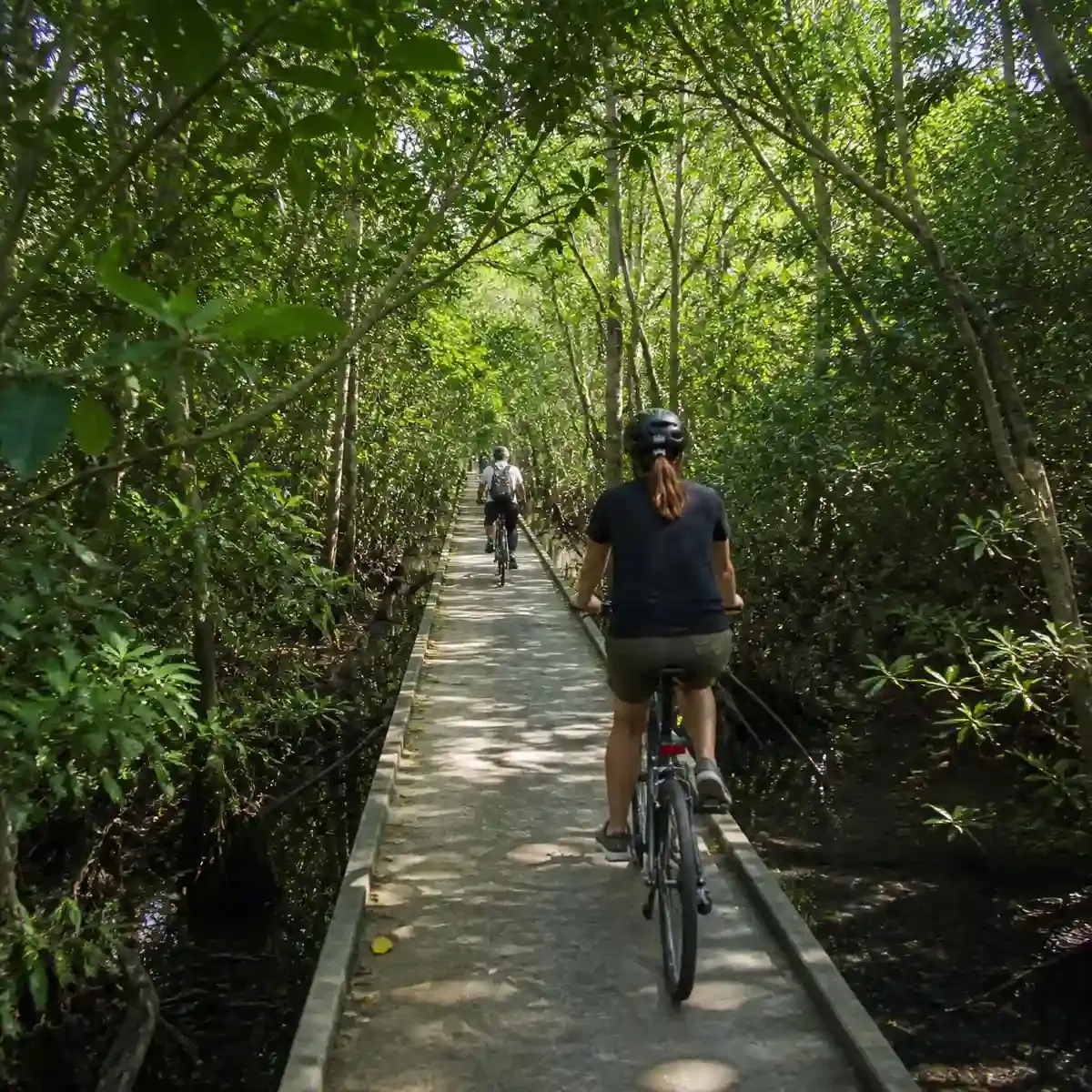
The rides that operators actually run take place in the parts of the city built before the car. Thonburi's lanes are barely wider than a doorway. Bang Krachao, the teardrop of jungle in the river bend, has almost no roads at all — just elevated concrete paths threading between coconut palms. Chinatown after 8pm empties of cars and fills with people eating. On a bike you move through these at the right speed: fast enough to cover ground, slow enough to stop for a boat noodle stall.
This guide covers what each route delivers, what the whole thing costs in 2026, which version suits which traveller, and the practical details — heat, timing, ferries, kit — that decide whether you finish the ride pleased or wrung out.
Is a Bangkok Bike Tour Worth It?
Yes, for most travellers with a spare half-day — and especially for anyone on a second or third visit. A Bangkok bike tour is the most efficient way to see the residential, working city that sits between the headline temples, and it does it without the heat exposure of walking or the sealed-off feeling of a car. The value is not the cycling itself. It is access to lanes and communities that are effectively unreachable any other way.
Worth it if…
- You've already done the temple circuit. If the Grand Palace, Wat Pho, and Wat Arun are behind you from a previous trip, this is the natural next layer — the neighbourhoods those temples were built to serve.
- You're travelling as a couple and want something unhurried. The Thonburi and Bang Krachao routes are quiet, shaded, and built around stopping rather than covering distance.
- You have a half-day gap and don't want to spend it in a mall. Most tours run three to four hours door to door, which fits neatly around an afternoon flight or a late dinner reservation.
- You want photographs that don't look like everyone else's. Canal-side wooden houses, morning markets, and Wat Arun lit from the water at night are all standard stops.
- You're visiting in the hot season and still want to be outdoors. The evening departures exist precisely for March to May.
Not ideal if…
- You haven't been to Bangkok before and only have 48 hours. The Grand Palace, Wat Pho, and the river should come first. Save the bike for the return trip.
- You haven't ridden a bicycle in a decade. The routes are flat, but Bang Krachao's raised paths are narrow and unrailed, and Old City routes cross live junctions.
- You're travelling with children under about seven. Most operators set a minimum age of eight; child seats are rare on guided tours.
- You have knee, back, or heart conditions. Several operators explicitly exclude riders with cardiac issues, and the full-day countryside tours are long.
- You want an air-conditioned overview of the city. A Chao Phraya boat tour covers the riverside landmarks with none of the effort.
The Four Bangkok Cycling Routes That Actually Differ
Search results throw up forty near-identical listings, but there are really only four distinct routes in Bangkok, and they deliver different days. Bang Krachao is nature and quiet. Thonburi is canal-side residential life. The Old City and Chinatown night ride is lit temples and street food. The full-day countryside tour is a proper excursion out of the city. Pick the theme first, then the operator.
Bang Krachao — the green lung
A teardrop-shaped peninsula in a bend of the Chao Phraya, Bang Krachao sits a five-minute ferry ride from Khlong Toei yet has almost no through traffic. The riding is on elevated concrete paths built above the mangroves and old plantation land, with coconut palms overhead and the occasional monitor lizard crossing in front of you. Sri Nakhon Khuean Khan Park sits at the centre, roughly a kilometre from the main pier, and more than half of it is left unmanaged — good for birdlife.
Typical tours run three to four hours and include the ferry, the park, a mangrove conservation area, a Ganesh shrine, and a stop at a plantation café. On Saturdays and Sundays the Bang Nam Phueng floating market adds a lunch stop.
Thonburi — the backstreets and canals
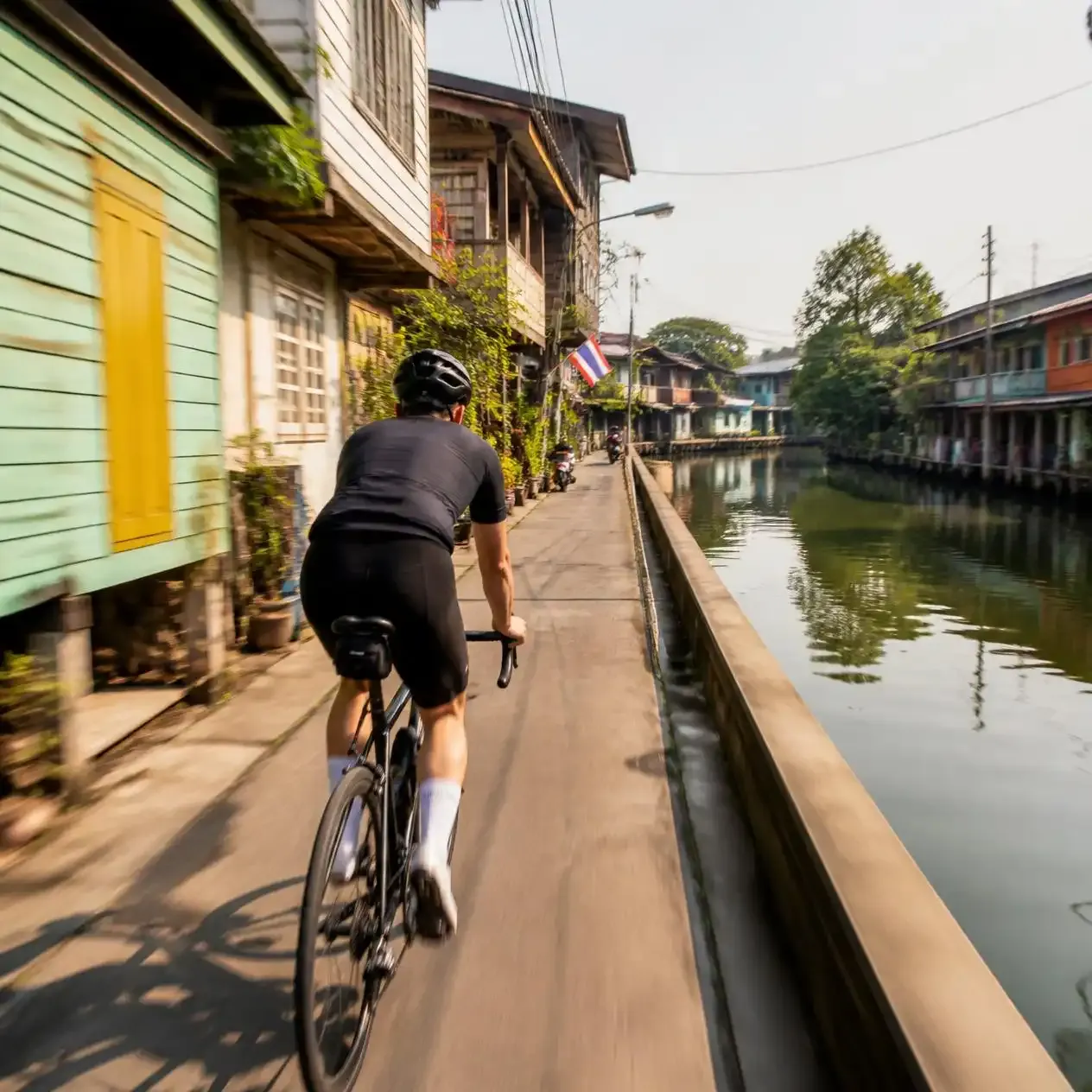
The west bank was the Thai capital before Bangkok was, and it still feels like a separate town. Routes here thread through sois barely wide enough for two bikes abreast, past wooden stilt houses, community temples where locals still worship, and canals lined with laundry and orchids. Most rides start on the Thonburi side, cross a klong or two by plank bridge, and finish with a ferry back.
This is the route for anyone chasing daily life rather than landmarks. The Khlong Bang Luang Artist House, a 200-year-old wooden building on the canal that hosts puppet performances, appears on several itineraries as the turnaround point.
The Old City and Chinatown after dark
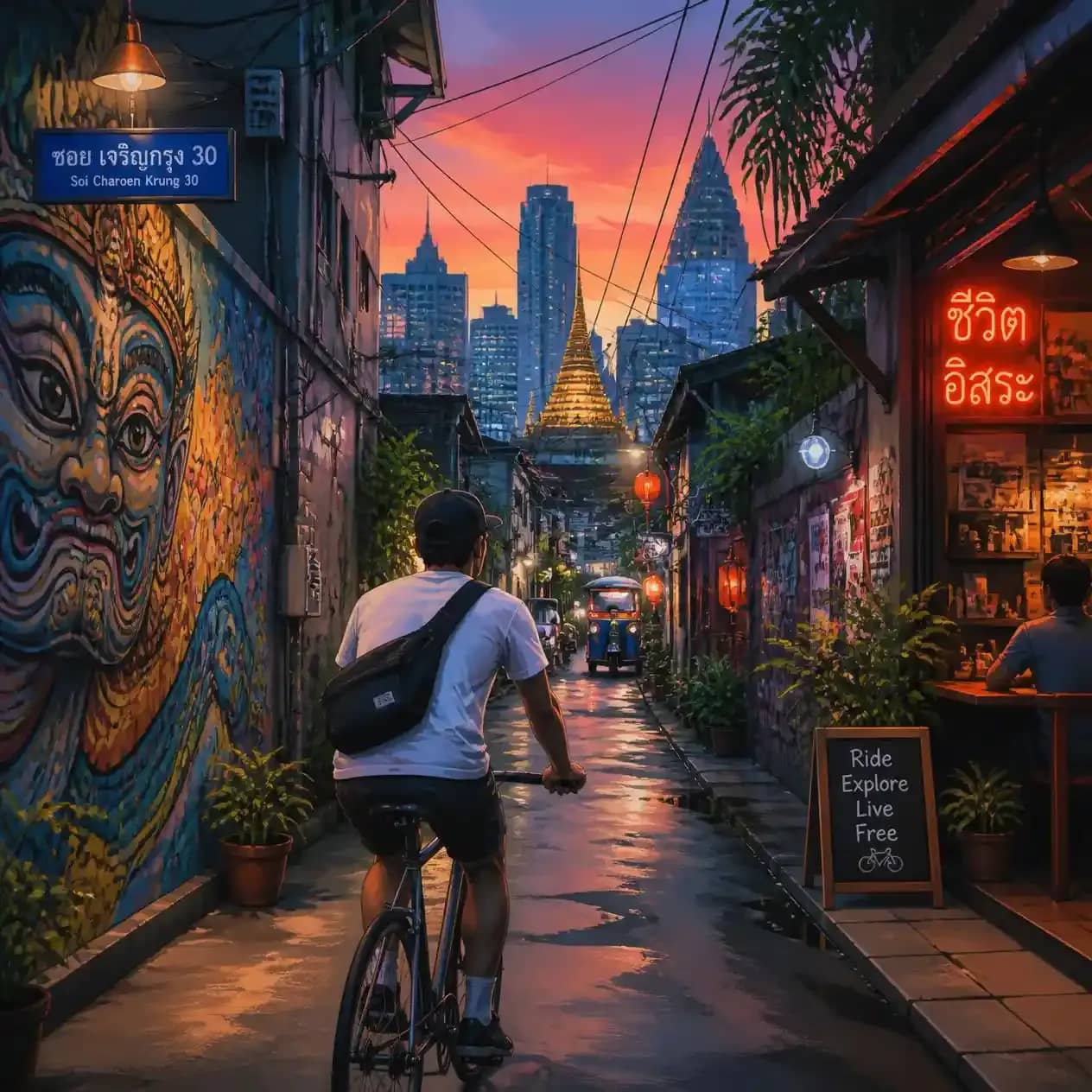
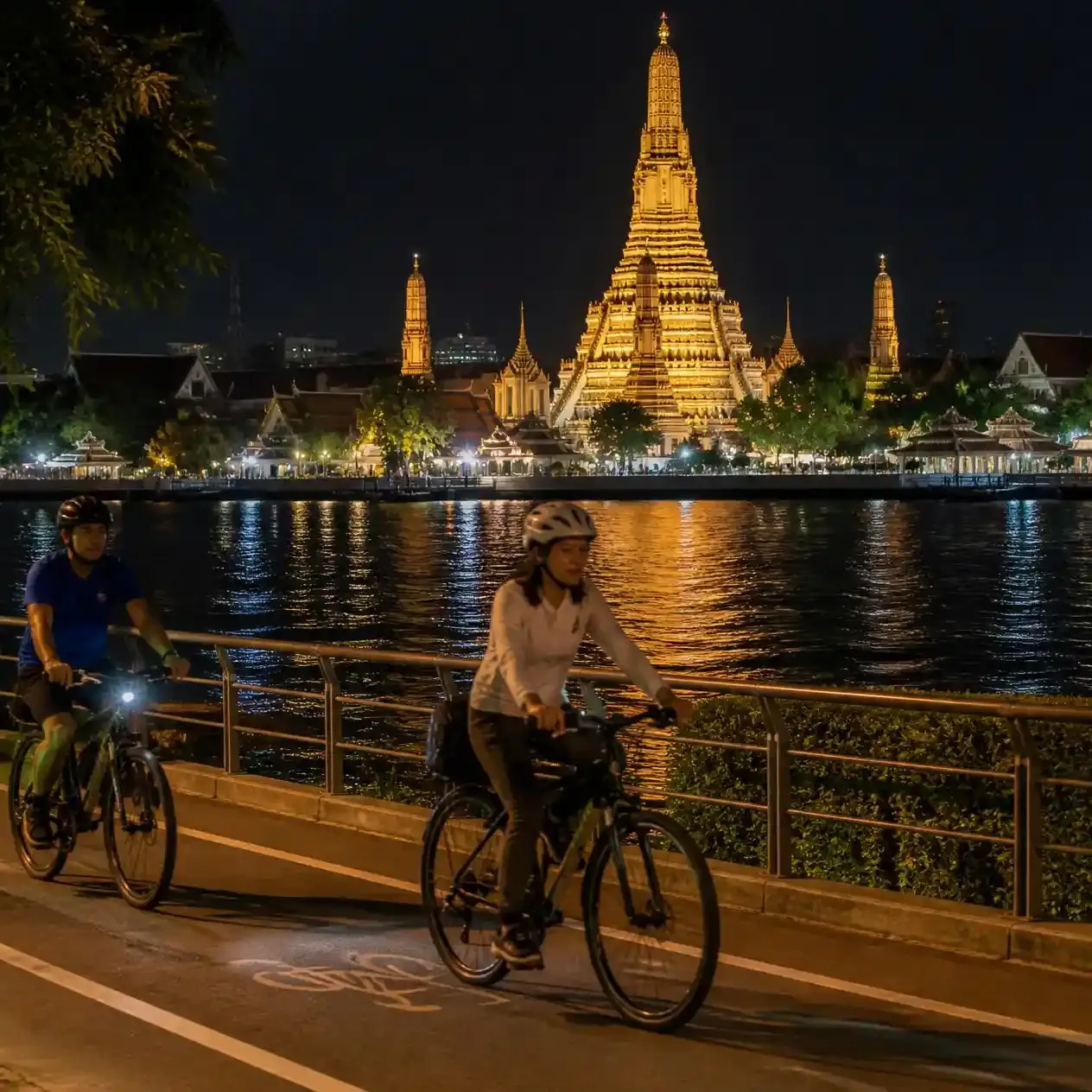
Night rides are the most atmospheric version of a Bangkok bike tour, and in the hot months they are also the only comfortable one. Departures are usually 6pm, running three hours. The standard loop takes in Talat Noi's old Chinese shophouses, the lanes of Yaowarat once the food stalls open, a ferry across to Thonburi, the riverside path past Wat Arun floodlit above the water, and a finish at the 24-hour flower market.
The full-day countryside and floating market ride
Eight-hour tours head out beyond the ring road into orchard country and canal villages, usually combining cycling with a longtail boat leg and a sit-down lunch. These involve hotel pickup and 30–40km of riding. They suit confident cyclists with a full free day, not travellers slotting an activity between other plans.
| Route | Duration | Price (2026) | Terrain | Best for |
|---|---|---|---|---|
| Bang Krachao green lung | 3–4.5 hrs | THB 1,500–2,200 (USD 45–67) | Flat, raised concrete paths, shaded | Couples, nature, morning rides |
| Thonburi backstreets and canals | 3 hrs | THB 1,200–1,600 (USD 36–48) | Flat, narrow lanes, plank bridges | Repeat visitors, photographers |
| Old City and Chinatown at night | 3 hrs | THB 1,300–1,900 (USD 39–58) | Flat, some live junctions | Hot season, food, city lights |
| Countryside and floating market | 7–8 hrs | THB 2,600–4,200 (USD 79–127) | Flat but 30–40km, sun-exposed | Confident riders, full free day |
What the Ride Is Actually Like
Slower than you expect, and more stop-start. A guided Bangkok bike tour averages around 8–10km/h including stops, because the route is the point rather than the distance. Groups are typically capped at eight to twelve riders, the guide leads and a second staff member sweeps at the back, and you will be off the bike as often as on it.
The bikes and the pace
Expect a simple city or hybrid bike with a basket, upright bars, and a few gears you will barely use — Bangkok has no hills. Nothing about the riding is technical. What takes adjusting to is the etiquette: single file in the sois, ringing the bell at blind corners, and pulling in tight when a motorbike comes the other way, because it will.
Ferries are part of the route
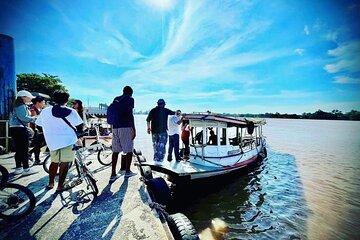
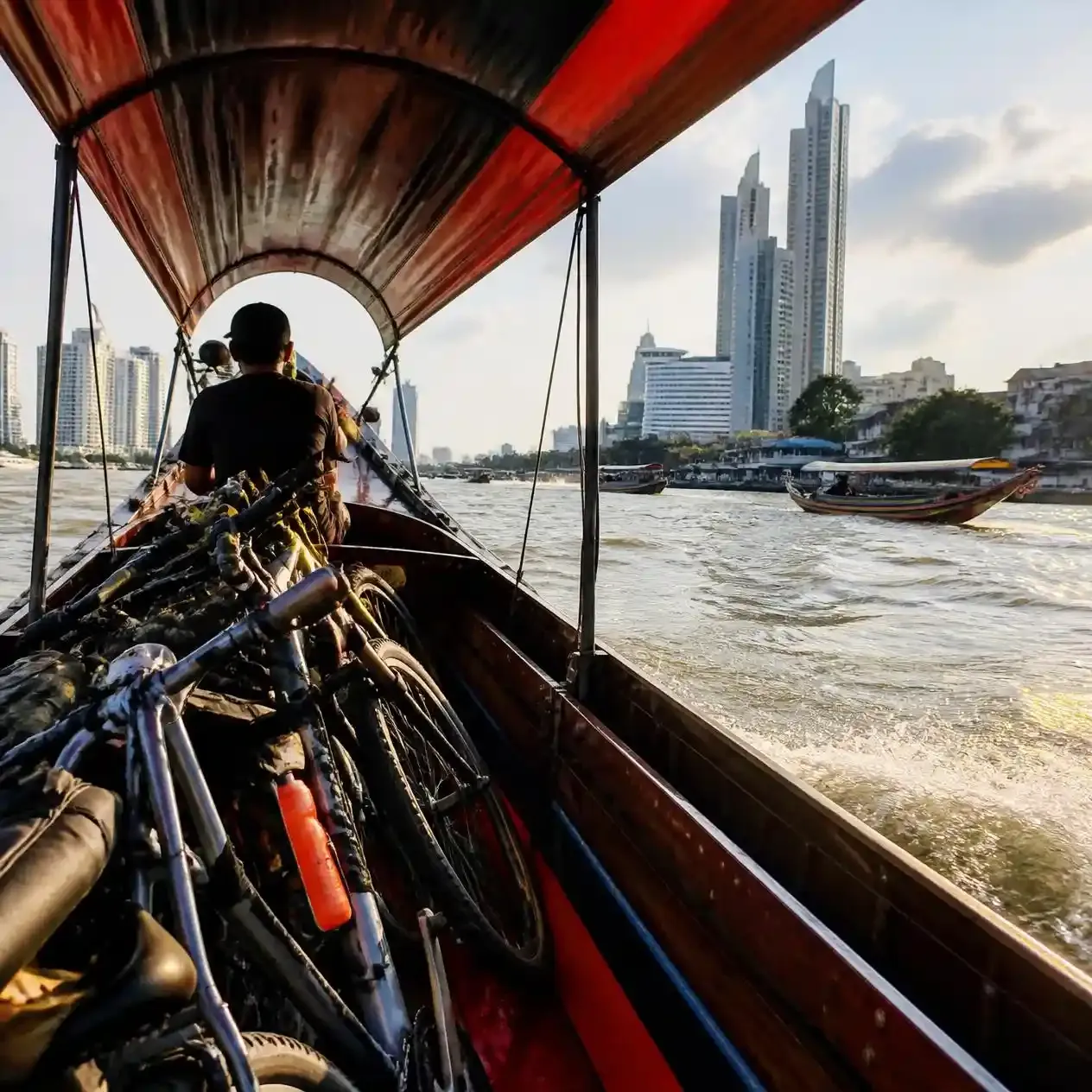
Almost every route crosses the Chao Phraya at least once, and the bikes come with you. On the larger cross-river ferries you simply wheel them on. On the longtail boats serving Bang Krachao, bikes are handed down and stacked, which limits numbers and is one reason group sizes stay small. The crossing takes about five minutes and is one of the better moments of the day.
What you actually stop for
- Community temples — working neighbourhood wats rather than the ticketed landmarks, where you'll be asked to remove shoes and cover shoulders and knees.
- A morning or night market — fresh produce on daytime routes, prepared food on evening ones.
- A drinks and snack break — usually a plantation café on Bang Krachao or a canal-side shop in Thonburi, and normally included in the price.
- Shrines and small museums — the Ganesh shrine on Bang Krachao, the artist house on Khlong Bang Luang.
Reality check: the paths at Bang Krachao are narrower than the photographs suggest
- Much of the peninsula is ridden on raised concrete causeways roughly a metre wide, built a metre or so above the mangrove, with no railings on either side.
- They are perfectly manageable at a steady pace, but they are not somewhere to be looking at your phone for directions — which is the practical argument for riding with a guide rather than navigating solo.
- The network is also a maze of unsigned junctions. Independent riders routinely double back; a guide simply turns.



What a Bangkok Bike Tour Costs in 2026
A guided small-group Bangkok bike tour costs THB 1,200–1,800 (USD 36–55) for a three- to four-hour ride in 2026, with the bike, helmet, water, and ferry fares included. Private departures run THB 2,000–2,800 (USD 60–85), and full-day countryside tours with lunch and a boat leg reach THB 4,200 (USD 127). Riding independently at Bang Krachao costs under THB 350 (USD 11) all in — a different proposition rather than a cheaper version of the same thing.
Riding independently
- Cross-river ferry: THB 10–20 (USD 0.30–0.60) each way, depending on pier and boat size. Some piers charge a few baht extra for the bicycle.
- Bike hire at the Bang Krachao piers: THB 80–300 (USD 2.50–9) for the day, or around THB 30–50 per hour. A passport or a THB 1,000 cash deposit is standard.
- Getting to the pier: MRT to Khlong Toei, then a short taxi or Grab to Wat Khlong Toei Nok pier.
- Entry to Bang Krachao and Sri Nakhon Khuean Khan Park: no charge.
Guided small-group tours
- Two-hour Old City ride: THB 1,200–1,400 (USD 36–42)
- Three-hour Thonburi backstreets or night ride: THB 1,300–1,900 (USD 39–58)
- Four-hour Bang Krachao ride with snack stop: THB 1,500–2,200 (USD 45–67)
- Usually included: bike, helmet, water, ferry fares, guide, one snack or drinks stop
- Usually extra: hotel pickup outside the central zone, temple entry where a ticketed site is on the route, tips
Private and full-day options
- Private Bang Krachao ride with lunch: THB 2,000–2,800 (USD 60–85) per person, often with a two-person minimum
- Full-day countryside or floating-market tour: THB 2,600–4,200 (USD 79–127), including hotel transfers, lunch, and a longtail boat leg
- What the premium buys: your own pace, hotel door-to-door transfers, and a guide who will restructure the route around what you actually want to see
Reality check: the "with lunch" full-day tour changes shape midweek
- Bang Nam Phueng floating market on Bang Krachao trades Saturday and Sunday only, roughly 8am to 4pm.
- Book the same tour on a Tuesday and the market lunch is substituted — usually two café stops instead. The itinerary text rarely spells this out.
- If the market is the reason you're going, confirm the departure date lands on a weekend before you book.
Which Bangkok Bike Tour Should You Choose?
Choose Bang Krachao if you want green space and quiet. Choose Thonburi if you want to see how people actually live. Choose the night ride if you want lit temples and street food, or if you're travelling between March and May. The routes are not ranked — they answer different questions, and the wrong pick is simply a mismatch rather than a bad day.
If you're travelling as a couple
Take the private Bang Krachao ride, morning departure. The pace is slow enough to talk, the paths are shaded, and a private booking means you stop where you want rather than where the group does. Follow it with an afternoon at a riverside spa and you have a well-shaped day.
If you're on a second or third visit
Take the Thonburi backstreets route. You already have the Grand Palace and the river landmarks; this is the layer underneath — community temples, canal houses, and neighbourhoods that no itinerary sends you to. It is the most rewarding Bangkok bike tour for anyone who already knows the city's headline sights.
If you're travelling with older children
Take a daytime Bang Krachao ride, and check the operator's minimum age — most start at eight. The traffic-free paths make this the only route worth considering with kids, and the park at the centre gives them somewhere to run around mid-ride.
If you're a nervous rider
Take a Bang Krachao tour rather than an Old City one. The peninsula has almost no cars, whereas Old City and Chinatown routes cross live junctions and use short stretches of shared road. Say so at booking — good operators will position you directly behind the lead guide.
If you want photographs
Take the night ride. The lit spires of Wat Arun from the river path, the flower market at Pak Khlong Talat in full swing at 9pm, and Chinatown's lanterns are the strongest images on any Bangkok cycling route. Bring a camera you can operate one-handed.
Every bike tour listed on Travjoy has been researched and approved by local experts, with operators checked for group size, bike condition, and guide quality — the three things that separate a good ride from an awkward one, and the three things hardest to judge from a listing page.
Timing, Heat and the Practical Details
Timing decides more about a Bangkok bike tour than the route does. Bangkok sits above 30°C for most of the year, so the comfortable months are November to February and the comfortable hours are before 9am or after 5pm. Get those two right and the riding is easy; get them wrong and you will spend the last hour thinking about water.
Best months to ride
- November to February (cool season): highs around 28–31°C, low humidity, clear skies. The best window, and the busiest — book a week or two ahead.
- March to June (hot season): 35–40°C by afternoon. Daytime rides are hard work; evening departures are the sensible choice.
- July to October (rainy season): showers are usually short and land in the late afternoon. Morning rides often go ahead untouched, and operators supply ponchos.
Best time of day
- Morning departures (7–9am): coolest air, active markets, best light on the canals. The strongest option for Bang Krachao and Thonburi.
- Evening departures (6–7pm): temperatures drop into the mid-20s, temples are floodlit, and street food is at its peak. The right call for the Old City and Chinatown.
- Midday (11am–3pm): avoid. Sri Nakhon Khuean Khan Park opens around 5am and closes near 7pm, so an early start costs you nothing in access.
What to bring
- Clothing: light long sleeves beat sunscreen in this climate, and shoulders and knees covered means you can enter any temple on the route without a wrap.
- Footwear: closed shoes you can slip off easily — you will be removing them at temple thresholds several times.
- Water: one litre minimum. Most operators provide it, but not all top up mid-ride.
- Cash: small notes for ferries, café stops, and market snacks. Many canal-side vendors do not take cards.
- Insect repellent: worth having on Bang Krachao and the mangrove sections, particularly at dusk.
Reality check: confirm the safety kit at booking, not at the meeting point
- Helmets are not universally supplied. Reputable operators include them, and night tours add lights and a reflective vest — but riders regularly report arriving to find neither.
- Ask three questions when you book: are helmets included, are the bikes fitted with front and rear lights for evening rides, and what is the maximum group size.
- Give the bike a thirty-second check before you set off — brakes, saddle height, tyre pressure. It is far easier to swap at the start than four kilometres into a peninsula.
Planning Your Ride
Three things decide whether a Bangkok bike tour lands well. Pick the route that matches what you want from the day — green space, residential life, or lit temples and food. Ride in the morning or the evening, never in the middle of the day. And book a small-group or private departure with a guide, because the value here is navigation through lanes that appear on no map you'll have with you.
If you're on a repeat visit, the Thonburi backstreets are the strongest single half-day in this guide. If it's your first trip, do the temples first and slot the night ride in on your last evening — it works beautifully as a farewell to the city.
Start planning your Bangkok trip on Travjoy's Bangkok collection, where every experience has been researched and approved by local experts.

.svg&w=1920&q=75)