


Bali: Blanco Renaissance Museum
Operating Hours:Monday - Sunday: 09:00 - 17:00
The Vibe:Flamboyance on a hilltop, the Dalí of Bali
Perched above the Campuhan River valley, this museum-mansion was the home and studio of Antonio Blanco, a Spanish-Filipino artist whose theatrical personality and sensuous paintings earned him the nickname 'the Dalí of Bali.'
Macaws screech at the entrance as you climb marble steps flanked by dragon sculptures. Inside, gilded frames hold paintings of Balinese women, and Blanco's preserved studio still smells faintly of oil paint and turpentine.
- • Cited by Frommer's and Lonely Planet as one of Ubud's most eccentric cultural attractions
- • Visitors frequently praise the Campuhan Valley views and the artist's undisturbed studio
- • The museum attracts art fans and architecture enthusiasts in equal measure
Persona Fit
- 🎨 Art Lovers: Over 300 original works — paintings, collages, and illustrated poetry — in a theatrical setting.
- 💕 Couples: Romantic hilltop gardens with valley views and a café for a quiet retreat.
- 📸 Photographers: Ornate marble interiors, exotic birds, and Campuhan Valley panoramas.
- 🎓 Culture Enthusiasts: A window into the expatriate art scene that shaped mid-century Bali.
Highlights
- Blanco's Studio — Preserved exactly as the artist left it, complete with unfinished canvas, paint tubes, and worn sofa.
- Great Marble Hall — A lavish three-storey gallery with gilded frames and a grand Italian marble archway.
- Campuhan Valley Viewpoint — The museum grounds offer sweeping views over the river valley and jungle canopy.
- Exotic Bird Garden — Macaws and cockatoos in a front courtyard; staff will photograph you with the birds for a small fee.
- Mosaic Ceiling and Spiral Staircase — Ornate decorative details throughout the building reward a close look — Hidden Gem.
Aura Salsa Dila
Our Bali Local Expert
Table of Contents
Things To Do Nearby
Campuhan Ridge Walk — Begins just below the museum; a photogenic early-morning walk along a narrow green ridge.
Neka Art Museum — A 10-minute walk north for a broader survey of Balinese art.
Ubud Art Market — A 15-minute walk east for handmade crafts and textiles.
Campuhan Ridge Walk — Begins just below the museum; a photogenic early-morning walk along a narrow green ridge.
Neka Art Museum — A 10-minute walk north for a broader survey of Balinese art.
Ubud Art Market — A 15-minute walk east for handmade crafts and textiles.
TJ's Guide - Blanco Renaissance Museum
Know Before You Go
Insider Tips
Best Time: Visit between 9:00–10:30 AM to enjoy the museum in cool, crowd-free conditions.
Hack: Combine with the Campuhan Ridge Walk — the trailhead is right below the museum entrance.
Hidden Gem: Ask a staff member for a guided walkthrough; family members occasionally lead tours and share personal anecdotes about Blanco.
Hack: The café terrace offers one of the best valley views in Ubud — linger over your included welcome drink.
Best Time: Visit between 9:00–10:30 AM to enjoy the museum in cool, crowd-free conditions.
Hack: Combine with the Campuhan Ridge Walk — the trailhead is right below the museum entrance.
Hidden Gem: Ask a staff member for a guided walkthrough; family members occasionally lead tours and share personal anecdotes about Blanco.
Hack: The café terrace offers one of the best valley views in Ubud — linger over your included welcome drink.
Know Your Facts
- Located on Jalan Raya Campuhan, a short drive or 10-minute walk west of central Ubud.
- A steep driveway leads uphill from the main road to the entrance; signage is clear.
- Parking available on-site for cars and motorbikes; Grab/Gojek drop-offs work well.
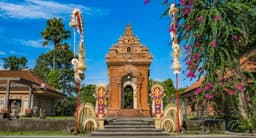
- First-time tip: The entrance stairs are flanked by two massive stone dragons and a 15-metre marble arch — you cannot miss it.
Once You Reach
Internal Navigation
Layout: A three-storey building structured around Balinese cosmology — lower, middle, and upper worlds. The upper floor houses the most esoteric works.
Studio Wing: Blanco's preserved studio is at the rear of the main building; look for the unfinished painting on the sunken easel.
Gardens: Wraparound gardens with sculpture, a bird farm, and a family temple accessed via paths from the main building.
Mario Gallery: Blanco's son's gallery is in an adjacent building — easily missed if you exit through the main entrance.
Time Tip: The interior takes 30–45 minutes; allow extra time for gardens, café, and bird interaction.
Food & Coffee Shops
Museum Café: Enjoy your complimentary welcome drink here; the terrace seating has postcard-worthy valley views.
Plant Bistro: A popular vegan café next door to the museum for a more substantial meal.
Museum Café: Enjoy your complimentary welcome drink here; the terrace seating has postcard-worthy valley views.
Plant Bistro: A popular vegan café next door to the museum for a more substantial meal.
Photography Tips
No photography inside galleries. Exterior shots and garden views are permitted.
Best vantage point for valley photos is the upper terrace behind the main building.
The entrance stairway with its dragon sculptures and marble archway makes for a striking arrival shot.
No photography inside galleries. Exterior shots and garden views are permitted.
Best vantage point for valley photos is the upper terrace behind the main building.
The entrance stairway with its dragon sculptures and marble archway makes for a striking arrival shot.
Explore Deeper
Antonio Blanco's legacy in Bali is less about art-historical influence than about a singular creative personality — a showman who turned his home into a theatrical monument to beauty, sensuality, and cross-cultural romance.
Born in Manila in 1912, Blanco studied at the National Academy of Art, travelled widely, and settled in Bali in the 1950s after meeting Balinese dancer Ni Ronji.
The museum building symbolises the three tiers of Balinese Hindu cosmology — its architecture was designed by Blanco himself.
Blanco's paintings focus overwhelmingly on the female form, blending Western surrealist techniques with Balinese cultural motifs.
The artist hosted dignitaries, celebrities, and royalty at his hilltop compound, cultivating a larger-than-life persona that was itself a work of art.
Born in Manila in 1912, Blanco studied at the National Academy of Art, travelled widely, and settled in Bali in the 1950s after meeting Balinese dancer Ni Ronji.
The museum building symbolises the three tiers of Balinese Hindu cosmology — its architecture was designed by Blanco himself.
Blanco's paintings focus overwhelmingly on the female form, blending Western surrealist techniques with Balinese cultural motifs.
The artist hosted dignitaries, celebrities, and royalty at his hilltop compound, cultivating a larger-than-life persona that was itself a work of art.
Did You Know?
Royal Gift — The land for Blanco's home and studio was granted by the King of Ubud, Tjokorda Gde Agung Sukawati, in recognition of the artist's contribution to the town.
Museum Dream Fulfilled — Blanco opened the museum on 28 December 1998, realising a lifelong dream just one year before his death in 1999.
Cremation Ceremony — After his death, Blanco was given a traditional Balinese Hindu cremation, reflecting his full adoption of his wife's faith and culture.