


London: West Norwood
Yes
Operating Hours:Daily: 08:00 - 17:00 (summer extended to 18:00). Crematorium Chapel: Open during service hours
The Vibe:Victorian Gothic with a living Greek Orthodox community.
One of the Magnificent Seven, West Norwood opened in 1837 on 40 acres of south London hillside. Its Anglican chapel stands ruined on the highest point; its Greek section — the largest Greek Orthodox burial ground in Britain — is still in active use.
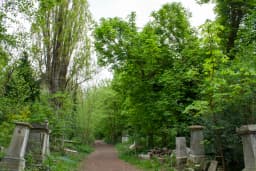
Monuments climb the hillside; distant south London stretches from the top. Active burials are marked with flowers; Victorian tombs settle under ivy. Pheasants scatter; the air smells of cut grass.
- • One of the Magnificent Seven Victorian cemeteries, opened 1837
- • Grade II* listed for its Greek Orthodox section — the largest such cemetery in Britain
- • Holds over 200,000 burials including Sir Henry Bessemer and Mrs Beeton
- • Managed by Lambeth Council with Friends of West Norwood Cemetery volunteers
Fit For
- 👨👩👧 Families: Quieter than Highgate; older kids can learn Victorian social history
- 💕 Couples: Hillside views and atmospheric Gothic tombs
- 👵 Seniors: Main paths step-free; hillside tombs involve a climb
- 📸 Photographers: Ruined Anglican chapel and Greek Orthodox monuments
Highlights
- Ruined Anglican chapel — Victorian Gothic on the cemetery's highest point
- Greek Orthodox section — largest in Britain, with distinctive Byzantine crosses
- Mrs Beeton's grave — author of the Victorian household bible
- Sir Henry Bessemer — inventor of mass-produced steel, engineer's monument
- Catacombs — underground vaults, occasional Friends-led tours
- Victorian-era crematorium — Britain's second built for cremation, 1915 — Hidden Gem
London Local Expert

Sarah Riches
Table of Contents
Things To Do Nearby
Crystal Palace Park — Victorian park with dinosaur sculptures, 10 minutes south
Dulwich Picture Gallery — England's oldest public gallery, 15 minutes east
Brockwell Park — rolling park with lido, 15 minutes north
Horniman Museum — 15 minutes east with free permanent galleries
Crystal Palace Park — Victorian park with dinosaur sculptures, 10 minutes south
Dulwich Picture Gallery — England's oldest public gallery, 15 minutes east
Brockwell Park — rolling park with lido, 15 minutes north
Horniman Museum — 15 minutes east with free permanent galleries
TJ's Guide - West Norwood
Know Before You Go
Insider Tips
Best Time: Friends tours monthly for specialist commentary; autumn for atmospheric visits
Hack: The ruined chapel on the cemetery's highest point gives the best viewpoint over south London
Hidden Gem: Mrs Beeton's tomb — author of the Victorian household management bible
Combine with Crystal Palace Park or Horniman Museum for a full south London day
Pheasants are often seen at dusk — arrive late afternoon
Best Time: Friends tours monthly for specialist commentary; autumn for atmospheric visits
Hack: The ruined chapel on the cemetery's highest point gives the best viewpoint over south London
Hidden Gem: Mrs Beeton's tomb — author of the Victorian household management bible
Combine with Crystal Palace Park or Horniman Museum for a full south London day
Pheasants are often seen at dusk — arrive late afternoon
Know Your Facts
- Closest station: West Norwood (Overground), 10-minute walk
- Bus 2, 432, 468 along Norwood Road
- Main entrance: Norwood Road
- First-time tip: The cemetery sits on a slope — park at the main gate and walk uphill
Once You Reach
Internal Navigation
Main paths: Follow curving avenues up the hillside
Anglican chapel: At the highest point — ruined but atmospheric
Greek Orthodox section: Separate enclave on the east side
Accessibility: Main paved avenues step-free; hillside tombs involve climbing
Efficient route: Main avenue up to the chapel, Greek Orthodox section detour, descent via catacombs path
Food & Coffee Shops
Norwood High Street cafés (five minutes): Local independent options
Brick & Barrel (West Norwood): Nearby gastropub for proper lunches
Crystal Palace Park Café (15 min south): Park café for a long walk
Norwood High Street cafés (five minutes): Local independent options
Brick & Barrel (West Norwood): Nearby gastropub for proper lunches
Crystal Palace Park Café (15 min south): Park café for a long walk
Photography Tips
Photography permitted throughout; respect any active funeral
Ruined chapel at golden hour reads particularly well
Greek section has distinctive monuments rarely photographed
Tripods permitted on main paths
Photography permitted throughout; respect any active funeral
Ruined chapel at golden hour reads particularly well
Greek section has distinctive monuments rarely photographed
Tripods permitted on main paths
Explore Deeper
West Norwood Cemetery was designed in 1837 by William Tite, architect of the Royal Exchange. Its distinctive Gothic Revival Anglican chapel once crowned the hilltop; it was lost to fire in 1957 and left as a picturesque ruin. The Greek Orthodox community of London purchased a section in 1842 — the largest such burial ground in Britain.
Sir Henry Bessemer (1813-1898) invented the Bessemer Converter, the first inexpensive industrial process for mass-producing steel; his grave marks the birthplace of modern industrial steel
Isabella Beeton (1836-1865), author of 'Mrs Beeton's Book of Household Management', died at age 28 of puerperal fever; her book defined Victorian domestic life
Henry Tate, sugar refiner and founder of the Tate gallery, is buried in the cemetery along with several Tate family members
The Greek Orthodox community of London established its section in 1842; over 100 notable Greek families are buried here, including shipping magnates and scholars
Sir Henry Bessemer (1813-1898) invented the Bessemer Converter, the first inexpensive industrial process for mass-producing steel; his grave marks the birthplace of modern industrial steel
Isabella Beeton (1836-1865), author of 'Mrs Beeton's Book of Household Management', died at age 28 of puerperal fever; her book defined Victorian domestic life
Henry Tate, sugar refiner and founder of the Tate gallery, is buried in the cemetery along with several Tate family members
The Greek Orthodox community of London established its section in 1842; over 100 notable Greek families are buried here, including shipping magnates and scholars
Did You Know?
Burial count — Over 200,000 burials in 185+ years of operation
Greek Orthodox largest — Britain's largest Greek Orthodox burial ground
Chapel fire — The Gothic Anglican chapel burned in 1957; the ruins are now atmospheric
Tate family — Henry Tate's burial connects West Norwood to the Tate gallery story