


London: Tower Hamlets
Yes
Operating Hours:Daily: Open 24/7
The Vibe:East London's wildest Victorian burial ground.
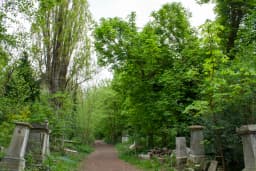
Tower Hamlets Cemetery Park, one of the Magnificent Seven, opened in 1841 to handle East London's cholera-dense mortality. Today it is a 33-acre Local Nature Reserve of broadleaf woodland and crumbling tombs — more wild park than formal cemetery.
Birdsong fills the broadleaf canopy; brambles swallow Victorian monuments. Locals jog; dog walkers wave. Foxes are regular companions; spring buttercups and summer berries give the place its wildlife reserve character.
- • One of the Magnificent Seven Victorian cemeteries, opened 1841
- • Designated a Local Nature Reserve — the largest in Tower Hamlets
- • Over 350,000 burials in just over 100 years of operation
- • Maintained by volunteers of the Friends of Tower Hamlets Cemetery Park
Fit For
- 👨👩👧 Families: Woodland paths and wildlife for nature-oriented children
- 💕 Couples: Peaceful wooded retreat, little-visited
- 👵 Seniors: Main paths step-free; side paths uneven
- 📸 Photographers: Ivy-covered tombs and woodland light
Highlights
- Woodland paths — broadleaf trees and seasonal wildflowers
- Crumbling monuments — atmospheric decay of Victorian tombs
- Local Nature Reserve — foxes, woodpeckers, orchids and butterflies
- Cholera victims — mass graves from the 1853-54 outbreak
- Broad Street station ruins — Victorian railway remains within the park
- Soanes Centre — ecological education centre — Hidden Gem
London Local Expert

Sarah Riches
Table of Contents
Things To Do Nearby
Mile End Park — linear park stretching north, 15 minutes walk
Queen Mary University — student cafés and green spaces adjacent
Victoria Park — larger traditional park, 20 minutes north
Whitechapel — East End neighbourhood with street art, 20 minutes west
Mile End Park — linear park stretching north, 15 minutes walk
Queen Mary University — student cafés and green spaces adjacent
Victoria Park — larger traditional park, 20 minutes north
Whitechapel — East End neighbourhood with street art, 20 minutes west
TJ's Guide - Tower Hamlets
Know Before You Go
Insider Tips
Best Time: Spring for wildflowers; autumn for atmospheric mist
Hack: Combine with a walk along the Regent's Canal — the park is 15 minutes from the canal
Hidden Gem: The Soanes Centre offers free ecology talks for visitors
Volunteer work days the first Saturday monthly — great way to learn
Wear sturdy shoes — paths are natural and can be muddy
Best Time: Spring for wildflowers; autumn for atmospheric mist
Hack: Combine with a walk along the Regent's Canal — the park is 15 minutes from the canal
Hidden Gem: The Soanes Centre offers free ecology talks for visitors
Volunteer work days the first Saturday monthly — great way to learn
Wear sturdy shoes — paths are natural and can be muddy
Know Your Facts
- Closest Tube: Mile End (District, Central, Hammersmith & City)
- Bus 25 and 323 stop along Mile End Road
- Main entrance: Southern Grove (east) or Cantrell Road (north)
- First-time tip: Enter via Southern Grove for the most atmospheric approach
Once You Reach
Internal Navigation
Main paths: Criss-cross the 33 acres with circular walking routes
Signage: Minimal; free maps available at the Soanes Centre
Accessibility: Main paths mostly step-free; side paths rough
Efficient route: Southern Grove entrance, main loop via Soanes Centre, exit Cantrell Road
Wildlife hot spots: Hazel copse, meadow and woodland mixed habitats
Food & Coffee Shops
Mile End Road cafés (five minutes): Multiple quick-eat options
The Palm Tree (Mile End): Historic East End pub 10 minutes away
Pavilion Café (Victoria Park): Quality park café 20 minutes north
Mile End Road cafés (five minutes): Multiple quick-eat options
The Palm Tree (Mile End): Historic East End pub 10 minutes away
Pavilion Café (Victoria Park): Quality park café 20 minutes north
Photography Tips
Photography permitted throughout; tripods allowed
Golden hour and overcast days both work — varied conditions give different moods
Woodland light filters through canopy beautifully in May-September
Winter reveals more tombs as foliage dies back
Photography permitted throughout; tripods allowed
Golden hour and overcast days both work — varied conditions give different moods
Woodland light filters through canopy beautifully in May-September
Winter reveals more tombs as foliage dies back
Explore Deeper
Tower Hamlets Cemetery opened in 1841 to serve London's densely populated East End, then home to docks, markets and industrial workers. Deaths from cholera, tuberculosis and industrial accidents filled the 33 acres quickly; it closed to new burials in 1966 and was converted to a public park in the 1980s.
The cemetery served East London's working class — over 350,000 people were buried here, including victims of the 1853-54 cholera epidemic that killed thousands in Soho and Whitechapel
When the cemetery closed in 1966 it fell into serious neglect; the Greater London Council took ownership in 1986 and designated it a Local Nature Reserve
The Soanes Centre, an ecological education centre within the park, runs school programmes teaching urban ecology using the cemetery as a living classroom
Many tombs remain buried beneath decades of undergrowth — the Friends organise work days to reveal and restore them
The cemetery served East London's working class — over 350,000 people were buried here, including victims of the 1853-54 cholera epidemic that killed thousands in Soho and Whitechapel
When the cemetery closed in 1966 it fell into serious neglect; the Greater London Council took ownership in 1986 and designated it a Local Nature Reserve
The Soanes Centre, an ecological education centre within the park, runs school programmes teaching urban ecology using the cemetery as a living classroom
Many tombs remain buried beneath decades of undergrowth — the Friends organise work days to reveal and restore them
Did You Know?
Burial count — Over 350,000 people were buried in the cemetery's 125-year active life
Cholera victims — Mass graves from the 1853-54 outbreak lie under modern grassland
Woodland age — Some trees are over 60 years old, establishing after burials ceased
East End poverty — The cemetery's burials tell the story of Victorian East London's working-class mortality