



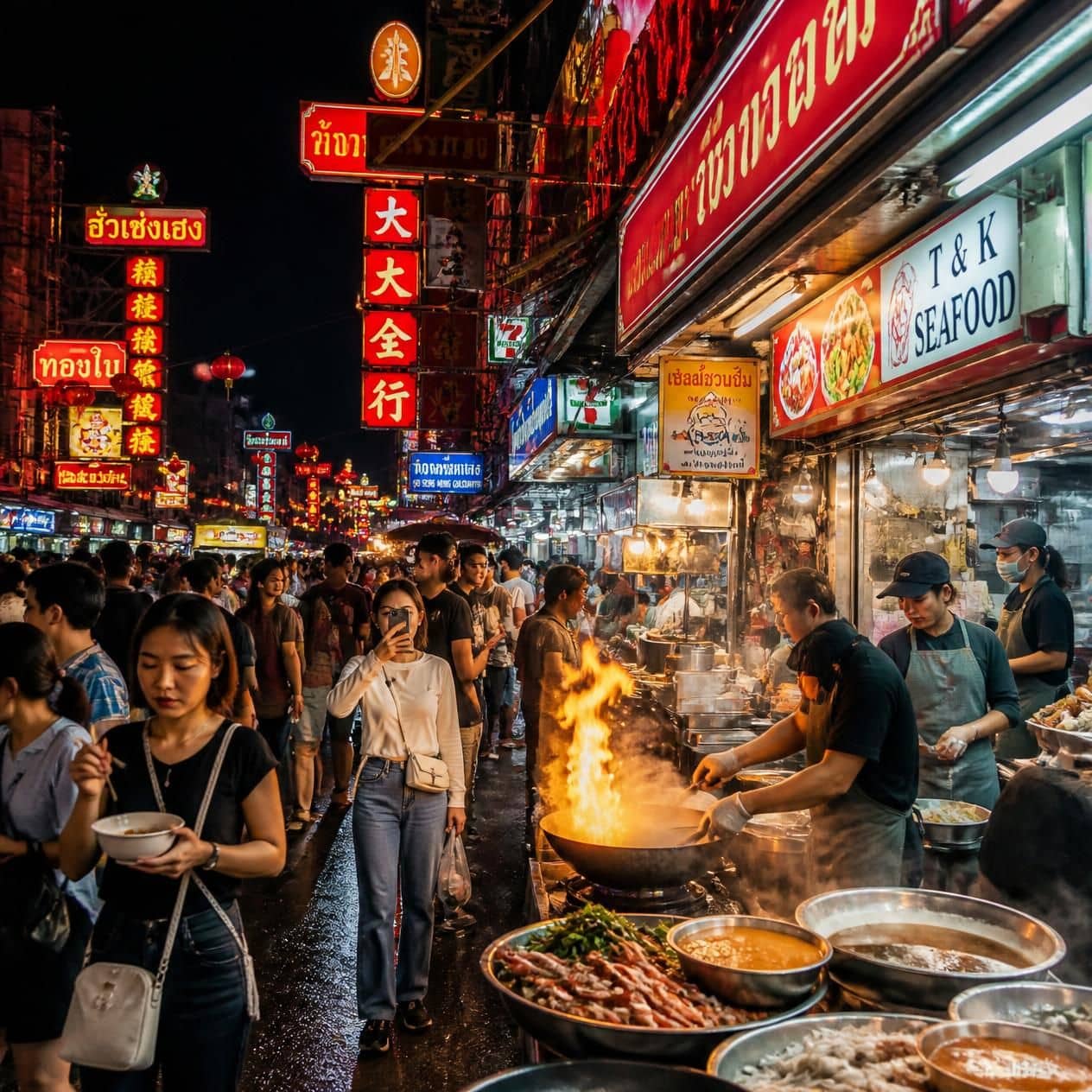
Yaowarat Street Food Tour: A Complete Guide to Eating Bangkok's Chinatown, Soi by Soi
9 min read
Key Highlights
- A guided Yaowarat street food tour runs three to four hours, covers eight to twelve tastings, and costs roughly ฿1,600–6,500 (USD 45–190) per person depending on format in 2026.
- Four formats exist — walking, tuk-tuk, private, and Michelin-led — and they cover noticeably different streets, not the same route at different prices.
- Yaowarat is an evening district. Most food stalls set up from about 5pm and run to midnight or later; the main strip barely functions as a lunch destination.
- MRT Wat Mangkon on the Blue Line opens directly into Chinatown, which makes an evening here easy to slot in without a taxi at rush hour.
- Two dates reshape the district entirely: the ten-day Vegetarian Festival each October, when Yaowarat turns meat-free, and Lunar New Year, when the road closes to traffic.
A Yaowarat street food tour is a three- to four-hour guided evening through Bangkok's Chinatown, taking in eight to twelve tastings across the main strip and its side lanes, and costing between ฿1,600 and ฿6,500 (USD 45–190) per person in 2026 depending on whether you walk, ride a tuk-tuk, or book privately. It is worth booking if you want a guide handling ordering, queue timing, and the stalls with no English signage; less so if you already read some Thai and prefer to graze at your own pace. Either way, the district works best between 6pm and 10pm.
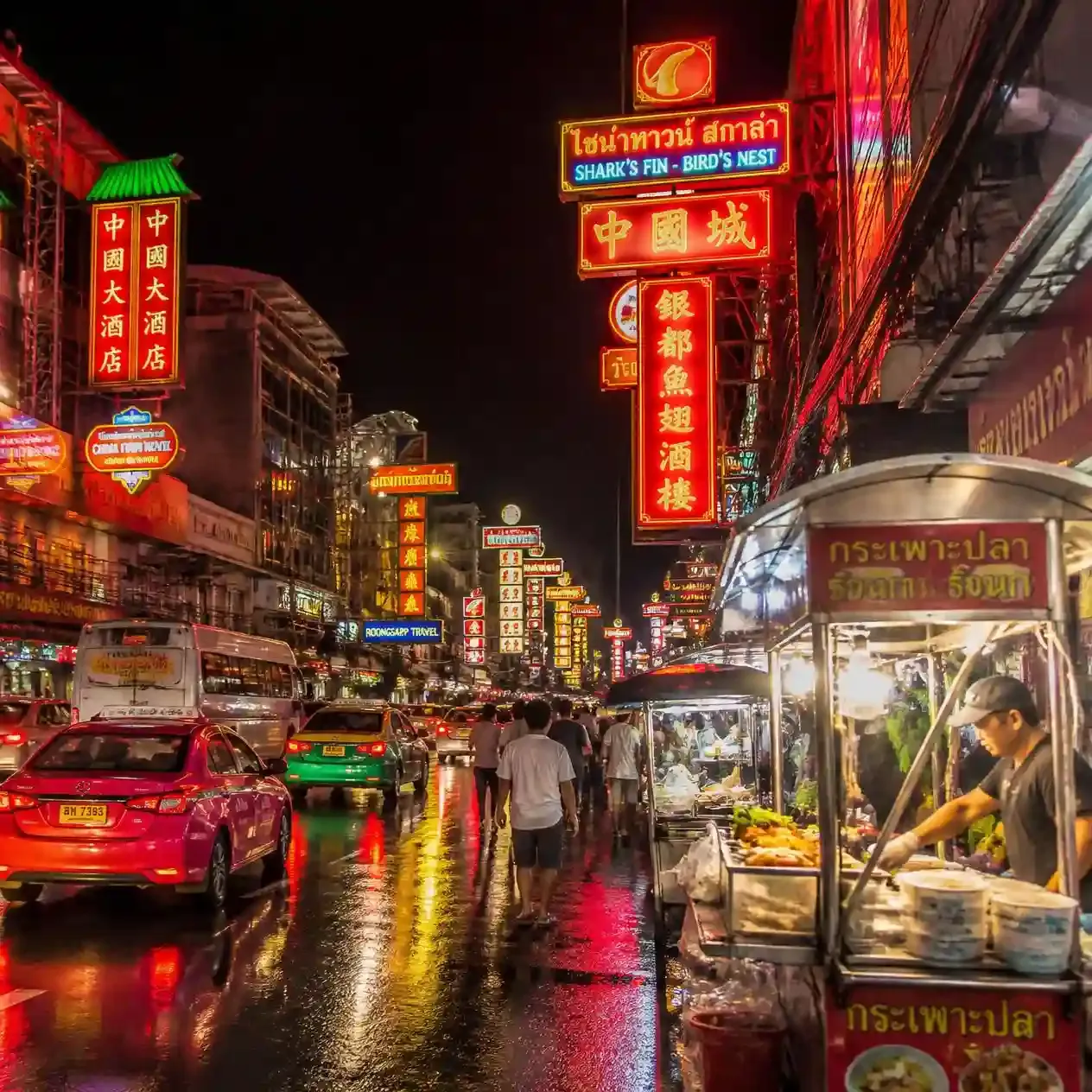
Yaowarat Road is 1.5 kilometres long and was cut through the district during the reign of King Chulalongkorn, curving in a shape locals compare to a dragon's spine. For most of the day it belongs to gold shops, herbal pharmacies and wholesale traders. Then, somewhere around five in the afternoon, carts appear from doorways and alley mouths, charcoal is lit, and the same street becomes the densest concentration of Thai-Chinese cooking anywhere in the world.
That transformation is why the district is so heavily toured — and why the tours vary so widely in quality. Some cover four blocks of the main road and call it an evening. Others take you into Talat Noi and Song Wat, where the food is quieter, older, and considerably less photographed.
This guide breaks down the four Yaowarat street food tour formats against each other, gives 2026 pricing in baht and dollars for each, maps the route soi by soi so you know what a tour is and is not covering, and answers the question most guides skirt: whether you need a guide here at all.
Is a Yaowarat Street Food Tour Worth It?
Yes, for most visitors — but for narrower reasons than the operators suggest. The value of a guided evening in Chinatown is not access, since nothing here is ticketed or gated. It is ordering, sequencing, and knowing which of two near-identical stalls is the one with the sixty-year reputation. Yaowarat has several hundred vendors within a fifteen-minute walk, most with Thai-only signage, and the gap between a very good bowl and an ordinary one is invisible from the pavement.
Worth booking if
- You have one or two evenings in Bangkok and want the district's best cooking without spending the first hour deciding.
- You want the Thai-Chinese dishes specifically — guay jub, kuay teow with fish balls, braised goose, oyster omelette — rather than the pan-Thai standards you can eat anywhere.
- You are travelling as a couple or a pair and would rather talk to a guide about Teochew migration history than read it off a plaque.
- You want someone else managing the queue at the two or three stalls where a twenty-minute wait is normal on a weekend night.
- You have dietary constraints — pork, shellfish, chilli tolerance — that are difficult to negotiate across a language barrier at speed.
Less suited to you if
- You read some Thai or have eaten your way through Bangkok before and simply want to graze at your own rhythm.
- You dislike group pacing. A join-in tour moves as a unit, and you will leave stalls before you have finished looking.
- You want one long sit-down seafood dinner rather than eight standing tastings.
- You are travelling with young children whose bedtime falls before 8pm, when the strip is at its best.
What a guide actually buys you
Three things, concretely. First, ordering — a guide asks for the dry version rather than the soup version, adjusts the chilli, and requests the cuts you would not know to ask for. Second, timing — knowing that one guay jub stall opens at 6pm and another at 8pm changes the shape of an evening. Third, editing. A good guide walks you past twenty stalls to reach six, and the twenty they skip matter as much as the six they choose.
If you would rather build the evening yourself, the Yaowarat Chinatown street food listing sets out what the district covers, and there is street food across the rest of Bangkok worth planning around on other nights.
Reality check: Monday is a thinner Yaowarat
- A number of long-running stalls and shophouse kitchens close on Mondays, and some take a second rest day mid-week.
- Tours still run, but the substitutions are real — you may get the second-choice noodle stall rather than the one in the itinerary photographs.
- If your Bangkok dates are flexible, put Chinatown on a Thursday, Friday or Saturday evening and keep Monday for the river or the Old City.
The Four Yaowarat Street Food Tour Formats
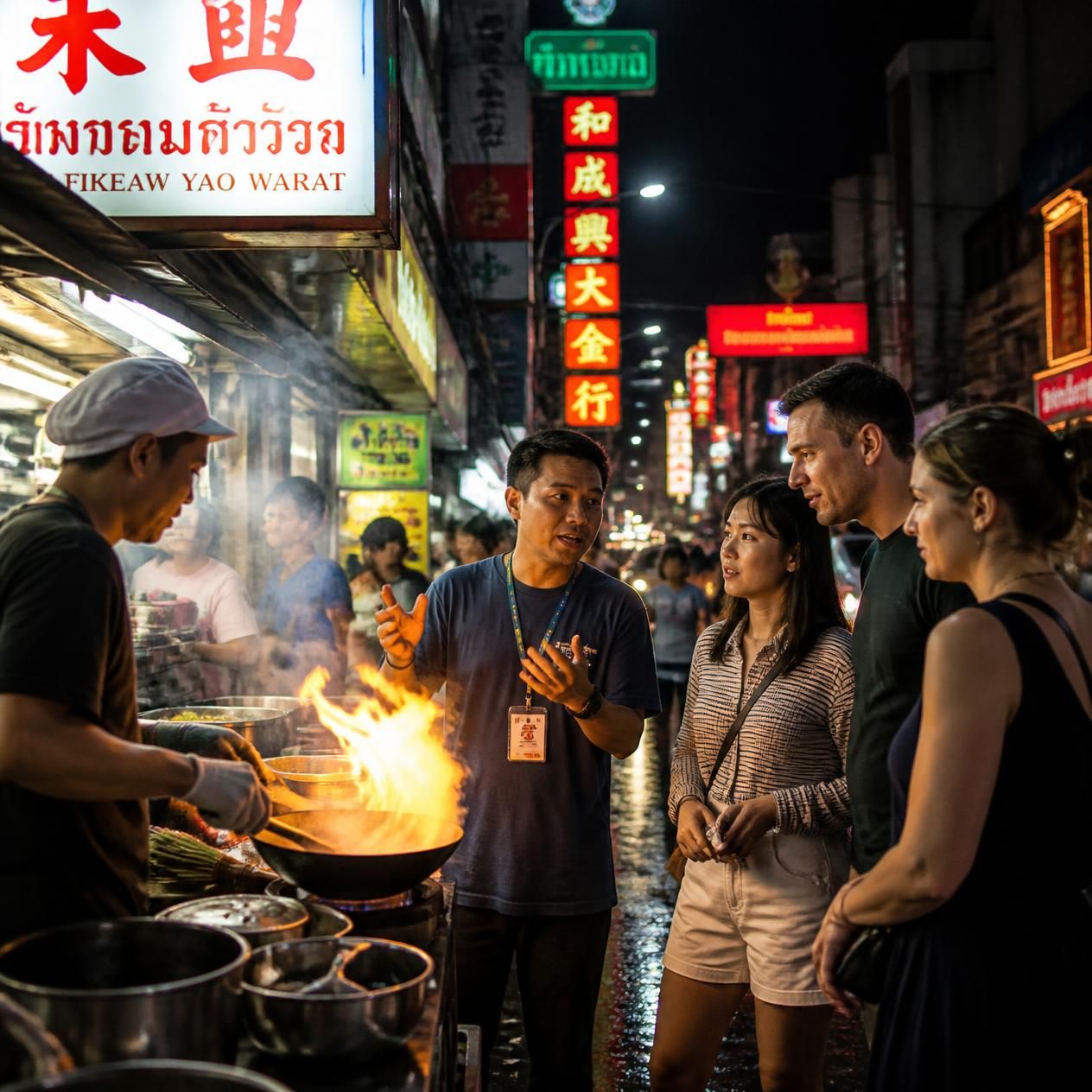
There are four formats, and they differ by ground covered rather than by food quality. Walking tours stay inside the Yaowarat–Sampeng–Charoen Krung triangle and go deepest into the alleys. Tuk-tuk tours trade some of that depth for range, usually adding a temple stop and a river viewpoint. Private tours adapt the route to what you want to eat. Michelin-led tours build the evening around Bib Gourmand-recognised stalls, which means more queueing and fewer surprises.
| Format | Duration | Price per person (2026) | Streets covered | Best for |
|---|---|---|---|---|
| Walking, join-in | 3–3.5 hrs | ฿1,600–2,600 (USD 45–75) | Main strip, Soi Phadung Dao, Sampeng Lane, alley kitchens | Serious eaters who want depth over range |
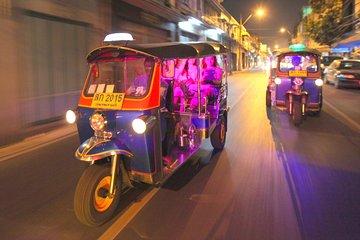
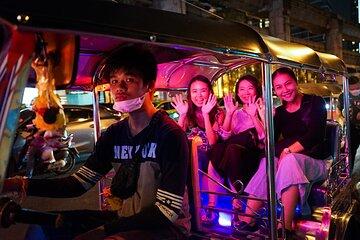
| Tuk-tuk, join-in | 3.5–4 hrs | ฿1,900–2,900 (USD 55–85) | Yaowarat plus Wat Traimit and a riverside stop | First evening in the city; couples wanting the night-ride element |
| Private guide | 3–5 hrs | ฿3,500–6,500 (USD 100–190) | Built to request — often Song Wat Road and Talat Noi | Returning visitors, dietary constraints, slower pacing |
| Michelin-led | 3–3.5 hrs | ฿2,200–3,400 (USD 65–100) | Bib Gourmand addresses on and just off Yaowarat | Anyone who wants the recognised names ticked off |
The choice that matters most is walking versus tuk-tuk. On foot you cover perhaps a square kilometre and eat in six or seven places, several of them down lanes a vehicle cannot enter. By tuk-tuk you cover more ground and see the district in motion, but the stops skew towards places with somewhere to pull up. Neither is better; they answer different questions about what you want from the evening.
Whichever format you pick, the operators listed among Bangkok food tours have been researched and approved by local experts, which spares you the job of working out which of forty near-identical listings actually goes where it says it goes.
Reality check: the "temple is closed today" diversion
- Around Wat Traimit and the Odeon Gate, drivers occasionally tell arriving visitors that a temple or the market is shut, then offer an alternative route that ends at a gem shop or tailor.
- Yaowarat's food stalls do not close on public holidays, and Wat Traimit keeps standard daily hours.
- A booked tour removes the situation entirely, since your driver or guide has no incentive in the diversion. Arriving independently, a polite decline and a walk to the MRT exit is enough.
What a Yaowarat Street Food Tour Costs in 2026
Expect ฿1,600–2,600 (USD 45–75) for a join-in walking evening, ฿1,900–2,900 (USD 55–85) with a tuk-tuk, ฿2,200–3,400 (USD 65–100) for a Michelin-focused route, and ฿3,500–6,500 (USD 100–190) per person for a private guide, with private pricing falling sharply as group size rises. Almost all include the food; almost none include alcohol.
What is normally included
- Eight to twelve tastings, described as "over ten dishes" by most operators — enough to constitute dinner.
- A licensed English-speaking guide for the full duration.
- Non-alcoholic drinks at the stops — herbal teas, chrysanthemum, iced longan.
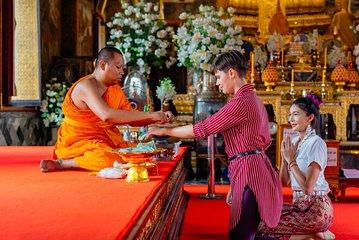
- Tuk-tuk transport between stops on vehicle-based formats, and temple entry where a temple is on the route.
What is normally extra
- Beer and spirits — Chinatown's bars sit on Soi Nana and Song Wat, and are almost always a post-tour decision.
- Hotel pick-up outside the immediate old-city and riverside zone.
- Anything you order beyond the itinerary. Carry ฿300–500 (USD 9–15) in small notes for this.
- Gratuity, which is discretionary in Thailand — ฿100–200 per person for a guide who has worked well is normal.
The self-guided benchmark
For comparison: eating Yaowarat independently costs roughly ฿300–500 (USD 9–15) per person across five or six stalls. A noodle or rice plate sits at ฿45–100 (USD 1.30–3), crab fried rice at ฿120–250 (USD 3.50–7), and a shared seafood table at ฿200–400 (USD 6–12) each. So the guided premium is real — you are paying several times the food cost for the guiding. Whether that is good value depends entirely on how much of the district you would otherwise miss, which for most first and second visits is a great deal.






The Yaowarat Route, Soi by Soi
Chinatown's food is not spread evenly along Yaowarat Road — it clusters in five distinct pockets, each with its own character and its own opening hours. Knowing which pocket a tour covers tells you more about the evening than the price does. The main strip is the spectacle; the side lanes are where most of the cooking that people remember actually happens.
The main strip: Odeon Gate to Ratchawong
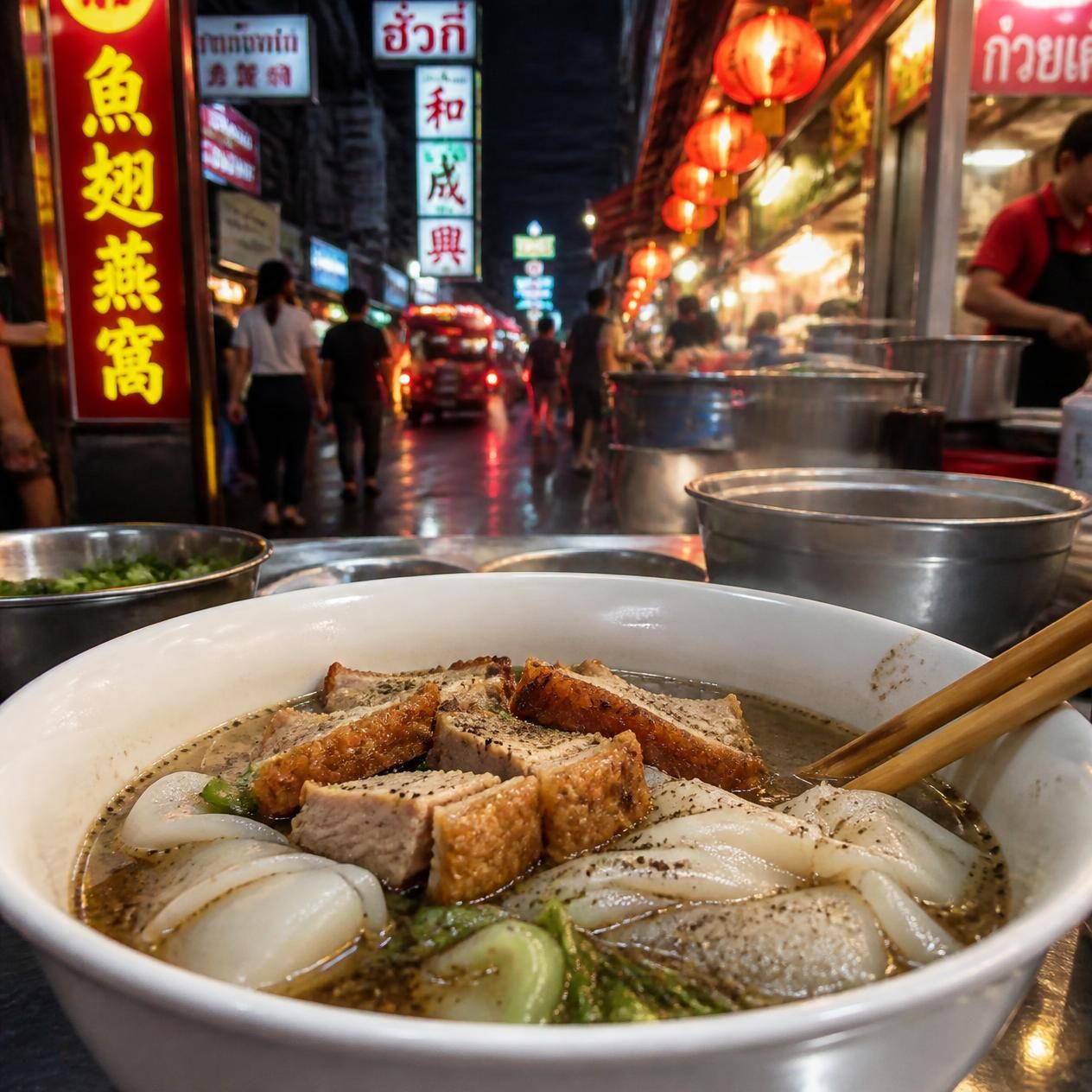
This is the postcard stretch — neon vertical signage, gold shops shuttering as carts roll out, and a crowd that thickens noticeably after 7pm. It is where the roast goose, braised duck over rice, and the two famous guay jub stalls sit, guay jub being rolled rice noodles in a clear, heavily peppered pork broth with crisp pork belly. Bowls run ฿50–100 (USD 1.50–3). One of the two long-runners opens from morning to midnight and works as a daytime option; the other starts at 6pm and serves into the small hours.
Soi Phadung Dao: the seafood alley
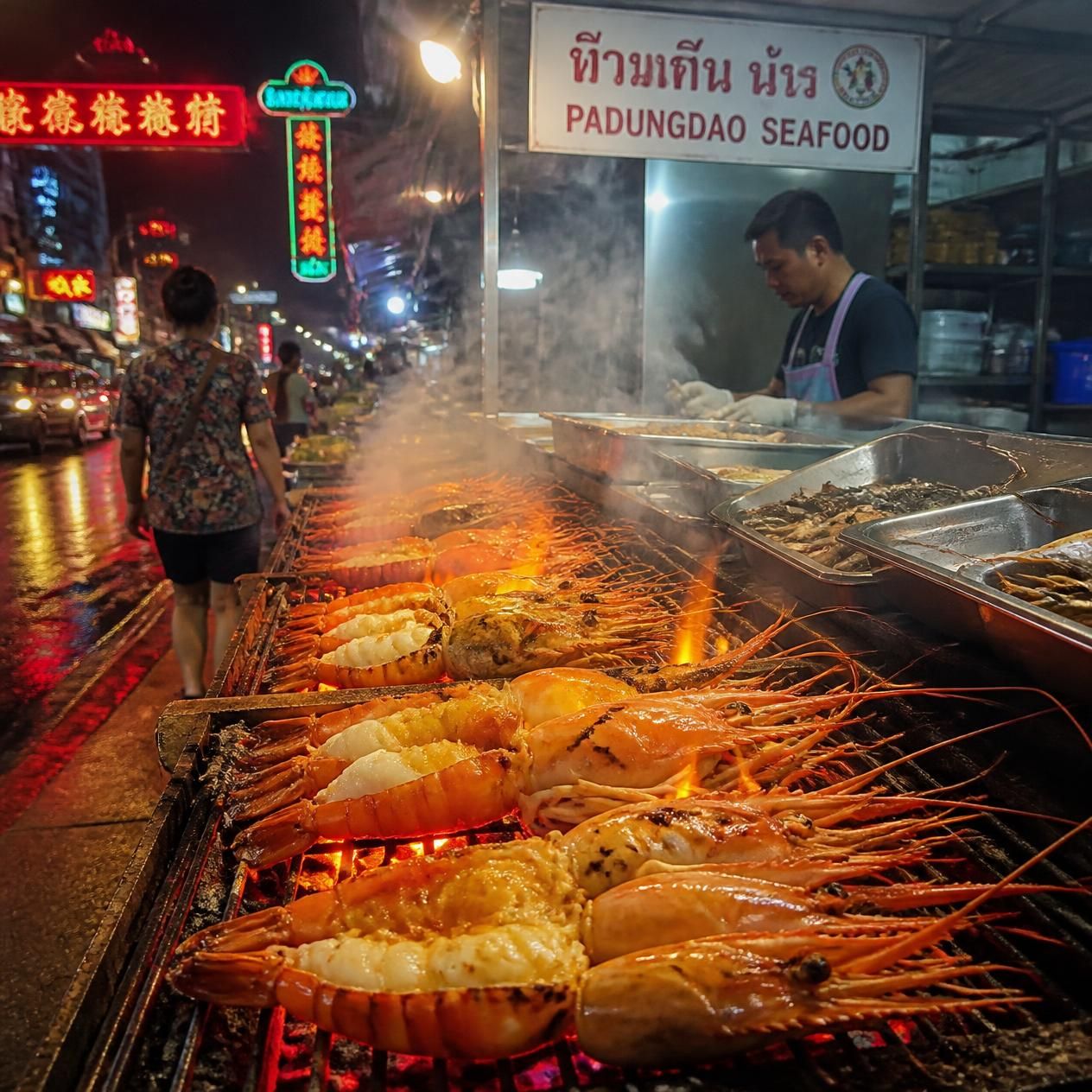
Known widely as Soi Texas, this short lane throws tables across the pavement from around 5pm and cooks over open charcoal until late. Grilled river prawns, tom yum, and crab are the reason to be here. Two large rival operations dominate the corner and get most of the attention, but the smaller kitchens three and four doors down cook the same dishes for less. Budget ฿200–400 (USD 6–12) per person, more if prawns are involved.
Soi Nana and the Charoen Krung end
A different Chinatown entirely — a short walk from the strip, this end holds dessert bars, third-wave coffee, and cocktail rooms in converted shophouses, alongside noodle kitchens that have never advertised. It is the natural place to end a Yaowarat street food tour if you want a drink afterwards, and it stays busy after the main road quietens around 11pm. Note that this Soi Nana is in Chinatown and is a completely separate place from the Sukhumvit street of the same name.
Sampeng Lane
Running parallel to Yaowarat, Sampeng Lane is a wholesale market rather than a food street — fabric, packaging, toys, trims — but a handful of stalls wedged between the shops serve braised pork leg over rice and noodle bowls at prices the main road no longer charges. It runs on daytime hours, largely winding down by late afternoon, so it appears on afternoon-start tours and rarely on evening ones.
Song Wat Road and Talat Noi
Song Wat Road and neighbouring Talat Noi are the district's quiet flank, running down towards the river — century-old rice warehouses, an old-machinery quarter, murals, and a slow drift of cafés and small kitchens into the shophouses. This is the part of Chinatown a second visit should be built around, and it is the clearest indicator of a good private guide: if Song Wat and Talat Noi are on the itinerary, the operator is not simply walking the main road.
Reality check: seafood is priced by weight
- River prawns, crab and whole fish on Soi Phadung Dao are sold by weight, not per plate, and the menu board often shows the per-kilo rate rather than the dish price.
- Point at what you want and ask for the price of that specific piece before it goes on the charcoal. Vendors are used to the question and answer it plainly.
- This is the single most common source of a surprising Chinatown bill, and it applies whether you are guided or not — though a guide will do the asking for you.
Which Yaowarat Street Food Tour Should You Choose?
Match the format to what you want from the evening rather than to the price. The walking tour gives the most food and the most alley access, the tuk-tuk gives range and a temple, the private option gives pacing and route control, and the Michelin route gives recognised names at the cost of queueing time.
- Choose the walking tour if food is the point and you are happy on your feet for three hours. It reaches the lanes vehicles cannot enter, which is where the older kitchens are.
- Choose the tuk-tuk tour if this is your first evening in Bangkok, or if you are travelling as a couple and want the ride through the neon as part of the experience. It also suits anyone who would rather not walk the full circuit in humidity.
- Choose a private guide if you have been to Bangkok before, if you want Song Wat and Talat Noi rather than the main strip, or if pork, shellfish or chilli need working around. It is also the sensible choice for a group of four or more, where the per-person cost converges with join-in pricing.
- Choose the Michelin-led route if you want the recognised Bib Gourmand addresses specifically. Accept that a queue is part of the format on Friday and Saturday nights.
- Skip the tour if you have eaten in Chinatown before and want to sit for two hours over a seafood table rather than move every twenty minutes.
If you are building a wider Bangkok itinerary around this, the top experiences in Bangkok shortlist is a sensible place to see how a Chinatown evening slots against the river, the palace complex and the Old City.
Reality check: the touts on the seafood corner
- On Soi Phadung Dao, staff work the pavement and will physically steer arrivals towards a table. It is not dangerous, but it is not a recommendation either.
- The kitchens with genuine reputations here have queues rather than touts. If someone is pulling you in, keep walking a few doors and look at where the Thai families are sitting.
- Likewise, pad thai is available on Yaowarat and is rarely the best version of itself. This is a Teochew and Cantonese district — order accordingly.
Planning the Evening
Yaowarat runs on an evening clock. Shops and gold dealers work daytime hours, food carts appear from around 5pm, the strip peaks between 7pm and 9.30pm, and the side lanes carry on past midnight. Arrive at 5.30pm and you will eat before the queues form; arrive at 8pm and you get the district at full volume with the waits that come with it.
Getting there
- MRT Blue Line to Wat Mangkon — the station opened in 2019 and exits directly into Chinatown; you are on Yaowarat Road within a minute or two.
- MRT to Hua Lamphong — roughly a ten to fifteen minute walk from the eastern edge, and the meeting point several tour operators still use.
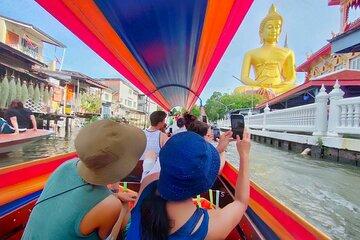
- By river — Ratchawong pier sits at the foot of Ratchawong Road, which makes a Chinatown food evening easy to pair with a Chao Phraya crossing rather than a taxi.
- By road — possible, but Charoen Krung and Yaowarat both clog badly from 5pm, and a taxi from Sukhumvit at that hour can take longer than the MRT by a wide margin.
Practicalities worth knowing
- Cash. Most stalls are cash-only. Carry ฿1,000–1,500 (USD 30–45) in small notes; ฿20s and ฿50s are the useful denominations. Some sit-down shophouses take PromptPay QR.
- Footwear. Closed shoes. Pavements are uneven, the lanes carry water near the stalls, and you will be standing for most of the evening.
- Temple dress. Wat Traimit and Wat Mangkon Kamalawat both require shoulders and knees covered. A light scarf in a bag is enough.
- Vegetarian eating. Options are limited on ordinary days in a pork-and-seafood district — the vegetarian restaurants in Bangkok listing is the better starting point outside festival season.
Two dates that change the district
Chinatown has two annual events that reshape what a Yaowarat street food tour actually delivers, and both are worth planning around rather than stumbling into.
Reality check: the Vegetarian Festival turns Yaowarat meat-free
- For ten days each year — falling in October in 2026 — the district observes the vegetarian festival, and more than a hundred stalls switch to meat-free cooking under yellow and red flags.
- It is one of the best times to be in Chinatown, but a pork, goose and seafood itinerary is not what you will get. Confirm with your operator what the route becomes.
- Lunar New Year, in late January or February, closes Yaowarat Road to traffic for the parade. Tuk-tuk formats are affected; walking tours simply become slower and far more crowded.
- Exact dates shift with the lunar calendar each year, so check before locking an evening in.
Planning your Chinatown evening
Three things decide how well this goes. Pick the format for the evening you want rather than the price — walking for depth, tuk-tuk for range, private for control. Aim for a Thursday to Saturday between 6pm and 10pm, when every kitchen is open and the district is working at full pace. And carry cash in small notes, because almost nothing on the strip takes a card.
Beyond that, Chinatown rewards a second look. The main road is the spectacle, but Song Wat, Talat Noi and the Charoen Krung end are where the district is quietly at its most interesting. Start planning your Bangkok trip on Travjoy and build the evening around what you actually want to eat.





.svg&w=1920&q=75)