



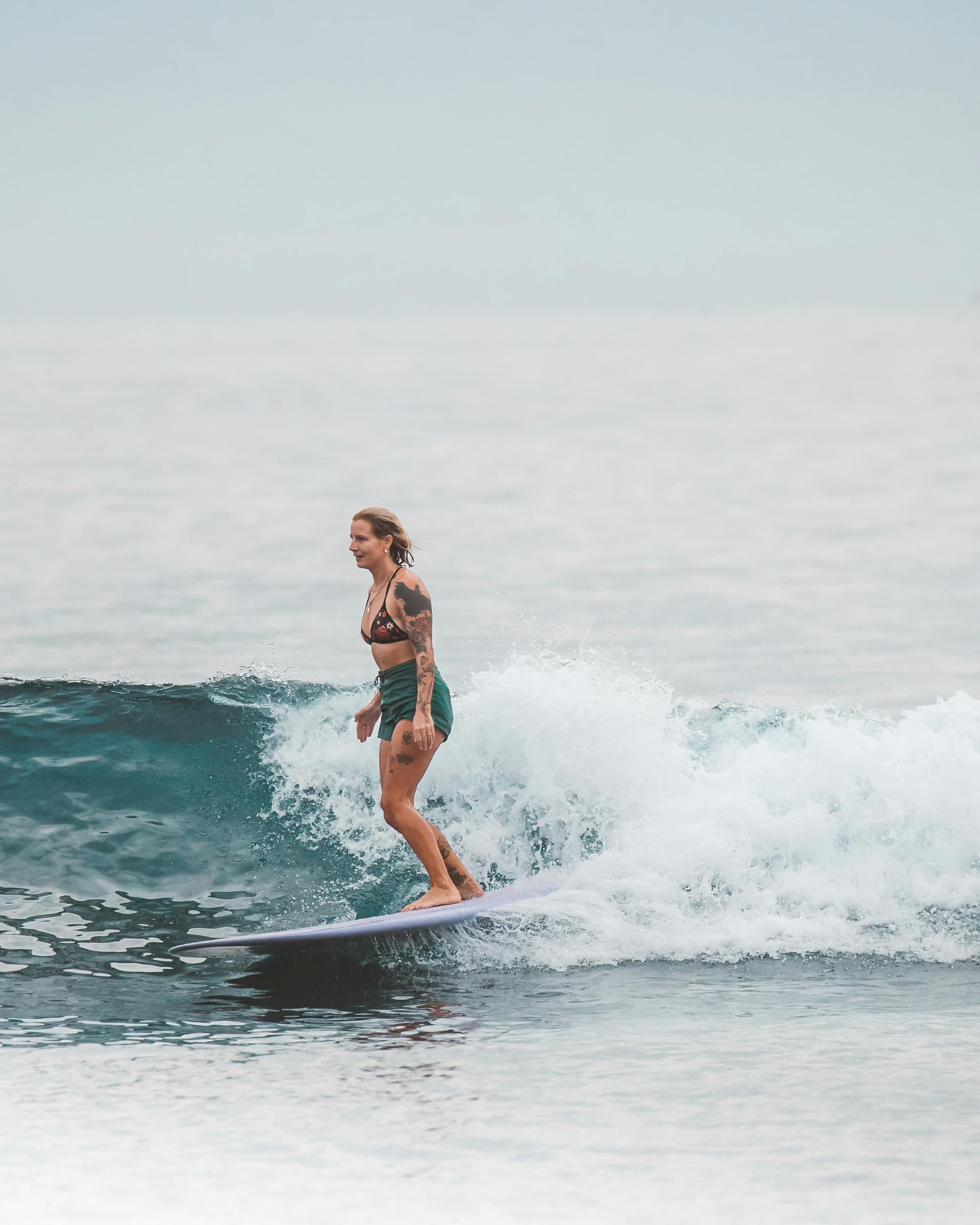
Surfing in Bali: Best Breaks for Every Skill Level (2026 Guide)
8 min read
Pratima Alvares
Author
Leisure Travel Expert Ex- SOTC & Cox & Kings
SHARE BLOG
TABLE OF CONTENTS
- Key Takeaways
- Is surfing in Bali worth it?
- Bali's two surf seasons (and what they mean for your level)
- Best Bali surf breaks for beginners
Key Takeaways
- Bali has two surf coasts on opposite seasons — the west coast (Apr–Oct) holds the iconic breaks; the east coast (Nov–Mar) wakes up when the west blows out.
- Beginners belong on sand and soft-top reef in Canggu (Batu Bolong, Old Man's) and Kuta — never the Bukit reef breaks.
- Intermediates step up at Padang Padang Right, Balangan, Medewi, and Echo Beach before tackling the heavies.
- Advanced surfers chase Uluwatu, Padang Padang Left, Bingin, Impossibles, and Keramas — all reef, all consequence.
- Budget IDR 350,000–650,000 (USD 22–42) for a two-hour lesson and IDR 70,000–150,000 (USD 4.50–9.50) per day for board rental in 2026.
Surfing in Bali works for every skill level if you match the break to your ability and the coast to the season. Beginners stick to soft sand in Canggu and Kuta, intermediates progress at Balangan and Medewi, and advanced surfers head for Uluwatu, Padang Padang Left, and Keramas. The dry season (April–October) favours the west coast; the wet season (November–March) wakes up the east.
Every Bali surf guide tells you the same thing: world-class waves, 20 named breaks, a season for every coast. None of them help you actually pick one. You're a first-time surfer, or you've stood up a few times in Goa, or you've done a season in Bali before — three completely different surfers reading the same generic list.
The two-coast logic is what most guides skip. Bali's west coast (Bukit Peninsula, Canggu, Kuta) and east coast (Sanur, Nusa Dua, Keramas) operate on opposite winds. Get the season wrong, drive an hour to the wrong beach, and you'll find onshore chop where someone promised you barrels.
This guide walks through the breaks by skill level, the season behind each one, and what it costs to surf them in 2026. The goal is simple: by the end, you'll know which beach to paddle out on, when to go, and roughly what to budget.
Is surfing in Bali worth it?
Yes, for almost every surfer — but the experience varies sharply by skill level and timing. Bali holds 70+ named breaks across two coastlines, water sits at 26–29°C year-round, lessons are among the cheapest in Asia, and the dry season delivers some of the most consistent waves on the planet. The catch is crowds, reef cuts, and a learning curve that gets unforgiving fast once you leave the sand.
Worth it if you're:
- A first-time surfer who wants soft sand, warm water, and patient instructors — Canggu and Kuta deliver this for IDR 350,000–650,000 (USD 22–42) per lesson.
- An intermediate ready to graduate to reef but not ready for Uluwatu — Balangan, Medewi, and Padang Padang Right are the natural step-ups.
- An advanced surfer chasing barrels, long walls, and a deep break inventory — the Bukit in dry season delivers six world-class waves inside a 10-km stretch.
- A surfer who wants to combine waves with everything else — temples, food, hikes — Bali is one of the only surf destinations where rest days are worth taking — and easy to fill.
Not ideal if you're:
- Looking for empty line-ups. Bali's main breaks are crowded by 7am most of the year, and Canggu's localism is real.
- Travelling in October–November or April–May expecting one specific break to fire — these are transition months and conditions flip without much warning.
- A complete beginner trying to surf the Bukit. Uluwatu, Padang Padang, and Bingin break over shallow reef and aren't lesson territory, no matter what an Instagram reel suggests.
Bali's two surf seasons (and what they mean for your level)
Bali runs on two surf seasons that swap which coast works. The dry season (April to October) brings southeast trade winds, which blow offshore on the west coast and turn Uluwatu, Padang Padang, Canggu, and Kuta into glassy walls. The wet season (November to March) flips the winds west, killing the famous spots and waking up the east coast — Keramas, Nusa Dua, Serangan, and Sanur. Knowing which coast is on is the single most useful piece of planning information for surfing in Bali.
Dry season (April–October) — west coast prime time
This is when the iconic breaks fire. Peak swell hits June through August, with wave faces ranging from head-high to triple-overhead on bigger days. Conditions are most reliable from May to September. The trade-off is crowds — July and August are full-blown peak season, and the Bukit lineups can hold 80+ surfers on the right swell.
- Best months for beginners: April, May, September, October — west coast beginner beaches stay manageable, crowds thin slightly
- Best months for intermediates: April–May and September–October for consistent swell without the August chaos
- Best months for advanced: June–August for size, May or September for size with fewer crowds
Wet season (November–March) — east coast wakes up
Most travel guides write off the wet season for surfers, which is wrong. The west coast goes onshore and choppy, but the east coast turns on. Keramas in particular is a wet-season specialty — fast, hollow, barreling right-handers that work best with morning offshore winds. Swells are smaller (3–6 feet) but the deep-water reefs amplify them. Rain is usually afternoon and brief.
- Conditions: 3–6 foot swells, offshore east-coast winds, lighter crowds
- Best for: intermediates and advanced regular-footers (right-hand waves dominate)
- Bonus: accommodation and surf-camp rates drop 20–30% off peak pricing
Shoulder months — the sweet spot for first-timers
April and October sit between seasons. You'll get cleaner days than the full wet season, lighter crowds than peak dry season, and lower prices than July. For a first Bali surf trip, these months are the most balanced pick.
Best Bali surf breaks for beginners
Beginners belong on soft sand or gentle inside reef — never the heavy outer Bukit reefs that show up first in Google image searches. The four breaks below are where every reputable Bali surf school runs lessons, and where you can rent a soft-top, stand up, and not slice your foot open on coral.
Batu Bolong, Canggu
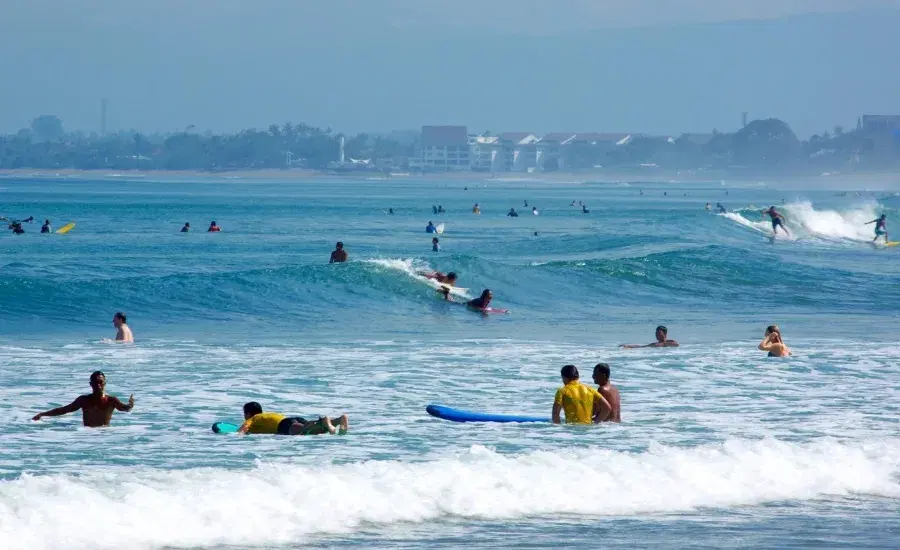
The default beginner break on the island, and the reason Canggu became a surf town. Batu Bolong is a long, sandy-bottomed beach break with multiple peaks, knee-to-shoulder-high whitewater on most days, and a dense ecosystem of surf schools renting boards every five metres of sand. The wave is forgiving; the crowd less so — by 8am the lineup is packed.
- Skill level: beginner to advanced beginner
- Wave type: sandy-bottom beach break with reef sections further out
- Best time: mid-tide rising, early morning
- Vibe: social, crowded, lots of first-timers — easy to find lessons
- Reality check: drop-ins are constant; learn to call your wave
Kuta Beach
The original Bali surf beach and still the most forgiving spot to take your first ever wave. The bottom is pure sand, the whitewater is consistent, and the surf schools along the strip charge less than Canggu. The stretch between Hard Rock Hotel and Halfway Kuta has the most consistent learner waves on the island.
- Skill level: absolute beginner
- Wave type: soft beach break
- Best time: year-round, less affected by season than Bukit breaks
- Cost edge: lessons typically run IDR 50,000–100,000 cheaper than Canggu
Old Man's, Canggu
One step up from Batu Bolong, and where most learners progress after a few sessions. Old Man's is a semi-reef break producing A-frame waves with longer rides. The inside section is friendly; the outside peak holds intermediates working on cutbacks. You'll know you're ready for Old Man's when you can paddle out through whitewater confidently and ride down the line without tip-diving.
- Skill level: advanced beginner to intermediate
- Wave type: semi-reef A-frame, both lefts and rights
- Best time: dawn patrol or sunset session — midday is brutal for crowds
Seminyak and Legian
Between Kuta and Canggu, these stretches offer the same forgiving sand-bottom waves as Kuta with slightly fewer crowds. Good fallback if Kuta feels too touristy or Canggu's parking nightmare is putting you off. Wave quality is similar to Kuta, with the same dependable beginner-friendly setup.
What every beginner needs to know before paddling out
- Wear a rash guard. Soft-top boards combined with sun-warmed water means underarm chafing within 20 minutes.
- Always rent at the beach, not in town — the beach guys check your board and adjust the fin/leash for you.
- Most lessons are 2 hours including 15 minutes of theory. Anyone offering "1-hour lessons" is selling you 40 minutes of water time.
- The taxi mafia in Kuta is real — pre-arrange transport through your accommodation or use Gojek/Grab.




Best Bali surf breaks for intermediates
Intermediate surfers are where Bali starts to open up. You've graduated from whitewater to unbroken waves, you can angle a takeoff onto a left or right, and you're starting to draw a line. The breaks below give you reef without the consequence of Uluwatu, and they're where every serious surfer's Bali progression actually happens. Start with Padang Padang Right and Balangan; work up to Echo Beach and Medewi.
Padang Padang Right (Baby Padang)
The forgiving sibling of the famous left. Padang Padang Right is a small, playful reef break that breaks on the opposite side of the same bay — and it's one of the best confidence-builders on the Bukit. Smooth faces, manageable size, and a friendlier crowd than its barrel-hunting neighbour.
- Skill level: intermediate
- Wave type: small reef A-frame, mostly right
- Best season: April–October (dry)
- Crowd: moderate — much lighter than the left
Balangan
The textbook intermediate break — a long left-hand reef break with room to work on turns and positioning. Balangan needs a medium swell to be at its best, and on those days it offers some of the longest rideable lefts on the Bukit. Reef is rounded rather than sharp, and the lineup tends to be more relaxed than the headline spots.
- Skill level: intermediate to advanced
- Wave type: long left-hand reef break
- Best season: April–October
- Why it ranks: long rides, room to practise carving, manageable consequence
Medewi
Bali's longest left, and worth the two-hour drive from the south. Medewi is a point break on the west coast (northwest of Canggu) with rides that can hit 60 seconds on a good swell. The wave is mellow rather than powerful — ideal for refining flow, footwork, and trim. Crowds are a fraction of the Bukit.
- Skill level: intermediate
- Wave type: long left-hand point break, cobblestone bottom
- Best season: April–October
- Logistics: 2.5-hour drive from Canggu — best as an overnight or weekend trip
Echo Beach, Canggu
The intermediate graduation ceremony for surfers based in Canggu. Echo is a reef break with multiple take-off zones, strong waves, and a packed lineup. On smaller days it's friendly; on bigger days it's fast and consequence-heavy. Best surfed dawn patrol before the swell maxes out and the crowd peaks.
- Skill level: intermediate
- Wave type: reef break, multiple peaks
- Best season: April–October
- Reality check: the localism is real — wait your turn
Serangan (wet season)
If you're in Bali November to February as an intermediate, Serangan is where you'll spend your sessions. Several peaks suit different levels — the left-side picks offer soft A-frame waves at mid-to-high tide on small/medium swell. It's one of the few wet-season options that consistently works for intermediates.
- Skill level: intermediate to advanced
- Wave type: reef with multiple peaks
- Best season: November–March
- Caveat: can be overcrowded December–February — it's one of the only working spots
Best Bali surf breaks for advanced surfers
This is what people travel to Bali for. Five world-class breaks sit within a 10-kilometre stretch of the Bukit Peninsula, plus Keramas on the east coast for the wet season. Every break listed below is reef, fast, and unforgiving — wave knowledge, fitness, and confidence on overhead surf are non-negotiable. If you're unsure whether you're advanced, you're not.
Uluwatu
The most famous wave in Indonesia and the benchmark advanced reef break. Uluwatu offers five take-off zones — Temples, Outside Corner, The Peak, Racetracks, and Inside — each with its own character. Long, powerful left walls on consistent swell, with the option to surf two-to-three-foot mellow days at The Peak or eight-foot consequence at Outside Corner. Access is through a cave at the base of the cliffs, directly below Uluwatu Temple.
- Skill level: advanced
- Wave type: fast, powerful left reef
- Best season: April–October, peak swell June–August
- Reality check: the cave entry/exit is timed with the swell — getting it wrong cuts you on coral. Watch a few cycles before going
Padang Padang Left
Indonesia's most photogenic barrel and one of the hollowest waves in the world when it's on. Padang Padang Left works on a specific swell window — too small and it doesn't break, too big and it closes out. When it's right, it's a six-second barrel ride down a perfect reef shelf. Localism is intense; the wave is short, and there are usually 40 surfers competing for 10 waves an hour.
- Skill level: advanced only
- Wave type: hollow left-hand reef barrel
- Best season: April–October, dependent on swell direction
- Reality check: if you're not getting barrels regularly, sit on the shoulder and watch — paddling into a Padang barrel without commitment is how injuries happen
Bingin
A short, hollow, super-fast left over very shallow reef. Bingin is the cousin Padang Padang doesn't talk about — equally hollow, slightly shorter, with a thicker local crew. The drop is steep, the barrel is automatic, and the kick-out happens fast. One of the best waves on the Bukit when conditions align.
- Skill level: advanced
- Wave type: short, hollow left reef
- Best season: April–October
- Best tide: mid-tide rising
Impossibles
A long, fast, sectioning left between Padang Padang and Bingin. On a perfect day, Impossibles offers 150-metre rides through three connecting sections — Middle, Outside, and Indicators. Less crowded than its neighbours because the sections close out unless conditions are perfect, but on the right day it's the longest ride on the Bukit.
- Skill level: advanced
- Wave type: long, fast, sectioning left reef
- Best season: April–October
- Tip: walk from Bingin or Padang at low tide rather than paddling — saves an hour of effort
Keramas (wet season)
The crown jewel of the east coast and the World Surf League stop on the Bali Pro tour. Keramas is a high-performance right-hand reef break that produces barreling, fast walls — best surfed at dawn before the wind picks up. It's the reason advanced regular-footers travel to Bali in the wet season rather than the dry.
- Skill level: advanced
- Wave type: fast, hollow right-hand reef
- Best season: November–March (especially morning sessions)
- Reality check: shallow reef and a strong rip — dawn patrol or skip
Costs, lessons, and which break should you choose?
What you'll actually spend depends on three things: whether you take lessons or surf solo, where you rent your board, and whether you base in Canggu, the Bukit, or somewhere else. Below is the 2026 price reality, followed by a decision framework that matches breaks to traveller type.
Bali surf pricing in 2026 (IDR + USD)
| Item | IDR (2026) | USD | Notes |
|---|---|---|---|
| Group lesson (2 hours, soft-top, instructor for 2–4 students) | 350,000–500,000 | 22–32 | Standard beginner package |
| Semi-private lesson (2 hours, 1 instructor for 2 students) | 540,000–700,000 | 34–44 | Faster progress; recommended |
| Private lesson (2 hours, 1 instructor for 1 student) | 650,000–900,000 | 42–58 | Best for nervous beginners or intermediate coaching |
| Soft-top board rental (per day) | 70,000–100,000 | 4.50–6.50 | Beach rental; swap allowed within 2 hours |
| Hard-top board rental (per day) | 100,000–150,000 | 6.50–9.50 | Shortboard or fish; some shops charge deposit |
| Mid-range surf camp (7 nights, lessons + dorm/twin) | 15.5M–40M | 1,000–2,500 | Includes board, transport, breakfast |
| Luxury surf camp (7 nights, private coaching, villa) | 40M–80M | 2,500–5,000 | Video analysis, premium accommodation |
| High-season surcharge (Jun–Sep) | +130,000 | +8 | Per lesson; applied by most schools |
You can surf in Bali on roughly USD 30 a day (cheap board rental + cheap warung lunch) or USD 250 a day (private coaching + villa). Most travellers land in the USD 80–150 range with two surf sessions, a lesson every other day, and mid-range accommodation. The options on Travjoy are hand-picked and vetted by local experts, so you can book a surf-focused day or a multi-day program knowing it's been checked against what actually delivers.
Which break should you choose?
The right answer is almost always "base in Canggu and travel for the day to the Bukit" or "base in Uluwatu and travel up for variety." Here's the decision logic by traveller type:
- Choose Canggu (Batu Bolong, Old Man's, Echo) if: you're a first-timer, an advanced-beginner, or an intermediate working on consistency. Easy lessons, dense surf-school scene, walkable cafés between sessions, and a quick taxi to the Bukit on bigger swells.
- Choose the Bukit (Uluwatu, Padang, Bingin, Impossibles) if: you're a confident intermediate or advanced surfer chasing the iconic dry-season breaks. Stay near Padang Padang or Bingin for short walks to multiple line-ups.
- Choose Medewi if: you're a longboarder, a stylist, or an intermediate wanting space to practise. Pair it with the Pemuteran or West Bali National Park region for a non-Bukit trip.
- Choose the east coast (Keramas, Serangan, Nusa Dua) if: you're travelling November to March and want to surf rather than wait out the wet season. Keramas in particular is a dry-season-quality wave when the west coast is onshore.
- Choose a surf camp if: you want progress in 7 days, structured coaching, video analysis, and someone deciding which break to surf each morning based on conditions. Worth it for first-time visitors and intermediates trying to break through plateaus.
- Skip the camp and go independent if: you've surfed Bali before, you have a forecast app, and you know your tide preferences. Renting a scooter, a board, and your own villa works out cheaper above two weeks.
For broader trip-planning beyond surfing, browse Bali's top experiences and the Bali adventure experiences page — both pair well with surf-focused itineraries.
Plan your Bali surf trip
Surfing in Bali rewards travellers who do two things: match the break to their skill level, and align the trip to the season the right coast is on. Beginners belong on Canggu and Kuta sand from April through October. Intermediates progress through Padang Padang Right, Balangan, and Medewi. Advanced surfers chase Uluwatu and the Bukit in dry season, then Keramas on the east coast from November onward.
The pricing is reasonable, the water is warm year-round, and the break inventory is deeper than any other surf destination in Asia. The piece you control is timing and break choice — get those right and the rest of the trip falls into place. Start planning your Bali trip on Travjoy's Bali page, where surf-friendly experiences sit alongside everything else worth doing on the island.



.svg&w=1920&q=75)