



Singapore Botanic Gardens: UNESCO Heritage Site Visitor Guide
16 min read

Author
SHARE BLOG
TABLE OF CONTENTS
- Free entry to the main gardens; the National Orchid Garden costs SGD 15 (~USD 11.70) for foreign adults
- Open daily from 5 am to midnight, with the Orchid Garden operating 8:30 am–7 pm
- Five distinct zones spanning 82 hectares — plan 2–4 hours depending on your pace
- Singapore's only UNESCO World Heritage Site, inscribed in 2015 as the world's sole tropical botanic garden on the list
- Nearest MRT: Botanic Gardens station (Circle Line / Downtown Line), a five-minute walk from the Orchard Road shopping belt
Singapore Botanic Gardens is a free-entry, 82-hectare UNESCO World Heritage Site open daily from 5 am to midnight. The key paid attraction is the National Orchid Garden (SGD 15 / ~USD 11.70 for foreign adults), home to over 1,000 orchid species and 2,000 hybrids. Plan 2–3 hours for the highlights or a full half-day to cover all five zones, from heritage landmarks to a rainforest canopy walk.
Singapore has more than 300 parks and green spaces threaded through its compact cityscape. Only one of them carries a UNESCO World Heritage designation — and it sits five minutes from the Orchard Road shopping belt, reachable by a single MRT stop. The Singapore Botanic Gardens is not a quiet afterthought on the tourist circuit. It draws over 4.5 million visitors a year, more than many national parks ten times its size.
Founded in 1859, the Gardens stretch across 82 hectares divided into five zones, each with a distinct character. The Tanglin core holds 19th-century heritage buildings and the world-famous National Orchid Garden. The Gallop Extension, opened in 2019, adds a nature playground, ridge-top hiking trail, and Singapore's oldest surviving colonial bungalow. In between, you'll find a six-hectare primary rainforest fragment, a freshwater swamp boardwalk, and a children's garden that was the first of its kind in Asia.
This guide walks you through each zone with timings, entry costs in both SGD and USD, gate strategies, and tips matched to how you travel — whether you're here with toddlers, on a morning run, or chasing the light for photographs.

Why Singapore Botanic Gardens Earned UNESCO World Heritage Status
The Singapore Botanic Gardens received its UNESCO World Heritage inscription on 4 July 2015, becoming the first and only tropical botanic garden on the World Heritage List. The recognition was not just about pretty landscaping — it honoured a 160-year arc of botanical science, colonial-era economic impact, and ongoing conservation that few urban green spaces anywhere can match.
The Colonial-to-Modern Evolution (1859 to Present)
The concept of a national garden in Singapore traces back to 1822, when Sir Stamford Raffles established the first "Botanical and Experimental Garden" on what is now Fort Canning Park. The Gardens moved to their current Cluny Road location in 1859, laid out by the Agri-Horticultural Society following the English Landscape Movement style. The British colonial government took over management in 1874.
A series of Kew-trained botanists then transformed the space from a recreational pleasure garden into a serious scientific institution. That dual identity — public park and research centre — persists today under the management of the National Parks Board (NParks).
The Rubber Trade Legacy
The Gardens' most consequential contribution to the region happened in the early 20th century. Henry Nicholas Ridley, the first scientific director, perfected a tapping technique for rubber extraction that made large-scale cultivation viable. His work at the Gardens helped catalyse the rubber boom across Malaya, fundamentally reshaping Southeast Asia's economy.
Today, the Singapore Botanic Gardens' herbarium houses over 750,000 specimens, and its research partnerships span leading botanical institutions worldwide. The science happens quietly — most visitors walk past the Botany Centre laboratories without realising what's inside.
What the UNESCO Inscription Means for Visitors Today
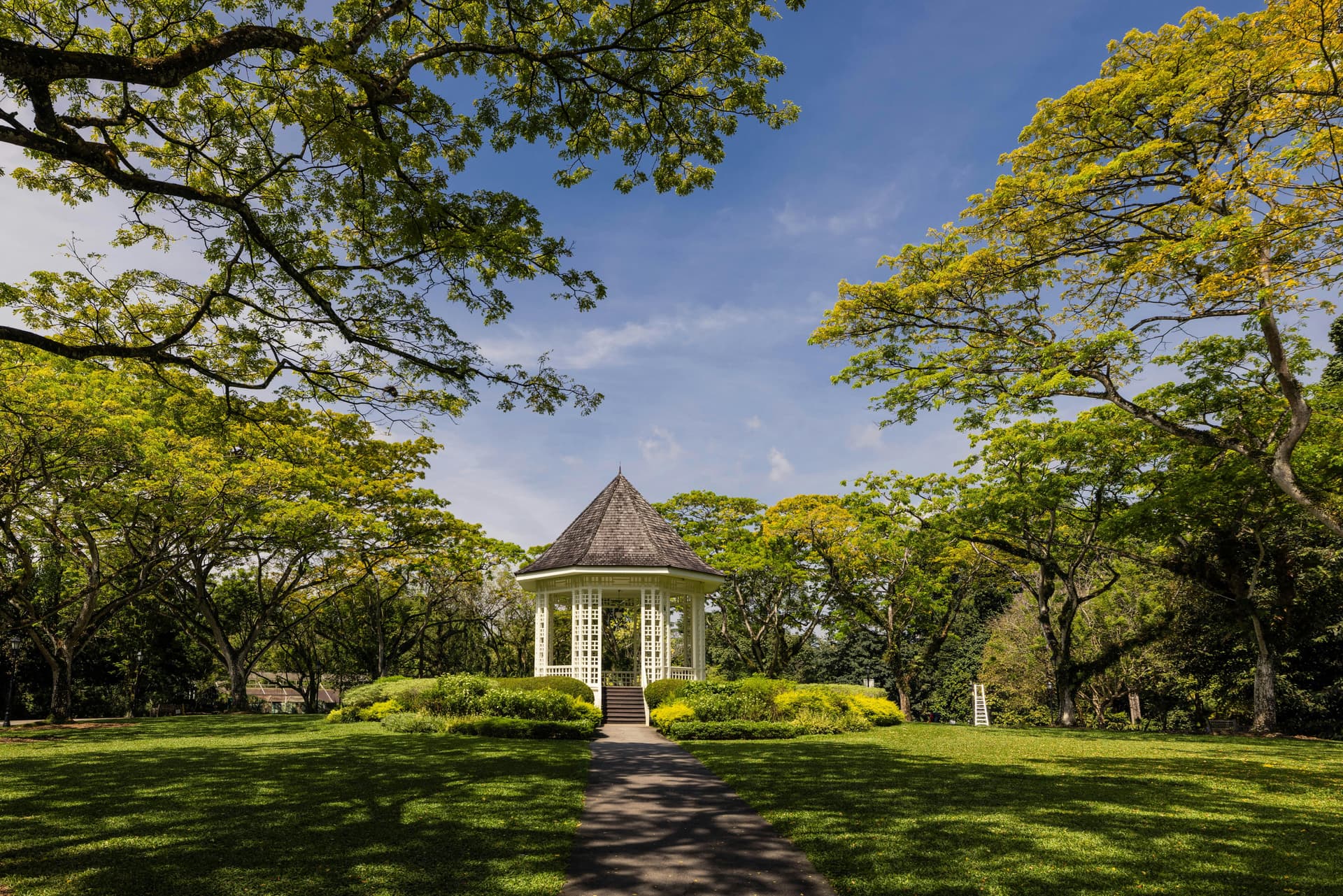
The Heritage designation ensures that the Gardens' historic landscape features, plantings, and buildings are protected under Singapore's Planning Act. For visitors, this means the 19th-century Bandstand, the heritage trees along Palm Valley, and the Rain Forest fragment are all conserved exactly as they have been for generations. You're walking through a living document of tropical botanical history, not a reconstructed theme park version of one.
What to See — Zone-by-Zone Guide to Singapore Botanic Gardens
The Gardens divide into five zones, stretching 2.5 km from the Tanglin Gate in the south to the Bukit Timah Gate in the north. You don't need to cover them all in one visit. Here's what each zone offers and how long to budget.
Tanglin Zone — The Heritage Core
This is the oldest section of the Singapore Botanic Gardens and the natural starting point if you enter from Tanglin Gate, the closest entry to Orchard Road. Key landmarks include the Bandstand (an octagonal structure built in the 1930s), Swan Lake (Singapore's first ornamental lake), and the Sundial Garden.
The National Orchid Garden sits at the top of the hill in this zone — more on that below. Budget 60–90 minutes for the Tanglin Zone if you include the Orchid Garden, or 30 minutes if you skip it.
Central Core — Symphony Lake, Rain Forest, Ginger Garden
The Central Core is the social heart of the Gardens. Symphony Lake hosts free weekend concerts at the Shaw Foundation Symphony Stage, and the surrounding lawns fill with picnic blankets on Saturday evenings. The six-hectare Rain Forest here is one of the few remaining primary rainforest fragments in Singapore — older than the Gardens themselves.
The Ginger Garden, adjacent to the Orchid Garden, is free to enter and showcases the diversity of the ginger family in a lush, shaded setting. The Halia restaurant sits inside this garden (more on dining below). Budget 45–60 minutes for this zone.
Bukit Timah Zone — Children's Garden and Eco-Garden
The Jacob Ballas Children's Garden, Asia's first garden dedicated to children, is the main draw here. It includes a farm, an orchard, a forest with its own stream, and interactive nature-play areas. Entry is restricted to children aged 14 and below; adults must be accompanied by a child.
- Opening hours: 8 am–7 pm daily (last entry 6:30 pm), closed every Monday unless it falls on a public holiday
- Entry: Free
- Best for: Families with children under 10
If you're visiting with kids, enter via Bukit Timah Gate (nearest to the Children's Garden) and pair this zone with the Eco-Garden next door. Budget 60–90 minutes for families.
Tyersall and Gallop Extension — Playground, Art Gallery, Arboretum
The Gallop Extension is an 8-hectare addition opened in 2019 — the largest expansion in the Gardens' history. It's the least crowded section and one of the most rewarding. Highlights include:
- COMO Adventure Grove — A nature-inspired playground with a 5.8-metre banyan tree climbing tower, swings shaped like aerial roots, and giant saga seed pods. Open daily 7 am–7 pm. Free entry.
- Botanical Art Gallery (Gallop House No. 7) — Singapore's first permanent display of botanical art, with over 2,000 paintings, sketches, and illustrations. Open 9 am–6 pm, closed last Thursday of each month. Free entry.
- Forest Discovery Centre (Gallop House No. 5) — Housed in Singapore's oldest surviving colonial-era bungalow (built 1898), with interactive displays on Singapore's forest ecosystems. Same hours as the Art Gallery. Free entry.
- Mingxin Foundation Rambler's Ridge — A 350-metre ridge-top hiking trail reaching 40 metres above sea level, with rocky steps and critically endangered native trees like the Spike Oak.
Enter via Gallop Gate for direct access. Budget 45–75 minutes.
Learning Forest — Canopy Walk and Swamp Boardwalks
The Learning Forest connects to the Gallop Extension via the HPL Canopy Link, an elevated walkway crossing Tyersall Avenue through the canopy of a deciduous forest. Inside, the SPH Walk of Giants takes you above towering jelutong and native rainforest species on an elevated boardwalk. The freshwater swamp habitat below supports species you won't find elsewhere in the Gardens.
This zone rewards slow walking and birdwatching. Budget 30–45 minutes.
Time Budget at a Glance
- Quick visit (highlights only): 2 hours — enter Tanglin Gate, see Orchid Garden, walk through Central Core, exit Nassim Gate
- Half-day exploration: 3–4 hours — cover Tanglin, Central Core, and either the Learning Forest or the Gallop Extension
- Full-day immersion: 5+ hours — all five zones, with a lunch stop at one of the in-garden restaurants
National Orchid Garden — Is It Worth the Entry Fee?
Yes, for most visitors. The National Orchid Garden is the centrepiece of the Singapore Botanic Gardens and the product of an orchid breeding programme that began in 1928. It's the only paid attraction in the Gardens, but the scale and variety of what's inside justifies the ticket — especially if you have even a passing interest in flowers, photography, or botanical history.
What You'll See Inside
The garden displays over 1,000 orchid species and 2,000 hybrids spread across three hectares. Sections include the Tropical Montane Orchidetum (a model montane forest with high-altitude orchid species), the Sembcorp Cool House (an air-conditioned conservatory for rare highland orchids), and the Tan Hoon Siang Mist House.
The VIP Orchid Garden is a highlight — over 200 orchid hybrids named after visiting heads of state, dignitaries, and celebrities, including varieties honouring Margaret Thatcher, Jackie Chan, and Nelson Mandela. Singapore's national flower, the Vanda Miss Joaquim, is also on display here.
Ticket Prices and Concessions
- Foreign adults: SGD 15 (~USD 11.70)
- Foreign students and seniors: SGD 3 (~USD 2.30)
- Singapore residents (adults): SGD 5 (~USD 3.90)
- Singapore residents (students/seniors): SGD 1 (~USD 0.80)
- Children under 12: Free
You can pre-book tickets online for a small discount. The Orchid Garden is open daily from 8:30 am to 7 pm, with last entry at 6 pm.
Best Time to Visit the Orchid Garden for Smaller Crowds
Weekday mornings between 8:30 and 10 am are the quietest window. Weekend afternoons bring the largest crowds. The soft morning light also makes this the best time for photography — the orchid arches and mist sections photograph particularly well before the midday glare sets in.

How to Get to Singapore Botanic Gardens and Which Gate to Use
The Gardens are centrally located in Singapore, bordered by Holland Road to the west and Bukit Timah Road to the north. Public transport access is straightforward, and which gate you choose shapes your visit more than you might expect.
MRT, Bus, and Taxi Options
- MRT: Botanic Gardens station (Circle Line CC19 / Downtown Line DT9) — exit and you're at the Bukit Timah Gate within 2 minutes. This is the most convenient option for most visitors.
- Bus: Buses 7, 75, 77, 105, 106, 123, 174 stop near the Tanglin Gate entrance. Buses 48, 66, 67, 151, 153, 154, 156, 170 stop near the Bukit Timah Gate.
- Taxi/ride-hail: Drop-off points at Tanglin Gate (1 Cluny Road), Nassim Gate, or Gallop Gate (via Tyersall Avenue). A Grab ride from Marina Bay takes roughly 10–15 minutes and costs SGD 10–18 (~USD 7.50–13.50) depending on demand.
The Four Main Gates — Which One Suits Your Plan
Your gate choice determines what you see first and how efficiently you cover the Gardens. Here's how to pick:
- Tanglin Gate — Best for: Heritage walk, National Orchid Garden, Swan Lake. Closest to Orchard Road. Start here if the Orchid Garden is your priority.
- Nassim Gate — Best for: Quick visits. Enter here for direct access to the Central Core, Symphony Lake, and Rain Forest. The UNESCO inscription plaque is displayed here.
- Bukit Timah Gate — Best for: Families heading to the Jacob Ballas Children's Garden, or visitors arriving by MRT. The Botanic Gardens MRT station puts you right at this entrance.
- Gallop Gate — Best for: The Gallop Extension (COMO Adventure Grove, Botanical Art Gallery, Rambler's Ridge). Enter via Tyersall Avenue; parking available here.
If you want to walk the full length of the Gardens, enter at Tanglin Gate and exit at Bukit Timah Gate (or vice versa) — that's roughly 2.5 km end to end.
Parking Options and Costs
Carpark lots are available near Tanglin Gate, Nassim Gate, and Gallop Gate. Rates run approximately SGD 1.20 (~USD 0.90) per half hour during weekdays and slightly higher on weekends. The Tyersall Avenue car park near Gallop Gate tends to have more availability, especially on weekends when the other lots fill early.
Practical Tips for Your Singapore Botanic Gardens Visit
The Gardens are straightforward to visit, but a few decisions — when you go, what you wear, where you eat — can significantly affect how much you enjoy your time here. Early planning pays off more than you'd expect for a free attraction.
Best Time of Day and Week to Visit
Early mornings (5–8 am) offer the coolest temperatures, the softest light, and near-empty paths. This is the window favoured by joggers, dog walkers, and serious photographers. If you prefer to combine your visit with the Orchid Garden, arrive by 8:30 am when it opens — you'll have 60–90 minutes of relative quiet before group tours start arriving around 10 am.
Late afternoons (4–6:30 pm) are the second-best window. The heat eases, the light warms, and you can catch a free concert at Symphony Lake if you're visiting on a weekend. Midday visits (11 am–3 pm) are the hardest — Singapore's equatorial sun is direct and intense, with minimal shade on the open lawns.
Weekdays are noticeably quieter than weekends across all zones.
What to Wear and Bring
- Footwear: Comfortable walking shoes with grip — paths are well-paved, but the Rambler's Ridge trail has rocky steps and the Rain Forest path can be slippery after rain
- Clothing: Light, breathable fabrics; a hat for the open lawn sections
- Essentials: Sunscreen, water bottle (refill stations at visitor centres), insect repellent for the Learning Forest and Rain Forest sections
- Rain gear: A compact umbrella — afternoon showers are common year-round in Singapore and can arrive with little warning
Where to Eat Inside the Gardens
You don't need to leave the Gardens for a meal. Several restaurants and cafés operate within the grounds, ranging from casual to fine dining.
- The Halia (Ginger Garden) — Southeast Asian and European fusion in a ginger-garden setting. Mains from SGD 28–48 (~USD 21–36). Reservations recommended for weekend brunch.
- Botanico at The Summerhouse (Tyersall Zone) — Italian-Mediterranean dishes with garden views. Set lunch from SGD 48 (~USD 36). Best for couples or a slower-paced visit.
- Food for Thought (Green Pavilion, Tanglin Core) — Casual café with sandwiches, pastas, and coffee. Mains from SGD 14–22 (~USD 10.50–16.50). Good for families.
- Bee's Knees Petite (Gallop Extension) — Light bites and drinks near COMO Adventure Grove. Coffee from SGD 5 (~USD 3.80).
- Ice Cream Man & Friends (Bukit Timah entrance) — Local-flavour ice cream including Teh Tarik and Mao Shan Wang Durian. Single scoops from SGD 4.50 (~USD 3.40).
Accessibility and Facilities
The Gardens have six visitor centres (open 8 am–5:30 pm daily) offering maps, wheelchair loans, and general information. Most main paths are barrier-free and wheelchair-accessible. Restrooms are located near each gate and at major attractions. The Botanical Art Gallery and Forest Discovery Centre are air-conditioned — useful as midday cool-down stops.
Best for Your Traveller Type
- Families with young children: Enter via Bukit Timah Gate for the Jacob Ballas Children's Garden, then walk to COMO Adventure Grove via the Learning Forest. Budget a half day.
- Couples: Enter via Tanglin Gate for the Orchid Garden and Swan Lake, then lunch at The Halia. The Ginger Garden path is one of the most photogenic walks in the Gardens.
- Solo travellers and photographers: Arrive before 7 am via Nassim Gate. The Rain Forest and Palm Valley are at their quietest and most atmospheric in early light.
- Nature and heritage enthusiasts: Start at Tanglin Gate, walk the full 2.5 km to Bukit Timah Gate, and double back through the Learning Forest and Gallop Extension. This is the full-day route.
Singapore Botanic Gardens vs Gardens by the Bay — How to Choose
This is one of the most common questions visitors ask, and the honest answer is that the two gardens serve different purposes. They're not interchangeable, and if your schedule allows, both are worth your time.
Key Differences at a Glance
The Singapore Botanic Gardens is a 160-year-old UNESCO World Heritage Site built around natural landscapes, heritage buildings, and tropical botanical research. It's free to enter, green and shaded, and rewards slow exploration. Gardens by the Bay is a modern, purpose-built attraction centred on engineered spectacles — the Supertree Grove, the Cloud Forest dome, and the Flower Dome. It's more visually dramatic but carries higher entry costs (the two conservatories cost SGD 53 / ~USD 40 for foreign adults).
If You Only Have Time for One
Choose the Botanic Gardens if you want a quiet, immersive nature experience with historical depth and prefer to spend minimally. Choose Gardens by the Bay if you want Instagram-ready architecture, the evening Supertree light show, and don't mind the ticket price. Families with children under 8 often get more value from the Botanic Gardens (Jacob Ballas Children's Garden and COMO Adventure Grove are both free), while older children may prefer the scale and spectacle of Gardens by the Bay.
Plan Your Visit to Singapore Botanic Gardens
The Singapore Botanic Gardens does not compete for attention with flashy marketing or towering structures. It earns visitors through 160 years of accumulated depth — the orchid hybrids named after world leaders, the rainforest fragment older than the nation itself, the rubber-tapping technique perfected here that changed an entire region's economy. All of it sits five minutes from Orchard Road, open daily, free to enter.
Whether you're filling a slow morning with a walk through the Ginger Garden or spending a full day covering all five zones, this is one of the most rewarding green spaces in Southeast Asia. For families, the COMO Adventure Grove and Jacob Ballas Children's Garden alone justify a half-day visit. For anyone interested in botanical history, the UNESCO-listed Tanglin core tells a story no other tropical garden in the world can.
Start planning your Singapore itinerary with more activities and experiences in Singapore on Travjoy — where options are researched and approved by local experts so you can spend less time second-guessing and more time exploring.

.svg&w=1920&q=75)