




Little India Singapore: A Complete Sightseeing & Food Guide
15 min read

Author
SHARE BLOG
TABLE OF CONTENTS
- A Brief History of Little India — From Cattle Fields to Cultural Icon
- Temples and Heritage Landmarks in Little India Singapore
- What to Eat in Little India — A Dish-by-Dish Food Guide
- Shopping in Little India — Markets, Mustafa Centre, and Spice Runs
- Street Art and Walking Routes Through Little India
- Festivals and the Best Time to Visit Little India Singapore
- Practical Tips for Visiting Little India
- Make Little India Part of Your Singapore Itinerary
- Little India is Singapore's most colourful cultural district, centred on Serangoon Road and easily reached via the Little India (NE7/DT12) or Farrer Park (NE8) MRT stations.
- Key landmarks include Sri Veeramakaliamman Temple, Sri Srinivasa Perumal Temple, the Indian Heritage Centre, and the rainbow-painted House of Tan Teng Niah.
- Tekka Centre is the neighbourhood's top hawker centre — expect to pay SGD 3–8 (~USD 2–6) per dish for biryani, dosa, roti prata, and more.
- Plan 3–4 hours for a thorough visit; aim for a weekday morning to avoid the heavy Sunday crowds.
Little India Singapore is the city's most sensory cultural quarter — a pocket of ornate Hindu temples, family-run eateries that have served dosa since 1947, and a 24-hour department store that stocks everything from saffron to suitcases. Whether you have a half-day to explore on foot or just an hour for a quick meal at Tekka Centre, this guide covers every landmark, dish, and practical detail you need to plan the visit.
A Brief History of Little India — From Cattle Fields to Cultural Icon
The district now known as Little India was never formally designated for Singapore's Indian community. Indian migrants first arrived with Sir Stamford Raffles in 1819, many as soldiers in the Bengal Native Infantry, but settled initially around Chinatown. The area around Serangoon Road developed organically through the early 1800s, when Indian cattle traders and brick makers gravitated towards the river and open grazing land.
By the early twentieth century, shophouses, provision stores, and small temples lined the road, and a recognisable South Asian commercial district had taken shape. Colonial-era municipal quarters housed Indian government workers, and restaurants and spice shops appeared to serve the growing population.
In the 1980s, the Singapore Tourism Promotion Board (now the Singapore Tourism Board) formally named the area "Little India" as part of a wider effort to preserve the city's ethnic precincts. Today it stands alongside Chinatown and Kampong Glam as one of Singapore's three gazetted heritage neighbourhoods — a living district where daily life, trade, and worship continue much as they have for over a century.
Temples and Heritage Landmarks in Little India Singapore
Little India is home to some of Singapore's oldest and most architecturally detailed places of worship. A walk along Serangoon Road and its side streets passes Hindu temples, a Buddhist shrine, a heritage mosque, and a modern museum — all within a 15-minute radius on foot. Free entry applies at every temple; the Indian Heritage Centre charges a small admission fee for non-residents.
Sri Veeramakaliamman Temple
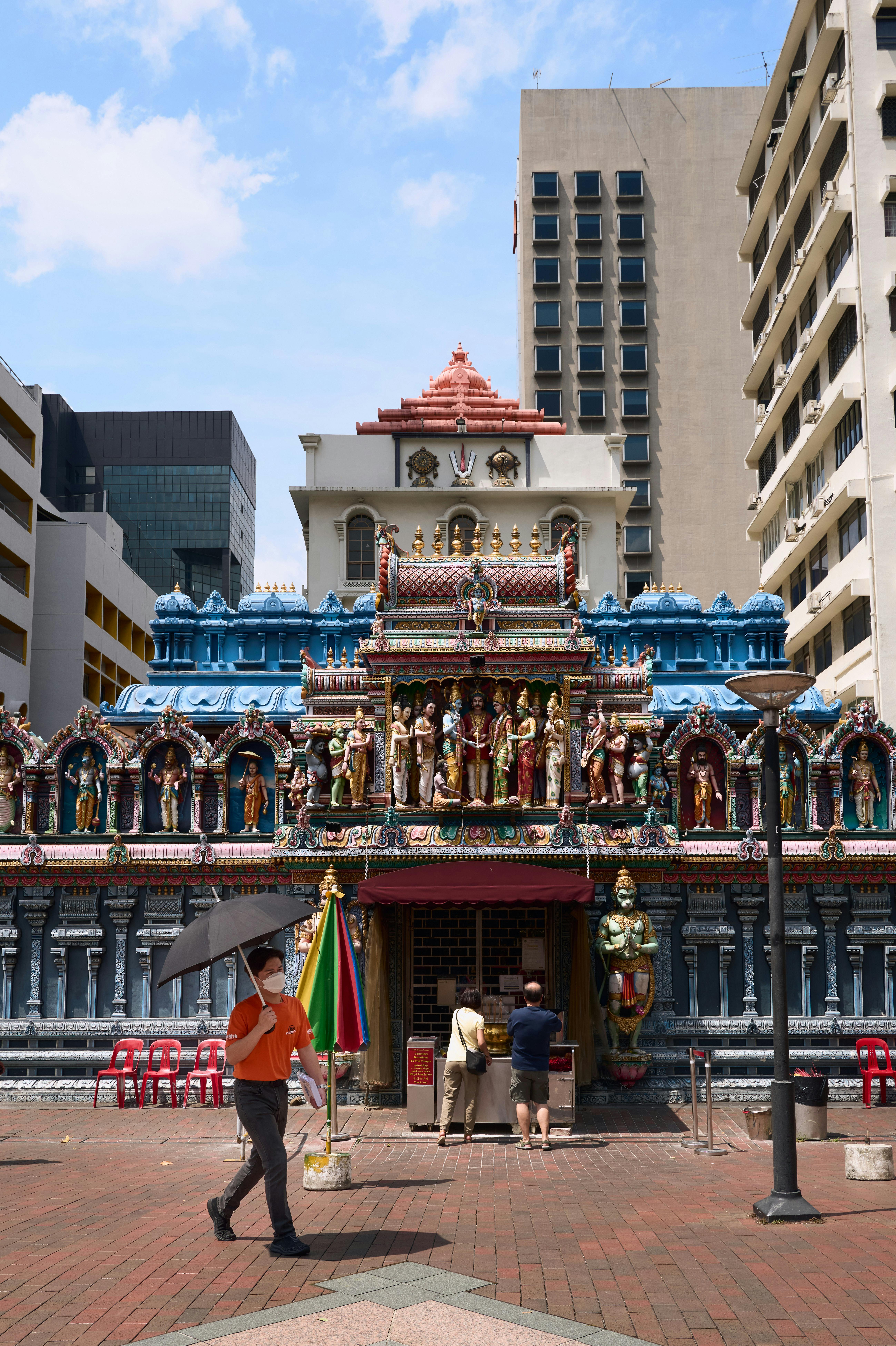
Dedicated to the goddess Kali, Sri Veeramakaliamman is one of the neighbourhood's most photographed landmarks. The temple was first established as a small shrine around 1855 by early Indian settlers and rebuilt in its current form in the 1880s. Its towering gopuram (entrance tower) is covered in colourful sculptures of Hindu deities, and the interior houses large statues of Kali flanked by her sons Ganesh and Murugan.
During World War II, locals sheltered inside the temple during air raids and — according to community accounts — emerged unharmed. The temple remains an active place of daily worship, particularly busy during Deepavali and Thaipusam.
- Location: 141 Serangoon Road
- Opening hours: Daily, typically 5:30 am–12:30 pm and 4:00 pm–9:00 pm (hours may shift during festivals)
- Entry: Free
Sri Srinivasa Perumal Temple
Built in 1855 and gazetted as a National Monument in 1978, this Dravidian-style temple is dedicated to Lord Vishnu (Sri Srinivasa Perumal). Its five-tiered gopuram, added in 1966, is adorned with sculptures depicting the various avatars of Vishnu. The temple is the starting point of the annual Thaipusam procession, during which devotees carry ornate kavadi (ritual frames) along a 4 km route to the Chettiar Temple on Tank Road.
- Location: 397 Serangoon Road
- Opening hours: Daily, approximately 6:30 am–12:00 pm and 5:00 pm–9:00 pm
- Entry: Free
Sakya Muni Buddha Gaya Temple (Temple of 1,000 Lights)
Not everything in Little India is Hindu. This Thai-influenced Buddhist temple houses a 15-metre-tall seated Buddha statue surrounded by hundreds of small lights — the source of its popular name. Founded in 1927 by a Thai monk, the temple blends Indian, Thai, and Chinese architectural elements and feels like a quieter, more meditative counterpoint to the bustling Hindu temples nearby.
- Location: 366 Race Course Road
- Opening hours: Daily, 8:00 am–4:30 pm
- Entry: Free (small donations appreciated)
Indian Heritage Centre
Opened in 2015, this four-storey museum on Campbell Lane traces the history of the Indian diaspora in Singapore and Southeast Asia through interactive exhibits, historical artefacts, and multimedia displays. The building itself is inspired by a traditional Indian baoli (stepwell), and its modern, angular facade stands out against the surrounding shophouses. Free guided tours run on Tuesdays to Fridays at 11:00 am and on weekends at 2:00 pm.
- Location: 5 Campbell Lane
- Opening hours: Tuesday–Thursday 10:00 am–7:00 pm; Friday–Saturday 10:00 am–8:00 pm; Sunday 10:00 am–4:00 pm; closed Mondays
- Entry: Free for Singapore citizens and PRs; SGD 6 (~USD 4.50) for adults, SGD 4 (~USD 3) for students and seniors
House of Tan Teng Niah
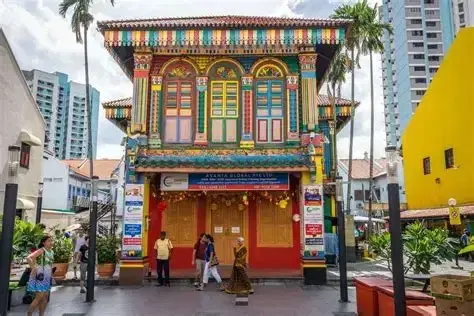
The last surviving Chinese villa in Little India, this 1900-era building at 37 Kerbau Road is impossible to miss — its facade is painted in vivid blocks of green, blue, pink, yellow, and purple. Originally built by Chinese businessman Tan Teng Niah, the house has become one of Singapore's most Instagrammed heritage buildings. There is no interior access; the draw is the exterior and the contrast it creates against the surrounding streetscape.
Temple Etiquette — Quick Reminders
- Cover your shoulders and knees before entering any Hindu or Buddhist temple.
- Remove shoes at the entrance — shoe racks or shelves are provided.
- Ask permission before photographing worshippers or rituals.
- Walk clockwise inside Hindu temples, following the traditional direction of prayer.
- Avoid pointing your feet at statues or sacred objects.
What to Eat in Little India — A Dish-by-Dish Food Guide
The food in Little India Singapore ranges from SGD 3 hawker plates to SGD 30+ sit-down meals, and it extends well beyond Indian cuisine. The neighbourhood rewards adventurous eaters who are willing to queue at the right stall and try dishes they may not have encountered before. Here is where to start.
Tekka Centre — The Anchor Hawker Centre
Tekka Centre is the first food stop for most visitors. The ground floor houses a wet market selling fresh produce, spices, and flowers, while the upper level is a busy hawker centre with dozens of stalls covering Indian, Malay, and Chinese cooking. Arrive before 11:30 am on a weekday for shorter queues.
Dishes to prioritise:
- Mutton dum biryani — slow-cooked rice layered with tender mutton, available at several stalls (Yakader Muslim Food at #01-259 is a local favourite). SGD 6–8 (~USD 4.50–6).
- Masala dosa — a crispy rice-and-lentil crepe filled with spiced potato, served with sambar and coconut chutney. SGD 3–5 (~USD 2–4).
- Roti prata — flaky, pan-fried flatbread served plain or with egg, cheese, or onion. Best with a side of fish or chicken curry. SGD 1.50–4 (~USD 1–3).
- Teh tarik and cendol — pulled milk tea and an iced coconut-milk dessert drink, both ideal for cooling down after a morning walk. SGD 1.50–3 (~USD 1–2).
Sit-Down Restaurants Worth a Detour
If you want a longer meal with table service, these three restaurants each offer a different angle on the neighbourhood's food story.
Komala Vilas (76-78 Serangoon Road) has served pure-vegetarian South Indian food since 1947. The masala dosa here is a benchmark version — crisp, generously filled, and paired with freshly ground chutneys. A full thali (assorted curries on a metal platter) costs SGD 8–12 (~USD 6–9) and covers the range of South Indian flavours in one sitting.
Banana Leaf Apolo (54 Race Course Road) is the place for fish head curry — a dish that fuses Indian and Chinese cooking traditions and has become a Singapore signature. The curry is rich, tangy, and served on a cut banana leaf. Main dishes run SGD 15–30 (~USD 11–22) per portion, and sharing is encouraged.
Meatsmith Little India (21 Campbell Lane) takes a different approach, applying low-and-slow barbecue techniques to Indian flavours. The crab biryani with flying fish roe and the tandoor-smoked pork ribs have made it a favourite among younger diners. Expect SGD 20–35 (~USD 15–26) per person.
Sweets and Snacks at Little India Arcade
The sweet shops clustered around Little India Arcade sell traditional North Indian confections by weight. If you have never tried Indian sweets, start with gulab jamun (syrup-soaked milk dumplings), motichoor ladoo (fine chickpea-flour spheres with cardamom), and jalebi (crisp, syrup-filled spirals). A small mixed box costs around SGD 8–15 (~USD 6–11) and makes a portable souvenir.
Beyond Indian — Cafes and Fusion Dining
Little India's food scene is not exclusively Indian. Generation Coffee, a specialty roaster inside Tekka Centre, pulls excellent espresso for SGD 5–7 (~USD 4–5). The Malayan Council on Jalan Besar serves localised pasta dishes (try the smoked duck lemak chilli padi pasta) alongside rich ondeh-ondeh cake. And Rangoon Road, on the Farrer Park side, has a growing cluster of brunch cafes serving Western-style eggs benedict alongside vegetarian options.
Shopping in Little India — Markets, Mustafa Centre, and Spice Runs
Shopping in Little India covers everything from bulk spices to gold jewellery, and the price points tend to sit well below Singapore's main retail belt on Orchard Road. The three main shopping zones each serve a different purpose.
Mustafa Centre — The 24-Hour Department Store
Mustafa Centre at 145 Syed Alwi Road is a six-storey, 200,000-square-foot retail complex stocking over 300,000 items — electronics, perfume, clothing, luggage, groceries, gold jewellery, and a money changer. Founded in 1971 as a small garment shop on Campbell Lane, the store has grown into one of Singapore's most recognisable retail institutions.
- Opening hours: Open 24 hours daily (hours were reduced post-pandemic but have since been restored).
- Best time to visit: Weekday mornings or late evenings (after 10 pm) for thinner crowds. Weekends and public holidays are packed.
- Best buys: Indian spices (whole and ground, at a fraction of supermarket prices), gold jewellery (competitively priced by weight), perfume (designer brands at discount), and Singapore souvenirs.
- Nearest MRT: Farrer Park (NE8), a 3-minute walk.
One quirk to expect: security staff will cable-tie your bag zips shut at entry and cut them when you leave. It is a standard anti-theft measure, not a reflection on you.
Little India Arcade — Heritage Shophouses
This cluster of restored 1920s shophouses between Serangoon Road and Campbell Lane sells textiles, henna tattoo services, handicrafts, and traditional Indian homeopathic remedies. It is the best spot for picking up a sari (from SGD 15 / ~USD 11 for simple cotton designs) or small souvenirs like brass figurines and incense sets. Prices are negotiable at most stalls.
Campbell Lane and Serangoon Road Shops
Walk the length of Serangoon Road and its side lanes to find Jothi Store & Flower Shop (prayer items and fragrant jasmine garlands), Haniffa Textiles (sari fabric by the metre), and a concentration of gold jewellery shops. Gold is sold by gram weight and prices track the daily market rate — compare a few shops before buying.
Street Art and Walking Routes Through Little India
Little India's street art adds another layer to the neighbourhood's identity. Unlike the curated murals in some other Singapore districts, many of the works here reflect the area's specific migrant history and daily trades.
Key Murals to Find
- "Traditional Trades of Little India" — a large-scale mural along Belilios Road depicting heritage occupations like garland-making, spice-grinding, and sari-draping.
- "Working Class Hero" — located near the car park at Hindoo Road, this piece pays tribute to the migrant workers who built the district.
- Kerbau Road murals — smaller, more whimsical works scattered along this quiet side street, including depictions of Indian folklore and daily life.
A Suggested Walking Route
This route covers the district's main highlights and works well at a relaxed pace.
- Start: Exit Little India MRT (Exit E) onto Bukit Timah Road, turn right onto Serangoon Road.
- Stop 1: Campbell Lane and the Indian Heritage Centre (30–60 minutes if entering the museum).
- Stop 2: Tekka Centre for a hawker breakfast or early lunch (30–45 minutes).
- Stop 3: Walk south-east along Serangoon Road to Sri Veeramakaliamman Temple (15–20 minutes inside).
- Stop 4: Continue along Serangoon Road, detour left into Kerbau Road for the House of Tan Teng Niah and street art.
- Stop 5: Cross to Race Course Road for Sri Srinivasa Perumal Temple and the Temple of 1,000 Lights.
- Stop 6: End at Mustafa Centre on Syed Alwi Road, a 5-minute walk from Farrer Park MRT.
- Total time: 1.5–2.5 hours without museum stops; 3–4 hours with food, museum, and shopping.
If you enjoy guided walks, consider one of Singapore's heritage tours that cover Little India's history with a local guide. Alternatively, the National Heritage Board publishes a free downloadable Little India Heritage Trail booklet that maps key landmarks with historical notes.
Festivals and the Best Time to Visit Little India Singapore
Little India is worth visiting year-round, but three annual festivals transform the neighbourhood into something more vivid than usual. If your travel dates are flexible, timing your visit around one of these events adds a dimension that ordinary sightseeing cannot match.
Deepavali (October or November)
The Festival of Lights is the district's biggest event. For several weeks leading up to Deepavali, Serangoon Road is decorated with elaborate light arches, and a bazaar stretches along Campbell Lane and surrounding streets selling festive clothing, sweets, and home decorations. The light-up runs from dusk until late each evening. Expect large crowds, especially in the final week before the festival date.
Pongal (mid-January)
This four-day South Indian harvest festival celebrates new beginnings with street performances, traditional dress, and communal cooking of the rice dish that gives the festival its name. It is smaller and less commercialised than Deepavali, making it a good option if you prefer fewer crowds with genuine cultural immersion.
Thaipusam (January or February)
The kavadi procession begins at Sri Srinivasa Perumal Temple and ends at the Chettiar Temple on Tank Road. Devotees carry ornate frameworks adorned with peacock feathers and flowers, some with ritual body piercings, in an act of devotion to Lord Murugan. The atmosphere is intense, reverent, and visually striking. Photography is permitted, but keep a respectful distance from participants.
General Timing Tips
- Best for quiet exploration: Weekday mornings (9–11 am) — temples are open, hawker stalls are fresh, and foot traffic is manageable.
- Best for food and atmosphere: Weekday evenings (6–9 pm) — restaurants fill up, street stalls light up, and the neighbourhood shifts into a more social gear.
- Avoid if crowd-sensitive: Sunday afternoons. Little India draws large numbers of workers on their weekly day off, and the streets become very congested.
Practical Tips for Visiting Little India
Little India at a Glance
- Nearest MRT stations: Little India (NE7/DT12) and Farrer Park (NE8)
- Key bus services: 23, 64, 65, 66, 67, 131, 139, 147
- Budget estimate: SGD 30–50 (~USD 22–37) per person for food and minor shopping
- Recommended duration: 3–4 hours for sightseeing, food, and a browse through the markets
- Dress code: Modest clothing for temple visits — cover shoulders and knees
Cash vs. card: Most sit-down restaurants and Mustafa Centre accept credit cards, but hawker stalls, wet market vendors, and smaller shops prefer cash. Carry SGD 30–50 in small denominations. Mustafa Centre also has a money changer with competitive exchange rates.
Safety: Little India is safe for tourists at all hours. Standard city precautions apply — keep valuables close in crowded markets and watch your step on uneven pavements around the older shophouses.
Combining with nearby districts: Little India sits a 10–15-minute walk from Kampong Glam (Arab Street and Haji Lane). If you have a full day, walk from Little India south-east through Jalan Besar into the Arab Quarter for a two-neighbourhood cultural loop. Alternatively, join one of Singapore's food tours that connect both precincts in a single guided walk.
What to wear: Lightweight, breathable clothing is essential — Singapore's heat and humidity are relentless, and Little India involves a lot of walking. Closed-toe shoes or comfortable sandals that slip on and off easily work best for the temple-to-market rhythm.
Make Little India Part of Your Singapore Itinerary
Little India is one of the few Singapore neighbourhoods where you can walk through a nineteenth-century temple, eat a SGD 4 biryani that rivals anything on the subcontinent, and shop for spices and gold in a 24-hour department store — all within a single afternoon. It is a district that rewards both planned visits and unstructured wandering, and it offers a side of Singapore that the Marina Bay skyline and Sentosa attractions simply do not.
Whether you are building a first-time itinerary or returning to explore a neighbourhood you skipped last trip, Little India deserves half a day of your time. Start planning your Singapore trip on Travjoy — where every experience has been researched, vetted, and approved by local experts — and add Little India to the list. You can also browse Singapore's top 20 experiences for more ideas across the city.
Plan Your Visit (FAQ's)
.svg&w=1920&q=75)


POWERED BY REAL EXPERTS
Adeline Ee
Local Expert -

Planning Your Singapore trip? TravJoy Recommends the Best for You


