




Kampong Glam & Arab Street Guide: What to See, Eat and Do
14 min read

Author
SHARE BLOG
TABLE OF CONTENTS
- What Is Kampong Glam? History and Character
- Top Attractions in Kampong Glam and Arab Street
- Shopping in Kampong Glam: Arab Street, Haji Lane, and Bugis
- Where to Eat in Kampong Glam
- When to Visit Kampong Glam and How to Get There
- Kampong Glam by Traveller Type
- Start Planning Your Singapore Visit
- Kampong Glam is one of Singapore's oldest urban quarters — a Malay royal settlement turned Arab trading hub, now home to street art, halal dining, and independent boutiques across a walkable 15-minute radius.
- The golden-domed Sultan Mosque is free to enter and open to non-Muslim visitors daily, except Friday afternoons. Cloaks and head coverings are provided free at the entrance.
- Arab Street's traditional textile and perfume shops close on Sundays — plan shopping visits for Tuesday to Saturday.
- Haji Lane is best explored before 11am for photography; evenings bring out the bars and a different, livelier atmosphere.
- The Malay Heritage Centre (SGD 6 / approx. USD 4.50 for adults) is inside the former Sultan's palace and closed on Mondays.
Kampong Glam and Arab Street form one of Singapore's most historically layered neighbourhoods. Centred on the golden-domed Sultan Mosque, the district offers a walkable mix of Malay royal heritage, Middle Eastern trade culture, independent boutiques, halal dining, and some of the city's most photographed street murals — all within a compact, navigable area. Whether you have two hours or a full day, this guide covers exactly what to see, where to eat, and how to make the most of your visit.
What Is Kampong Glam? History and Character
The name comes from a paperbark tree — gelam — that once covered this coastal stretch between Beach Road and Rochor Canal. Long before Singapore became a global city, this land was home to Malay royalty, Arab merchants, Bugis traders, and Muslim pilgrims departing for Mecca through Singapore's busy port.
In 1819, Sultan Hussein Shah signed a treaty with the British East India Company, ceding trading rights in exchange for financial support. As part of the agreement, Kampong Glam was designated as the royal settlement for the Sultan and his court. The palace he built — Istana Kampong Glam — still stands today, now housing the Malay Heritage Centre.
By 1822, Sir Stamford Raffles had designated the area for Malay, Arab, and Bugis communities under Singapore's town planning framework. Arab merchants arrived in numbers, and the streets that bear their influence — Muscat Street, Baghdad Street, Bussorah Street — were laid out in the early 20th century. The district was gazetted as a historic conservation area in 1989, protecting its pre-war shophouse rows.
What distinguishes Kampong Glam from Singapore's other heritage precincts is how naturally the old and new coexist. A century-old perfume emporium sits beside a speciality coffee shop. A Michelin-recommended Turkish restaurant faces a row of hand-woven Persian carpet stalls. This is a working neighbourhood, not a sanitised museum quarter — and that gives it a character you can feel on the street.
Top Attractions in Kampong Glam and Arab Street
Sultan Mosque (Masjid Sultan)
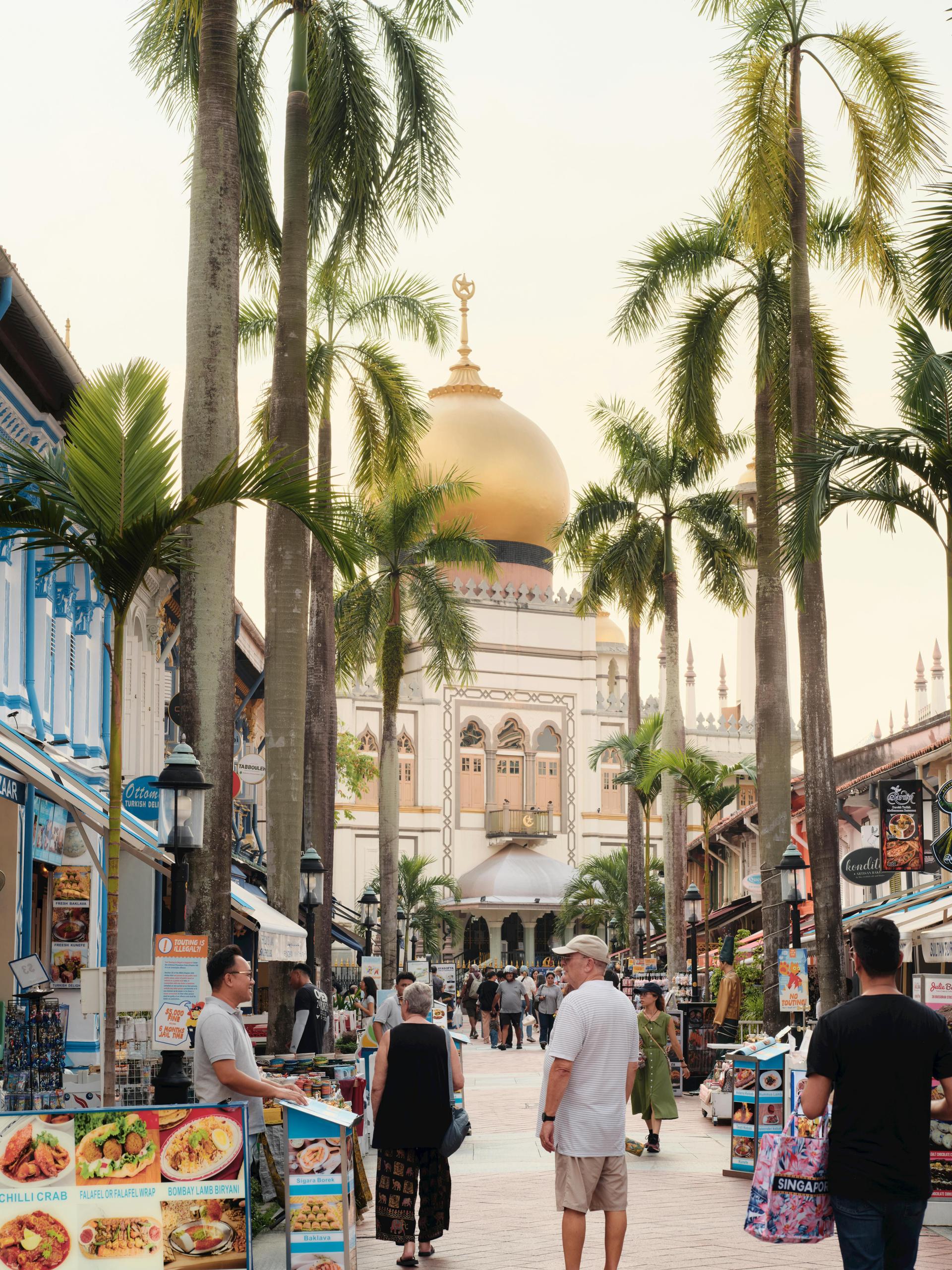
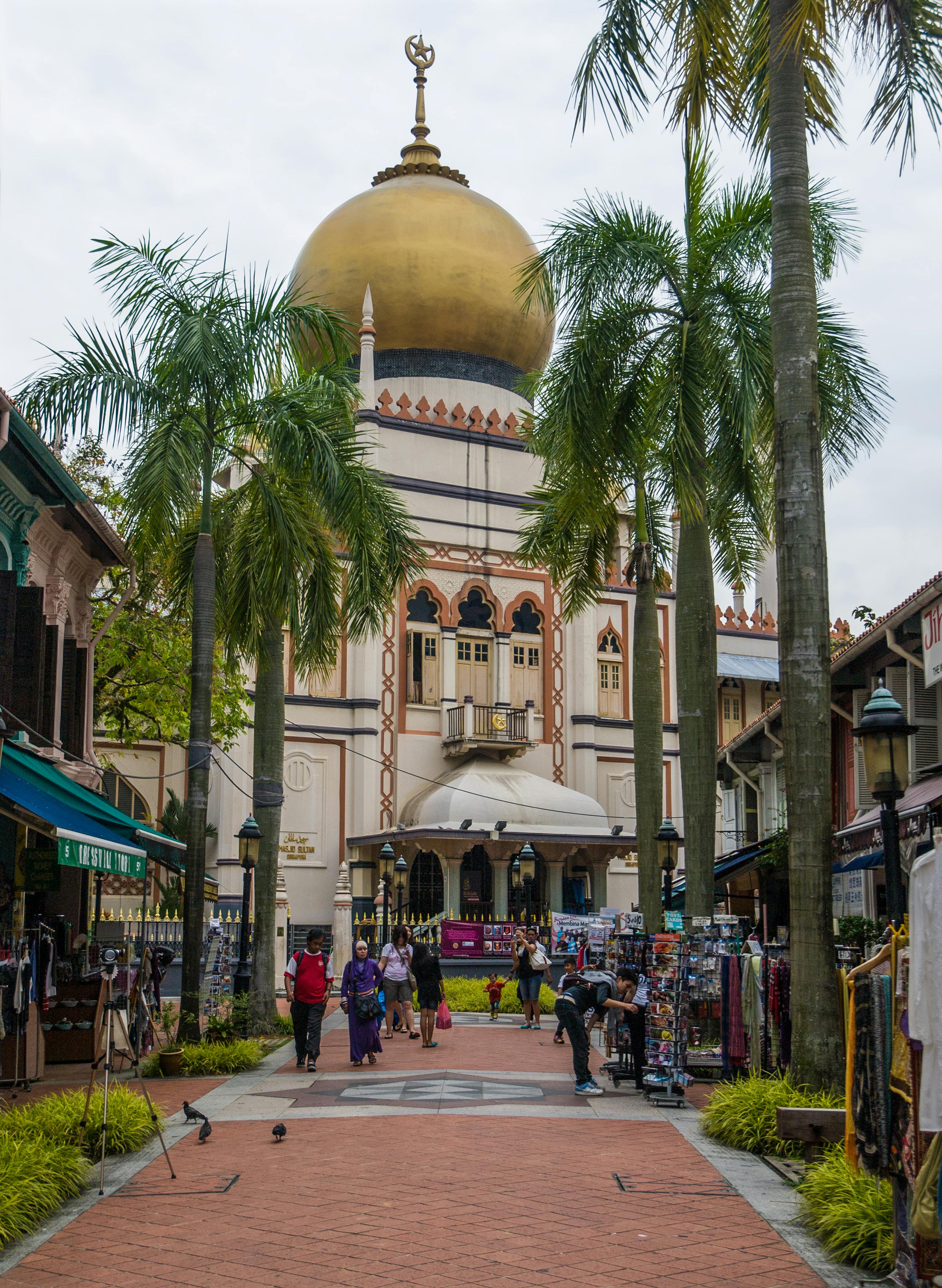
The Sultan Mosque is the visual and spiritual anchor of Kampong Glam. Its gold-plated domes and white minarets are visible from several streets away, but the most striking view is from the far end of Bussorah Street, where the mosque is framed by palm trees and two rows of restored shophouses. For the best photograph of the full facade, stand at the intersection of Bussorah Street and North Bridge Road.
Built originally in 1824 for Sultan Hussein Shah — with a contribution of 3,000 Spanish dollars from the British East India Company — the current structure was completed in 1932 to a design by Irish architect Denis Santry. One distinctive detail: the base of the smaller domes is built from glass bottles donated by members of the Muslim community who could not afford more expensive materials. The mosque was gazetted as a national monument in 1975.
- Visiting hours for non-Muslim visitors: 10am–12pm and 2pm–4pm daily; Fridays 2:30pm–4pm only
- Admission: Free for all visitors
- Dress code: Modest attire required — shoulders and knees must be covered. Complimentary cloaks and head coverings are available at the entrance.
- Photography: Permitted throughout most of the mosque; flash photography is not allowed inside the prayer halls
- Best approach: Arrive on weekday mornings or post-Friday prayer for a quieter visit. Avoid the 12pm–2pm window on Fridays when the mosque is closed to visitors.
Malay Heritage Centre
Housed inside the yellow-walled Istana Kampong Glam — the former Malay royal palace — the Malay Heritage Centre is a six-gallery museum covering the history and culture of Singapore's Malay community from early seafaring origins to the post-independence era. Artefacts include royal regalia, traditional textiles, trade goods, and photographs from the kampong years. The building itself, with its distinctive yellow render, green shutters, and red roof, is worth seeing from the courtyard even if you don't go in.
- Opening hours: 10am–6pm daily, closed Mondays
- Admission: SGD 6 (approx. USD 4.50) for adults; SGD 4 (approx. USD 3) for students and seniors; free for children under 6
- Allow: 1–1.5 hours for a thorough visit through all six galleries
Haji Lane and the Street Art District
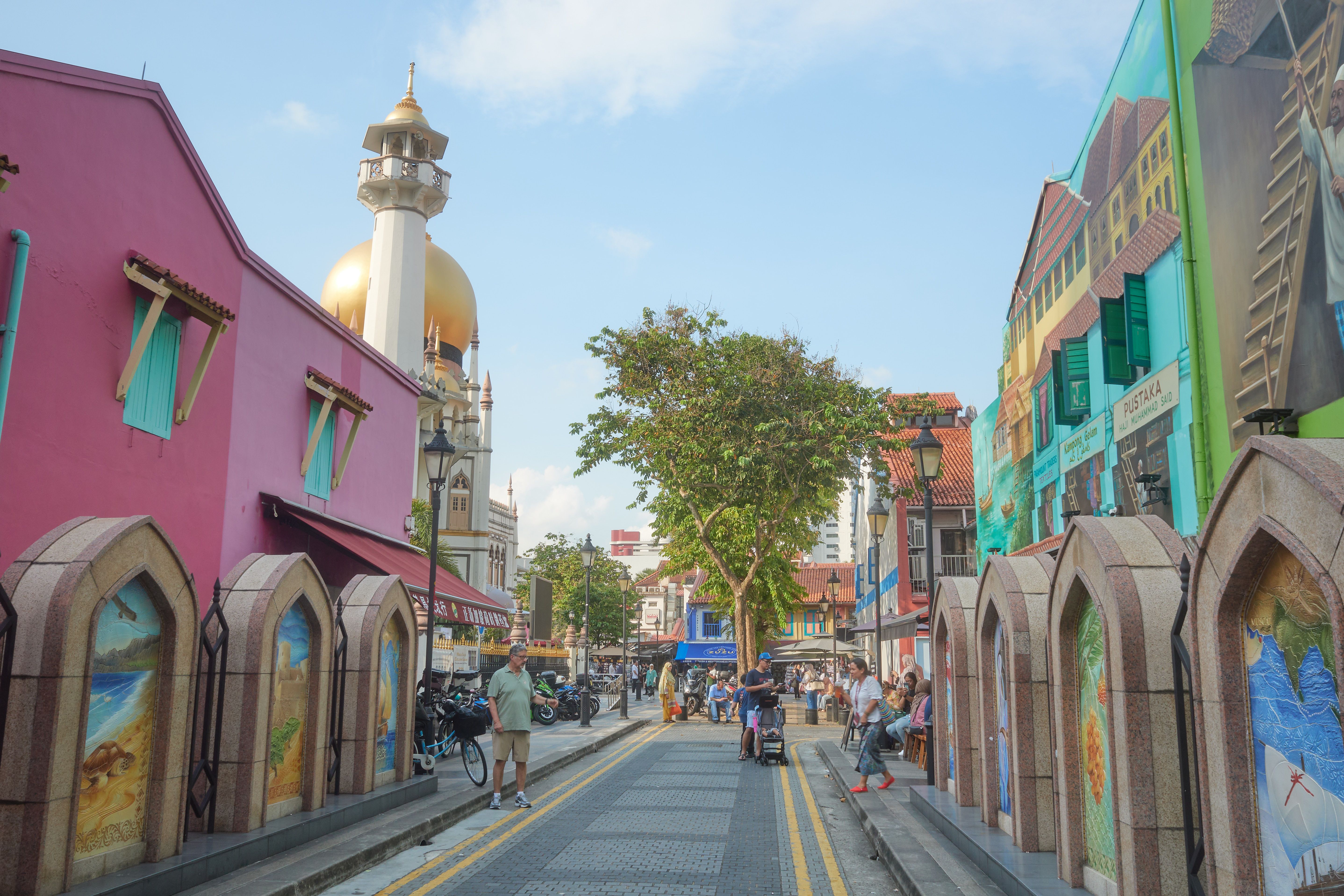
Haji Lane is a narrow alley roughly 200 metres long, but it holds a concentrated mix of murals, independent boutiques, and cafes that draws visitors from across Singapore. The lane takes its name from the Muslim pilgrims (Haji) who historically used it as a staging point before departing for Mecca. Today, the Haji Lane Street Art District extends well beyond the lane itself, with murals filling alleyways, hotel facades, and gallery walls across the surrounding streets.
Works by internationally recognised artists appear throughout the district. Ernest Zacharevic's pieces run along Victoria Street toward North Bridge Road. Didier 'Jaba' Mathieu has painted on Arab Street walls and the side of the Cuturi Gallery. The Gelam Gallery on Muscat Street fills a narrow back alley with a rotating exhibition by local and international artists — pieces change regularly, so even repeat visitors find something new.
Haji Lane: Practical Tips
- Visit before 11am for photography — the narrow alley gets congested by mid-afternoon and the morning light catches the murals at a better angle
- The lane is at its liveliest on Friday and Saturday evenings when bars open their doors and tables spill onto the street
- Most boutiques open between 11am–12pm; some don't open until early afternoon on weekdays. Check individual Instagram pages before making a dedicated trip.
- Haji Lane itself is too narrow for vehicles — if arriving by taxi or ride-hail, drop off on Arab Street or Victoria Street and walk in
Bussorah Street and Gelam Gallery
Running from North Bridge Road directly to the Sultan Mosque entrance, Bussorah Street is a pedestrianised strip lined with cafes, restaurants, and souvenir shops. It's the most photogenic approach to the mosque and tends to fill up from 10am onward. Early risers who arrive before 9am find the street nearly empty — the morning light on the mosque dome at that hour is a completely different experience from the busier midday visit that most guides describe. At night, the illuminated mosque against a dark sky makes Bussorah Street one of the most atmospheric spots in Singapore.

Shopping in Kampong Glam: Arab Street, Haji Lane, and Bugis
Textiles, Perfumes, and Persian Carpets on Arab Street
Arab Street was historically the centre of Singapore's textile and basket trade, and traces of that heritage remain on the street today. Family-run carpet shops like Samad & Sons and Amir & Sons stock hand-woven antique rugs sourced from Central Asia, Turkey, and Iran. Smaller decorative pieces start from around SGD 100 (approx. USD 75); antique pieces run considerably higher.
Perfume is a major draw in this part of the district. Sifr Aromatics on Arab Street operates a laboratory-style emporium where you can create a custom fragrance blend — a bespoke bottle costs around SGD 60–120 (approx. USD 45–90) and the process takes 30–45 minutes. It's one of the more genuinely memorable things to do in the area. Royal Fragrances and Aljunied Brothers offer ready-made oud-based blends if time is limited.
Key note: Most Arab Street shops close on Sundays. If you're planning to browse the traditional traders — carpets, textiles, perfume — visit on a Tuesday to Saturday.
Independent Boutiques on Haji Lane
The Haji Lane boutique scene skews toward independently designed fashion, vintage clothing, and one-of-a-kind accessories. The lane functions as an incubator for Singapore's younger designers, with shopfronts that change regularly. For antiques and decorative objects, Dwiz and Grand Bazaar on Arab Street stock Turkish ceramics, mosaic lamps, and kilims alongside more contemporary souvenir pieces.
For ceramics with a Singapore identity, Supermama on Beach Road carries its signature Singapore Blue range — blue-and-white porcelain plates, cups, and saucers inspired by Chinese export ware but rendered with modern Singapore imagery. A single plate costs around SGD 25–40 (approx. USD 19–30) and packs flat for travel.
Bugis Street Market and Bugis Junction
A five-minute walk from Haji Lane brings you into Bugis, where the neighbourhood transitions from artisanal heritage to mainstream retail. Bugis Street Market is one of Singapore's most affordable street shopping destinations — clothing, accessories, and souvenirs at accessible prices in a covered open-air market. Directly opposite, Bugis Junction is a fully air-conditioned mall with international brands and local retailers, a useful midday escape from Singapore's heat.
Where to Eat in Kampong Glam
Kampong Glam has one of the most concentrated and diverse halal dining scenes in Singapore. Kitchen influences span Malay, Indonesian, Middle Eastern, Turkish, and Lebanese — with a growing number of cafes and fusion spots adding further range. Most restaurants around Bussorah Street and Arab Street are halal-certified; look for signage at the entrance if this is a consideration for your group.
Middle Eastern and Turkish Restaurants
Alaturka on Bussorah Street is one of the most established Middle Eastern restaurants in the district — a Michelin-recommended Turkish spot serving pide (Turkish flatbread pizza), mezze platters, grilled lamb, and baklava in a room decorated with copper lamps and hand-painted tiles. Expect to spend SGD 30–50 (approx. USD 22–37) per person for a full meal. Booking ahead is advisable on weekends.
Beirut Grill on Baghdad Street is a reliable choice for Lebanese and Arabic food — hummus, falafel, and lamb kebabs — and also serves shisha, making it a common evening spot. Tabbouleh on Arab Street is another strong Lebanese option if you want a quieter lunch setting.
Malay Heritage Food
For traditional Malay food, Zam Zam on North Bridge Road is a Kampong Glam institution — it has been serving murtabak (stuffed flatbread filled with spiced minced meat and egg) since 1908 and remains one of the most historically significant food stops in the district. A murtabak costs SGD 7–12 (approx. USD 5–9) depending on filling and size. The queue moves quickly even when it looks long.
Kampong Glam Café near the Sultan Mosque serves no-frills nasi goreng, mee rebus, and curry with roti in a casual outdoor setting with good views of the mosque courtyard. For nasi padang — the Indonesian-Malay tradition of choosing from a spread of cooked dishes — Sari Ratu on Pahang Street is frequently cited as one of the best in Singapore, with Sundanese grilled chicken as the standout.
Cafes and Baked Goods
% Arabica on Bussorah Street is a branch of the well-known Japanese specialty coffee chain — a minimal, high-ceilinged space that makes a solid morning stop before the main sights open at 10am. Mother Dough, nearby, has built a local following for its almond croissants and sourdough pastries. It sells out by mid-morning on weekends, so arrive early or expect to leave empty-handed. Bhai Sarbat, a decades-old teh tarik stall in the area, is a good counter to the Instagram cafes — order the traditional pulled milk tea and drink it standing at the kerbside as locals do.
When to Visit Kampong Glam and How to Get There
Best Time to Visit
Timing Your Visit by Goal
- Photography (Sultan Mosque, Bussorah Street): Weekday mornings, 7am–9am — empty streets and soft directional light on the dome
- Shopping (Arab Street): Tuesday–Saturday, 10am–5pm — shops close on Sundays
- Dining and evening atmosphere: From 6pm onward, especially Friday and Saturday nights on Bussorah Street and Haji Lane
- Haji Lane boutiques: Weekends from noon onward — more shops open, livelier street atmosphere
- Ramadan evenings: If your visit coincides with Ramadan, a popular night market forms around the Sultan Mosque — one of the most atmospheric food events on Singapore's calendar
Singapore's heat is consistent year-round, so time of day matters more than month of year. The district is walkable but has limited shade on Arab Street itself — mornings and evenings are considerably more comfortable than a midday visit. The two-hour window between 12pm and 2pm is when the district is hottest and most crowded simultaneously.
Getting to Kampong Glam
- MRT: Bugis station (EW12/DT14) — take Exit E, turn right onto Victoria Street, and walk 5–7 minutes to Arab Street. The East-West Line and Downtown Line both serve Bugis.
- By bus: Services 7, 32, 51, 61, 63, 80, 851, and 961 run along Victoria Street, Beach Road, and North Bridge Road — all within easy walking distance of the main streets.
- By taxi or ride-hail: Drop off on North Bridge Road or at the mouth of Bussorah Street. Haji Lane is too narrow for vehicles to enter.
- Parking: Limited in the immediate area. The nearest car park is at Golden Landmark Shopping Complex on Beach Road.
Kampong Glam by Traveller Type
The district suits a range of travel styles, but what you prioritise shapes a very different experience.
First-time visitors to Singapore: Start at Bugis MRT Exit E, walk to Arab Street, through Haji Lane, across to Bussorah Street, and finish at the Sultan Mosque. This loop takes about two hours at a relaxed pace and gives you a complete cross-section of the neighbourhood — history, shopping, street art, and food in one route.
Couples: An evening visit works particularly well. Start with dinner on Bussorah Street around 7pm, walk through the illuminated Sultan Mosque courtyard after dark, and move on to Haji Lane's bars for the second half of the evening. The laneway atmosphere at night is a different place from the daytime boutique scene.
Families with children: The Malay Heritage Centre is genuinely family-friendly — the galleries use photography and artefacts more than dense text panels, making them accessible for older children. The Gelam Gallery on Muscat Street is a short, engaging stop for kids interested in street art. Avoid peak lunchtime hours on Arab Street — pavements get narrow and congested.
Solo travellers and repeat visitors: Go beyond the main strip. The quieter residential streets behind Haji Lane — Jalan Kubor, Ophir Road — show a slower, less photographed side of Kampong Glam where conservation shophouses are being gradually restored. The morning walk along these streets before the tourist hours begin is a worthwhile detour.
Start Planning Your Singapore Visit
Kampong Glam fits naturally into a broader Singapore itinerary. It pairs well with a morning in Little India (10 minutes by MRT) or an afternoon at the National Museum on Stamford Road. If you're mapping out the full city, the Singapore travel hub on Travjoy has curated experiences across the city selected by local experts — a useful starting point for cutting through the noise of what's actually worth your time. For a ranked view of Singapore's top experiences, the Top 20 Singapore highlights on Travjoy covers the city's essential draws with practical detail.
Kampong Glam is compact enough to feel manageable and layered enough to reward a slower, more curious approach. Half a day covers the key sights; a full day lets you sit at a Bussorah Street café, wander the back alleys at your own pace, browse a perfumery without rushing, and still be back at your hotel well before dinner. Bring flat shoes, a light scarf (useful for mosque entry), and enough charge on your phone — there's a lot worth photographing here.
Plan Your Visit (FAQ's)
.svg&w=1920&q=75)



POWERED BY REAL EXPERTS
Adeline Ee
Local Expert -

Planning Your Singapore trip? TravJoy Recommends the Best for You


