


Bali: Mount Ijen
Operating Hours:Monday - Sunday: 04:00 - 12:00
The Vibe:Blue flames in a moonless crater 🔵
Technically in East Java but widely accessed from Bali, this active volcano sits within a UNESCO Global Geopark and draws travellers willing to hike through darkness for a sight found almost nowhere else on Earth.
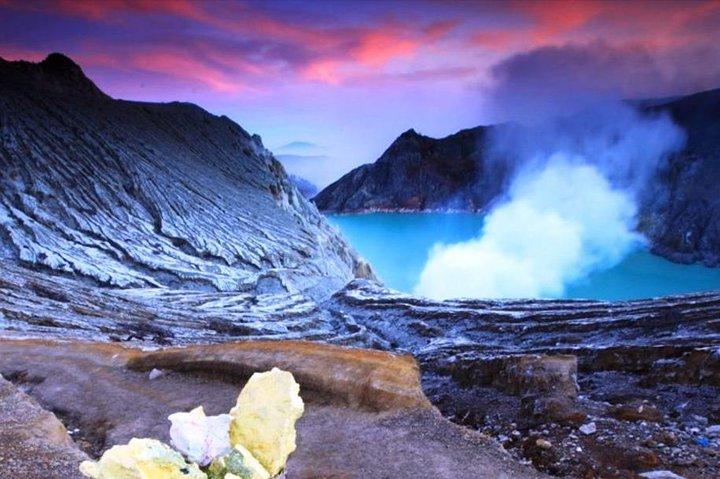
Sulphur bites the air as headlamps carve a narrow path uphill. At the rim, silence drops away to reveal a turquoise lake glowing beneath a veil of white gas 🌋.
- • Part of the Ijen UNESCO Global Geopark since 2023
- • Ranked among the top volcano treks in Southeast Asia by Lonely Planet
- • Visitors call the crater-lake sunrise a once-in-a-lifetime moment 🌅
- • TripAdvisor Travellers' Choice award recipient
Persona Fit
- 🧗 Adventure Seekers: A demanding pre-dawn hike rewarded with rare blue fire and a surreal crater lake.
- 📸 Photographers: Long-exposure blue-flame shots, turquoise lake at sunrise, and dramatic volcanic terrain.
- 🎓 Culture Enthusiasts: Witness the tough daily routine of traditional sulphur miners up close.
- 💕 Couples: A shared bucket-list challenge under a canopy of stars.
Highlights
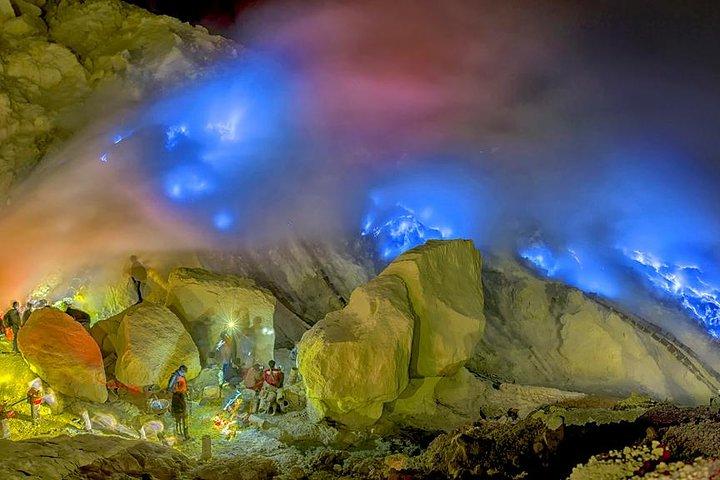
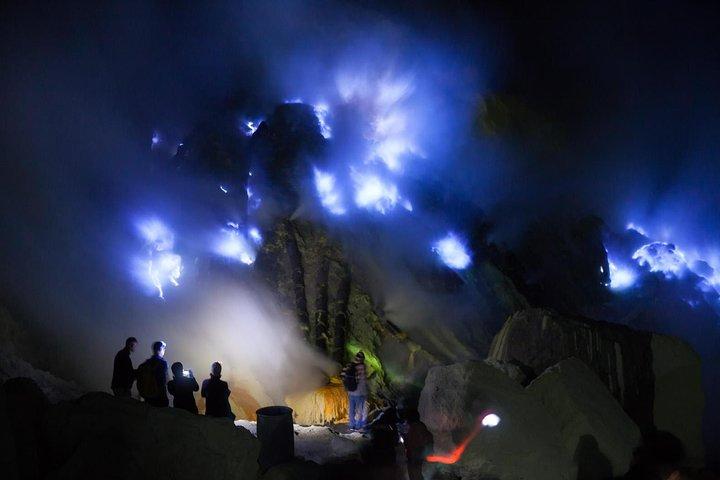
- Blue Fire Phenomenon — One of only two places on Earth where ignited sulphuric gas creates electric-blue flames visible in darkness.
- Turquoise Acid Lake — The world's largest highly acidic crater lake, glowing an otherworldly milky blue at sunrise.
- Sulphur Miners at Work — Observe miners carrying 60–80 kg loads from the crater floor, a humbling cultural encounter.
- Crater Rim Sunrise — Panoramic views across East Java as first light paints the volcanic landscape.
- Dead Tree Viewpoint — A hauntingly photogenic lookout between the blue-fire zone and the summit — Hidden Gem.
- Rainforest Drive to Paltuding — The approach road passes coffee and clove plantations and remnant tropical rainforest — Hidden Gem.
1 Curated Booking Option
Starts From
(Per Person)
Aura Salsa Dila
Our Bali Local Expert
Table of Contents
Things To Do Nearby
Mount Bromo — Often combined with Ijen on a multi-day East Java volcano tour for a dramatic sunrise over the caldera.
Banyuwangi Waterfront — A laid-back coastal town with local seafood and easy access to Baluran National Park.
Tumpak Sewu Waterfall — A jaw-dropping curtain waterfall in East Java, frequently added to Bromo-Ijen itineraries.
Baluran National Park — Known as the 'Africa of Java' with savannah landscapes and wild deer.
Mount Bromo — Often combined with Ijen on a multi-day East Java volcano tour for a dramatic sunrise over the caldera.
Banyuwangi Waterfront — A laid-back coastal town with local seafood and easy access to Baluran National Park.
Tumpak Sewu Waterfall — A jaw-dropping curtain waterfall in East Java, frequently added to Bromo-Ijen itineraries.
Baluran National Park — Known as the 'Africa of Java' with savannah landscapes and wild deer.
TJ's Guide - Mount Ijen
Know Before You Go
Insider Tips
Best Time: Visit during the dry season (May–October) for the clearest skies and safest trail conditions.
Hack: Book a tour that departs from Banyuwangi rather than Bali to cut travel time in half and get more sleep.
Hack: Bring your own gas mask and sealed goggles — rental masks at the trailhead vary in quality.
Best Time: Avoid full-moon nights if you want to see the blue fire; bright moonlight dims the flames.
Hidden Gem: After the crowds descend, walk an extra 10 minutes along the crater rim for unobstructed views of the turquoise lake.
Best Time: Visit during the dry season (May–October) for the clearest skies and safest trail conditions.
Hack: Book a tour that departs from Banyuwangi rather than Bali to cut travel time in half and get more sleep.
Hack: Bring your own gas mask and sealed goggles — rental masks at the trailhead vary in quality.
Best Time: Avoid full-moon nights if you want to see the blue fire; bright moonlight dims the flames.
Hidden Gem: After the crowds descend, walk an extra 10 minutes along the crater rim for unobstructed views of the turquoise lake.
Know Your Facts
- From Bali: Most tours pick up in south Bali (evening), drive to Gilimanuk ferry, cross to Ketapang, and continue 1.5 hours to the Paltuding trailhead.
- From Banyuwangi: A 1–1.5 hour drive to Paltuding; many budget hotels and homestays available in town.
- Entrance is at Paltuding post where tickets, gas masks, and flashlights are distributed. A medical check (blood pressure) is required before entry.
- First-time tip: Arrive at the trailhead early to avoid the bottleneck on the single-track path, especially during Indonesian holidays.
Once You Reach
Internal Navigation
Paltuding to Rim: A single paved-then-gravel road climbs 3 km over roughly 1.5–2 hours. Follow the crowd but keep a steady pace.
Crater Descent: A steep, rocky, unmarked path drops from the rim into the crater. Footing is uneven; use your headlamp and follow your guide.
Rim Circuit: A narrow path runs along the crater rim connecting the main viewpoint, dead-tree photo spot, and the sunrise summit.
Signage: Minimal. Google Maps works at the rim but not inside the crater. Stick with your guide for all below-rim navigation.
Wheelchair/Stroller: Not accessible at any point on the hike.
Food & Coffee Shops
Post-hike breakfast: Most tours stop at a local warung near the base for nasi goreng and Javanese coffee.
Banyuwangi town: Several casual eateries and coffee shops for a meal before the long drive back to Bali.
Post-hike breakfast: Most tours stop at a local warung near the base for nasi goreng and Javanese coffee.
Banyuwangi town: Several casual eateries and coffee shops for a meal before the long drive back to Bali.
Photography Tips
Tripods are allowed and essential for long-exposure blue-fire shots; use manual focus set to infinity.
Best light for the crater lake is 15–30 minutes after official sunrise, when the turquoise colour is most vivid.
Position yourself at the dead-tree viewpoint for an iconic foreground frame with the lake behind.
Protect gear in a sealed bag — sulphur fumes can corrode lens coatings over extended exposure.
Tripods are allowed and essential for long-exposure blue-fire shots; use manual focus set to infinity.
Best light for the crater lake is 15–30 minutes after official sunrise, when the turquoise colour is most vivid.
Position yourself at the dead-tree viewpoint for an iconic foreground frame with the lake behind.
Protect gear in a sealed bag — sulphur fumes can corrode lens coatings over extended exposure.
Explore Deeper
Ijen is not merely a volcano hike — it is a convergence of extreme geology, centuries-old mining tradition, and one of Earth's rarest natural light shows, all compressed into a single pre-dawn ascent.
The crater lake has a pH of nearly 0, making it one of the most acidic bodies of water on the planet.
Blue fire occurs when sulphuric gas exits volcanic vents at over 600°C and ignites upon contact with air — visible only in darkness.
Traditional sulphur miners have worked Ijen since at least the 1960s, carrying loads of up to 90 kg twice daily for roughly USD 13 per day.
The Ijen volcanic complex became part of the UNESCO Global Geoparks network in 2023, recognising its geological, biological, and cultural significance.
The surrounding caldera spans about 20 km and includes the Gunung Merapi stratovolcano, the highest point of the Ijen complex.
The crater lake has a pH of nearly 0, making it one of the most acidic bodies of water on the planet.
Blue fire occurs when sulphuric gas exits volcanic vents at over 600°C and ignites upon contact with air — visible only in darkness.
Traditional sulphur miners have worked Ijen since at least the 1960s, carrying loads of up to 90 kg twice daily for roughly USD 13 per day.
The Ijen volcanic complex became part of the UNESCO Global Geoparks network in 2023, recognising its geological, biological, and cultural significance.
The surrounding caldera spans about 20 km and includes the Gunung Merapi stratovolcano, the highest point of the Ijen complex.
Did You Know?
World's Largest Acid Lake — Ijen's crater lake holds approximately 27.5 million cubic metres of turquoise water so acidic it can dissolve metal.
Only Two Blue-Fire Sites — The combustion of sulphuric gas creating blue flames has been documented at only two locations worldwide: Ijen and Hekla in Iceland.
Cinematic Fame — Ijen's sulphur mining was featured in the 1991 IMAX film Ring of Fire and in the BBC documentary Human Planet.