


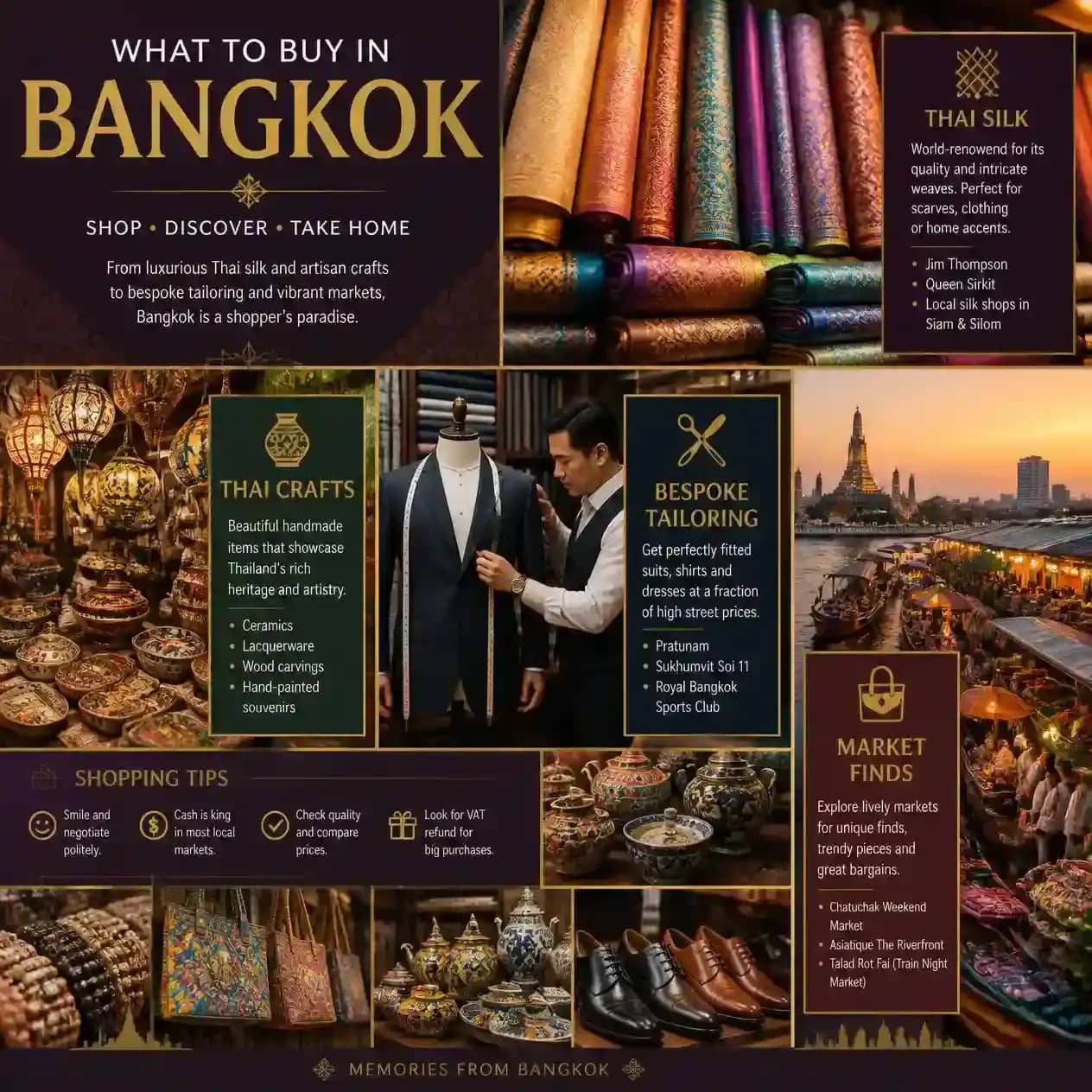
What to Buy in Bangkok: A Complete Guide to Thai Silk, Craft and Bespoke — and Where to Buy Each
8 min read
Key Highlights
- Thai silk carries an official Royal Peacock certification in four grades — Gold, Silver, Blue and Green — which tells you exactly what you are paying for.
- Benjarong porcelain and celadon are the two ceramics worth luggage space; hand-painting versus transfer decoration is visible to the naked eye once you know what to look for.
- Bespoke tailoring runs THB 7,000–50,000+ (USD 215–1,540) in 2026, and the price tier tells you the construction — fused, half-canvas or full-canvas.
- Any Buddha image over 12 cm needs an export permit from the Fine Arts Department, capped at five per person, taking three to five days to process.
- The 7% VAT refund needs THB 2,000 (USD 62) per store per day and THB 5,000 (USD 154) across the trip — plan it from your first purchase, not your last.
The short answer on what to buy in Bangkok: certified Thai silk, hand-painted Benjarong and celadon ceramics, commissioned tailoring, and lab-certified coloured gemstones. These are the four categories where Bangkok's quality and pricing beat London, Sydney or New York by a clear margin. Everything else — global designer labels, electronics, watches — is usually the same price or higher once you account for Thai import duty.
A traveller buys a bronze Buddha on Charoen Krung on the last afternoon of the trip. It is 30 cm tall, beautifully cast, and wrapped with care. At Suvarnabhumi the following morning, it is confiscated. Not because it was stolen or antique, but because Thai law requires an export permit for any Buddha image above 12 cm, and that permit takes three to five working days.
This happens often enough that it is worth leading with. Bangkok rewards the shopper who plans, and quietly penalises the one who leaves it to the departure lounge. The city's real value sits in things that need a little lead time — silk you can verify, ceramics that need packing, a suit that needs three fittings, a stone that needs a lab report.
This guide answers what to buy in Bangkok by object rather than by district. For each category, you get the quality markers that separate the real thing from the tourist version, a fair 2026 price band in baht and dollars, and the specific places in Bangkok where that purchase is worth making. If you would rather browse by venue, the Bangkok shopping guide covers the districts in detail.
Is Bangkok Worth Shopping In? What the City Actually Does Better
Yes — but only in four or five categories, and not the ones most visitors assume. Deciding what to buy in Bangkok is mostly a matter of separating the two. Bangkok's advantage is in craft and commission: things made in Thailand by people whose labour is not priced in euros. Its disadvantage is in imported goods, where Thai duty and excise push prices above what you would pay at home.
Worth it if…
- You want textiles, ceramics, or homeware with real provenance and are willing to learn two or three quality markers
- You have three or more days in the city and can commission tailoring early in the trip
- You buy coloured gemstones and are prepared to have them independently certified before paying
- You are furnishing a home and want pieces that are not available through Western retail
Not ideal if…
- You are hunting European designer handbags or watches — Thai import duty means these frequently cost more here than in Europe
- You are after electronics; the VAT refund rarely closes the gap against home-market pricing
- You have a single day in Bangkok, in which case buy finished goods only and leave commissions alone
Reality check: the luxury-mall myth
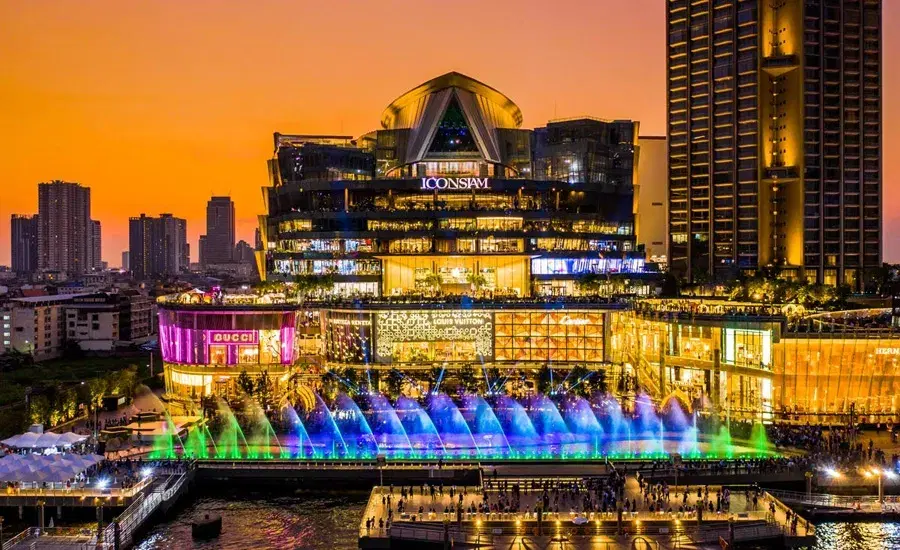
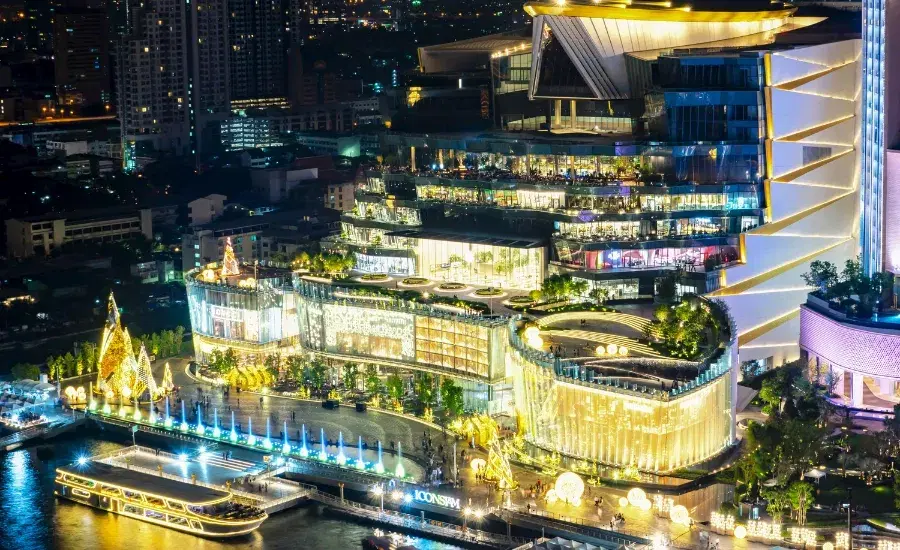
- The flagship boutiques at ICONSIAM and Central Embassy are beautifully stocked, but a Chanel or Hermès piece is rarely cheaper than in Paris or Milan once Thai duty is applied.
- Even with the 7% VAT refund, the saving is usually swallowed by the duty differential.
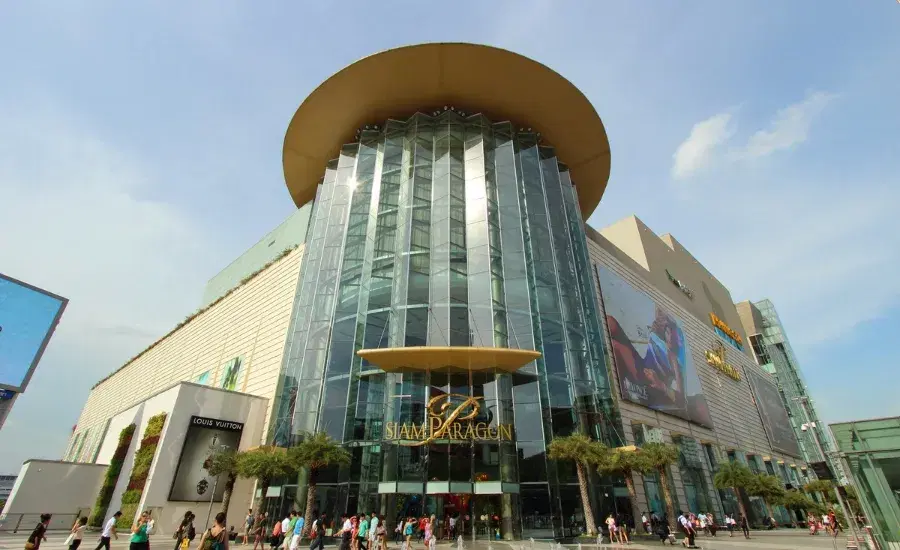
- Where these malls earn their place is Thai design — labels like Asava, Flynow, Sretsis, Kloset and Painkiller, which are difficult to find outside Thailand at any price.
Thai Silk — What the Royal Peacock Mark Actually Tells You
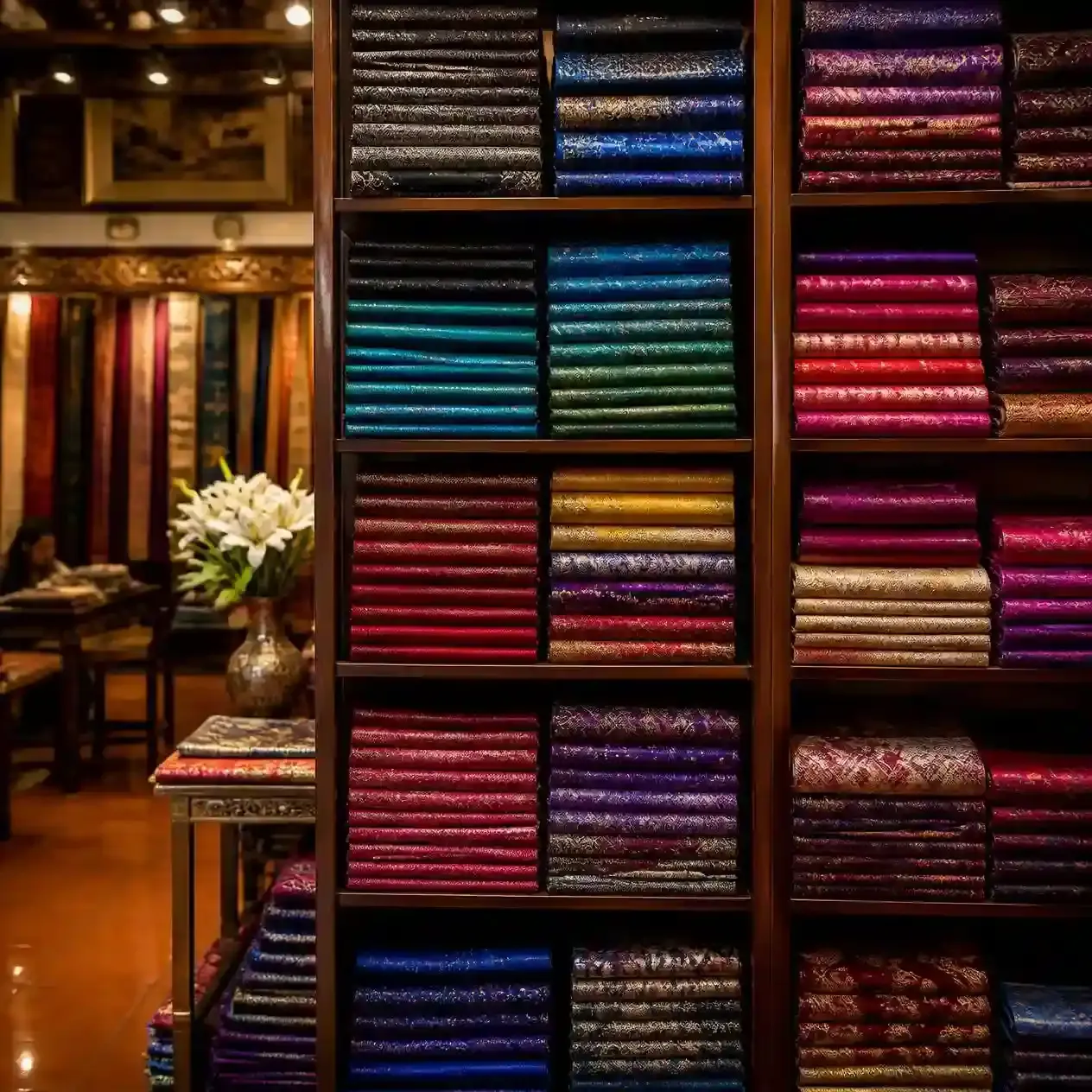
Silk is the first answer most people give to what to buy in Bangkok, and it is the right one — provided you can read the grading. Certified Thai silk is graded by a government certification mark, and reading it takes about thirty seconds. Introduced in 2007 by Queen Sirikit and administered by the Department of Sericulture, the Royal Peacock logo appears in four colours, each certifying a different composition and method. If a shop cannot show you the mark, you are buying on trust alone.
The four grades, and what each one certifies
- Gold Peacock (Royal Thai Silk) — native Thai silkworm, hand-reeled, handwoven, no chemical bleaching. The top tier, and priced accordingly.
- Silver Peacock (Classic Thai Silk) — Thai or hybrid silkworm, hand-reeled or machine-reeled, still handwoven on a traditional loom.
- Blue Peacock (Thai Silk) — 100% pure Thai silk yarn, woven by hand or machine. The workhorse grade, and the right choice for scarves and cushion covers.
- Green Peacock (Thai Silk Blend) — silk blended with other natural or synthetic fibres. Perfectly good cloth, but priced as a blend, not as pure silk.
Where to buy silk in Bangkok
Three routes, depending on what you want from the purchase. The Jim Thompson House is the historical anchor — the teak compound of the American who rebuilt the Thai silk export trade in the 1950s — and its shop carries the brand's own weaves in finished form. The craft floor at ICONSIAM stocks silk alongside other regional textiles with provenance labelling. For cloth by the metre and dressmaking on site, the silk shops around Old Siam Plaza remain the working district.
What silk should cost in 2026
- Blue Peacock silk by the metre: THB 500–800 (USD 15–25)
- Gold or Silver Peacock handwoven cloth by the metre: THB 1,500–4,000 (USD 46–123)
- Finished scarf, brand-house quality: THB 2,500–6,500 (USD 77–200)
- Cushion covers and table runners: THB 900–2,500 (USD 28–77)
- Made-up garment from cloth bought on site: add THB 2,000–6,000 (USD 62–185) for dressmaking, three to five days
Real silk has a slightly uneven weave and a two-tone shimmer that shifts as the cloth moves — warp and weft dyed in different colours is the traditional Thai construction. A perfectly uniform sheen usually means polyester.
Ceramics, Craft and Homeware — Benjarong, Celadon and OTOP
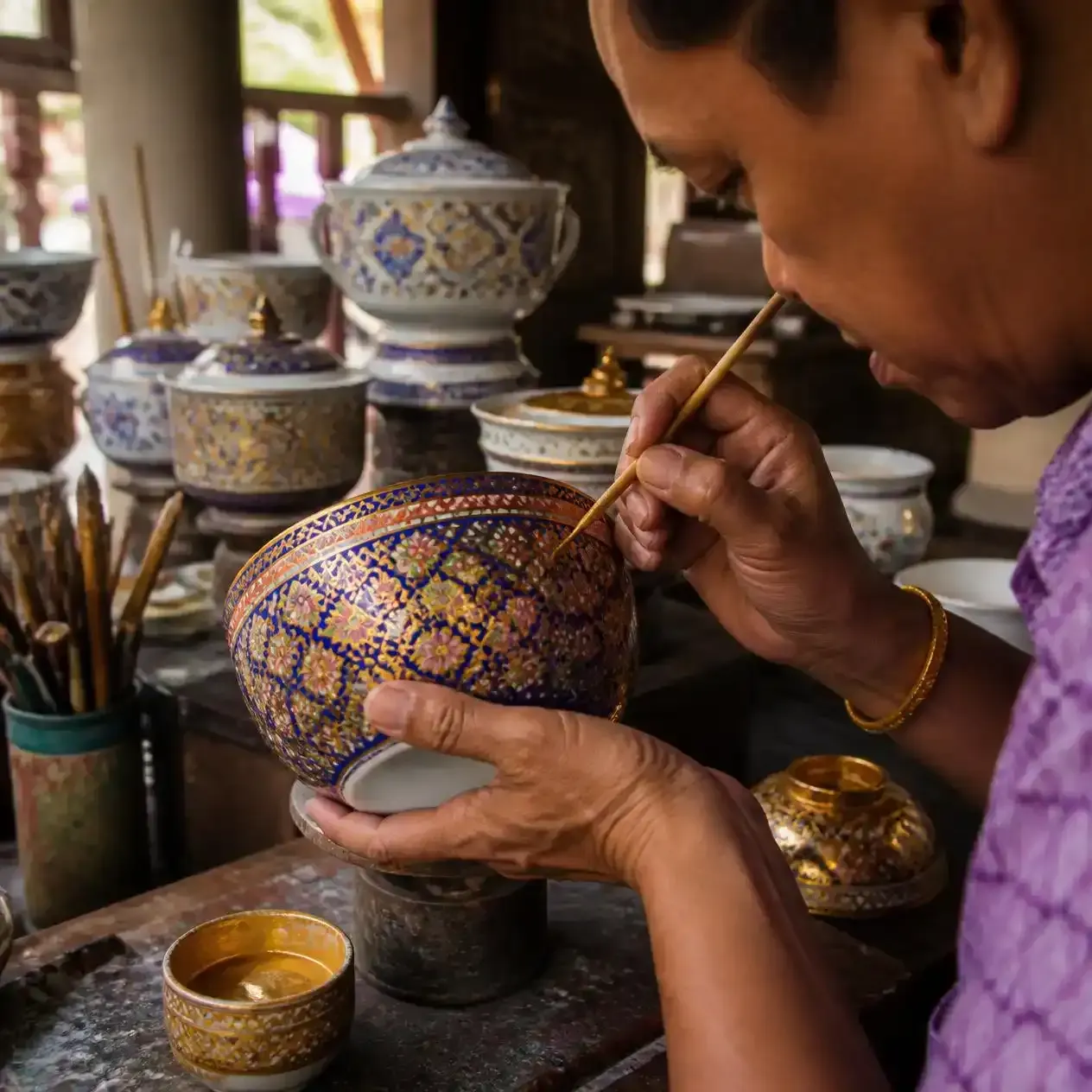
Thailand's two ceramic traditions are easy to tell apart and worth knowing before you shop. Benjarong is the five-colour, gold-accented porcelain that was once restricted to the royal court; celadon is the quieter jade-green stoneware associated with the north. Both travel well if packed properly, and both are widely faked at the decorative end.
Benjarong — reading the decoration
Authentic Benjarong is hand-painted in raised enamel over glaze, then gilded. Run a fingertip across the surface: hand-painted work has perceptible texture where the enamel sits proud, and the gold has a slight unevenness at the edges of each motif. Transfer-printed pieces are completely flat and the gold line is mechanically perfect. Both are sold as Benjarong, but the price gap between them should be substantial.
- Small transfer-decorated pieces: THB 300–800 (USD 9–25)
- Hand-painted bowl or vase: THB 1,500–5,000 (USD 46–154)
- Full hand-painted tea or dinner set: THB 8,000–25,000 (USD 246–770)
Celadon and northern stoneware
Celadon is defined by its crackle glaze — a deliberate network of fine lines produced by the glaze and body cooling at different rates. The green should have depth rather than a flat painted look, and the crackle should run through the glaze, not sit on top of it. Prices run THB 400–3,000 (USD 12–92) for tableware, more for large decorative pieces.
Where the vetted craft sits
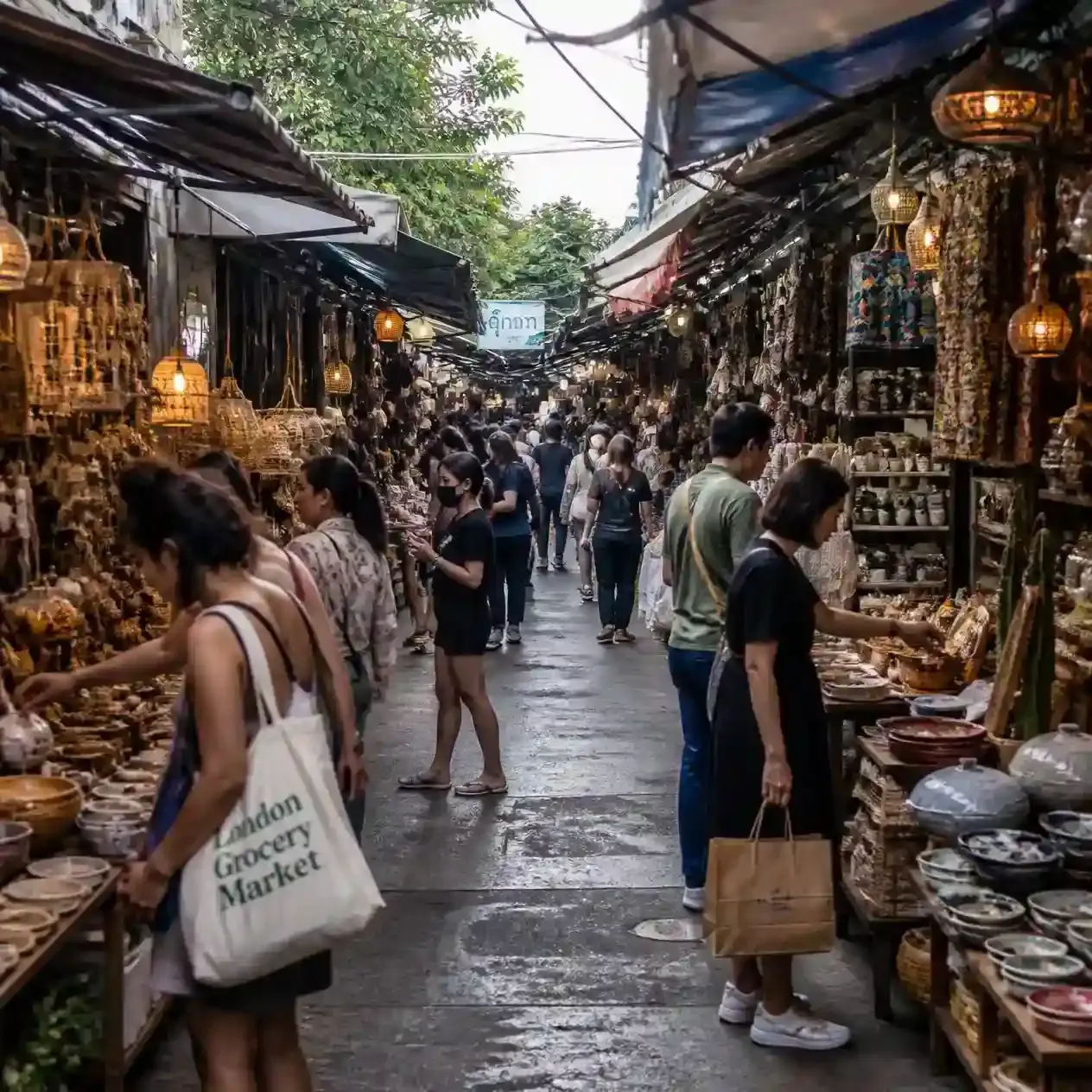
ICONCRAFT, on the fourth and fifth floors of ICONSIAM, is the most reliable single stop — it works directly with artisan communities across Thailand and labels provenance. Narai Phand, the government-supported handicraft centre, sources from rural producer groups under the OTOP scheme and is the safer option if you are unsure of your eye. Or Tor Kor Market is primarily a produce market but carries good regional craft and packaged food alongside it. The experiences on Travjoy are researched and approved by local experts, so if you would rather have someone else do the vetting, that layer already exists — browse the shopping experiences in Bangkok.
Reality check: ceramics and cabin baggage
- Anything hand-painted should travel in the cabin, not the hold — Benjarong enamel chips at the rim before the body cracks.
- Established shops will crate a full set for shipping; ask before you buy, because the crating cost can rival the piece.
- Buy ceramics early in the trip so a shipping option is still open if the piece turns out to be larger than your case.



Bespoke Tailoring and Gemstones — The Two High-Value Commissions
At the top of the list of what to buy in Bangkok sit two things that are not really products at all. These are the two purchases where Bangkok's advantage is largest and the downside risk is highest. Both need time, both need verification, and both reward the traveller who starts on day one rather than day four. Treat them as commissions rather than shopping.
Tailoring: what each price tier actually buys
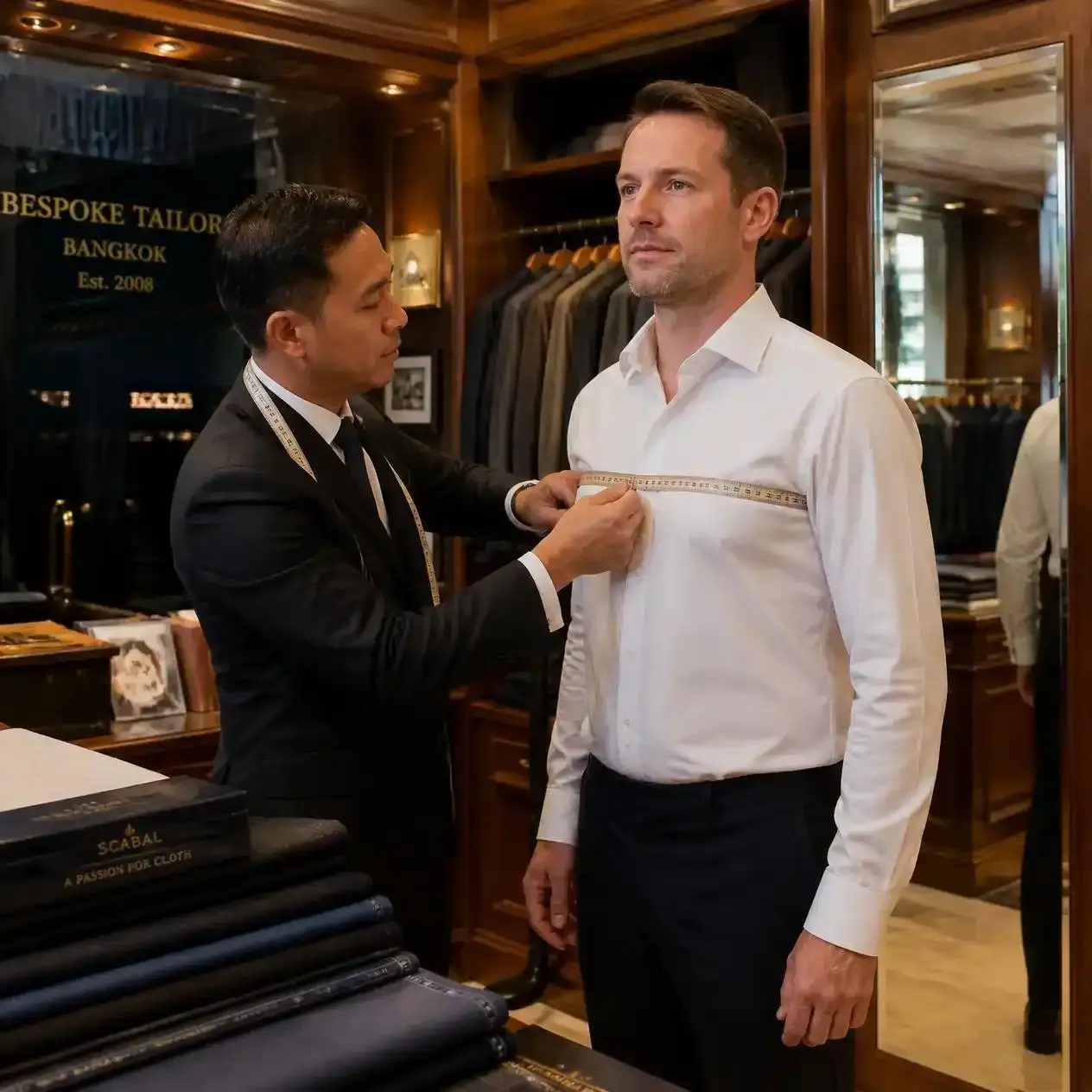
Price maps almost directly onto construction method in Bangkok, and construction is what determines whether a jacket holds its shape for a decade or sags within a season. The 2026 bands at reputable houses:
- THB 7,000–15,000 (USD 215–460) — wool blends or basic worsted, fused front construction, one to two fittings. Serviceable for a single occasion.
- THB 15,000–30,000 (USD 460–925) — Super 100s–120s worsted, half-canvas construction, better linings, partial handwork. The band most travellers choose.
- THB 30,000–50,000+ (USD 925–1,540+) — Super 130s–150s or named European mill cloth, full-canvas construction, hand-finished buttonholes and lapels, three to four fittings.
- Custom shirts: THB 1,200–2,500 (USD 37–77) each, usually with a minimum order of two or three
- Women's blazers and dresses: THB 3,500–10,500 (USD 108–325)
The fitting timeline — why 48-hour suits are fused suits
A properly constructed jacket cannot be made in two days. A half-canvas suit needs a minimum of two fittings across four to five days; a full-canvas commission needs three or four fittings and realistically a week, though many houses will complete the pattern while you are in the city and ship the finished garment. If a shop promises a full-canvas suit overnight, it is selling something else.
Reality check: read the discount, not the price
- A tailor with published, fixed pricing has little built-in negotiating margin — that is a sign of an honest cost structure, not a poor deal.
- The pattern to walk away from is the reverse: a high opening quote followed by a dramatic "today only" reduction.
- Ask to see the cloth's mill selvedge. A house working with Zegna, Loro Piana, Vitale Barberis Canonico or Holland & Sherry will show you the bolt without hesitation.
- Book the first appointment for your arrival day. Everything else in the process is fixed by that decision.
Gemstones: a legitimate trade with a well-known parasite
Bangkok is one of the world's principal centres for coloured stone cutting and trading, particularly rubies and sapphires, and buying here is entirely sound if you buy the right way. The problem is a long-running confidence scheme that operates alongside the real trade and specifically targets visitors.
The approach follows a script. Someone near a major temple or the Grand Palace tells you the site is closed for a holiday or a ceremony. A helpful tuk-tuk driver appears. You are taken to a "government export centre" running a one-day tax promotion, shown stones in a well-appointed room, and told they can be resold at a profit at home. The stones are real but worth a fraction of the price, and the paperwork is a shop-issued opinion rather than an independent report.
How to buy stones properly
- Buy only from established dealers with a physical showroom and a trading history you can look up.
- Insist on a report from an independent laboratory — AIGS and GRS both operate in Bangkok and both are recognised internationally. A shop's own certificate is not a laboratory report.
- Never buy on the same day you are introduced to a shop, and never through an intermediary who found you on the street.
- Anyone who explains that you can resell the stone at a profit abroad is describing the scheme, not the trade.
- If something goes wrong, the Tourist Police line is 1155.
Reality check: the temple is not closed
- Wat Pho, Wat Arun and the Grand Palace do not close for unannounced religious holidays or lunch breaks.
- Anyone who tells you otherwise on the pavement outside is opening the script.
- The correct response is to walk to the official ticket office and check for yourself.
Where to Buy What — Bangkok's Districts Mapped to Purchases
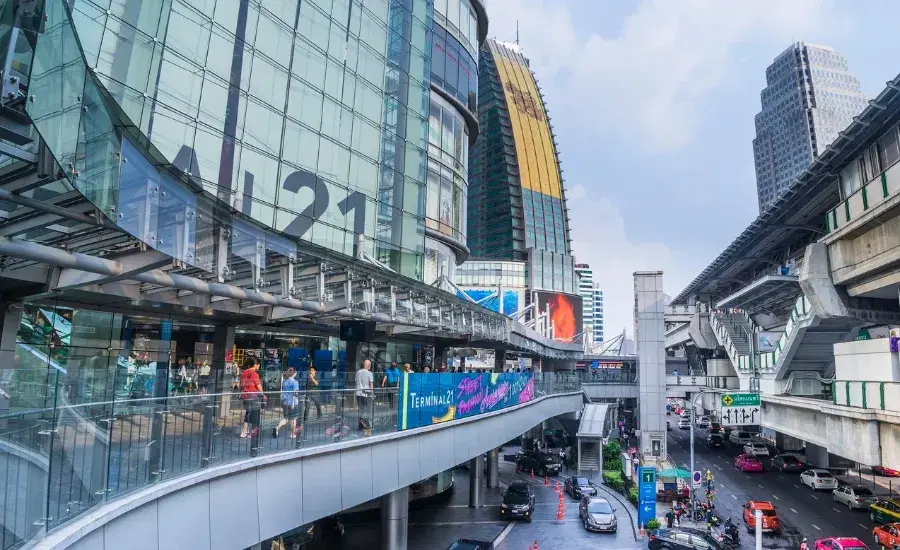
Bangkok's shopping geography is unusually legible once you match venue to purchase type. The malls cluster along the BTS Sukhumvit line between Siam and Phrom Phong, the wholesale districts sit around Pratunam, the weekend market anchors the north at Mo Chit, and the riverside holds the craft and luxury end. This table covers what to buy in Bangkok and where each purchase actually belongs.
| What you're buying | Where to buy it | Price band (THB / USD) | Best for |
|---|---|---|---|
| Certified Thai silk | Jim Thompson House, Old Siam Plaza | 500–6,500 / 15–200 | Gifts with provenance; cloth for dressmaking |
| Benjarong, celadon, artisan craft | ICONCRAFT at ICONSIAM, Narai Phand | 300–25,000 / 9–770 | Homeware buyers wanting labelled provenance |
| Thai designer fashion | Siam Paragon, Siam Centre, Central Embassy | 2,000–40,000 / 62–1,230 | Labels unavailable outside Thailand |
| Bespoke tailoring | Sukhumvit and Silom ateliers | 7,000–50,000+ / 215–1,540+ | Stays of three days or more |
| Craft, vintage, homeware at volume | Chatuchak Weekend Market | 100–5,000 / 3–154 | Weekend visitors with time and stamina |
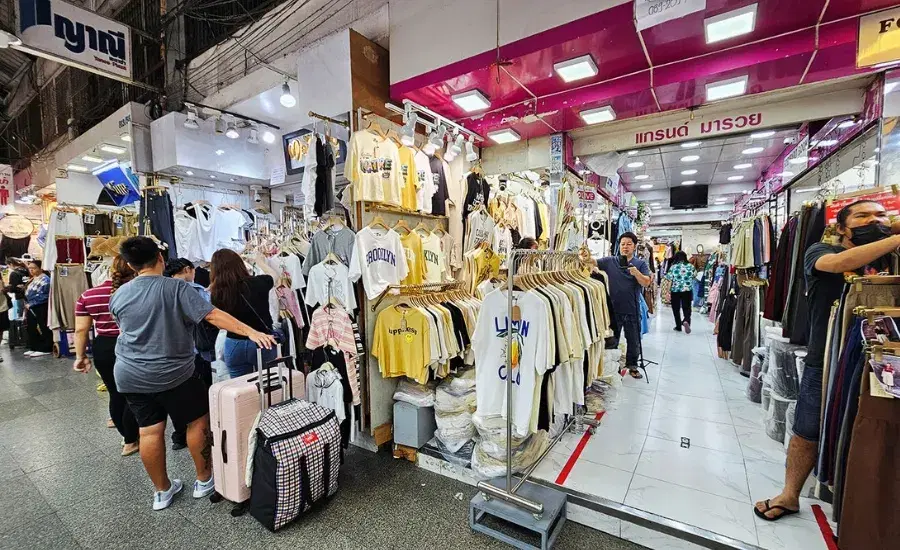
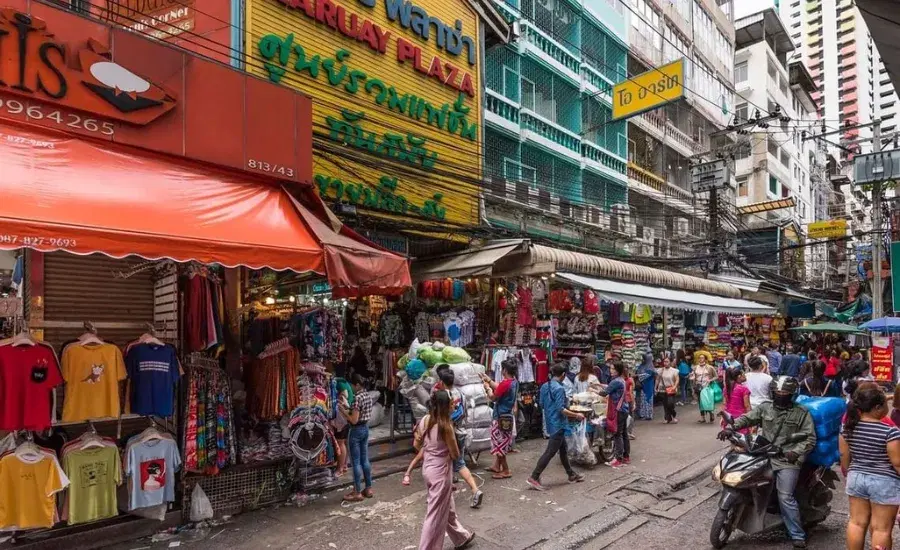
| Fabric, accessories, volume fashion | Pratunam Market, Platinum Fashion Mall | 150–2,000 / 5–62 | Buyers purchasing in multiples |
| Packaged food, spices, tea | Or Tor Kor Market | 100–1,500 / 3–46 | Edible gifts that clear customs easily |
Which district should you choose?
- Choose the Siam and Ploenchit malls if you want Thai designer labels, air conditioning, VAT-refund desks on site, and everything within one BTS stop of each other.
- Choose ICONSIAM and the riverside if craft, ceramics and provenance labelling matter more than fashion — and take the river boat rather than a taxi.
- Choose Chatuchak if you are in Bangkok over a Saturday or Sunday and want breadth. It runs to roughly 15,000 stalls, so go with a section plan and a meeting point.
- Choose Pratunam or Platinum only if you are buying in multiples — the pricing structure is wholesale, and single purchases carry no advantage.
- Choose Or Tor Kor if you want edible gifts. It is the cleanest, best-organised food market in the city, and vacuum-packed goods travel well.
Getting It Home — VAT Refunds, Export Permits and Shipping
The logistics are where most of the value in what to buy in Bangkok is either captured or lost. The 7% VAT refund is real money on a substantial purchase, the Buddha permit is a hard legal requirement, and the shipping decision is best made at the point of sale rather than at the airport.
Claiming the 7% VAT refund
- Shop only at stores displaying the blue-and-white "VAT Refund for Tourists" sign; the major malls have dedicated desks.
- Spend a minimum of THB 2,000 (USD 62) per store per day, and THB 5,000 (USD 154) across all purchases.
- Present your passport at the till and ask for the P.P.10 form with the original tax invoice — photocopies and digital receipts are not accepted.
- Goods must leave Thailand unused, in original packaging, within 60 days of purchase.
- Purchases totalling over THB 20,000 (USD 615) require a customs inspection stamp before you check in your bags — do this before, not after, dropping luggage.
- Refunds under THB 30,000 (USD 925) are paid in baht cash after immigration; larger amounts go to a credit card or bank transfer and take one to two weeks.
- A processing fee is deducted, so the net recovery is closer to 5–6% than the headline 7%.
Buddha images and antiques — the permit rule
Under the Ancient Monuments, Antiques, Objects of Art and National Museums Act, any Buddha image taller than 12 cm requires written permission and an export permit from the Fine Arts Department before it can leave Thailand. A separate permit is needed for each image, officials inspect each piece, and the process takes three to five working days. No more than five images may be exported per person. Partial images — a head, a hand, a fragment — cannot be exported at all, and genuine antiques generally cannot leave the country under any circumstances.
Small souvenir figurines under 12 cm from ordinary tourist shops are not covered. If you want anything larger, buy it in the first two days of your trip from a dealer who handles the paperwork routinely, and confirm they will supply the official tag and documentation with the piece.
Shipping versus excess baggage
- Thailand Post caps individual parcels at 30 kg and restricts batteries, liquids and perfumes.
- Airline excess baggage on long-haul routes typically runs USD 100–200 per additional bag, which makes shipping competitive for anything bulky or fragile.
- Declare items at actual purchase price — Thai customs officers know local market values, and under-declaring risks delay or confiscation.
- Check your own country's import threshold before shipping: the US allows USD 800 duty-free, the EU only EUR 150.
- Do not post alcohol; it requires an excise licence. Vapes are illegal in Thailand entirely.
Reality check: build the VAT trail from day one
- The THB 5,000 aggregate threshold is easy to miss by a few hundred baht because early purchases were made at non-participating shops.
- Ask about VAT-refund registration before you pay, not after — the form cannot be issued retrospectively.
- Keep purchases in original packaging until you have cleared the customs desk; opened goods are routinely rejected.
- Allow a full hour at Suvarnabhumi for the refund process at peak departure times.
Planning Your Bangkok Shopping
The categories worth your luggage allowance are narrower than the listicles suggest, but they run deeper. Certified silk, hand-painted ceramics, a properly constructed suit and a lab-verified stone are all things Bangkok does better and more affordably than almost anywhere — provided you know the quality markers and give each purchase the lead time it needs.
Three decisions turn a good answer to what to buy in Bangkok into a case that actually gets home. Commission anything bespoke on your arrival day. Build the VAT paper trail from the first purchase rather than the last. And buy any Buddha image early enough for the permit to clear. Get those right and the rest is enjoyable.
Start planning your shopping trip to Bangkok on Travjoy, where every experience is researched and approved by local experts.





.svg&w=1920&q=75)