


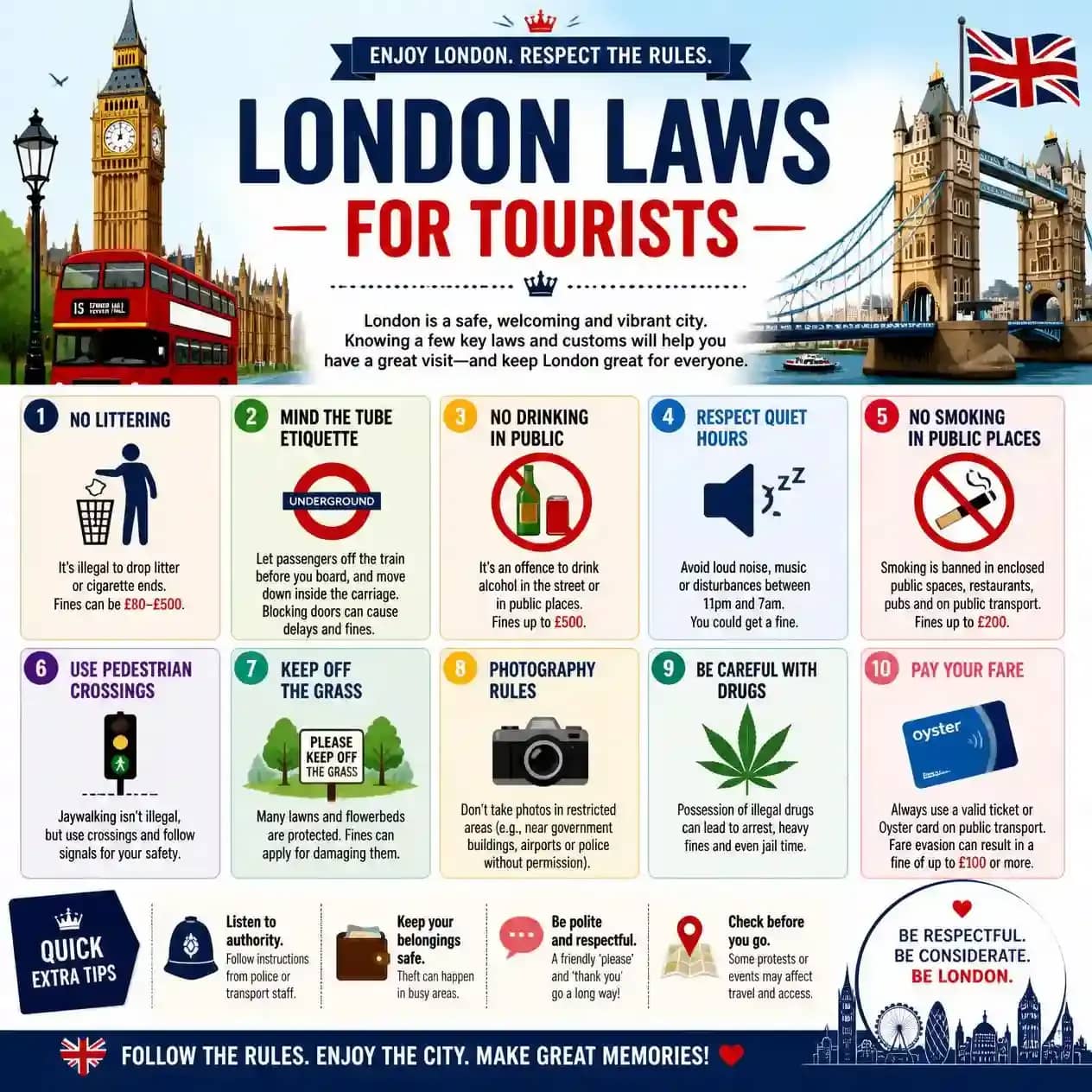
London Laws for Tourists: What to Know Before You Go — A Complete Guide for Discerning Travellers
7 min read
Key Highlights
- An approved UK Electronic Travel Authorisation (ETA) is now required before you fly — apply online for £20, not at the border.
- Alcohol is banned on the Tube, buses and all Transport for London services, and has been since 2008.
- Traffic drives on the left, so look right before you step off any kerb.
- Drivers face an £18 daily Congestion Charge plus a separate £12.50 ULEZ charge in central London.
- A 12.5% restaurant service charge is discretionary, not compulsory — you can ask for it to be removed.
Most London laws for tourists are common sense and lightly felt, but a handful catch visitors off guard: you need an approved ETA before you board your flight, alcohol is banned across all Transport for London services, traffic drives on the left, and drivers pay both a Congestion Charge and a ULEZ charge in the centre. Know these before you land and London is one of the easiest major cities to navigate.
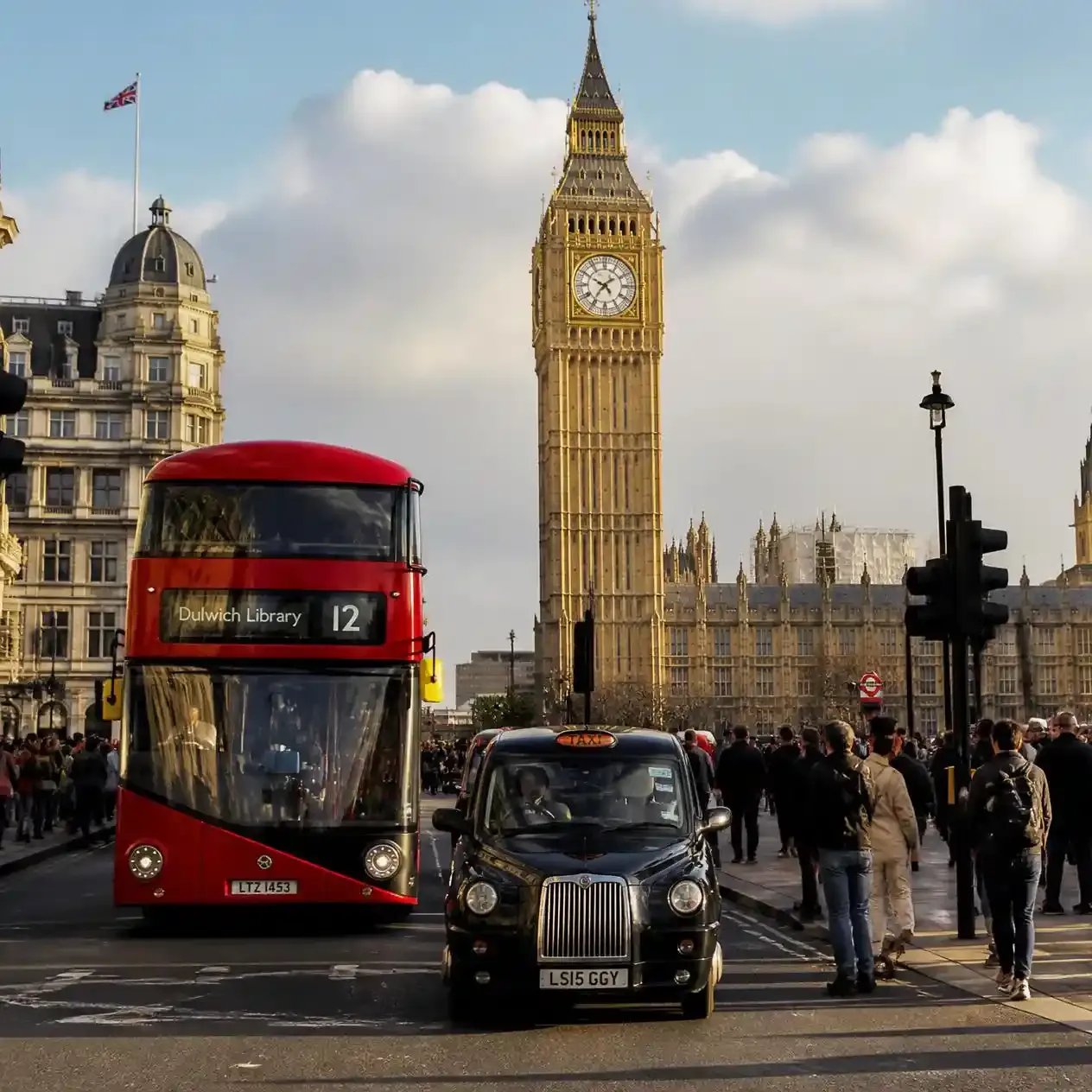
London rewards visitors who arrive knowing how the city works. It is welcoming, walkable and, for the most part, governed by rules that feel light on the ground — but a small number of them really surprise people, and a couple can cost you money or a missed flight if you get them wrong. The most important London laws for tourists are less about obscure statutes and more about the practical machinery of the city: entry paperwork, transport, driving charges, and the licensing and etiquette rules that shape everyday life here.
This guide covers what you actually need to know before you go, laid out the way a well-travelled local would explain it — starting at the airport and working through getting around, going out, spending money, and the everyday courtesies that make you look like you belong. Where the rules changed recently, the current figures are here. Where a myth has taken hold, we clear it up. Think of it as the short list of London laws for tourists that actually change how you plan.
The aim is simple: arrive informed, and let London be the easy, absorbing city it is — one where the only thing you have to decide is what to do first.
Before You Fly: Entry Rules That Catch Visitors Out
The single biggest rule to sort before a London trip is the UK Electronic Travel Authorisation (ETA): most visa-exempt visitors now need one, and without it your airline will not let you board. Apply online or through the official UK ETA app for £20 per person, well before you travel — everyone needs their own, including babies and children.
The ETA has been mandatory since late February 2026, and it is linked digitally to your passport, so there is nothing to print. It covers multiple visits of up to six months over two years, or until your passport expires. Approvals often arrive within minutes, but allow up to three working days to be safe, and apply before booking non-refundable flights.
Paperwork and prohibited items
A few more entry rules surprise people, and each is easy to get right in advance:
- Prohibited items: pepper spray and mace are treated as firearms in the UK — never pack them. Carrying one is a serious offence, not a packing slip-up.
- Medication: bring prescription medicines in their original packaging with a doctor's letter, especially for strong painkillers or ADHD medication, some of which are controlled substances here.
- Customs and cash: use the green channel if you have nothing to declare, and declare cash of £10,000 or more when entering Great Britain.
- Duty-free: allowances apply to alcohol and tobacco brought from outside the UK; exceed them and you may face seizure of the goods or a penalty.
These are the London laws for tourists most likely to trip you up before you have even landed, which is exactly why they belong at the top of your list rather than the bottom.
Getting Around Within the Law
Getting around London is easy and largely rule-light, with two exceptions that catch visitors out: you cannot drink alcohol on public transport, and driving into the centre costs more than most people expect. Both are simple to sidestep once you know them.
Alcohol has been banned across the Underground, buses, trams, the DLR and the Overground since 2008. An open drink can be confiscated and you can be refused travel. Smoking and vaping are not permitted anywhere on the network either, including open-air platforms.
On the roads: which way and what it costs
- Drive on the left. As a pedestrian, that means look right first at every kerb — the painted "look right" reminders at central crossings exist because visitors instinctively look the wrong way.
- Central London charges stack up. Driving into the centre on a weekday means an £18 daily Congestion Charge (7am–6pm Monday to Friday, noon–6pm at weekends and bank holidays). If your vehicle does not meet emissions standards, a separate £12.50 ULEZ charge applies 24/7 across all London boroughs. A non-compliant car can therefore cost £30.50 a day before you have even parked.
For most visitors, the simpler and more comfortable option is not to drive at all. Contactless or an Oyster card on the Tube caps your daily fare automatically, a licensed black cab or a booked private transfer folds any charges into the fare, and a hop-on hop-off bus or guided tour handles the logistics for you. If you want to reach the city's top experiences without a second thought about zones and charges, the network is the way to do it.
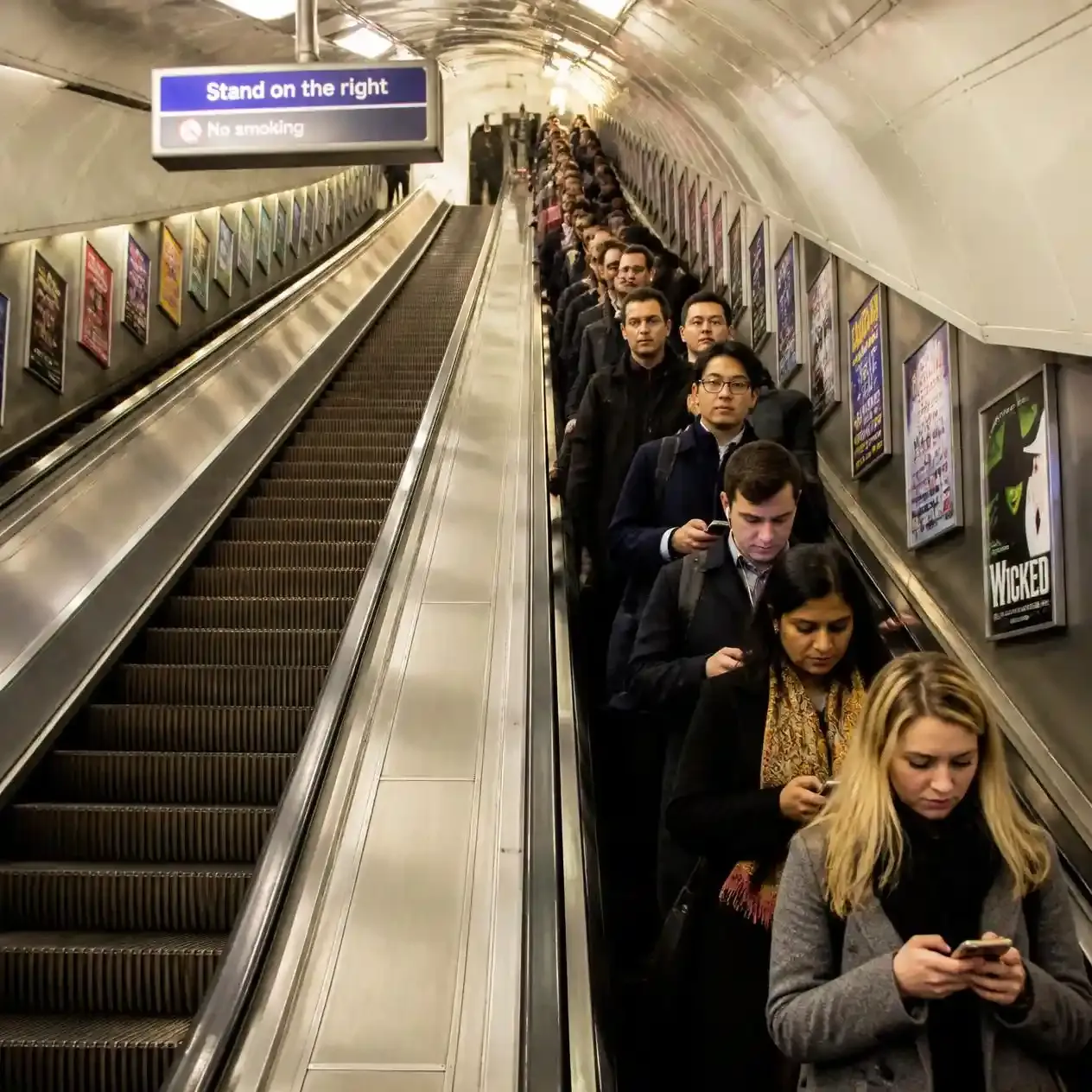
Two more small things mark you out as someone who knows the city:
- Stand on the right on escalators. The left side is a walking lane, and blocking it is the fastest way to irritate a commuter.
- Private e-scooters are illegal on public roads and pavements. Only the official rental-scheme e-scooters are legal to ride in London; a privately owned one can be seized.
Out in Public: Drinking, Smoking, Vaping and Drugs
In public, London is relaxed about most things and strict about a few. Drinking in the street is broadly legal, but some areas are controlled zones where police can ask you to stop or hand over alcohol. Drugs and vaping carry firmer rules that can surprise visitors from more permissive places.
Public drinking and licensing
- You can drink in most public spaces, but many boroughs enforce Public Spaces Protection Orders (PSPOs) where police can require you to stop drinking or confiscate alcohol — common around nightlife districts and some parks.
- The legal age to buy alcohol is 18, and staff operate a "Challenge 25" policy, so carry photo ID even if you are comfortably older.
- Pubs and bars close on their own licences; last orders are often around 11pm, though many venues in London's nightlife districts run much later.
Smoking, vaping and drugs
- Smoking has been banned in all enclosed public places — pubs, restaurants, stations, workplaces — since 2007. You can smoke outdoors, but not on covered transport platforms.
- Vaping follows similar courtesy rules and is banned across Transport for London. Since June 2025, single-use disposable vapes can no longer be sold in England, so bring a refillable device if you vape.
- Recreational drugs are illegal and enforcement is real. Cannabis is a Class B drug, with no tourist exception. Nitrous oxide ("laughing gas") became a Class C controlled substance in late 2023, and possession can now bring a penalty.
None of this makes London feel heavy-handed. The rules are applied consistently rather than aggressively, and knowing them means the only thing you have to think about on a night out is where to go next.



Money, Tipping and Shopping Etiquette
Tipping in London is simpler and less obligatory than in many countries: a discretionary service charge of around 12.5% is often added to restaurant bills, and beyond that, tipping is appreciated but never demanded. Nothing about spending money here requires haggling or guesswork.
How tipping actually works
- Restaurants: check the bill for a service charge before adding anything. If 12.5% is already included, you need not tip on top. It is discretionary, so you can ask for it to be removed if service fell short.
- Since October 2024, a change in the law means service charges and tips must be passed to staff in full, so the amount on your bill now reaches the people who served you.
- Pubs and bars: there is no tipping when you order at the bar, which is how most pubs work. To acknowledge good service, offer to buy the bartender a drink instead.
- Taxis: rounding up to the nearest pound or adding roughly 10% is normal for black cabs, and not expected for app rides unless you choose to.
- Hotels and porters: a pound or two per bag is a courteous touch, not an obligation.
On shopping, the rules are gentle. Prices are fixed — there is no haggling in shops or department stores. Most shops open daily, but under Sunday trading rules, large stores can open for only six continuous hours on a Sunday, usually late morning to early evening. If shopping is a focus of your trip, our dedicated London shopping guidance covers hours, sales and the VAT position in detail. And if food is the draw, London's food tours are an easy way to eat well without navigating any of it alone.
One quiet reassurance for planning: the experiences you book through Travjoy are researched and approved by local experts, so you are choosing from options that already fit the city's rhythms rather than guessing from a search result.
The Unwritten Rules: Queuing, Pubs and Everyday Courtesy
Beyond the written laws, London runs on a set of unwritten courtesies that locals follow without thinking — and visitors who pick them up blend in immediately. None are enforceable, but ignoring them is the quickest way to stand out.
The ones that matter most
- Queue, and queue properly. Orderly queuing is taken seriously. Join the back, wait your turn, and never push in — jumping a queue draws real disapproval.
- Order at the bar in pubs. There is usually no table service in a traditional pub; go to the bar, order, and pay there. Keep your round in mind if you are with a group.
- Mind personal space and volume. Public transport is quiet; loud phone calls and speakerphone audio are frowned upon.
- "Sorry" is a reflex. People say sorry when you bump into them. It is social lubricant, not an admission of fault.
- Stand on the right on escalators, and keep left when walking on busy pavements.
A few place-specific rules
- Feeding the pigeons in Trafalgar Square is banned under a local byelaw, and wardens do enforce it.
- Photography is legal in public spaces, including of buildings and landmarks, though some interiors and galleries restrict it — look for signage.
- At Changing the Guard, arrive early for a spot, stay behind the marked lines, and do not touch or block the guards.
If you would rather absorb these rhythms with a local setting the pace, London's walking tours are a low-effort way to learn the city's etiquette while you see it.


Emergencies, Health and the Myths Worth Dropping
For emergencies in London, dial 999 (or 112) for police, ambulance or fire; both are free from any phone. For non-urgent police matters call 101, and for non-emergency medical advice call the NHS on 111. London is a safe city by big-city standards, and knowing these numbers is precaution, not cause for worry.
Useful numbers to save
- 999 or 112 — police, ambulance or fire (emergencies, free)
- 101 — police, non-emergency
- 111 — NHS, non-emergency medical advice
Health and safety essentials
- Travel insurance is essential. Visitors are charged for NHS hospital treatment — typically 150% of the standard cost — so medical cover for your trip matters more than most people assume.
- Tap water is safe to drink everywhere in London; carry a refillable bottle.
- Pickpocketing is the main petty-crime risk in crowded spots and on transport — keep bags zipped and phones off the table at pavement cafés.
Weapons and drones
- It is an offence to carry a knife or bladed article in public without good reason. A small non-locking folding pocketknife is a narrow exception, but anything else — and certainly anything sold as a "self-defence" tool — can bring arrest.
- Drones must follow Civil Aviation Authority rules: registration for most models, no flying near airports or over crowds, and a ban on flying in the Royal Parks.
Two myths worth dropping
- Jaywalking is not illegal in the UK. You can cross the road where you like — just remember traffic comes from the right first, and use judgement near fast roads.
- It does not rain constantly. London sees less annual rainfall than New York; showers are frequent but light, so a compact umbrella beats a heavy raincoat most of the year.
These are the last of the practical London laws for tourists — the safety net and the myth-busting that let you stop second-guessing and start enjoying the city.
Arrive Informed, Travel Easy
The London laws for tourists that matter are few and easy to master: sort your ETA before you fly, keep alcohol off the Tube, look right at every kerb, and treat the driving charges as a good reason to leave the car behind. The etiquette — queuing, standing on the right, ordering at the bar — you will pick up within a day.
Get these right and London stops being a city to decode and becomes one to enjoy: absorbing, walkable and welcoming to anyone who arrives with a little local knowledge. Start planning your trip to London on Travjoy, where every experience is researched and approved by local experts, so the only thing left to decide is what to do first.




.svg&w=1920&q=75)