



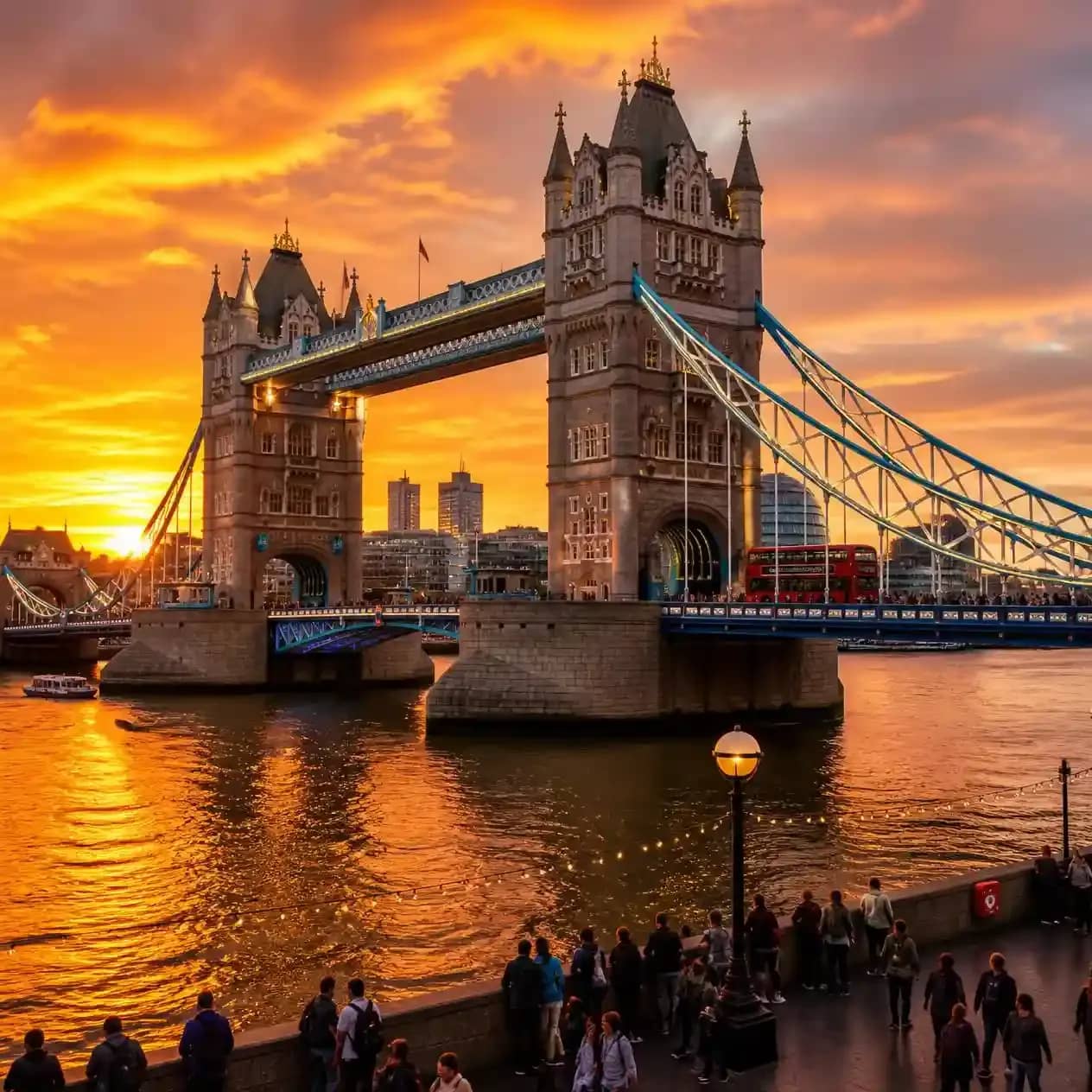
London Bridge History: A Complete Guide for Discerning Travellers — From Roman Crossing to Borough Market
7 min read
Key Highlights
- London Bridge history spans nearly 2,000 years — a Roman timber crossing of around AD 50 came first, and the city grew around it.
- The medieval Old London Bridge, finished in 1209, carried around 200 houses, shops and a chapel, and stood for 622 years.
- John Rennie's 1831 granite bridge was sold in 1968 for $2.46 million and rebuilt in Lake Havasu City, Arizona; the bridge you cross today opened in 1973.
- Borough Market has traded at the bridge's southern gate for over 1,000 years — the market exists because of the crossing.
- A compact heritage walk links Southwark Cathedral, the Winchester Palace ruins, the Golden Hinde and the Old Operating Theatre within ten minutes of the bridgehead.
London Bridge history covers nearly two millennia: a Roman timber crossing of around AD 50, the medieval Old London Bridge of 1209 that carried houses and shops for 622 years, John Rennie's 1831 granite bridge — sold in 1968 and rebuilt in Lake Havasu City, Arizona — and the plain 1973 crossing in use today. Borough Market, trading at the southern bridgehead for more than 1,000 years, grew directly out of the bridge's traffic, and the streets around it hold the densest cluster of surviving historic sites in Southwark.
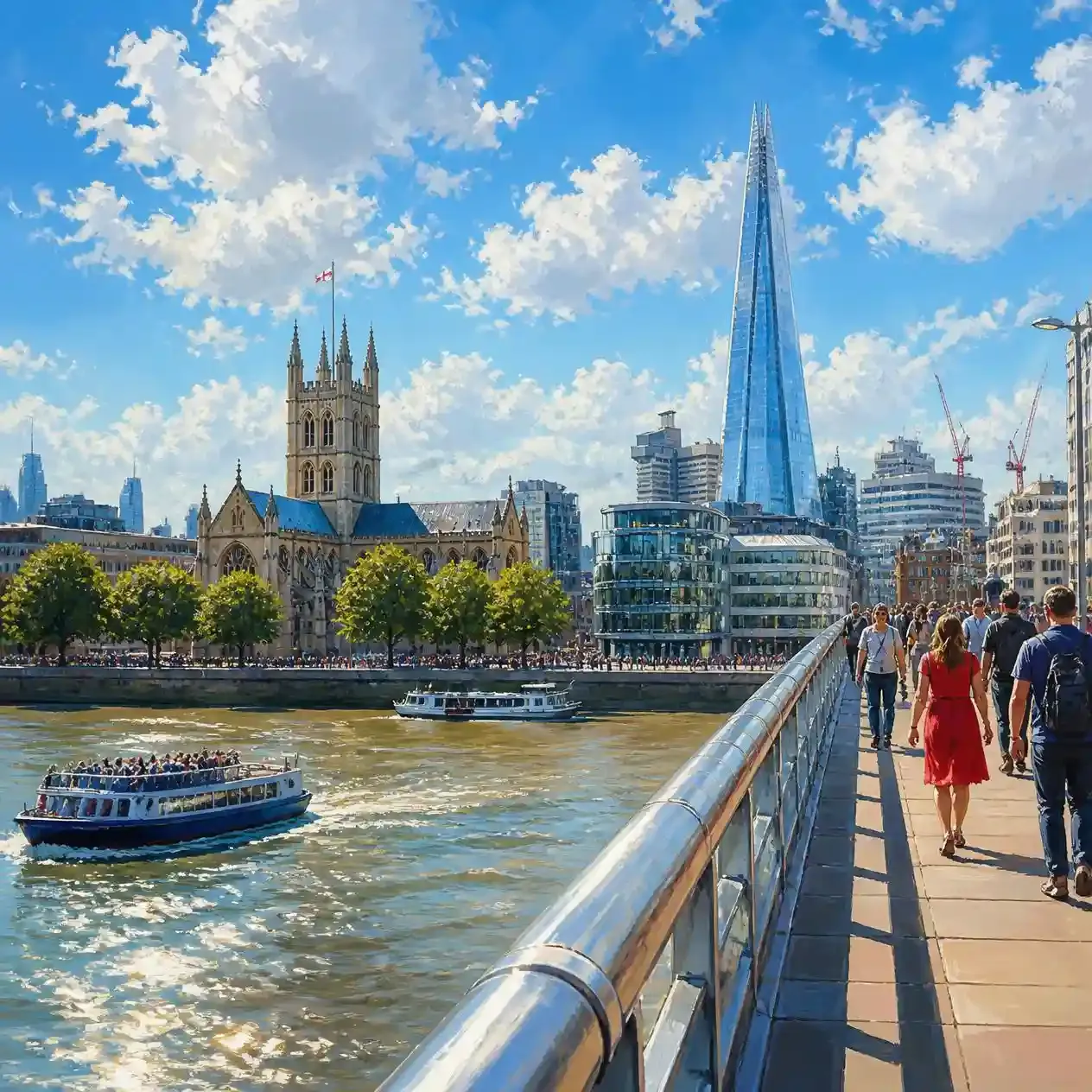
Stand on London Bridge today and you are on the least remarkable structure in sight — a plain concrete span from 1973, routinely mistaken for its photogenic neighbour downstream. Yet you are also standing on the single most consequential piece of ground in the city. Every version of London, from the Roman settlement to the financial district behind you, exists because a bridge crossed the Thames at this exact point.
That is what makes London Bridge history so rewarding for a returning visitor. The first trip covers the Tower, the Abbey and the views; the second trip is when the layers underneath start to pay off. This guide tells the full story of the crossing — the Roman original, the medieval bridge with houses on it, the Victorian bridge that now sits in the Arizona desert — and then walks you through what survives on the ground: Borough Market, Southwark Cathedral, and the heritage quarter packed around the southern bridgehead. You leave with a route, timings and admission details, not just the story.
Two Thousand Years of Crossing: Why London Exists Where It Does
London exists because of London Bridge, not the other way round. Around AD 50, Roman engineers identified the lowest point on the Thames where the river was narrow enough to bridge yet still deep enough for sea-going ships, and built a timber crossing close to the line of the present bridge. The settlement of Londinium grew at its northern end; Southwark grew at its southern end as the landing point for every road from the Channel ports.
The bridge as the city's engine
For the better part of eighteen centuries, this was the only bridge in central London — Westminster Bridge did not open until 1750. Every cart of produce, every pilgrim, every army entering the City from the south funnelled across this one crossing. That single fact explains most of what you see around the bridgehead today: why Borough Market sits where it does, why Southwark filled with inns and theatres, and why the City's oldest institutions cluster within a few hundred metres of the northern approach.
Vikings, fire and the nursery rhyme
The early timber bridges led eventful lives. In 1014, a fleet under Olaf II of Norway attacked the bridge and pulled part of it down — one of several episodes often suggested as the seed of the "London Bridge is falling down" rhyme. Successive wooden bridges burned, collapsed or were swept away until the City resolved to build in stone — the moment London Bridge history moves from legend into masonry.
Old London Bridge: The Medieval City in the Air
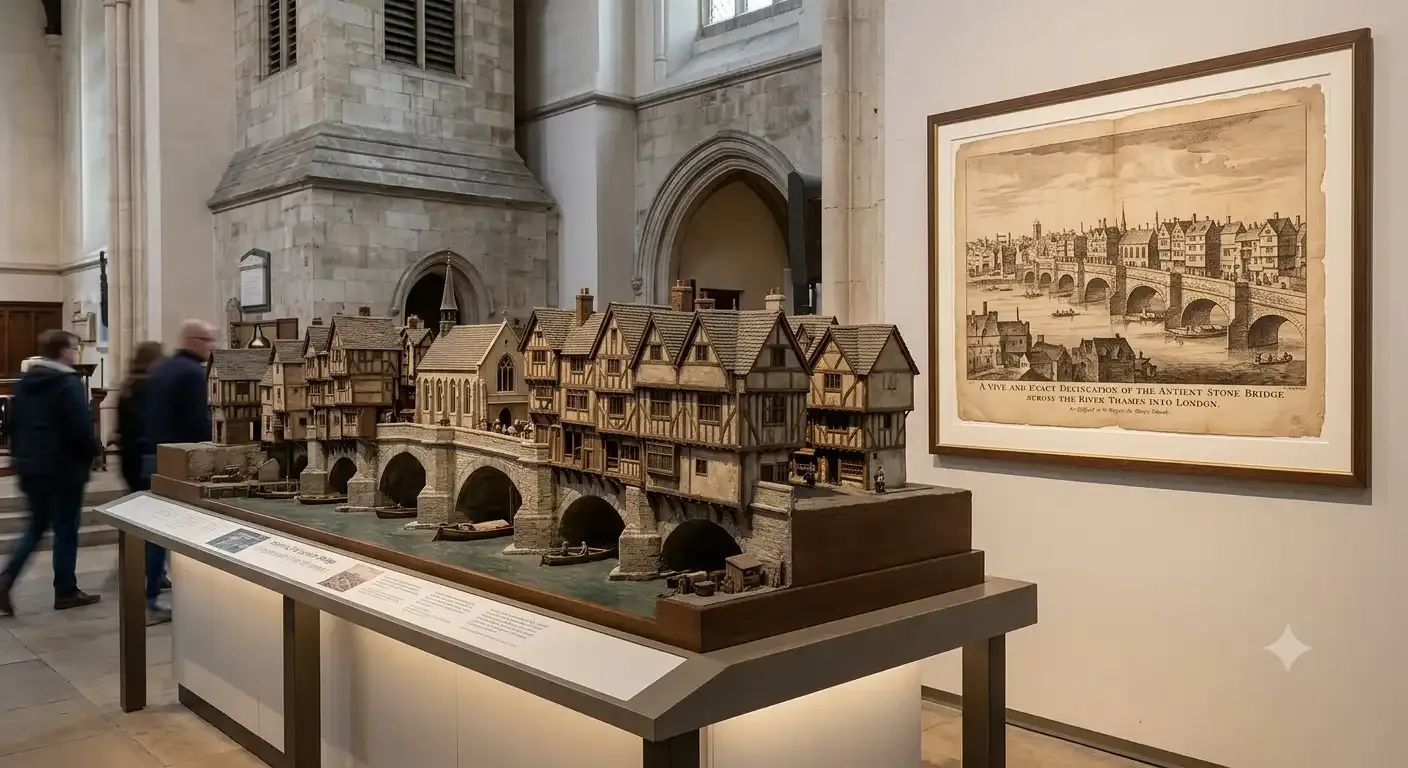
The bridge of legend — the one with houses on it — was begun in 1176 under Peter of Colechurch, a priest and architect, and completed in 1209 after 33 years of construction. It stood for 622 years, and for most of that time it was less a bridge than a street suspended over the river.
A high street over the Thames
Old London Bridge carried 19 stone arches, a drawbridge for shipping, fortified gatehouses and, at its peak, around 200 buildings — houses, shops and a chapel dedicated to St Thomas Becket that pilgrims visited on the road to Canterbury. Records from 1358 count 138 premises on the bridge. Upper storeys extended over the roadway until crossing felt like passing through a tunnel of timber and plaster, with the river roaring through the narrow arches below.
The grisly gatehouse
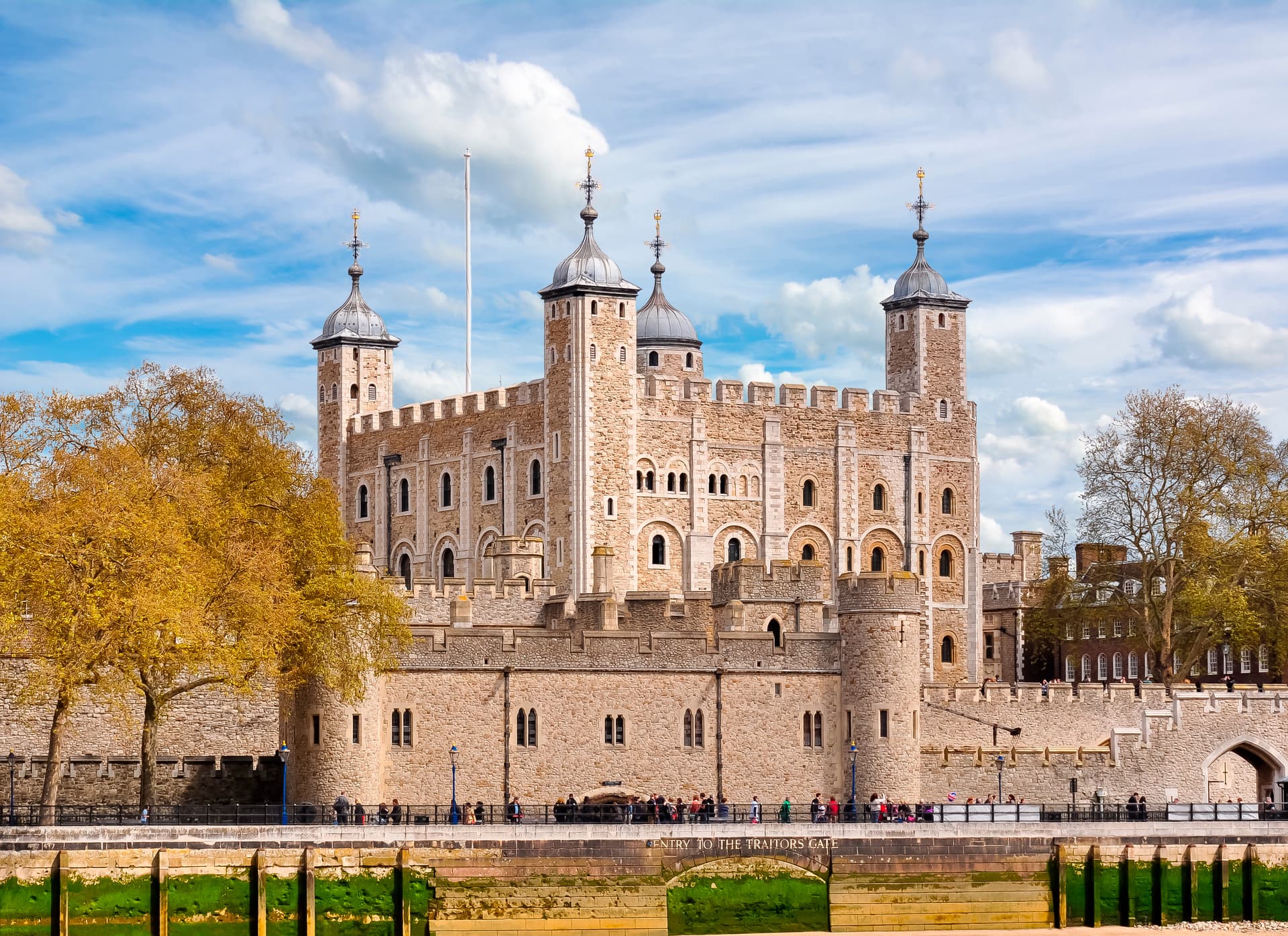
The southern gatehouse served a darker purpose. From 1305 — beginning with the head of William Wallace — until around 1660, the severed heads of traitors were displayed on pikes above the gate, dipped in tar to preserve them. For three and a half centuries this was the first sight of London for travellers arriving from the south. Many of those condemned had been held at the Tower of London, a short distance downstream, which makes the two sites natural companions on a history-led day.
The long decline
The bridge was as impractical as it was picturesque:
- The 19 closely spaced piers dammed the river, creating rapids that made "shooting the bridge" by boat a genuine hazard.
- Fires broke out repeatedly among the timber buildings; the bridge only narrowly survived the Great Fire of 1666.
- By 1762 all the houses had been removed and the roadway widened to about 14 metres, but the structure was beyond saving.
The Bridge That Moved to Arizona — and the One You Cross Today
The strangest chapter in London Bridge history is true: the 19th-century bridge now stands in the Arizona desert. When the medieval bridge finally came down, its replacement — a handsome five-arch granite structure designed by the engineer John Rennie and completed by his sons in 1831 — lasted less than 140 years before it, too, was retired. This time the City sold it.
The $2.46 million sale
By the 1960s Rennie's bridge was sinking into the Thames under the weight of motor traffic — roughly an inch every eight years, with one side measurably lower than the other. Rather than demolish it, the City of London put it up for sale, and in April 1968 the American entrepreneur Robert P. McCulloch bought it for $2,460,000 (about £1.9 million at today's rates) as the centrepiece for Lake Havasu City, the community he was building in the Mojave Desert.
- 10,276 numbered granite blocks were dismantled, shipped through the Panama Canal and trucked across the desert.
- The stones were re-hung on a reinforced concrete core; the rebuilt bridge was rededicated on 10 October 1971.
- Contrary to the enduring myth, McCulloch knew exactly which bridge he was buying — he was not under the impression it was Tower Bridge.
Reading the riverfront today
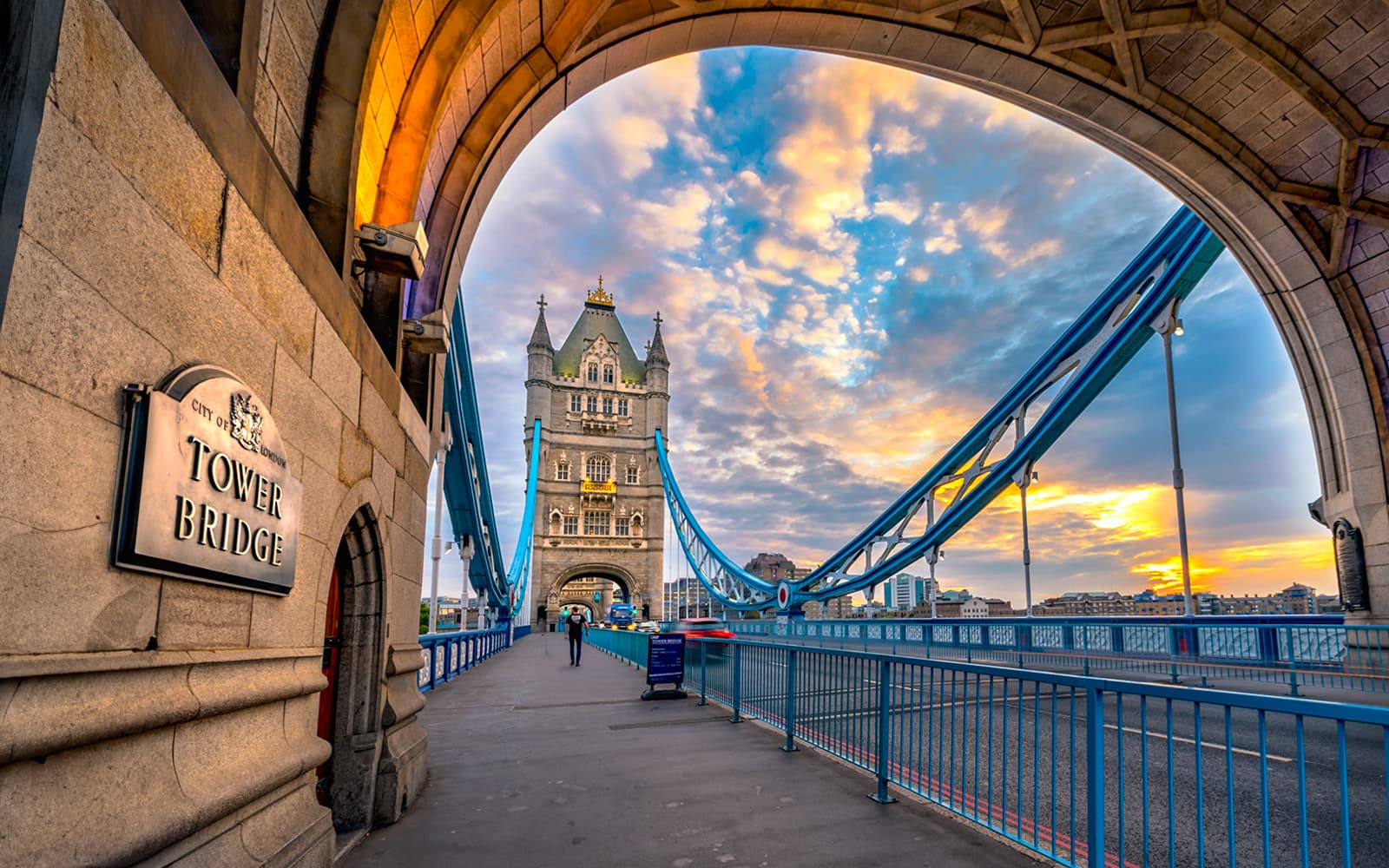
The current London Bridge, opened in 1973, is deliberately plain — which is why nearly everyone photographs Tower Bridge instead and assumes they are looking at London Bridge. The confusion is useful once you understand it: Tower Bridge (1894) is the Victorian showpiece; London Bridge is the 2,000-year-old idea. Walk the modern span slowly and the history reveals itself in fragments — the tower of St Magnus the Martyr church on the north bank once stood at the very entrance to the old bridge, and its pedestrian passage was part of the medieval roadway.




Borough Market: A Thousand Years of Trading at the Bridgehead
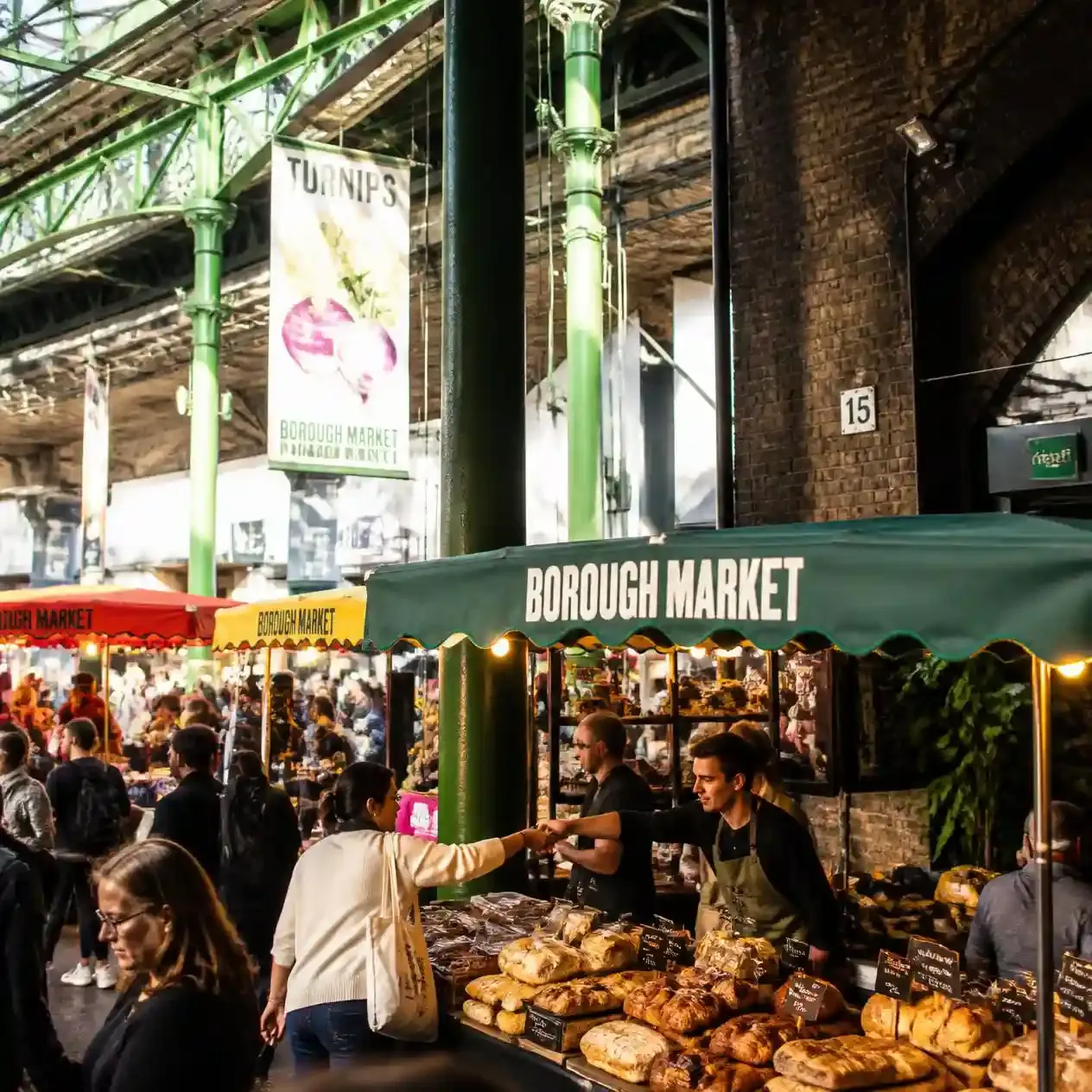
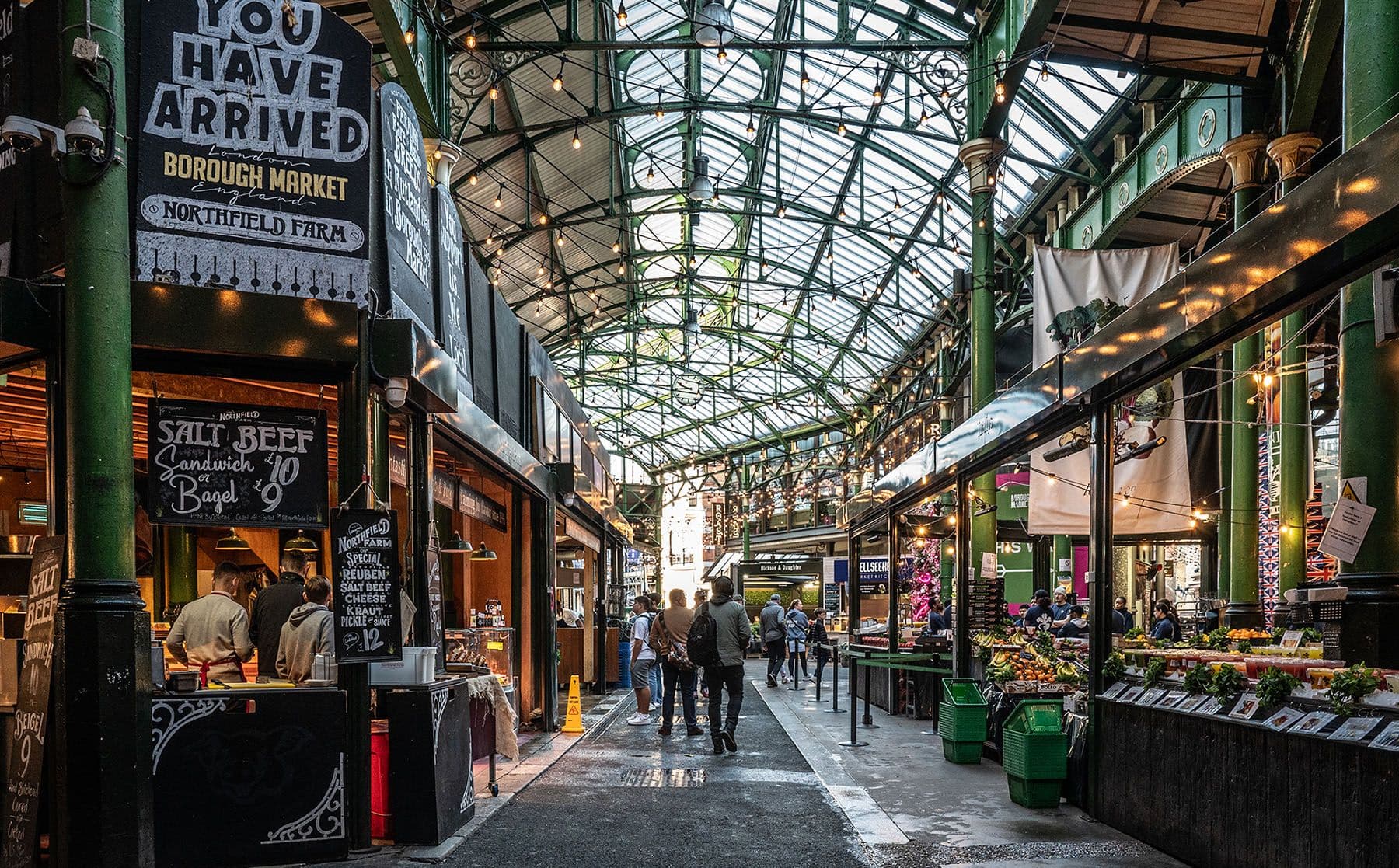
Borough Market is the most direct living consequence of London Bridge history. Records point to a market at the southern bridgehead as far back as 1014 — because for centuries this was the last stop before the only crossing into the City, so produce from Kent, Surrey and the Channel ports arrived here first. The market has occupied its present site, in the lanes wrapped around Southwark Cathedral, since 1756.
Why the market feels the way it does
The market's layout was never designed; it accreted. Cobbles, low railway arches and passages that narrow to shoulder width are the physical residue of a thousand years of trading in the same constrained spot. That continuity is also why Borough Market supports a density of specialist producers — cheesemongers, single-origin roasters, rare-breed butchers — that newer food halls cannot match. If you want the full eating strategy, the market rewards a dedicated visit; on a history-led day, come mid-morning on a Tuesday to Friday, when the stalls are trading but the weekend crush has not arrived, and read the buildings as much as the produce.
The market's City-side sibling
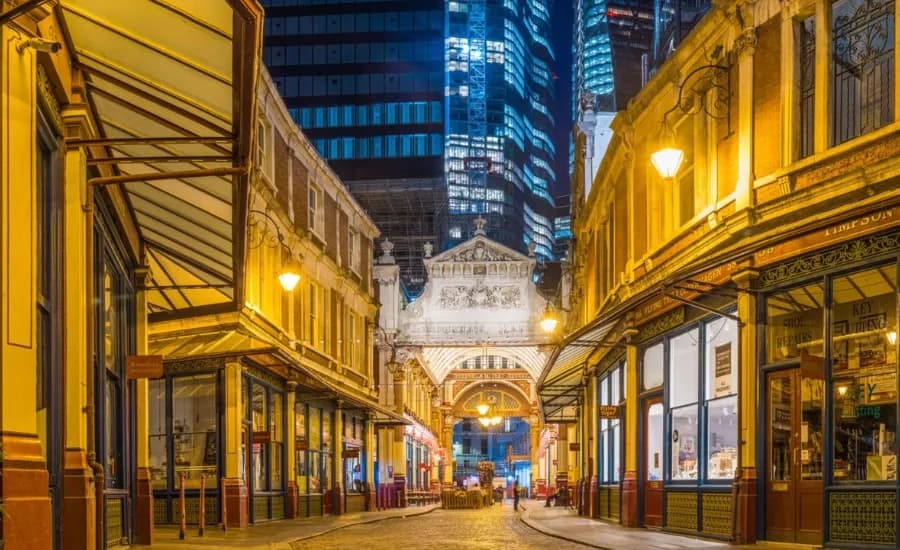
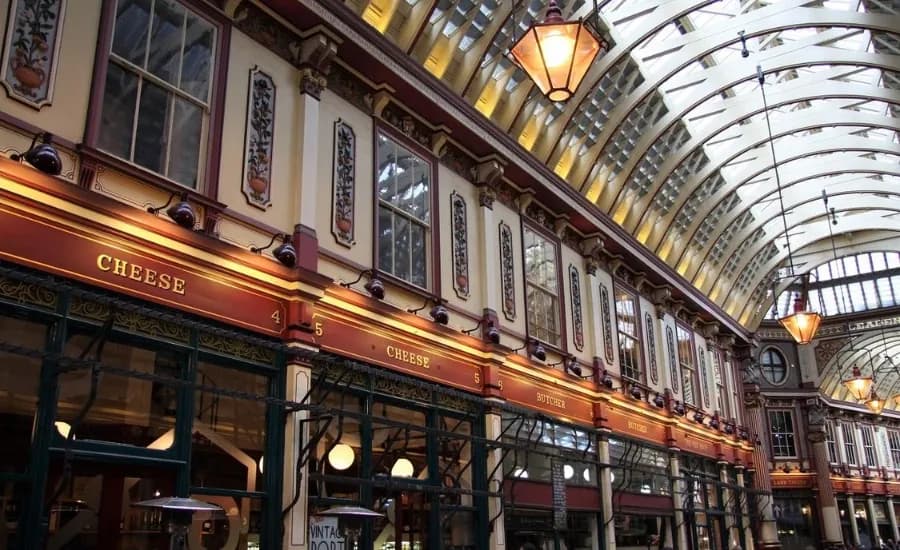
For the complete picture of how the bridge shaped commerce, cross to the north bank. Leadenhall Market, ten minutes' walk from the northern bridgehead, stands over the remains of Roman Londinium's forum — the marketplace of the city the bridge created — and its ornate Victorian arcade makes an elegant counterpoint to Borough's viaduct grit. The two markets bookend the crossing: one fed the city, the other governed it.
The Surviving Fabric: A Heritage Walk Around the Bridgehead
The densest cluster of surviving historic sites in Southwark sits within ten minutes' walk of London Bridge station, and most visitors walk straight past all of it on the way to the river. Taken together, these five stops turn London Bridge history from a story into something you can touch.
Southwark Cathedral
London's oldest Gothic church, with a Christian site here since at least the 7th century, sits hard against Borough Market's stalls. Shakespeare worshipped here when Bankside was theatre-land; his brother Edmund is buried in the church. Entry is by donation, and the quiet of the retrochoir a few metres from the market crowds is one of the area's best contrasts.
Winchester Palace
On Clink Street, one gable wall of the 12th-century palace of the Bishops of Winchester survives, its rose window intact and open to the sky. It is free to view from the street and takes five minutes — but it is the single most evocative medieval fragment in the area.
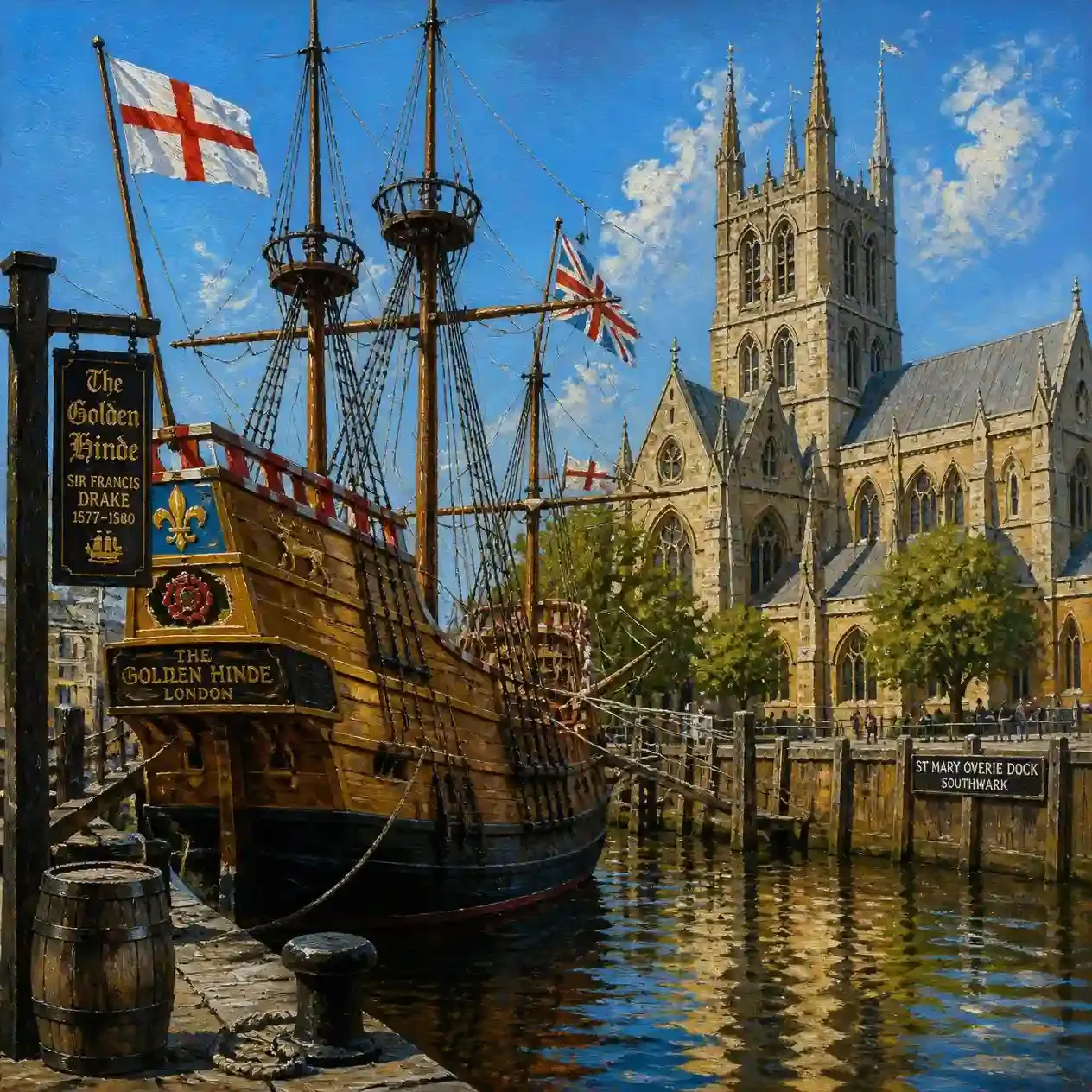
The Golden Hinde
A full-scale, seaworthy reconstruction of Sir Francis Drake's galleon — the ship that circumnavigated the globe in 1577–80 — sits in St Mary Overie Dock beside the cathedral. Below decks the ceilings drop and the ladders steepen, which is precisely the point.
- Admission: around £6 (about $8) for self-guided visits; open daily, last entry 30 minutes before closing.
- Allow 45 minutes to an hour; access involves steep stairs and low ceilings throughout.
The Old Operating Theatre
Hidden in the roof of an 18th-century church on St Thomas Street is Europe's oldest surviving operating theatre, built in 1822 for old St Thomas' Hospital and rediscovered, sealed, in 1956. Reached by a 52-step spiral staircase, it is the most atmospheric small museum near the bridge.
- Admission: around £9.50 (about $12.50) for adults; typically open 10:30am–5pm Tuesday to Friday, shorter hours Monday and weekends.
- The spiral staircase is narrow — not suited to limited mobility.
The George Inn and the Monument
Two final stops complete the story. The George Inn on Borough High Street, rebuilt in 1677, is London's last surviving galleried coaching inn — the kind that once lined the road to the bridge. Across the river, the Monument to the Great Fire of London marks where the 1666 fire began, a few hundred metres from the bridge the fire nearly destroyed; climbing its 311 steps costs £7 (about $9) for adults and earns you the classic view back over the crossing.
Reality checks for the heritage walk
- The Old Operating Theatre and the Golden Hinde both close for private events with little notice — check opening times on the day rather than assuming.
- Saturday midday is Borough Market's peak crush; if your visit is about the history rather than the eating, a weekday morning gives you space to actually see the buildings.
- Winchester Palace and the cathedral exterior are best in low morning light, before Clink Street fills with walking-tour groups.
- The Monument accepts limited payment methods and has no step-free access — treat the climb as optional rather than essential.
How to Explore London Bridge History in Half a Day
The whole story fits comfortably into a half day on foot, because everything above sits within a one-kilometre radius of the bridge. The route below runs south to north, saving the river crossing — the point of the entire exercise — for last.
The route
- 9:30am — London Bridge station: exit to St Thomas Street for the Old Operating Theatre at opening.
- 10:45am — Borough Market and Southwark Cathedral: mid-morning stalls, then the cathedral's retrochoir and Shakespeare memorial.
- 11:45am — Clink Street and the riverside: Winchester Palace's rose window, then the Golden Hinde in its dock.
- 12:30pm — Cross London Bridge itself: pause at St Magnus the Martyr on the north bank, which holds a detailed model of Old London Bridge and stood at the medieval bridge's entrance.
- 1:00pm — Finish at the Monument or Leadenhall Market for the City side of the story, with Bankside's other stage — Shakespeare's Globe — a ten-minute riverside walk west if theatre history is your thread.
If you want the story told to you
The bridgehead's history is dense enough that a specialist guide earns their fee — the Roman, medieval and Victorian layers overlap within metres, and the best anecdotes are attached to unmarked spots. Several of London's strongest walking tours cover Southwark and the bridge; the options listed on Travjoy have been researched and approved by local experts, so you can pick a history-led route with confidence rather than sorting through dozens of near-identical listings.
The elevated reading
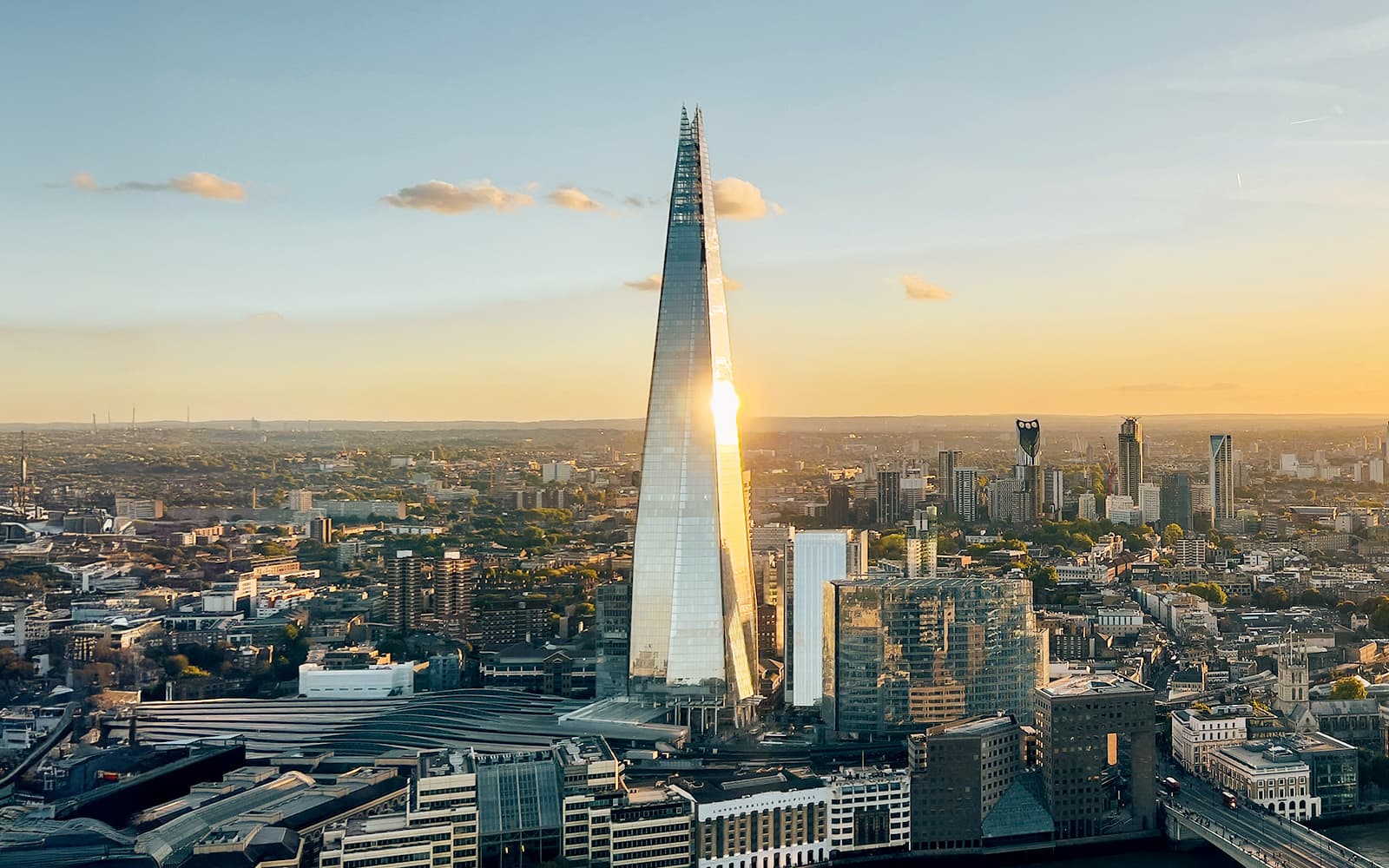
To see why the bridge sits where it does, end at height. From The Shard, directly above London Bridge station, the geography of two thousand years reads in a single view: the river narrowing at the crossing point, the City packed against the northern bridgehead, Borough's lanes fanning out from the southern gate. It is the one vantage from which London Bridge history looks less like a story and more like a diagram — and a late-afternoon slot puts the low light on the water.
Plan Your London Bridge Day
London Bridge history rewards the traveller who slows down: two thousand years of the city's story sit within a kilometre of one unremarkable concrete span. Remember the three layers — the Roman crossing that created London, the medieval bridge that carried a street of houses for six centuries, and the Victorian bridge now standing in Arizona — and the riverfront rearranges itself around them. Anchor the visit with Borough Market and the Southwark heritage walk, cross the bridge itself on foot, and finish at height to read the geography whole. When you are ready to build the rest of your itinerary, explore experiences across the city on Travjoy's London page.



.svg&w=1920&q=75)