



Local Food in Bangkok: A Complete Guide to the Dishes and Drinks Worth Travelling For
11 min read
Key Highlights
- Bangkok runs the full span in a single district — a 40 THB (about USD 1.25) noodle bowl on one soi, a three-Michelin-star tasting menu two streets away.
- The 2026 MICHELIN Guide Thailand lists 137 Bib Gourmand addresses nationwide, 44 of them across Bangkok and its surrounding provinces — the tier where shophouses and street stalls sit alongside restaurants.
- Four regional Thai kitchens — central, Isan, northern Lanna and southern — converge here, and each has its own neighbourhood where it is cooked properly.
- Drinks deserve equal billing: cha yen, oliang, cha manao and butterfly-pea anchan run 20–60 THB (USD 0.60–1.90) and reset the palate between spicy dishes.
- Three Thai phrases at the point of ordering change what arrives on your plate more than any reservation will.
The essential local food in Bangkok falls into four groups: noodle bowls such as boat noodles and tom yum mama; rice plates including khao man gai, khao kha moo and pad kra pao; charcoal grills and pounded salads like moo ping, gai yang and som tam; and wok-fired dishes such as pad thai, hoi tod and poo pad pong karee. Most street dishes cost 40–120 THB (roughly USD 1.25–3.75), while a Bib Gourmand meal rarely passes 400 THB (about USD 12.50) a head. Order cha yen or cha manao alongside, and finish on mango sticky rice between March and June, when Thai mangoes are at their peak.

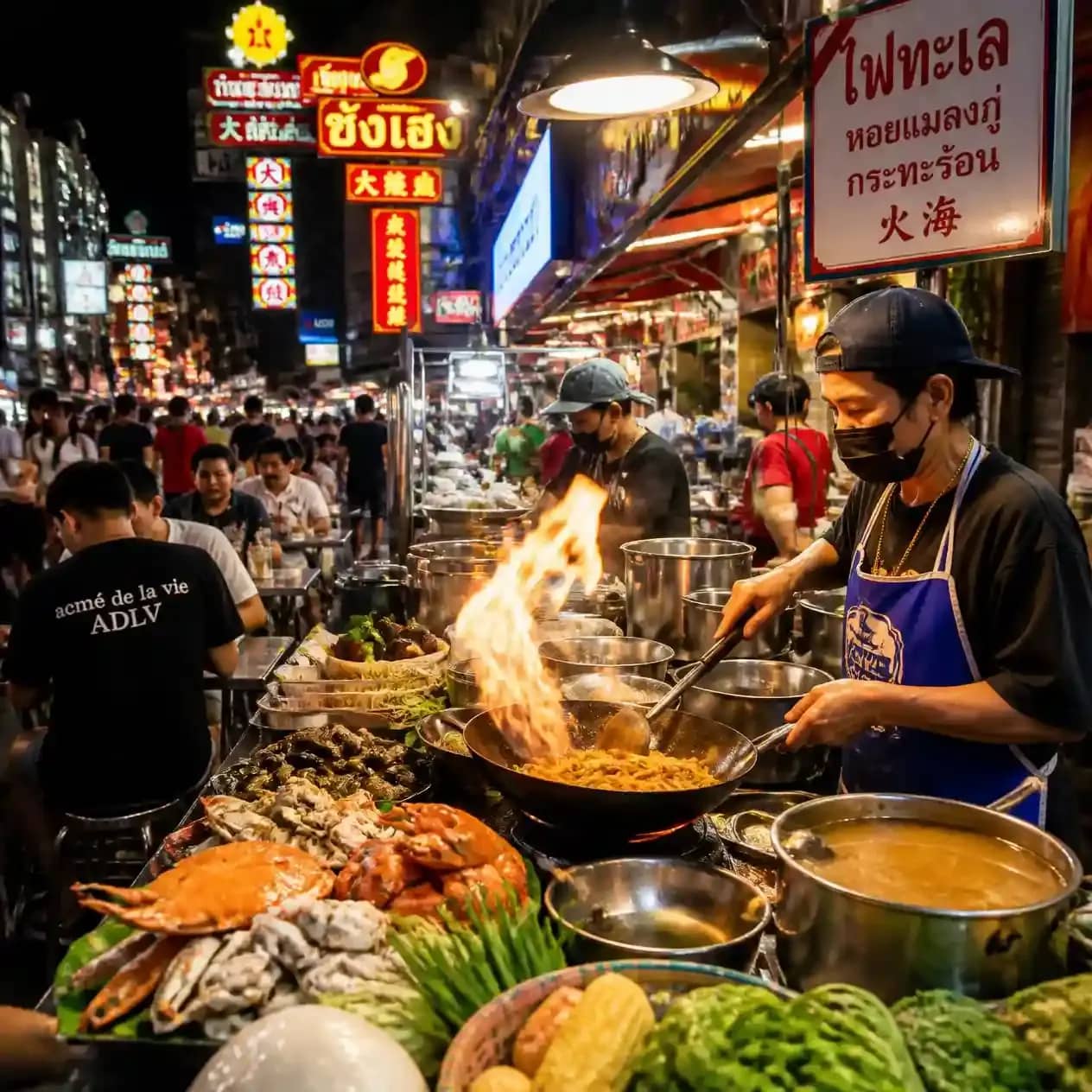
At seven in the evening on Yaowarat Road, a cook lifts a wok off a gas ring, tips a crab omelette onto a plate, and starts the next one before the first has reached the table. She has cooked that one dish for three decades. Two blocks north, a restaurant is plating course eleven of twenty-two. Both are recognised by the same guide.
That compression is what makes eating here different from anywhere else in Asia. Bangkok does not treat street cooking as a lesser tier — the city eats out two or three times a day, and the pavement kitchen is the default, not the novelty. The consequence for a visitor is a genuine planning problem: the range is so wide that the obvious dishes crowd out the ones actually worth the detour.
This guide fixes that. It maps the local food in Bangkok that earns the detour: the savoury dishes worth building a day around, the four regional kitchens and where each is cooked properly, the drinks that almost every food list ignores, the sweets and the fruit calendar, and the ordering vocabulary that decides whether your som tam arrives edible or incendiary. Prices are given in baht and US dollars, current for 2026.
What Sets Local Food in Bangkok Apart
Thai cooking is built on the balance of four flavours in a single mouthful — sweet from palm sugar and coconut, sour from lime and tamarind, salty from fish sauce and shrimp paste, and hot from fresh chillies and peppercorns. What separates local food in Bangkok from the Thai food most travellers know at home is that this balance is calibrated per plate, at the table, by you. The condiment caddy is not decoration.
The four-flavour rule, and the caddy that enforces it
Every noodle stall in the city puts four jars on the table: dried chilli flakes, chilli in vinegar, sugar, and fish sauce with sliced bird's eye chillies. The cook sends the bowl out deliberately underseasoned so you can finish it. Thais do this without thinking; visitors often eat the bowl as it arrives and conclude the food was flat.
Adjust in small increments. Vinegar chilli lifts a heavy pork broth. Sugar rounds out an aggressively sour tom yum. A spoon of prik nam pla — fish sauce and chilli — is what most locals add to almost anything served over rice.
A city that eats out by default
Bangkok has hundreds of thousands of registered food vendors, and for most households a plate of pad kra pao bought on the way home is faster and cheaper than cooking. This matters to you for one practical reason: turnover. A stall serving three hundred office workers between eleven and two is cooking fresh continuously, which is both why the food tastes the way it does and why the queue is the single most reliable quality signal in the city.
What the Michelin listing actually tells you
The 2026 MICHELIN Guide Thailand runs to 468 addresses: two three-star restaurants, both in Bangkok, eight two-stars, 33 one-stars, 137 Bib Gourmands and 288 Selected entries. Bangkok holds both three-star tables and the bulk of the country's stars.
- The stars — Sorn (southern Thai) and Sühring (modern German) hold three stars. Sorn releases reservations on the 15th of each month for the following month, and they go within minutes, so this is a table to arrange well before you fly.
- The Bib Gourmands — 44 of the national 137 sit in Bangkok and its surrounding provinces. These are shophouses, noodle shops and stalls; most meals land under 400 THB (about USD 12.50) a head.
- The starred street kitchen — Jay Fai in the Old City holds a star for crab omelette and drunken noodles, cooked over twin charcoal woks on the pavement. Expect a queue measured in hours, and a plate priced far above its neighbours.
The practical read: chase the Bib Gourmand list rather than the stars if you want to understand how the city eats. The star list is where you go for a designed evening, and it needs booking weeks ahead.
The Savoury Local Food in Bangkok You Should Not Leave Without
If you eat only a dozen things here, make them these. The savoury canon of local food in Bangkok splits cleanly into four formats — noodle bowls, rice plates, charcoal and pounded salads, and wok-fired dishes — and a good day involves at least one from each. Prices below are typical 2026 street and shophouse rates; air-conditioned restaurants run roughly double, and hotel dining rooms considerably more.
Noodle bowls
The noodle bowl is Bangkok's most-ordered format, and the vocabulary rewards learning. Noodle types run sen yai (wide rice), sen lek (thin rice), ba mee (egg) and woon sen (glass). Broth styles run nam sai (clear), tom yum (sour and hot), nam tok (rich, pork or beef stock) and yen ta fo (pink, fermented tofu, sweet-sour). Ask for haeng if you want it dry with broth on the side.
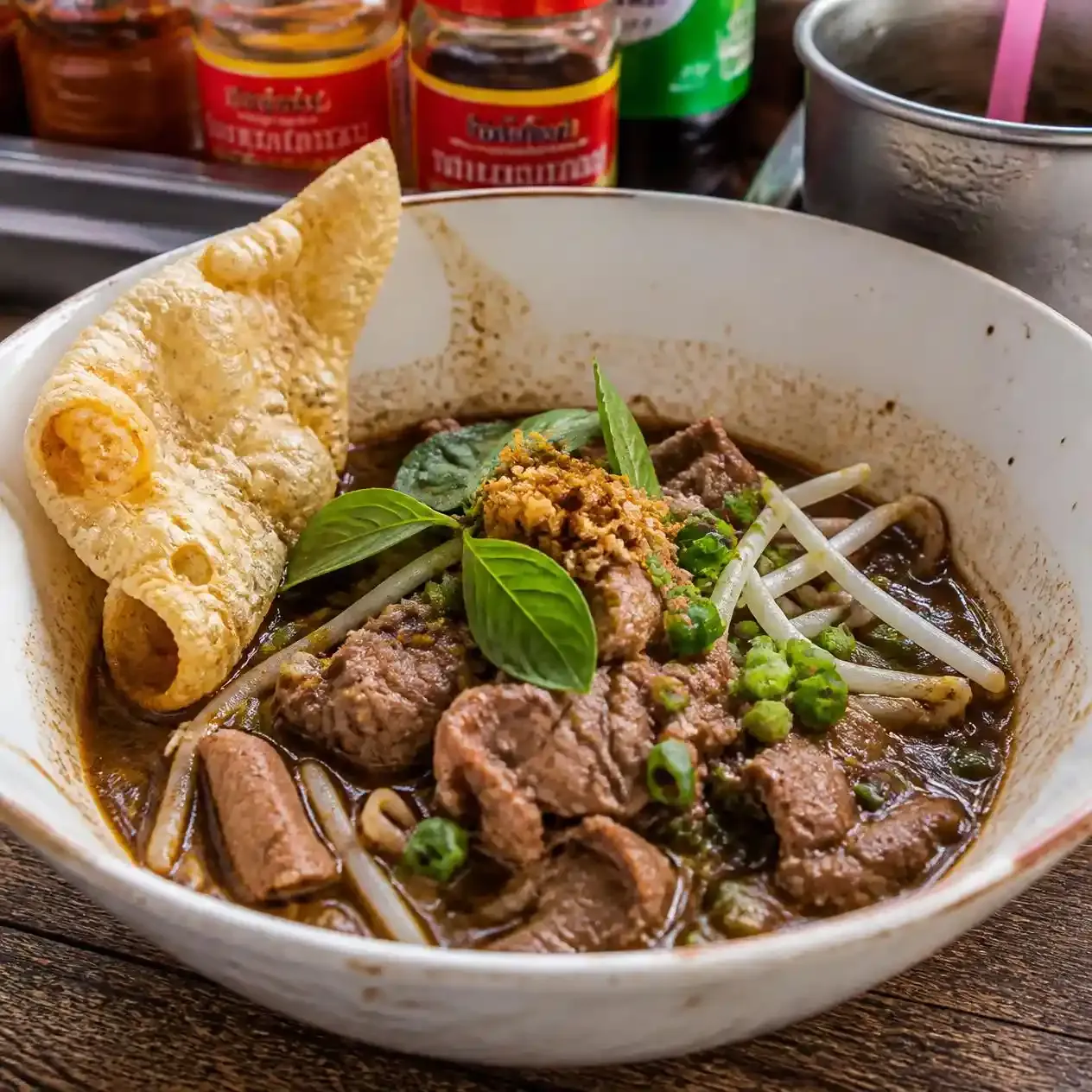
- Boat noodles (guay teow ruea) — small, dark, intensely savoury bowls thickened with pork or beef blood, topped with crispy pork rind and Thai basil. Portions are deliberately tiny; three or four bowls is a normal sitting. 50–70 THB (USD 1.60–2.20) a bowl. The cluster around Victory Monument is the reference point.
- Tom yum mama — instant noodles in a tom yum broth, loaded with prawns, crispy pork or, in the more theatrical versions, lobster. A late-night institution. 120–350 THB (USD 3.75–11) depending on what goes in.
- Guay jub — rolled rice noodles in a peppery broth with crisped pork belly and offal. Yaowarat's version, served past midnight, is the one to seek out. 60–100 THB (USD 1.90–3.10).
- Yen ta fo — the pink bowl. Fermented bean-curd broth, fish balls, morning glory, squid. Divisive and worth trying once. 60–90 THB (USD 1.90–2.80).
Rice plates
Rice plates are Bangkok's working lunch — one dish, one plate, ten minutes. They are also where the city's Thai-Chinese heritage shows most clearly.
- Khao man gai — poached chicken over rice cooked in the poaching stock, with a ginger, soybean and chilli sauce and a bowl of clear broth. Deceptively plain, ruthlessly judged by locals on the sauce. 50–80 THB (USD 1.60–2.50); add 20–30 THB for a larger portion (piset).
- Khao kha moo — pork leg braised in soy and star anise until it collapses, served over rice with pickled mustard greens and a boiled egg. 60–90 THB (USD 1.90–2.80).
- Pad kra pao — minced pork or chicken wok-fried hard with garlic, bird's eye chilli and holy basil. Order it kai dao, with a fried egg on top, and use the prik nam pla. This is the dish Thais eat most often. 50–90 THB (USD 1.60–2.80).
- Khao moo daeng — roast red pork and crackling over rice with a sweet-savoury gravy and boiled egg. The gentlest entry point on this list if you are still calibrating to the heat. 50–80 THB (USD 1.60–2.50).
Charcoal grills and pounded salads
This is Isan cooking, and it has colonised the whole city. Eaten as a shared spread with sticky rice, never as a solo plate.
- Moo ping — palm-sugar-marinated pork skewers over charcoal, sold from dawn carts and midnight carts alike. 10–25 THB (USD 0.30–0.80) a skewer, plus 10–20 THB for a bag of sticky rice.
- Gai yang — marinated chicken grilled flat and slow. 80–120 THB (USD 2.50–3.75) for a half bird.
- Som tam — green papaya pounded to order in a clay mortar. Tam thai is the milder, peanut-and-lime version; tam lao or tam pu pla ra brings fermented fish and pickled crab and is a considerably bigger ask. 50–80 THB (USD 1.60–2.50), more with extras.
- Laab — minced pork, beef or duck tossed with toasted rice powder, lime, chilli and mint. Sharp, dry-textured, and the best thing on most Isan tables. 60–90 THB (USD 1.90–2.80).
Wok-fired and seafood
- Pad thai — worth eating properly at least once. The charcoal-cooked versions, some of them Michelin-listed for years at around 150 THB (USD 4.70), are a different dish from the 60 THB (USD 1.90) tourist-strip plate.
- Hoi tod — oyster or mussel omelette, crisped at the edges, served with sriracha. 80–150 THB (USD 2.50–4.70).
- Poo pad pong karee — crab wok-fried in yellow curry powder and egg. The single dish most worth spending on; a whole crab version at a Chinatown seafood house runs 600–1,500 THB (USD 19–47).
- Goong ob woon sen — prawns baked over glass noodles with pepper, ginger and coriander root in a clay pot. 250–500 THB (USD 8–16).
Beyond Central Thai: Four Regional Kitchens in One City
Most visitors eat central Thai food for a week and assume they have eaten Thai food. Bangkok is a migration city, and its Isan, northern, southern and Thai-Chinese kitchens are cooked by people from those regions for people from those regions — usually in identifiable districts. This is the layer that rewards a second or third trip.
Isan — the northeast
Sharper, funkier and far less sweet than central cooking, built on grilled meat, fresh herbs, fermented fish and sticky rice. The neighbourhoods around Victory Monument, heavy with northeastern families, are where the som tam arrives with fermented crab rather than the quietly softened version. Evening carts on the Sukhumvit sois turn out the same food at speed. Order gai yang, laab and som tam together, with sticky rice to scoop.
Northern Lanna
Milder, more herbal, more dried-spice than chilli-forward, with Burmese and Yunnanese threads. Khao soi — egg noodles in a turmeric-coconut curry broth under a nest of crisp fried noodles — is the dish, though Bangkok versions run richer than they should. Sai ua, the Chiang Mai herb sausage, and nam prik ong travel better. The Ari district holds several kitchens run by northern families.
Southern Thai
The hottest and most astringent of the four, built on turmeric, dried spices, shrimp paste and seafood, with clear Malay and Indian influence. Gaeng tai pla and kua kling are the markers; massaman, mild and slightly sweet, is the approachable end of the same tradition. Bangkok's southern restaurants have multiplied since Sorn's three stars put the cuisine on the map — and most will moderate the chilli if you ask, though a southern kitchen's idea of moderate is not universal.
Thai-Chinese
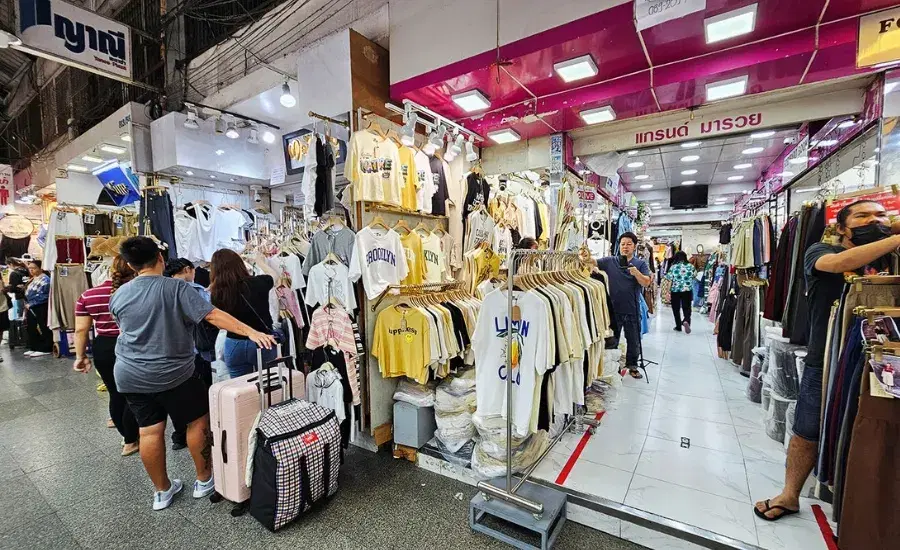
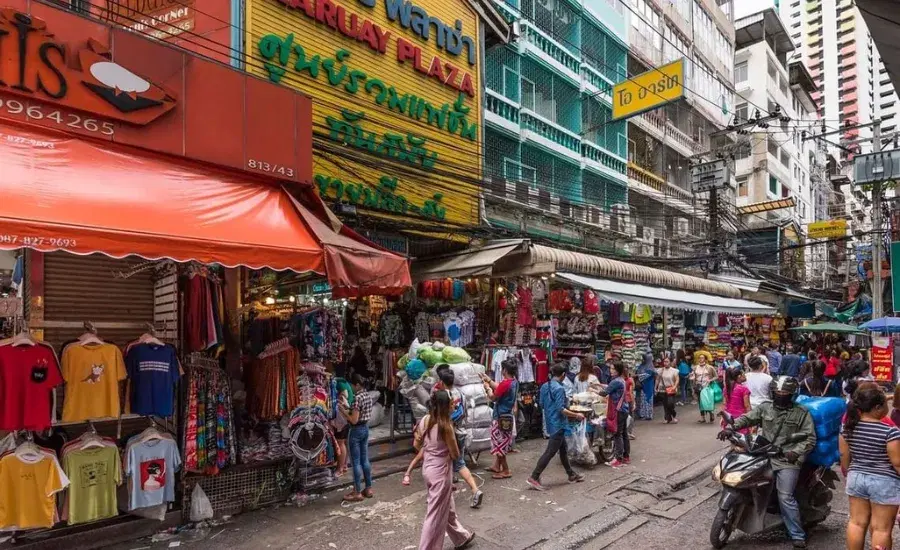
The oldest layer of the city's food, concentrated in Yaowarat's Chinatown street food district and largely Teochew in origin. Guay jub, roast duck, braised goose, rice porridge (jok) at dawn, birds-nest and ginkgo desserts late at night. Yaowarat functions as a wholesale market by day and turns into the city's densest eating street after sunset — go after eight, walk east to west, and order in small quantities from several stalls rather than sitting down once.




The Local Beverages Worth Ordering
Almost every guide to local food in Bangkok stops at the plate, which is a mistake — the drinks are half the point. Thai beverage culture is built around heat management and palate reset, and the local beverages sold from street carts cost 20–60 THB (USD 0.60–1.90) and do more for a spicy meal than any wine pairing. One standing note: nearly everything is sweetened well beyond a European palate by default. Vendors will often ask wan nit noi? — a little sweet? — and the answer you want is usually yes, less.
Tea and coffee, the Thai way
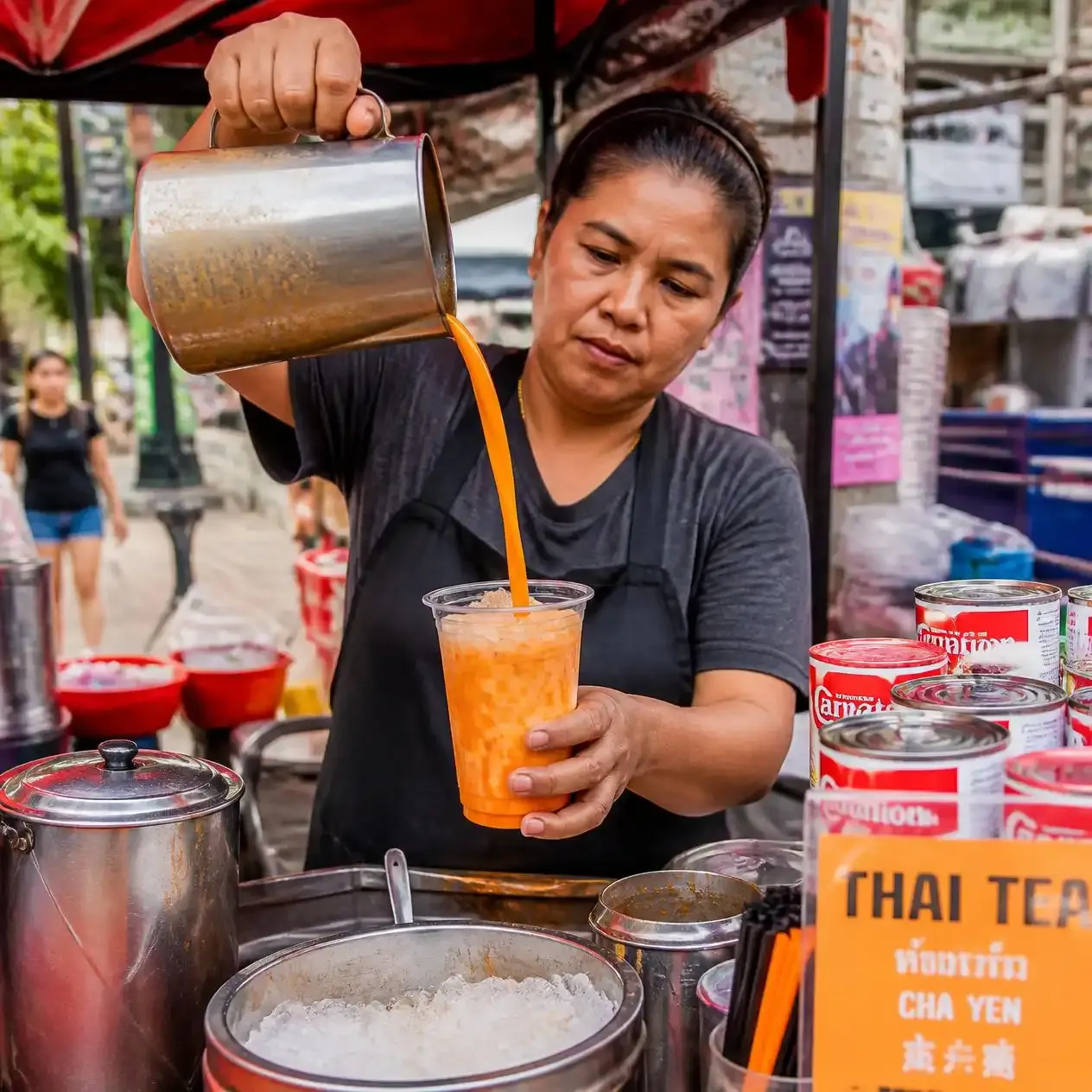
- Cha yen — the orange one. Ceylon black tea brewed with star anise, tamarind and cardamom, then cut with condensed and evaporated milk over crushed ice. 20–40 THB (USD 0.60–1.25) from a cart.
- Oliang — Thai iced black coffee, a Teochew inheritance. Dark-roast beans blended with corn, sesame and roasted rice, then brewed through a cloth filter. Bitter, smoky and nothing like an iced americano. 25–45 THB (USD 0.80–1.40).
- Yok lor — oliang softened with a heavy pour of evaporated and condensed milk. Sweeter, rounder, and the version most people prefer on a first encounter. 30–50 THB (USD 0.95–1.60).
- Cha manao — black tea with fresh lime and no milk. Sharp, aromatic, and the best palate cleanser on this list for anything southern or Isan. 25–40 THB (USD 0.80–1.25).
Cold, sharp and floral
- Nam manao — lime juice, soda, sugar syrup and a pinch of salt. The single most effective thing to drink after too much chilli. 30–50 THB (USD 0.95–1.60).
- Nam anchan — butterfly-pea flower tea, deep indigo, which turns violet-pink when lime is added. Vendors often serve the two separately so you can do it yourself. Mildly earthy, more about the theatre than the flavour. 30–60 THB (USD 0.95–1.90).
- Nom yen — iced pink milk, coloured and flavoured with sala syrup from the salak fruit. Nostalgic for Thais, and sweeter than almost anything else here. 30–50 THB (USD 0.95–1.60).
- Nam maprao — young coconut water, drunk from the shell with the flesh scraped out afterwards. 40–80 THB (USD 1.25–2.50) from a cart; considerably more at a riverside terrace.
- Nam bai toey — pandan leaf infusion, pale green, gently sweet and grassy. Rarely ordered by visitors and worth correcting.
Beer, rum and what to drink with heat
Thailand's lagers are built for the climate and the food — light, cold and carbonated enough to cut through fish sauce and chilli. Singha is the maltiest, Chang the heaviest, Leo the lightest and most widely drunk. All three run 60–90 THB (USD 1.90–2.80) at a shophouse and 200–350 THB (USD 6–11) at a rooftop bar.
For spirits, Mekhong and Sangsom are the local reference points — both technically rum, both traditionally drunk long with soda and lime rather than neat. Bangkok's cocktail bars have spent the past decade rebuilding Thai spirits into serious drinks lists, using pandan, tamarind, makrut lime and Thai chilli, and several now sit on Asia's leading bar rankings. If drinks are a priority on your trip, the Bangkok nightlife guide covers where the bar scene has moved.
Sweets, Street Snacks and Seasonal Fruit
Thai desserts are less sweet and more textural than most visitors expect, built on coconut, pandan, palm sugar and sticky rice rather than dairy and chocolate. Buy them as you walk rather than ordering them at the end of a meal — that is how they are eaten here.
The sweets to order
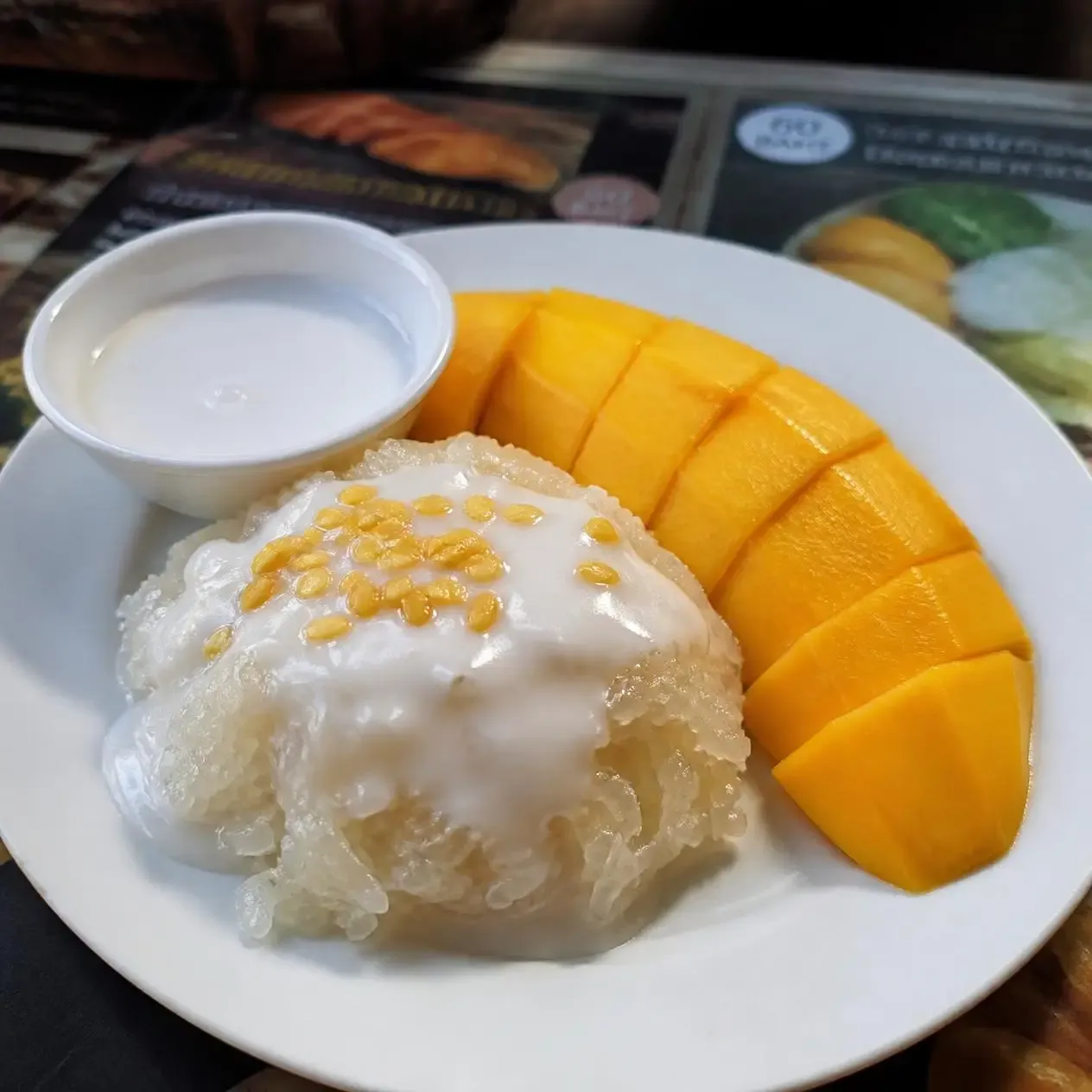
- Khao niao mamuang — mango sticky rice. Ripe nam dok mai mango, salted coconut cream and sticky rice, usually with toasted mung beans or sesame. 80–150 THB (USD 2.50–4.70), with a clear seasonal price swing.
- Khanom buang — crisp folded crepes filled with meringue cream and either sweet golden threads or salty shredded coconut. Order one of each. 10–20 THB (USD 0.30–0.60) apiece.
- Kanom krok — coconut-rice pancakes cooked in a dimpled pan, crisp outside and molten inside. Best straight off the griddle. 30–60 THB (USD 0.95–1.90) for a box.
- Roti — griddled flatbread with banana and condensed milk, or egg. A late-night order. 40–80 THB (USD 1.25–2.50).
- Coconut ice cream — served in a half coconut with peanuts, sweetcorn, sticky rice and palm seeds. 50–80 THB (USD 1.60–2.50).
- Pa tong go — Thai-Chinese fried dough sticks with pandan custard, eaten at dawn with jok or oliang. 30–50 THB (USD 0.95–1.60).
The fruit calendar
Fruit is seasonal here in a way it no longer is in most of Europe, and timing a trip around it changes what you eat. Or Tor Kor Market is the reference address — a produce hall rather than a street market, with graded, boxed fruit and a food court behind it.
- Mango — March to June is the window for nam dok mai and ok rong. Outside it, mango sticky rice is made with imported or cold-stored fruit and is a noticeably lesser dish.
- Durian — roughly April to August, peaking in May and June. Mon thong is the mild, custardy variety to start with; kan yao is the connoisseur's choice and priced accordingly.
- Mangosteen and rambutan — May to September, and both are at their best when they overlap with durian.
- Rose apple, longan, pomelo — available across most of the year, with pomelo strongest between August and October.
How to Eat Well in Bangkok
Eating your way through the local food in Bangkok is less about finding the right address than about matching the neighbourhood to the hour and knowing what to say when you order. Bangkok's food districts operate on schedules, and turning up at the wrong time gets you a shuttered stall on a quiet street.
Match the district to the hour
- Dawn to mid-morning — jok and pa tong go stalls in the Old City and Chinatown; the fresh-produce halls at Or Tor Kor.
- Weekday lunch — Bangrak, Silom and Sathorn, where office turnover keeps stalls at their sharpest. This is the window Michelin inspectors favour, and stalls close once the day's ingredients run out.
- Late afternoon — Victory Monument for boat noodles; Wang Lang, across the river from the Old City, for a daytime food route with almost no visitor traffic.
- After dark — Yaowarat from eight onwards; Isan carts along the Sukhumvit sois; the night markets out along the MRT.
- Weekends only — the food section of Chatuchak, in the southern half of the market, where locals eat rather than shop.
The words that change your plate
A handful of phrases is the difference between eating what visitors are served and eating what everyone else is served. Thai has no tonal forgiveness, but vendors are used to approximations and will meet you most of the way.
Ordering vocabulary worth memorising
- Phet nit noi — a little spicy. The setting most visitors actually want.
- Mai phet — not spicy. Expect a tingle regardless.
- Mai sai pla ra — no fermented fish. Relevant for som tam and Isan salads.
- Mai sai prik — no chilli. Sai kai — add egg.
- Mangsawirat — vegetarian. Kin jay — strict vegan Buddhist, no egg, dairy, garlic or onion.
- Haeng — dry, broth on the side. Piset — a larger portion.
- Ao ... khrap / kha — I'll take ..., closing with the polite particle for your gender.
Spice, pacing and practicalities
Bangkok's food safety standards for street vendors have tightened considerably over the past decade, and illness traced to well-patronised stalls is rare. The sensible approach is about sequencing rather than avoidance: eat cooked-to-order dishes in your first days, leave raw shellfish, pickled crab and fermented-fish salads until your palate and digestion have settled, and treat pre-cut fruit that has been sitting in a bag as a different proposition from fruit sliced in front of you.
- Payment — cash still governs street stalls and small shophouses; carry 500–1,000 THB (USD 16–31) in small notes. PromptPay QR is now widely accepted, cards rarely are outside restaurants.
- Tipping — not embedded in Thai custom, though rounding up is increasingly normal in restaurants. Never expected at a stall.
- Timing around traffic — the BTS, MRT and river boats move between food districts far faster than a car at peak hours.
- The Vegetarian Festival — for nine days around late September or October, Yaowarat turns almost entirely meat-free and flies yellow flags. Worth planning around in either direction.
If you would rather have the decisions made for you, the experiences listed on Travjoy are researched in depth and approved by local experts before they appear, which removes the guesswork from choosing between a Chinatown walking route, a market visit and a cooking session. For a wider view of the city's eating and drinking, the Bangkok food and beverage guide goes further into venues and formats.
Planning a Trip Around Local Food in Bangkok
Three things carry most of the weight when you plan around local food in Bangkok. Eat across formats rather than repeating one — a noodle bowl, a rice plate, a grill and a wok dish in a single day tells you more about the city than four visits to the same well-reviewed address. Order the drinks with as much attention as the food, because cha manao and nam manao are doing real work against the chilli. And treat the regional kitchens as the reason to come back: Isan around Victory Monument, northern in Ari, southern wherever the queue is Thai, Thai-Chinese along Yaowarat after dark.
Time the trip to the fruit if you can — March to June for mango, May and June if durian is the point. Then build the rest around it. Start planning your eating in Bangkok on Travjoy, or browse the top experiences in Bangkok to anchor the days between meals.



.svg&w=1920&q=75)