



Jim Thompson House in Bangkok: A Complete Guide for Discerning Travellers — Silk, Teak and an Unsolved Mystery
9 min read
Key Highlights
- The Jim Thompson House is six antique teak houses, most of them dismantled in Ayutthaya and floated up the canal, reassembled between September 1958 and April 1959
- Adult entry is 250 THB (about USD 7.60 in 2026); ages 10 to 21 pay 150 THB and under-10s go free with an adult
- Open daily 10:00 to 17:00, with the last house tour leaving at 17:00 — arrive by 15:30 if you also want the Art Center
- The compound now runs to a four-storey art centre, two permanent exhibitions, a silk store, a restaurant and a bar
- The Cham Muslim weaving community that supplied Thompson's first silk still works five minutes away across the canal
The Jim Thompson House Bangkok is a museum of six antique teak houses on Khlong Saen Saep in Pathum Wan, a four-minute walk from National Stadium BTS, open daily from 10:00 to 17:00. Adult admission is 250 THB (roughly USD 7.60 at 2026 rates) and the main house is seen on a guided rotation lasting 35 to 60 minutes. Allow two to three hours if you want the Art Center, the textile exhibitions and lunch on the terrace as well.
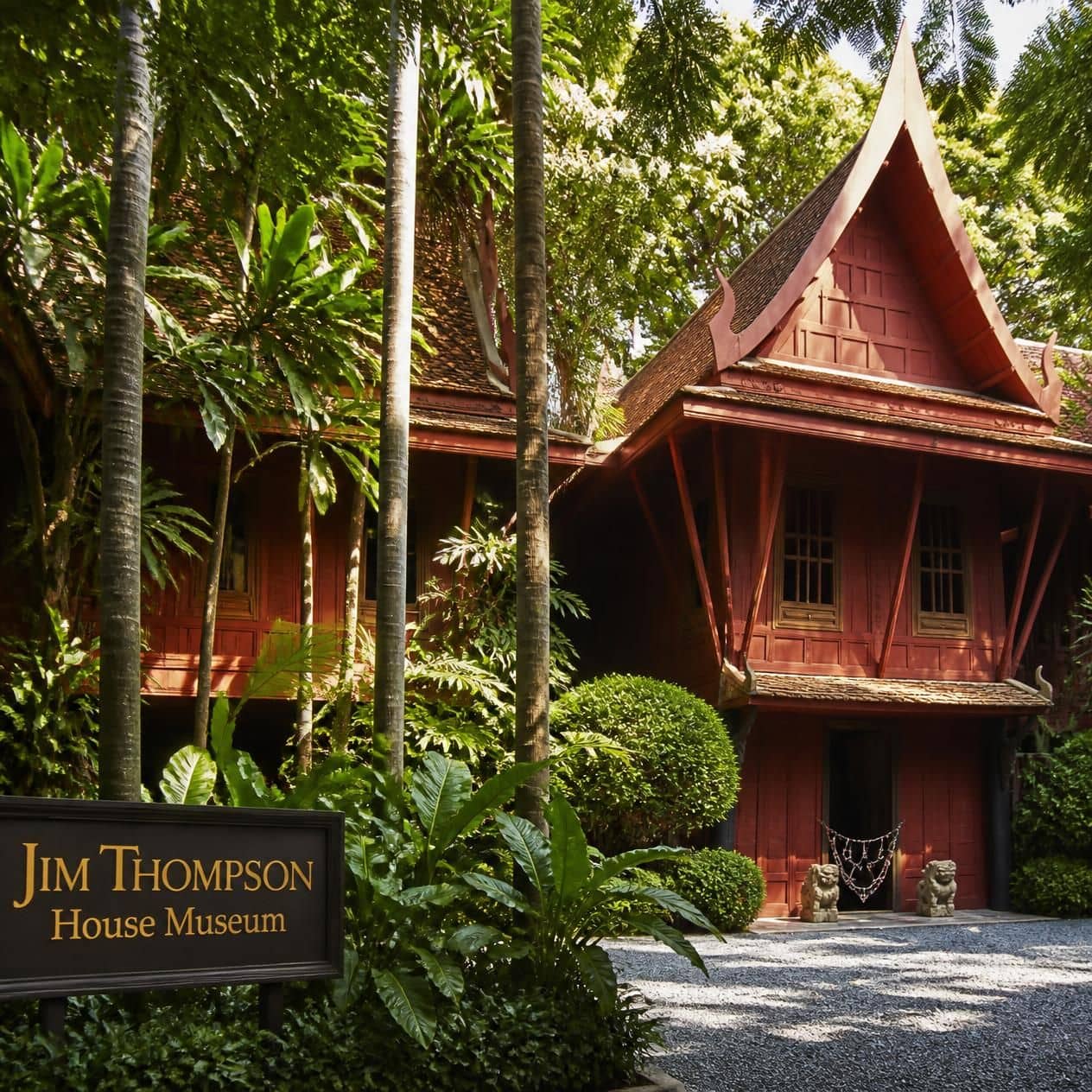
Turn off Rama I Road into Soi Kasem San 2 and the noise drops within about thirty paces. The horns thin out, the light goes green under the trees, and you are standing in front of a wall of teak the colour of dark honey. This is the Jim Thompson House — half an acre in the middle of Pathum Wan that an American architect turned silk merchant assembled out of six salvaged houses in the late 1950s, lived in for eight years, and then vanished from entirely.
Most guides hand you the ticket price, the word "teak" and the disappearance, then move on. That leaves out the interesting part of the Jim Thompson House: what Thompson deliberately changed about the houses, why the weaving community across the canal matters more than the gift shop, and how the compound has grown since 2022 into a block that holds an art centre, two permanent exhibitions, a restaurant and a bar alongside the museum.
This guide covers what you actually see, what each part of the compound costs in 2026, how ticketing works on the day, and which version of the visit suits the trip you are taking.
Is the Jim Thompson House worth visiting?
Yes, if you have more than three days in the city and any interest in design, textiles or the shape of a life. The Jim Thompson House is not a large museum and it will not fill an afternoon on its own, but it is the most rewarding hour in central Bangkok for anyone who has already done the Grand Palace and the river temples. It also happens to be one of the few shaded, quiet, walkable stops in the Siam district, which counts for a great deal in April.
Worth it if
- You care about textiles, interiors or vernacular architecture — this is a working demonstration of how a Thai house is put together, annotated by someone who broke the rules on purpose
- You are on a second or third trip and want something with a story rather than another temple courtyard
- You want an hour of shade and still air between Siam's malls and the river, without leaving the BTS network
- You are travelling with someone whose tolerance for gilded stupas has run out
- You intend to buy Thai silk and want to understand what you are paying for before you do
Not ideal if
- You have one day in Bangkok and the headline sights are still unticked — the Grand Palace, Wat Pho and the river will serve you better
- You want a large, formally interpreted museum; this is a house, and the interpretation is a guide talking as you walk
- You need step-free access throughout — there is a lift to the upper exhibition rooms, but the historic houses have high timber thresholds between rooms
- You dislike guided rotations; the main house cannot be walked unaccompanied
Who Jim Thompson was, and why the silk still carries his name
James Harrison Wilson Thompson arrived in Thailand in 1945 as an officer of the Office of Strategic Services, the wartime agency that preceded the CIA, and stayed on after his discharge the following year. He was a trained architect from Delaware with no background in textiles. Within two years he had founded the Thai Silk Company and turned a dying cottage craft into an export business.
The Ban Krua connection
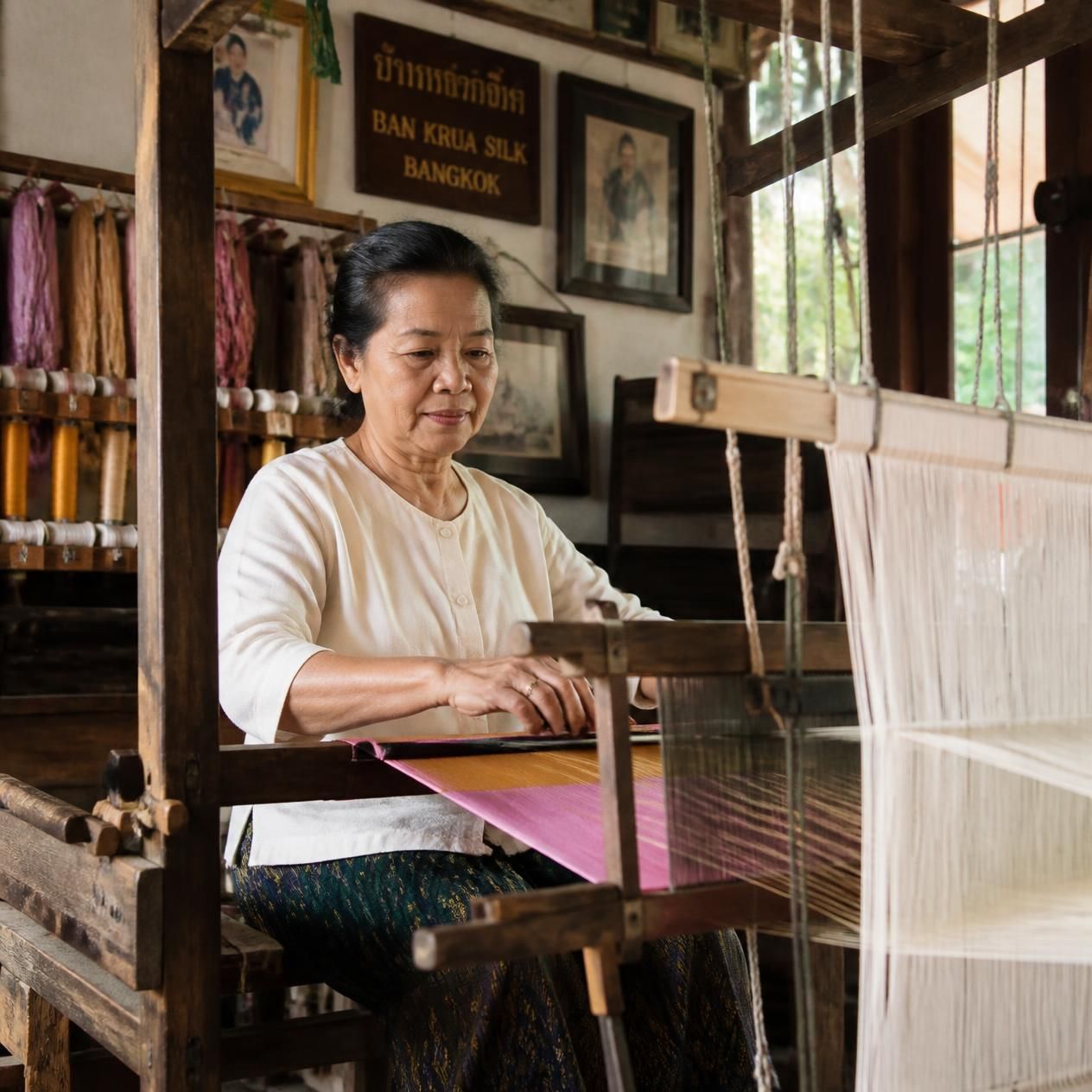
The silk itself came from a Cham Muslim community on the north bank of Khlong Saen Saep, a few hundred metres from where he would later build his house. The Cham had arrived from Cambodia and Vietnam generations earlier, were granted land along the canal in the reign of Rama I, and had woven silk there ever since — by the 1940s as a fading sideline. Thompson visited repeatedly, persuaded a group of families to weave him a sample batch, and carried it to New York. It ran in Vogue, and the business followed. For his part in reviving the industry he was awarded the Order of the White Elephant, a Thai decoration given to foreigners for exceptional service to the country. It is the layer of the Jim Thompson House story that the tour has least time for, and the one the culture and heritage guide to Bangkok picks up in more detail if you want the wider craft history.
The disappearance
On Easter Sunday, 26 March 1967, Thompson was staying at a bungalow in the Cameron Highlands in Malaysia with three friends. He had turned 61 five days earlier. After the morning service and lunch the party rested; Thompson said he was going for a walk and did not come back. Police, volunteers and tracker dogs searched for eleven days across dense highland jungle and found nothing — no clothing, no remains, no trace at all.
Four explanations have circulated ever since: he fell into a ravine, he was taken by a tiger, he was abducted for reasons connected to his intelligence past, or he arranged his own exit. None has ever been supported by physical evidence, and the file has stayed open for close to sixty years. The house was preserved by the James H.W. Thompson Foundation and opened to the public much as he left it, which is why the collection still reads as a private arrangement rather than a curatorial one.
What you actually see: six teak houses and a collector's eye
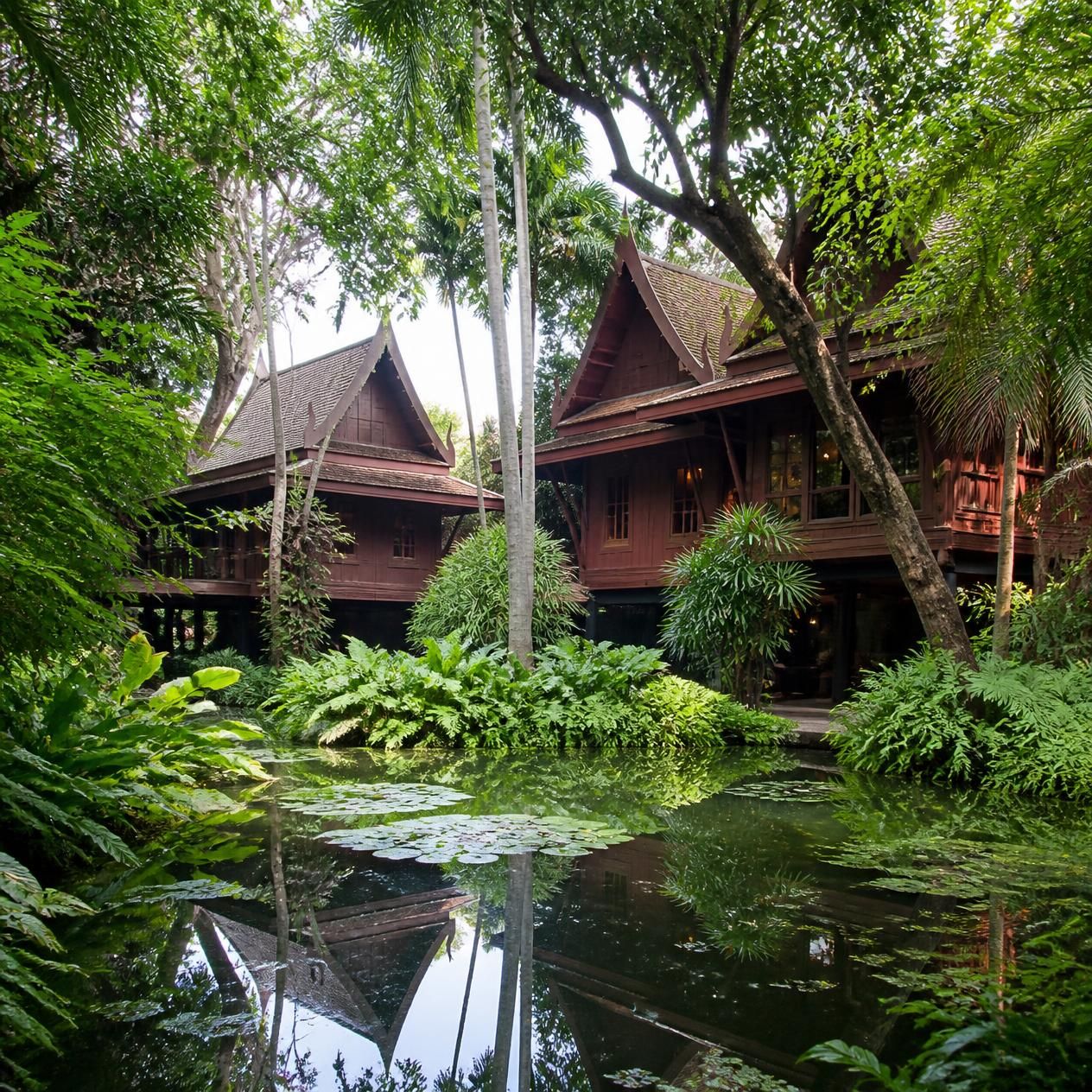
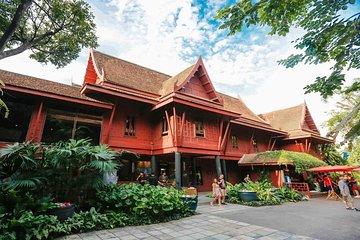
The Jim Thompson House is six 19th-century Thai houses joined into a single residence, and the pleasure of the visit is in noticing where Thompson followed convention and where he did not. He bought the structures from several owners, most in Ayutthaya, had them dismantled and floated down the canal system to Pathum Wan, and reassembled them on a rectangular rai of land between September 1958 and April 1959. Traditional Thai houses are pegged rather than nailed, so they come apart cleanly and go back together elsewhere.
The building itself
- Raised a full storey on stilts, the standard precaution against seasonal flooding along the klongs
- Roof tiles fired in Ayutthaya to an old pattern, with curved ends carrying naga serpent finials of the kind you see on temple roofs
- Exterior walls painted the deep red preservative common on old Thai timber buildings
- Carved brackets and window panels supplying nearly all the ornament; the surfaces are otherwise plain
- An indoor staircase — a plain Western convenience and a clear break with Thai practice, which puts the stairs outside
- A dining room floored in 19th-century Italian marble salvaged from a demolished Bangkok palace
- A chong maeo, the small floor-level cat opening that also moves air through the room
Thompson moved in on a spring day in 1959 that astrologers had confirmed as auspicious, having observed the customary rituals through the whole construction. The compound won an ASA architectural conservation award in 1996.
The collection
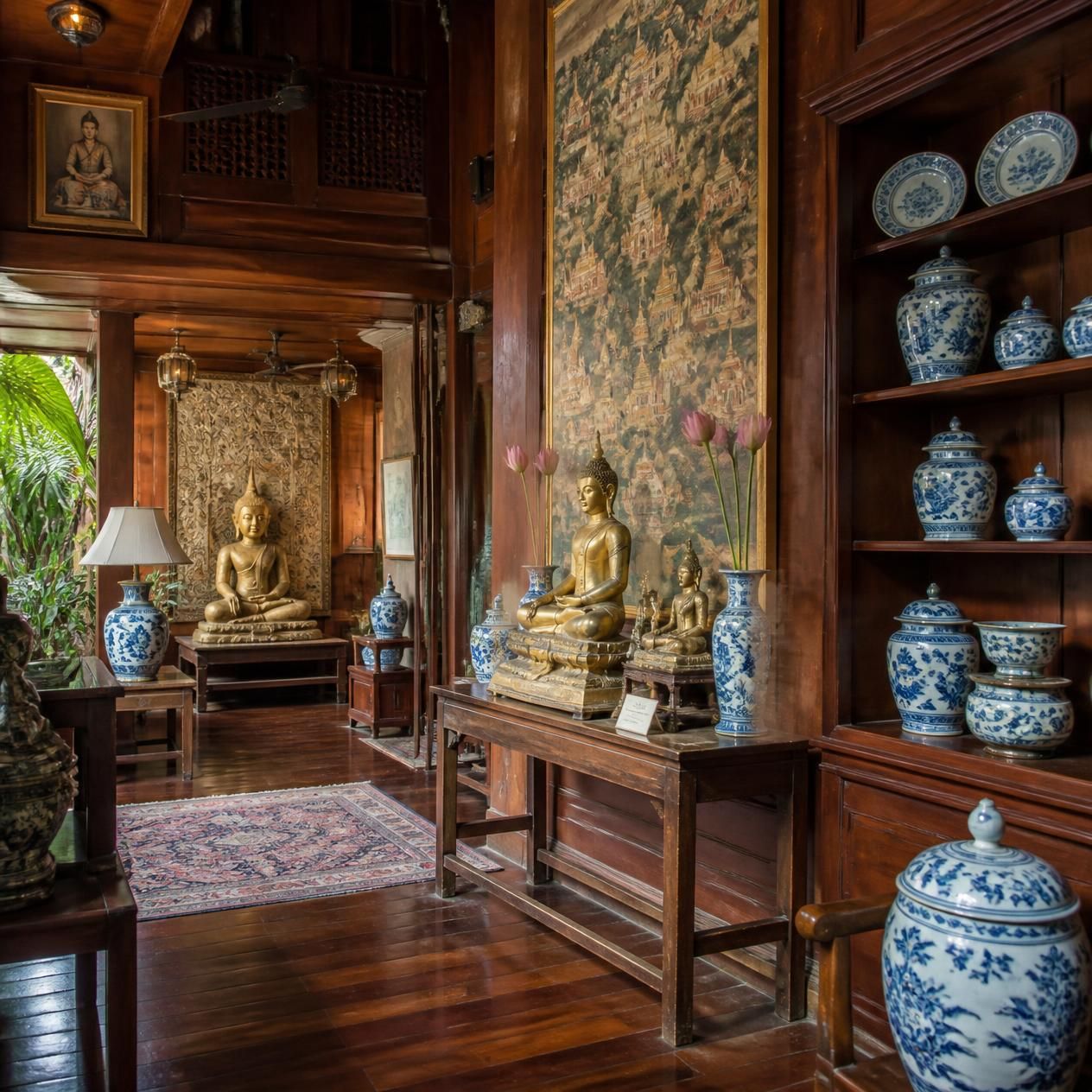
Thompson had been buying Thai antiques since 1946 and the house was built to hold them. You move past standing and seated Buddha images spanning several centuries, blue-and-white Chinese porcelain of the type that reached Siam in the 16th and 17th centuries, benjarong enamelled ware, Thai temple paintings and Burmese and Cambodian pieces picked up on upcountry trips. The old pantry and servants' quarters have since been converted into exhibition pavilions for the smaller objects, but the main rooms are arranged broadly as they were in his lifetime.
For a sense of how a canal-side timber house works when it is still lived in rather than preserved, the Khlong Bang Luang Artist House on the Thonburi side makes a useful counterpoint on another day.
Reality check: the tour moves faster than the house deserves
- The rotation runs 35 to 60 minutes depending on group size, and it does not stop for every detail
- Look down in the dining room — the marble underfoot is older than the house and came off a demolished palace
- Ask your guide to point out the reversed wall panels; Thompson turned several outward-facing surfaces inward, which is not how it is done
- The garden is yours for as long as you like afterwards, and it is where most of the shade is




Tickets, tours and the rest of the Heritage Quarter
Jim Thompson House Bangkok tickets cost 250 THB for adults and 150 THB for visitors aged 10 to 21, with under-10s admitted free alongside an adult. That single admission covers the guided house rotation plus the two permanent exhibitions in the compound. The Art Center next door is charged separately and depends on what is showing. Since 2022 the block has been developed as the Jim Thompson Heritage Quarter, so the museum is now one component of a larger site rather than the whole of it.
What each part of the compound is
- The House Museum — the six teak houses and the collection, seen on a guided rotation only
- Museum About the Man — an exhibition drawn from the foundation archives covering Thompson's life from his architectural training through to 1967
- The textiles exhibition — how the company and its home furnishings arm developed after his disappearance, including a wall of coloured spools
- Jim Thompson Art Center — four floors of rotating contemporary exhibitions, talks and workshops run by the foundation
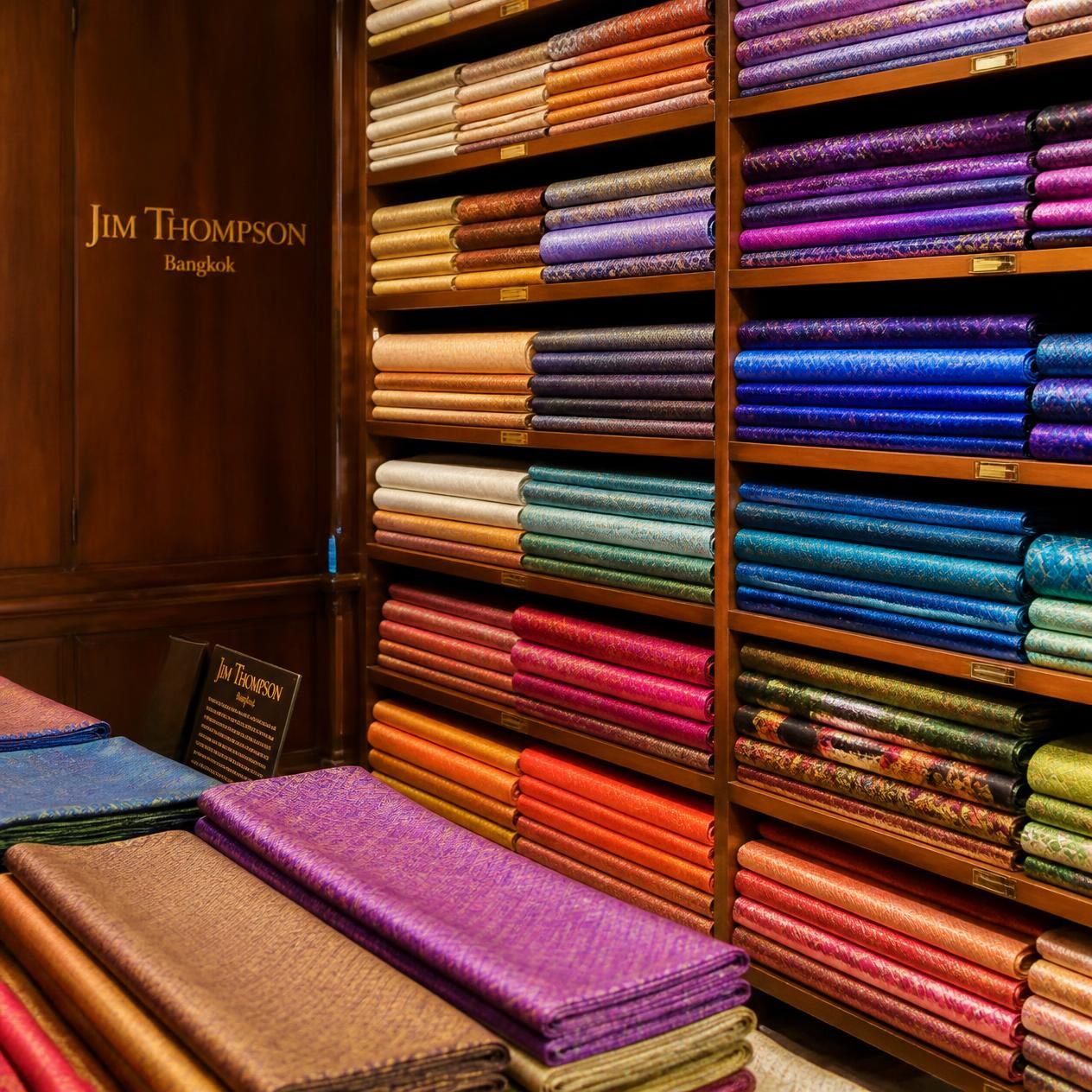
- The Iconic Store — the flagship silk retail floor, with several thousand product lines
- Eating and drinking — Jim Thompson, A Thai Restaurant for modern Thai; the O.S.S. Bar for cocktails; Jim's Terrace and Silk Café for something lighter
Options and costs compared
Prices below are 2026 figures converted at roughly 33 THB to USD 1. Museum pricing and exhibition charges change, so treat them as close ranges rather than fixed numbers.
| Option | Duration | Price (2026) | Best for |
|---|---|---|---|
| House tour at the Jim Thompson House | 35–60 min | 250 THB adult / 150 THB age 10–21 (USD 7.60 / 4.50) | Everyone — this is the core visit |
| Museum About the Man + textiles exhibition | 20–30 min | Included with house admission | Anyone drawn to the biography and the mystery |
| Jim Thompson Art Center | 30–45 min | From around 50 THB (USD 1.50), varies by exhibition | Contemporary art and design; pairs with MOCA Bangkok |
| Guided visit with private transfer | About 3 hrs | From around 4,300 THB (USD 130) per adult | Hotel-door convenience and a non-English guide |
| Ban Krua weaving community walk | 45–60 min | No admission; scarves from about 500 THB (USD 15) | Repeat visitors and anyone buying silk seriously |
The house tour is included in every version. What the higher-priced options actually buy you is the transfer, the guide language and the sequencing — not different access to the collection.
Reality check: how ticketing works on the day
- The museum issues its own admission at the on-site ticket office, open 10:00 to 17:00; it does not run its own online sales channel
- What is worth arranging in advance is the guide, the language slot and the car — not the admission slip itself
- Tours run on a rolling rotation rather than fixed departures, so a short wait at busy times is normal
- English guides run throughout the day; French, Chinese and Japanese are available on scheduled rounds and are easier to secure through a booked tour
Planning the visit: timing, transport, dress and access
Arrive between 10:00 and 11:30 or after 15:00, and give yourself two hours minimum. The Jim Thompson House sits on Soi Kasem San 2 off Rama I Road, which puts it inside the Siam district but a world away from it in noise terms. Weekday mornings are the quietest window; weekends fill from late morning onward.
Getting there
- BTS: National Stadium station on the Silom line, then a four to five minute walk north up Soi Kasem San 2
- Canal boat: the Saen Saep line, which runs past the property; useful if you are coming from the Old City side
- Car or taxi: 15 to 30 minutes from most central hotels, longer in the 16:00 to 19:00 window
- On foot from Siam: about 12 minutes from Siam Paragon, most of it covered by the skywalk
Hours, dress and access
- Open daily 10:00 to 17:00, with the final house tour departing at 17:00
- Shoes come off before you enter the main house; there is no formal dress code, but shoulders covered is the courteous default
- Photography rules vary by room — the guide will tell you where cameras go down
- A lift reaches the upper exhibition rooms, but the historic houses have high timber thresholds between spaces that manual wheelchair users may need help with
- Strollers are not permitted inside the historic buildings; there is a parking area near the entrance
- November to February is the comfortable season for the garden and the terrace; April and May are hot enough that the interiors are the draw
Reality check: the 17:00 trap
- The last house tour leaves at 17:00, but the Art Center, the store and the kitchens wind down before the house does
- Arriving at 16:30 gets you the house and very little else
- For the full compound, be through the gate by 15:00 at the latest
- If you want dinner at the restaurant afterwards, book the table separately — museum admission does not hold it
Which visit should you choose, and what to pair it with
Choose the shortest version if the Jim Thompson House is a stop rather than a destination, and the longest if textiles are the reason you came. The compound scales cleanly from a 45-minute detour to most of a day, and the difference is entirely in how much of the Heritage Quarter you add to the house tour.
Match the visit to the traveller
- If you have a spare morning between meetings or flights — house tour only, in and out inside an hour, straight back onto the BTS at National Stadium
- If you are design-led — house tour, then the Art Center, then the textiles exhibition; allow three hours and eat on the terrace
- If you are on your second or third Bangkok trip — house tour in the morning, then cross the canal to Ban Krua; almost nobody does this and it is the part that reframes everything else
- If you are travelling as a couple — late afternoon house tour, then the O.S.S. Bar and dinner at the restaurant without moving the car
- If you are buying silk — see the house first so you understand the grading, then the Iconic Store, then Ban Krua for handwoven lengths direct from the weavers
Crossing to Ban Krua
Turn left out of the front gate, walk to where the road meets Khlong Saen Saep, follow the canal path to the pedestrian bridge and cross to the north bank. A handful of families still weave there on wooden handlooms, and one or two will show you the process and sell you lengths directly. It is five minutes of walking for the other half of the story, and it is free to look.
What to combine with the Jim Thompson House on the same day
- Works well: the Bangkok Art and Culture Centre, one BTS stop away at National Stadium, for a straight art-and-architecture afternoon
- Works well: the Erawan Museum on another day, if collectors' houses are the thread you are following
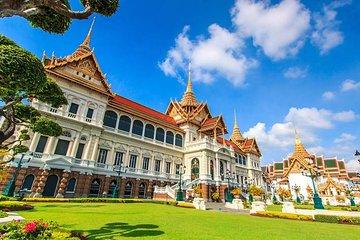
- Works badly: the Grand Palace on the same morning — the dress code, the heat and the cross-city transfer will flatten both
- Works badly: anything with a fixed entry time immediately after; the house rotation does not run to a timetable you can plan around to the minute
Every Bangkok experience listed on Travjoy has been researched and approved by local experts, which is worth knowing when you are deciding between a walk-in visit and a guided version with a car — the difference is rarely obvious from a listing page alone.
Reality check: what most visitors miss
- The weaving community across the canal, five minutes away — the single biggest omission on almost every itinerary
- The Art Center, which is a serious four-floor exhibition space, not an annexe
- The garden, which people photograph and then leave; it is the coolest part of the compound at midday
- The Museum About the Man, usually rushed because it sits after the house tour when energy has dropped
Pulling it together
The Jim Thompson House in Bangkok rewards about two hours and punishes forty-five minutes. The house itself is a lesson in how Thai timber architecture works and where one owner chose to ignore it; the exhibitions fill in a life that ended without an ending; and the weaving community across the canal supplies the part of the story the compound cannot tell about itself.
Go on a weekday morning, take the full rotation, cross the bridge afterwards, and buy your silk once you know what you are looking at. If the day runs long, the Art Center and the terrace will hold you until the light drops.
Start planning your Bangkok itinerary on Travjoy's Bangkok collection and build the rest of the trip around it.




.svg&w=1920&q=75)