


Food Tours in Bangkok: A Complete Guide to the Formats, Costs and Which One to Book
11 min read
Key Highlights
- Six distinct formats operate under the same "food tour" label — walking, tuk-tuk, canal boat, bike, market-plus-cooking-class, and dinner cruise — and they suit very different evenings.
- Expect THB 1,800–3,200 (USD 56–100) per person for a join-in walking tour, and THB 3,500–6,500 (USD 110–203) per person for a private tuk-tuk evening in 2026.
- Most join-in street food tours cannot adapt for vegetarian, no-pork, or severe shellfish and peanut allergies — a private guide or a cooking class solves this.
- "Michelin-recommended" on a tour listing almost always means Bib Gourmand or Selected. Only one Bangkok street stall holds a star, and it takes no bookings.
- Routes matter more than operator names: Yaowarat, Nang Loeng, Thonburi's canals and Talat Phlu each deliver a different kitchen tradition.
Food tours in Bangkok run in six main formats and cost between THB 1,300 and THB 6,500 (USD 41–203) per person in 2026, depending on whether you join a group or book privately. A join-in walking tour of three to four hours with 10–15 tastings is the standard entry point at around THB 1,800–3,200 per head; private tuk-tuk evenings, canal-and-market boat tours, and half-day cooking classes sit above and below that line. The format you choose matters more than the operator, because each one covers a different set of districts at a different pace.
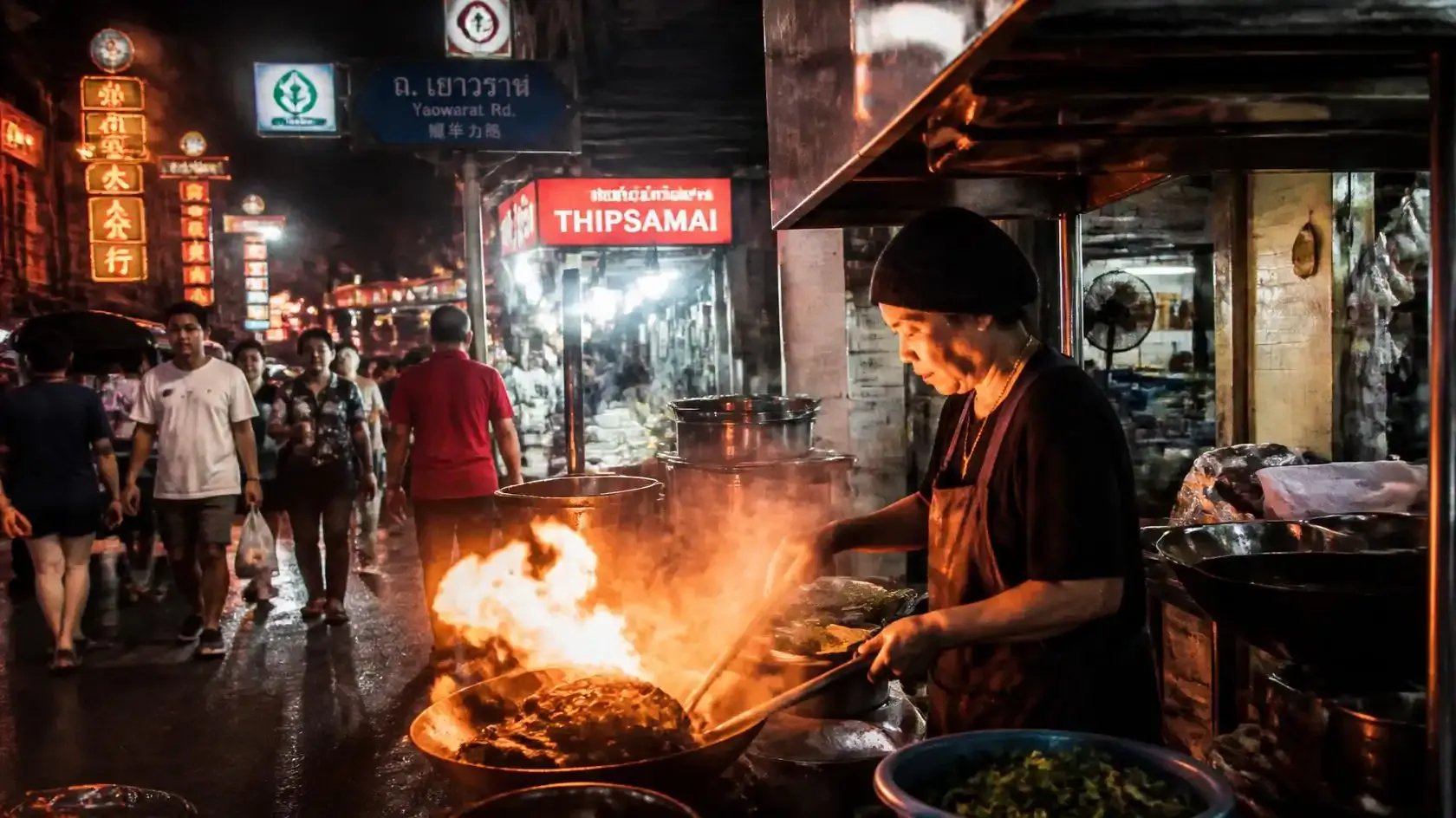
Bangkok has roughly half a million street vendors and 468 restaurants in the 2026 MICHELIN Guide Thailand. That combination is the problem, not the appeal. Standing on Yaowarat Road at nine in the evening with four stalls in front of you, all busy, all unlabelled in English, the question is not whether the food is good — it is which of the four is doing the thing it has done for forty years, and which opened last month.
A guided tour buys you that judgement. It also buys you the ordering, the seat, the second stall you would not have found, and the reason the third one matters. What it does not do is come in one shape. The listings that dominate search results present dozens of individual products with no organising logic, which makes them near-useless for the actual decision.
This guide organises food tours in Bangkok by format rather than by operator. You get what each format costs in baht and dollars for 2026, what is included and what is not, the districts each route actually covers, and clear guidance on which one suits your group. There is also honest detail on where these tours fall short — dietary limits, pace, and the gap between what a listing promises and what a queue allows.
Are Food Tours in Bangkok Worth It?
Yes, for most travellers, and the reason is editing rather than access. Bangkok's street food is not hard to find; it is hard to choose between. A good guide compresses days of trial and error into three hours, orders in Thai at stalls with no English menu, and explains why the Thai-Chinese noodle shop, the Isan grill and the Southern curry counter are three separate cuisines rather than one. On a second or third visit, that editing is worth more, not less — the headline stalls are behind you and the interesting question becomes what else the city eats.
Worth it if
- It is your first Bangkok trip and the scale of the street food scene is closing down your options rather than opening them up.
- You have already done Yaowarat on your own and want Nang Loeng, Talat Phlu, or the Thonburi canal markets with someone who knows the vendors.
- You want the regional distinctions explained — Thai-Chinese, Isan, Northern and Southern kitchens all cook in Bangkok, and they are not interchangeable.
- You have one free evening and want it to land rather than gamble it on a shortlist from a review site.
- You are travelling with someone nervous about eating from a street cart, and a guide's presence removes the hesitation entirely.
Not ideal if
- You have severe shellfish or peanut allergies. Street kitchens share woks, oil and prep surfaces, and most operators state plainly that they cannot manage this.
- You keep strictly vegetarian, vegan, halal, or avoid pork. Join-in street food tours are built around a fixed vendor sequence with very little room to substitute.
- You want long, seated meals. Tasting tours move — five to eight stops, standing or perched, over three to four hours.
- Mobility is a consideration. Walking tours cover two to four kilometres on uneven pavements, often in heat.
Insider reality check: the dietary fine print
- Several of Bangkok's most-booked join-in street food tours state in their own terms that they are unsuitable for vegetarians, pescatarians, and no-pork diets, because street vendors have limited menus.
- The same listings usually exclude severe shellfish and peanut allergies outright.
- Two fixes work. A private food tour in Bangkok lets the guide rebuild the vendor sequence around what you eat. A Thai cooking class is better still — every reputable school adapts each dish for vegetarian, vegan or jay diets when you flag it at booking.
- Raise it before you book, not on the morning. Guides cannot re-route a fixed group itinerary on the day.
The Six Formats of Food Tours in Bangkok, Compared
Six formats trade under the same name, and the differences are substantial. Walking tours go deepest on food and shallowest on ground covered. Tuk-tuk tours reverse that. Canal tours add a landscape the street-level formats never reach. Cooking classes are the only format you leave with a skill. Dinner cruises are a different proposition altogether — a seated meal with a river view rather than a tasting crawl.
| Format | Duration | Price per person (2026) | Best for |
|---|---|---|---|
| Walking tasting tour (join-in) | 3–4 hours, 10–15 tastings | THB 1,800–3,200 (USD 56–100) | Depth over distance; anyone wanting the most food per hour |
| Tuk-tuk night tour (private) | 3.5–4 hours | THB 3,500–6,500 (USD 110–203) | Couples and small groups wanting food plus lit temples and markets |
| Canal and market boat tour | 4–5 hours | THB 3,000–3,500 (USD 94–110) | Returning visitors; the Thonburi side and Wang Lang Market |
| Bike food tour | 3–5 hours | THB 2,000–3,500 (USD 63–110) | Active travellers; back lanes and Bang Krachao's green loop |
| Market tour plus cooking class | 3–4 hours (half day) or 6–8 hours | THB 1,300–2,500 half day; 2,500–4,500 full day (USD 41–141) | Dietary restrictions; families; anyone wanting to cook it again at home |
| Chao Phraya dinner cruise | 2–2.5 hours | THB 1,500–4,500 (USD 47–141) | A seated evening; groups with mixed appetites for street food |
Walking tasting tours
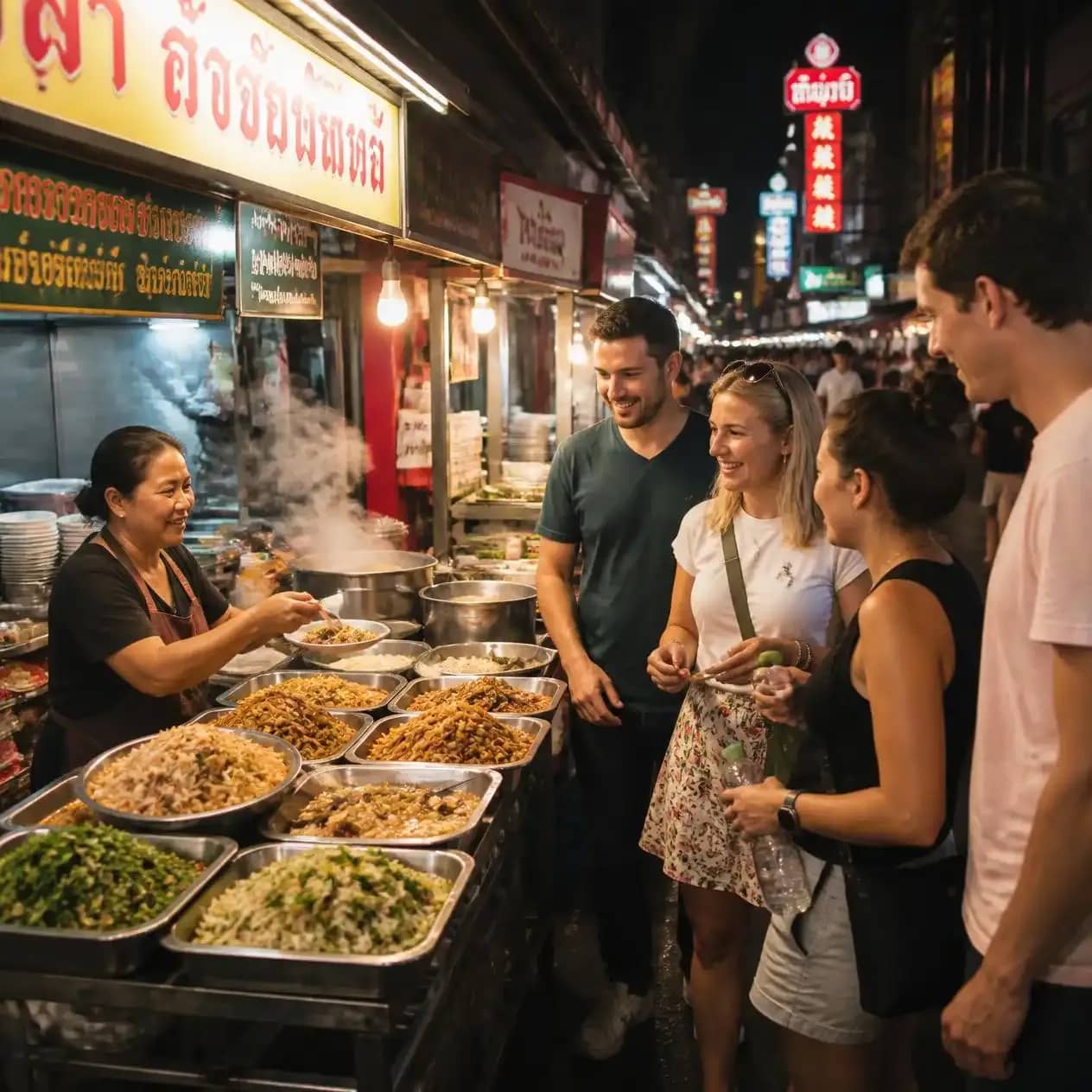
The default format, and the one that delivers the most food. Three to four hours, five to eight stops, 10 to 15 tastings, covering two to four kilometres on foot. Because the guide is not managing a vehicle, the stops can be tighter and stranger — a shophouse doorway, a stall with four stools, a dessert cart that packs up at ten. Group sizes of eight to twelve are common. This is the format to pick if food is the point and sightseeing is a bonus.
Tuk-tuk night tours
These trade tasting volume for ground covered and atmosphere. A typical evening loops the Old City and riverside — lit temples, the 24-hour Pak Khlong Talat flower market, Chinatown — with a mix of standing snacks and one seated meal. Three and a half to four hours is standard, hotel pickup usually included. The food is real but secondary to the ride.
Canal and market boat tours
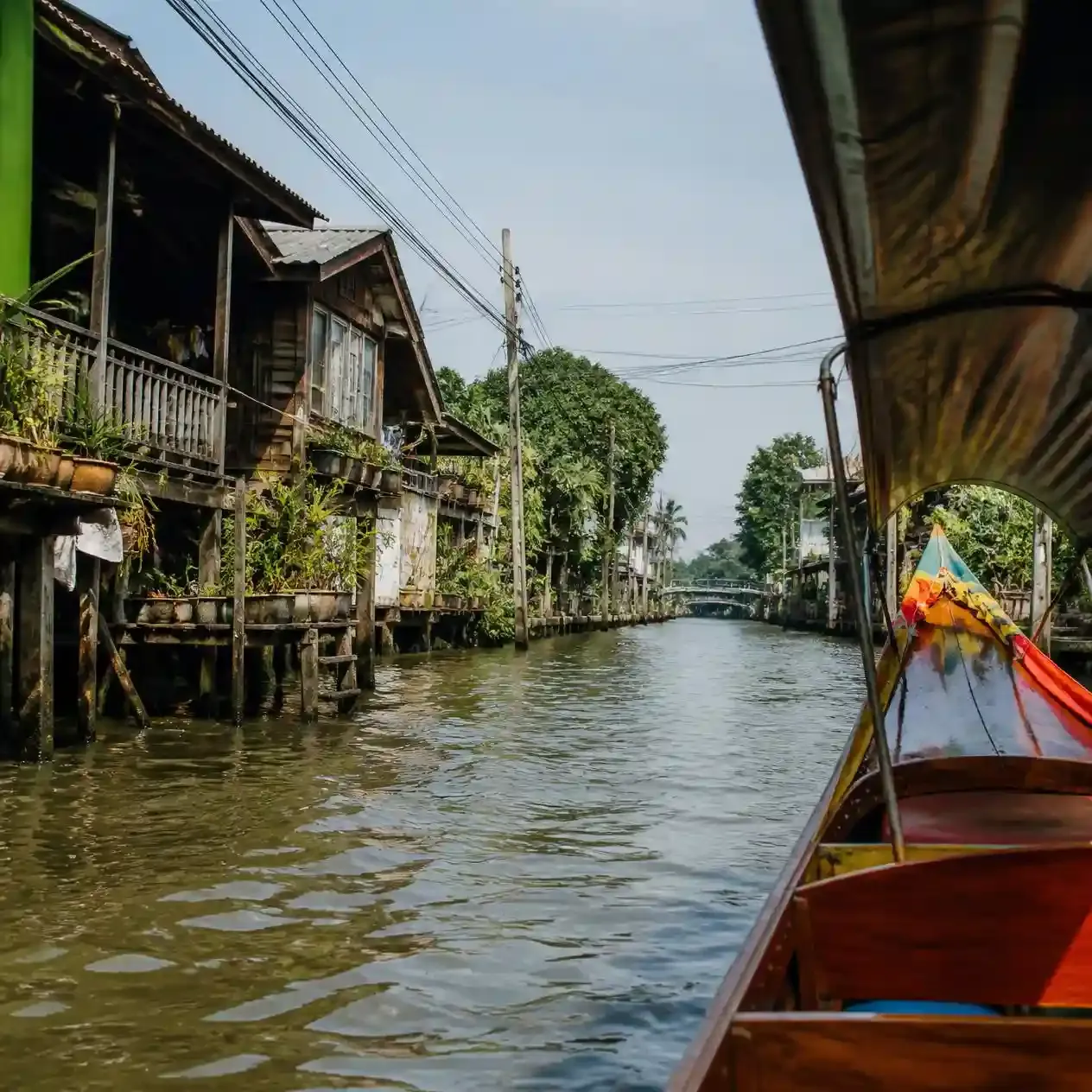
The format returning visitors tend to enjoy most. A long-tail boat runs the Thonburi canals to markets the street-level tours never reach — Talat Phlu for Chinese chive dumplings and beef soup, Wang Lang for Isan grilling and papaya salad, with a stop at Khlong Bang Luang's Artist House along the way. Four to five hours, ten or more dishes across five stops. Substantial enough to serve as both breakfast and lunch.
Bike food tours
Early-morning or late-afternoon departures through back lanes and, on longer versions, across to the Bang Krachao green loop. Distances are modest and the pace is unhurried, but this is the one format where heat management shapes the experience most. Best booked in the cooler months.
Market tour plus cooking class
Half a day: a guided market walk for ingredients, then three to five dishes at your own station, then you eat what you made. Curry paste from scratch is usually the centrepiece. The most adaptable format for dietary needs and the only one that sends you home with something.
Dinner cruises
A different category of evening. Two hours on the Chao Phraya with a buffet or set menu, passing Wat Arun and the Grand Palace lit up. Nobody books this for the cooking, and the honest framing is that it is a river experience with dinner attached. Worth it for a group where not everyone wants to eat standing up.
Insider reality check: what "Michelin-recommended" actually means
- The 2026 MICHELIN Guide Thailand lists 468 restaurants: 2 with three stars, 8 with two, 33 with one, 137 Bib Gourmands and 288 Selected.
- When a tour listing says "Michelin-recommended eateries", it is nearly always referring to Bib Gourmand or Selected entries — good, often excellent, but not starred.
- One Bangkok street stall holds a star: Jay Fai in the Old City, where the chef cooks crab omelettes and drunken noodles over twin charcoal woks. It takes no reservations, runs a two-to-three-hour queue, and is cash only.
- Most tours therefore walk past Jay Fai and tell you the story rather than feed you there. A handful advertise skip-the-line access — verify what that means before you pay a premium for it.
What a Food Tour in Bangkok Costs in 2026
Prices sit in a fairly tight band once you separate them by format and by whether you are joining a group or booking privately. The figures below are per person for 2026, in Thai baht with US dollar equivalents at roughly THB 32 to the dollar.
Price by format
- Join-in walking tasting tour: THB 1,800–3,200 (USD 56–100) for 3–4 hours and 10–15 tastings
- Private walking tour: THB 3,000–5,500 (USD 94–172), often priced per group of two to four rather than per head
- Private tuk-tuk night tour: THB 3,500–6,500 (USD 110–203), typically 3.5 hours with hotel pickup
- Canal and market boat tour: THB 3,000–3,500 (USD 94–110) for a private half day
- Half-day cooking class: THB 1,300–2,500 (USD 41–78), covering four to five dishes plus a market visit
- Full-day cooking class: THB 2,500–4,500 (USD 78–141), adding curry paste from scratch and one or two extra dishes
- Premium cooking school: around THB 3,500 (USD 110) at the heritage-restaurant schools
- Chao Phraya dinner cruise: THB 1,500–4,500 (USD 47–141) depending on vessel and menu tier
What is included, and what is not
- Nearly always included: all tastings, an English-speaking guide, and transport between stops on vehicle-based tours.
- Usually included on private tours: hotel pickup and drop-off within central Bangkok.
- Usually extra: alcohol. Beer and cocktails are rarely bundled into tasting tours, even where soft drinks are.
- Sometimes extra: temple or attraction entry on tuk-tuk tours that include sightseeing stops.
- Never included: tips. Not obligatory in Thailand, but THB 100–200 per person for a guide who has done the job well is normal on tours pitched at international visitors.
Insider reality check: the tuk-tuk per-head maths
- A tuk-tuk seats five to six. Private tuk-tuk tours are commonly priced per vehicle, so a couple absorbs the full cost between two while a group of four or five splits it — the per-person figure can halve.
- If you are two, compare the private tuk-tuk price against a join-in walking tour before assuming private is the upgrade. It is often the same money for less food.
- Separately: a standalone tuk-tuk city tour quoted at an unusually low rate is a commission route. The stops are gem shops and tailors, and they will cost you 30 to 60 minutes of the evening.
- Tuk-tuks are not metered. On a booked tour this is irrelevant — the fare is fixed in advance, which is precisely the point of booking one.


Which Food Tour Should You Choose?
Match the format to your group and your evening, not to the review count. The highest-rated tour in the city is the wrong booking if it walks four kilometres and someone in your party would rather sit. Here is how the decision usually breaks down.
If you are a couple with one free evening
Take a join-in walking tasting tour through Yaowarat or the Old City. Three to four hours, 10 to 15 tastings, and the group format is an advantage rather than a compromise — you are eating standing up in a night market, not sharing a minibus. Book a private tuk-tuk evening instead if the appeal is the ride and the lit temples as much as the food, and accept that you will eat less.
If you are travelling with children
A half-day cooking class beats a street tour outright. Children get their own station, the pace is controlled, the room is air-conditioned, and the dishes are adjustable. Schools generally take children from around five, often at a reduced rate. A tuk-tuk night tour is the second-best option — the ride does a lot of work for younger travellers.
If you have been to Bangkok before
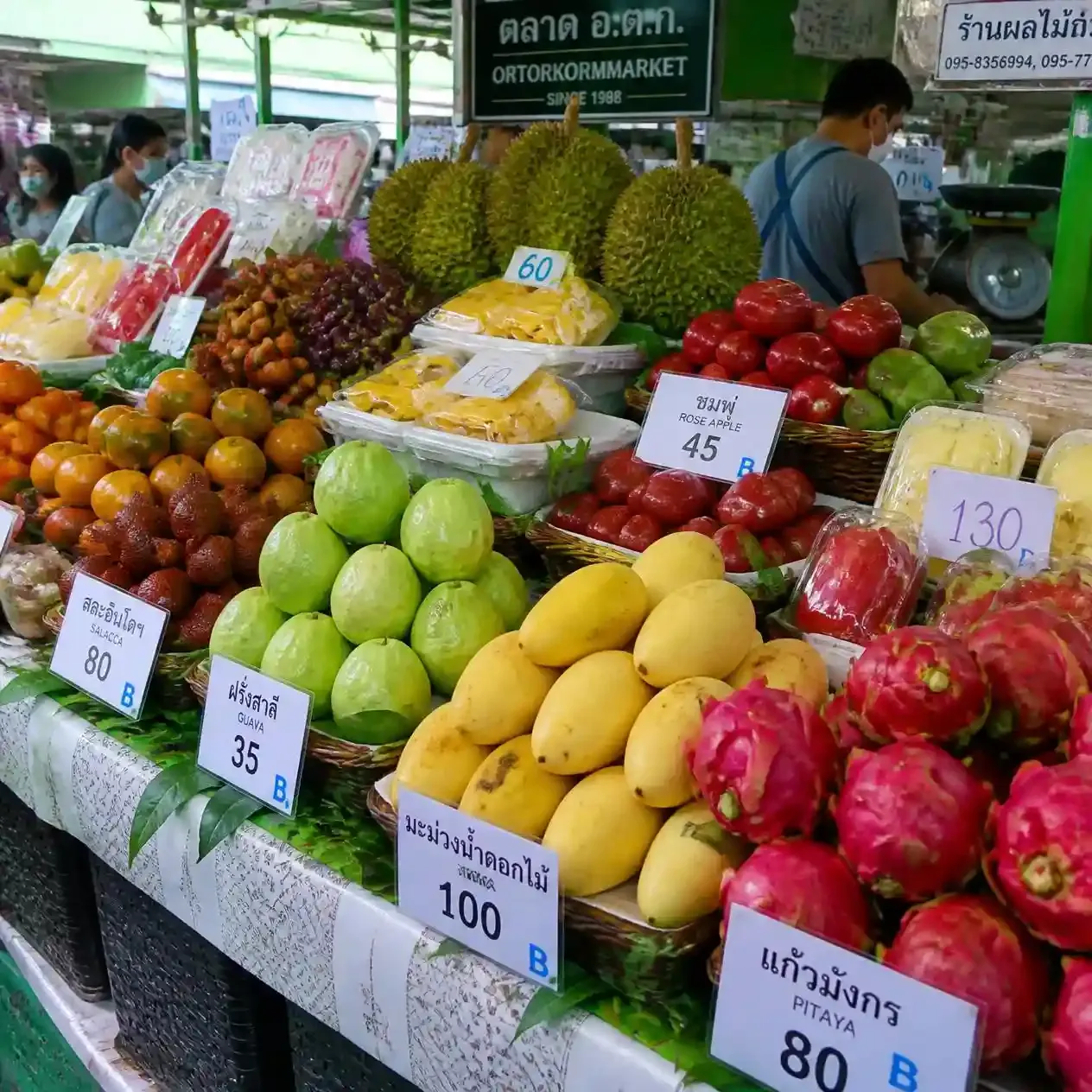
Skip Yaowarat and book the canal-and-market boat format. Talat Phlu, Wang Lang and the Thonburi khlongs are a different city from the Sukhumvit-and-Chinatown circuit, and the tours that run there are smaller and more specific. A morning at Or Tor Kor Market, which trades in produce rather than prepared food, adds a layer most visitors never see.
If you have dietary restrictions
Book a private guide or a cooking class. This is not a preference, it is a practical constraint — join-in street tours run fixed vendor sequences that cannot be rebuilt on the morning. Flag vegetarian, vegan, jay, halal or allergy requirements at the point of booking and confirm in writing.
If you want food and sightseeing in one booking
The tuk-tuk night format is built for this, covering Wat Arun from across the water, Pak Khlong Talat and Chinatown alongside the eating. If you would rather keep them separate, a dedicated food tour plus a morning at Bangkok's top 20 experiences gives you more of both.
Every operator listed on Travjoy has been researched and approved by local experts before it appears, which is the part of this decision you should not have to make yourself. Comparing food tours in Bangkok on format, duration and route is a reasonable use of your planning time. Working out which operator actually turns up with a guide who knows the vendors is not.
Where the Tours Actually Go
Route matters more than most listings admit. Two tours at the same price, both described as "Bangkok street food", can cover entirely different cuisines depending on which district they work. These are the five routes in regular operation.
Yaowarat and Chinatown
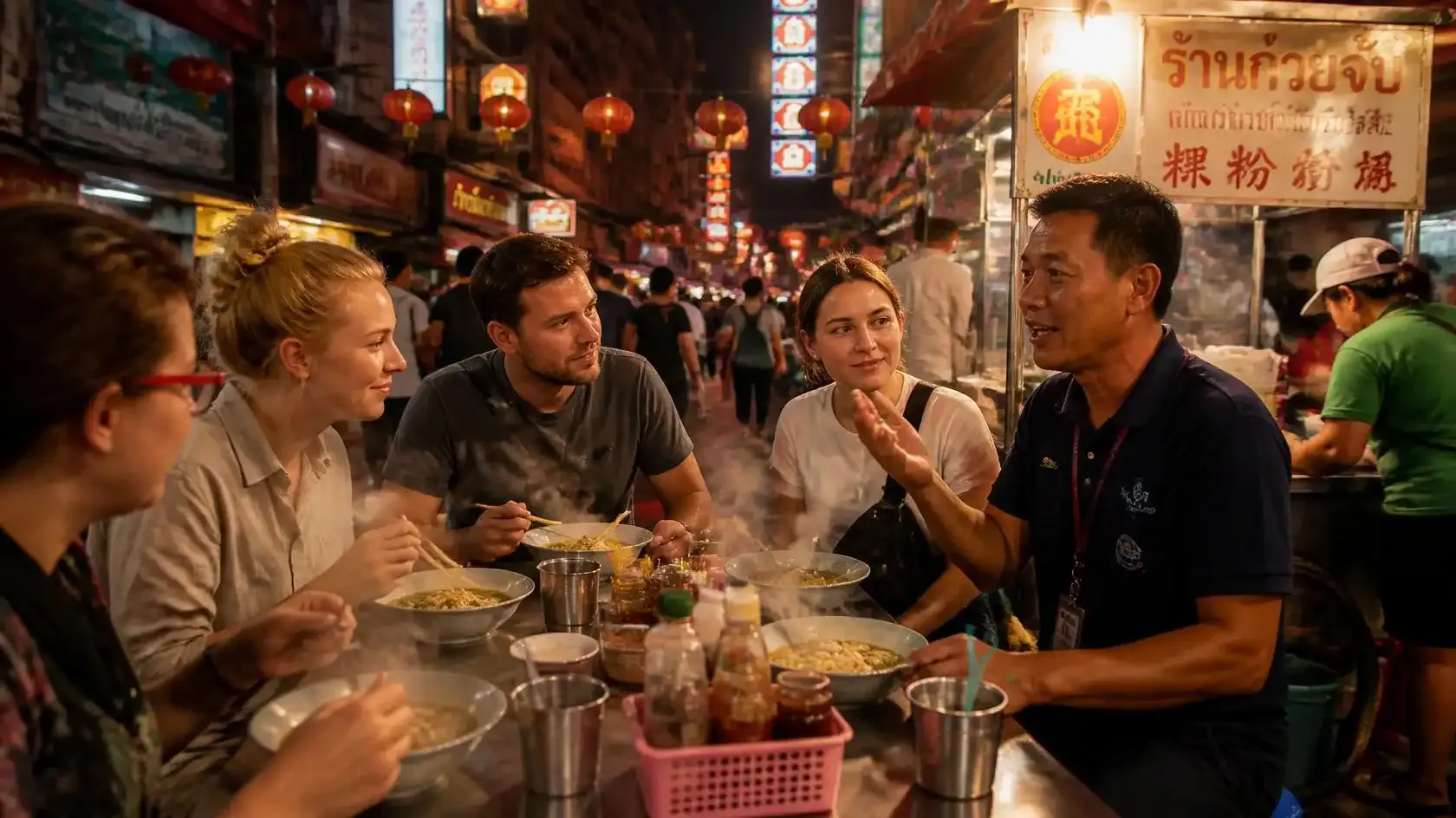
The busiest route and the most Thai-Chinese. Yaowarat Road comes alive after dark, with the stall density peaking between seven and ten in the evening. Expect fishball noodles, rolled rice noodles, crab fried rice, pa tong go doughnuts and a stop for chestnuts or durian in season. Tours here often work the side sois — Sampeng Lane and Song Wat Road — where the shophouse kitchens are older and quieter than the main strip. If you want the district on your own terms first, Yaowarat's street food scene rewards a walk-through before you book anything.
The Old City and Nang Loeng
Quieter, older, and more royal-adjacent. Nang Loeng Market is one of Bangkok's oldest land markets and the anchor for several chef-designed tasting routes. This is the district for khao gaeng — curry over rice, chosen from a counter of ten or twelve pots — plus Thai desserts made to court recipes. Tours here frequently pass Jay Fai and the Golden Mount, and several combine the walking with a klong boat leg.
Thonburi's canals, Talat Phlu and Wang Lang
Across the river, and the most interesting route for anyone on a repeat visit. Talat Phlu delivers Chinese chive dumplings, beef noodle soup and traditional Thai coffee. The long-tail boat leg runs past Wat Paknam and stops at Khlong Bang Luang's Artist House, a 200-year-old wooden compound with a puppet stage and a coffee counter. Wang Lang Market handles the Isan end — grilled chicken, sticky rice, papaya salad — and peaks at lunchtime.
Bang Rak
The riverside strip between Saphan Taksin and Silom, and the most compact route in the city. Muslim-Thai roti stalls, hundred-year-old bakeries, pork satay counters and Indian-Thai kitchens sit within a few hundred metres of each other. Good for anyone who wants a tasting route without much walking, and the easiest to reach by BTS.
Ari, Ekkamai and Thonglor
The modern-Bangkok routes, and the ones least likely to be described as street food. Third-wave coffee, chef-led shophouse restaurants, natural wine counters and craft beer alongside the older noodle shops. Fewer operators work these districts, and the tours that do tend to run smaller and later. Worth considering if you have done the classic circuit and want to see where the city eats now.
Booking, Timing and What to Expect
Book two to four weeks ahead for private tours and popular join-in departures, particularly between November and February. Most tours run a fixed schedule — morning departures around 8.30 to 9.00 for market and cooking formats, evening departures between 4.00 and 6.00 for street food and tuk-tuk routes.
Timing across the year
- November to February: the cool season, daytime highs around 32°C and low humidity. The best window for walking and bike formats, and the busiest for bookings.
- March to May: hot season, regularly above 35°C. Evening tours only; morning walking routes are hard work.
- June to October: monsoon. Rain arrives in heavy short bursts, usually late afternoon. Tours run in all weather — bring a compact umbrella rather than rescheduling.
- Early October: the Vegetarian Festival, when Yaowarat turns almost entirely meat-free for nine days and yellow flags mark participating stalls. Excellent for vegetarian travellers, disruptive for anyone expecting the standard route.
Practical notes
- Carry cash. Tour tastings are prepaid, but anything extra at a stall — a second bowl, a drink, fruit for later — will be cash. Small notes work better than large ones.
- Wear closed shoes. Pavements are uneven, kitchens spill onto them, and markets get wet.
- Calibrate spice at the first stop. Tell the guide once and they will manage it for the rest of the evening. "Mai phet" means not spicy; guides will usually order a middle setting by default for international groups.
- Expect standing. Most tasting stops have stools rather than seats, and some have neither.
- Hydrate more than feels necessary. Even on an evening tour, three hours of walking in Bangkok humidity is more demanding than the distance suggests.
Insider reality check: the tour is dinner
- Fifteen tastings is a real volume of food. A well-run walking tour will leave you comfortably full and slightly over-served on dessert.
- Eat lightly beforehand — a late breakfast, no lunch, or nothing after mid-afternoon for an evening departure.
- Do not book a restaurant for afterwards. It is the single most common planning mistake on these tours, and it wastes both the reservation and the last three stops.
- Equally, do not stack a food tour on the same day as a floating-market day trip or an Ayutthaya excursion. Both involve eating, and both involve heat.
Pulling it together
The decision on food tours in Bangkok comes down to three questions, in order. How much do you want to eat, how far do you want to move, and does anyone in your group have a dietary requirement? Answer those and the format picks itself: walking for volume, tuk-tuk for ground covered, canal boat for a second visit, cooking class for adaptability and for the recipes you take home.
Prices in 2026 run from THB 1,300 to THB 6,500 (USD 41–203) per person, and the gap between the cheapest and the most expensive tour is rarely about food quality — it is about vehicle, group size and whether the guide is yours alone. Book two to four weeks out, flag any dietary needs in writing, and skip lunch.
Start planning your eating in Bangkok on Travjoy's Bangkok collection, where every experience has been researched and approved by local experts before it goes live.


.svg&w=1920&q=75)