


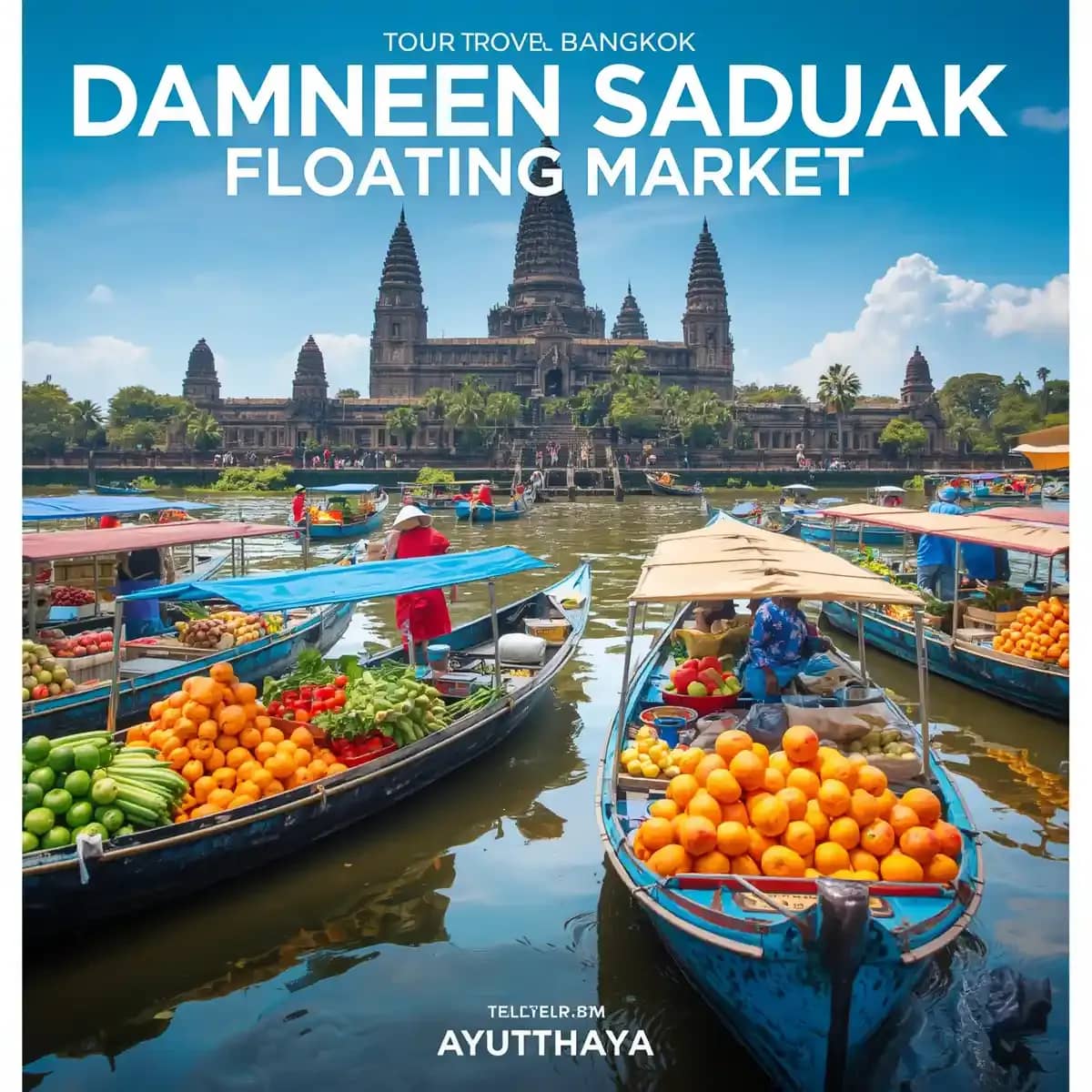
Damnoen Saduak Floating Market & Ayutthaya Tour from Bangkok: A Complete Guide to Doing Both in One Day
9 min read
Key Highlights
- The two sites sit on opposite sides of Bangkok — roughly 155 km apart by road, with the connecting leg running back past the capital. Expect five to five and a half hours in the vehicle across the full day.
- Shared small-group departures run THB 1,200–2,500 (USD 34–71) per person in 2026; a private car with a licensed guide runs THB 4,500–8,000 (USD 128–228) for the vehicle, not per head.
- Maeklong railway market is only on the 07:00 departure, and only pays off if your arrival lines up with a train — 08:30, 11:10, 14:30 or 17:40.
- Ayutthaya temple entry is 50 THB (USD 1.40) each, or 220 THB (USD 6.30) for the six-temple pass. Most tours exclude it, payable in cash at the gate.
- If you have four or more days in Thailand, splitting the two into separate days gives you Ayutthaya at golden hour — the version most day-trippers never see.
A Damnoen Saduak and Ayutthaya tour from Bangkok takes 9 to 11 hours and costs THB 1,200–2,500 (USD 34–71) per person shared, or THB 4,500–8,000 (USD 128–228) for a private car and guide in 2026. It is a real, widely sold itinerary, but the two sites lie on opposite sides of the capital, which means around five hours of driving for roughly five hours on the ground. It suits travellers with three or four days in Thailand who want both experiences handled in one go; anyone with a longer trip gets more from separating them.
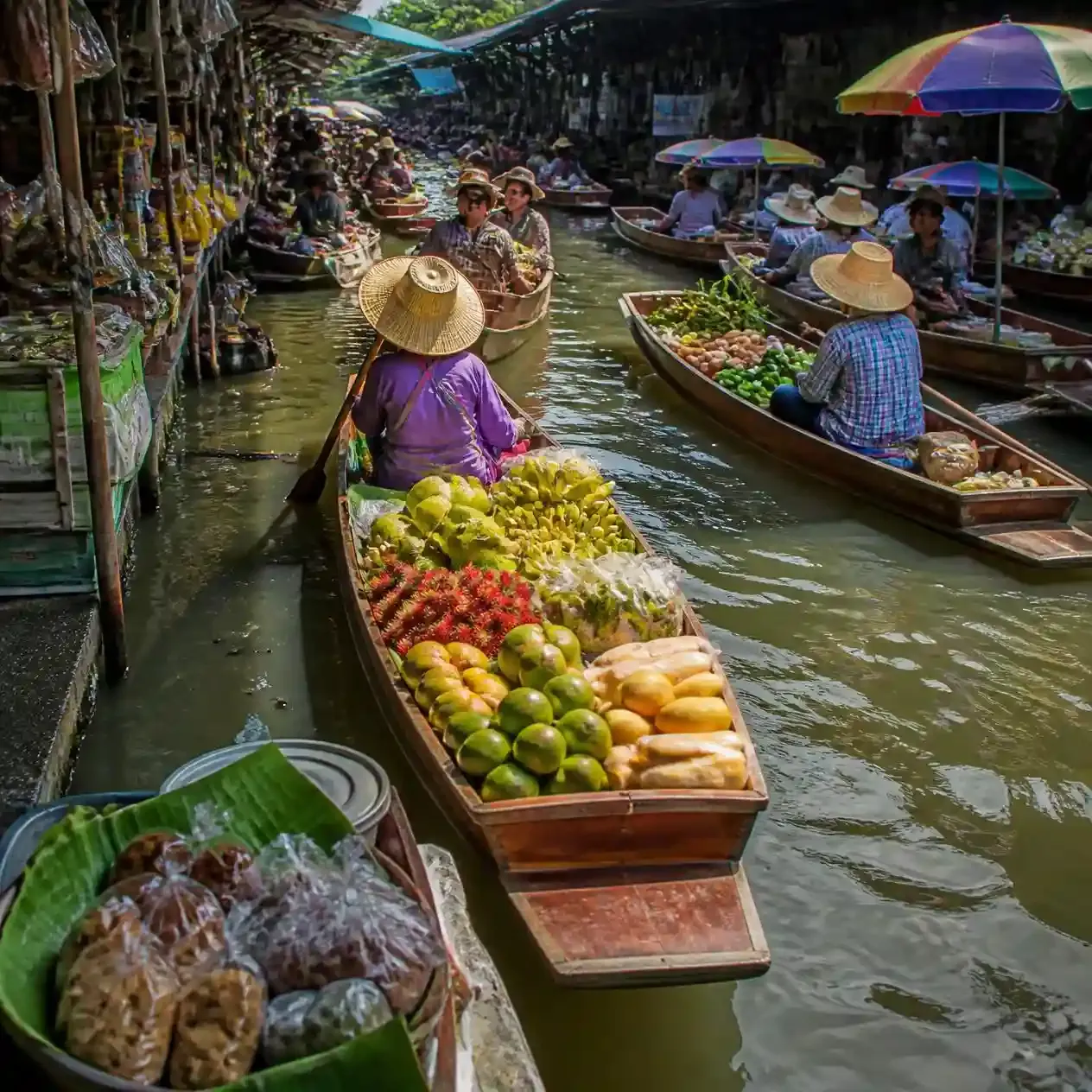
Ask any Bangkok concierge which day trip people request most and you will hear the same two names. The floating market southwest of the city, where vendors paddle produce along a canal cut in 1866. And Ayutthaya, the Siamese capital that ran the region's trade for four centuries until the Burmese sacked it in 1767. Both are on almost every Thailand shortlist, and a whole industry has grown up around fitting them into a single day.
What that industry rarely explains is the map. Damnoen Saduak sits about 100 km southwest of Bangkok. Ayutthaya sits 80 km north. The road between them runs back through the capital's orbit — 155 km, a little over two hours in reasonable traffic. No operator listing states this, which is why so many travellers arrive at the second stop already tired and unsure why.
This guide covers the Damnoen Saduak and Ayutthaya tour from Bangkok in the order you need it: the arithmetic first, then the itinerary hour by hour, 2026 pricing broken down by format with what is and is not included, and an honest read on who should book the combination and who should not. If the answer for your trip turns out to be two separate days, that is a useful outcome too.
Is the Damnoen Saduak and Ayutthaya tour from Bangkok worth it?
Yes, if your time in Thailand is short and you want both a canal market and the ruined capital without organising two separate excursions. No, if you have the days to spare — because splitting them turns two compressed half-days into two properly paced ones, and unlocks Ayutthaya in late-afternoon light. The combination is a time-efficiency decision, not a quality one.
Worth it if
- You have three or four nights in Thailand and Bangkok is one stop on a wider trip. This is the format that gets both onto your itinerary.
- You want the logistics handled — hotel pickup, a licensed guide, temple entries sorted, lunch arranged — rather than assembling transport yourself.
- You are travelling as a couple or a pair of friends who are comfortable with a long day and want variety inside it. The contrast between a canal at 09:00 and a 14th-century prang at 15:00 is the point.
- You have already spent your Bangkok days on the river and the temples inside the city, and want one day that leaves the capital entirely.
Not ideal if
- You are returning to Thailand or have four or more days. Give each site its own day; the payoff is real and specific, covered below.
- You are travelling with children under about seven, or with anyone for whom five hours in a vehicle is uncomfortable. This is a long, hot, seated day.
- Photography matters to you. Ayutthaya's brick turns gold in the last two hours of daylight, and the combined tour has you back in Bangkok before then.
- You want depth at Ayutthaya. The combined format fits three or four temples; a dedicated day fits six or seven plus Bang Pa-In Royal Palace.
What the tour listings leave out
Almost every product page for this itinerary lists the stops and the inclusions, and stops there. None of them state the distance between the two sites, total the hours you will spend seated, or explain that the Damnoen Saduak boat ride is sold in tiers at the pier. Those three omissions account for most of the disappointment travellers report afterwards, and each is easy to plan around once you know.
The geography: what this day actually costs you in the car
The combined itinerary is a triangle, not a loop. You drive southwest out of Bangkok, then northeast back past the capital, then north to Ayutthaya, then south again to your hotel. Across the day that is roughly 330 km and five to five and a half hours of driving, against about five hours actually standing on the ground.
The three legs, in real numbers
- Bangkok to Damnoen Saduak: around 100 km, 1 hour 20 minutes to 1 hour 45 depending on your hotel and the hour you leave. Early departures move well.
- Damnoen Saduak to Ayutthaya: around 155 km, 2 hours to 2 hours 30. This is the leg nobody mentions, and it lands in the middle of the day when the heat peaks.
- Ayutthaya back to Bangkok: around 80 km, 1 hour 15 to 2 hours. The return coincides with the capital's evening build-up, so the upper end is common.
Why the middle leg matters more than the total
Five hours of driving spread across a day is manageable. Two of those hours landing in one uninterrupted block between 11:30 and 14:00, in the hottest part of the afternoon, immediately after a market visit and immediately before you are asked to walk a temple complex — that is what people actually feel. Plan around this specific leg rather than the daily total. It is the reason a private vehicle with proper air conditioning changes the day more than it changes the price.
Reality check: the leg no listing states
- Damnoen Saduak and Ayutthaya are roughly 155 km apart by road, and the fastest route runs back past Bangkok rather than around it.
- Operators quote total tour duration (9–11 hours) but not the driving split. Ask directly before booking: how long is the transfer between the market and Ayutthaya?
- A private booking lets you take lunch during this leg rather than losing separate time to it — worth specifying when you book, as it recovers close to an hour on the ground.
- If a listing claims the two sites are "close" or "on the way", the itinerary has not been checked against a map.
What you actually see, hour by hour
Two departure patterns dominate. A 07:00 start adds the Maeklong railway market before the floating market; an 08:00 start skips it and gives you longer at each of the two main stops. Both return to Bangkok between 17:00 and 18:00. Which you choose should depend on the train timetable, not on the price difference.
The 07:00 departure, with Maeklong
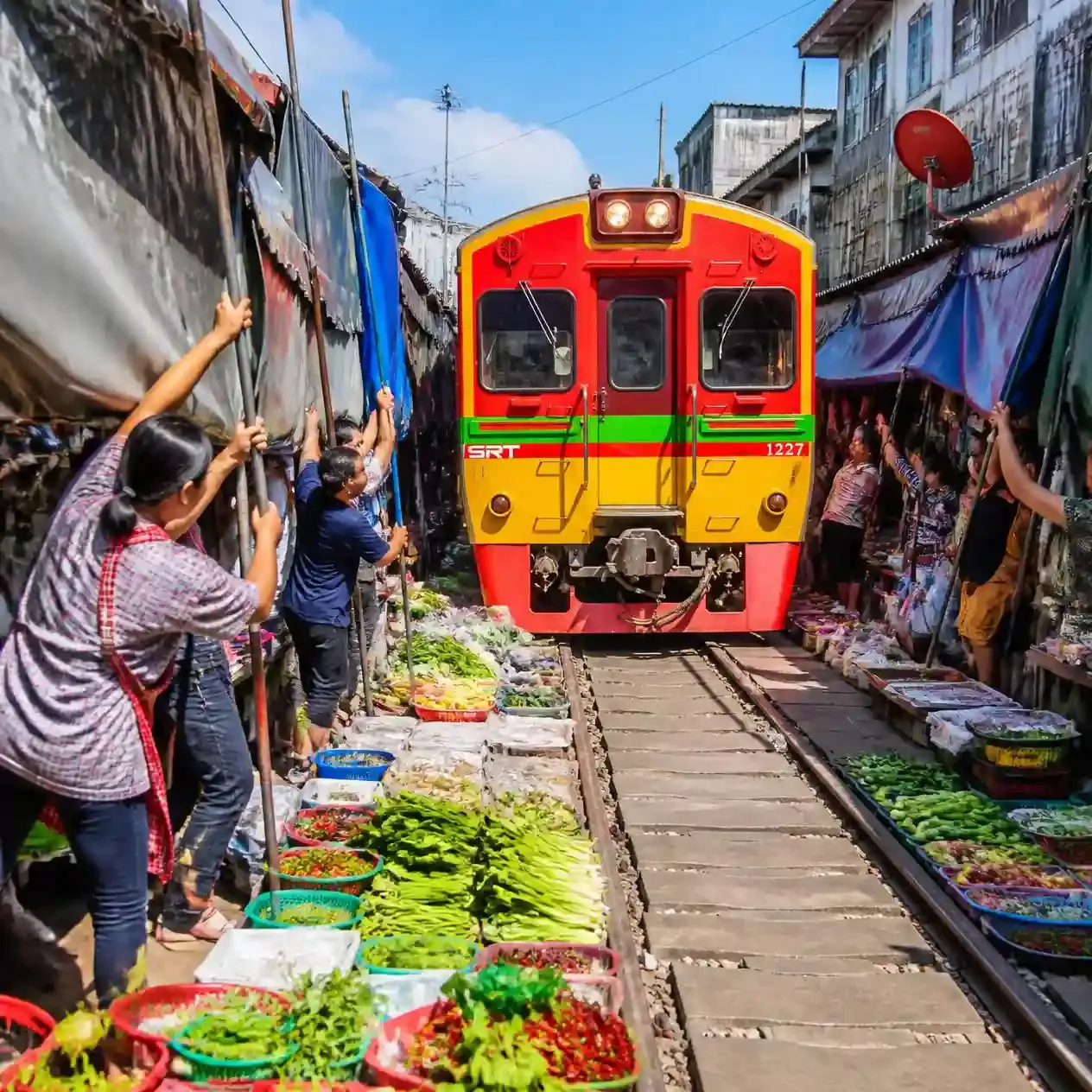
Pickup between 06:30 and 07:00, arriving at Maeklong around 08:15 for the 08:30 train. The market sits directly on a working railway line, and the stalls fold back and reopen in the seconds around each passing train — locals call it Talad Rom Hub, the umbrella pulldown market. Allow 45 minutes to an hour. Damnoen Saduak is 15 to 20 minutes further on, reached around 09:30.
- Maeklong train arrivals: 08:30, 11:10, 14:30, 17:40
- Maeklong train departures: 06:20, 09:00, 11:30, 15:30
- Market hours: roughly 06:00 to 18:00 daily, though vendors thin out after 15:00
- Entry: free at both Maeklong and Damnoen Saduak — the boat is the cost at the latter
The 08:00 departure, without Maeklong
You arrive at Damnoen Saduak around 09:30 with two to two and a half hours there instead of ninety minutes, then leave for Ayutthaya by midday. This is the better choice if your date does not line up with a morning train, and it is the version most private operators run by default. You reach the ruins with more energy, which is where it counts.
The Ayutthaya half: which temples actually fit
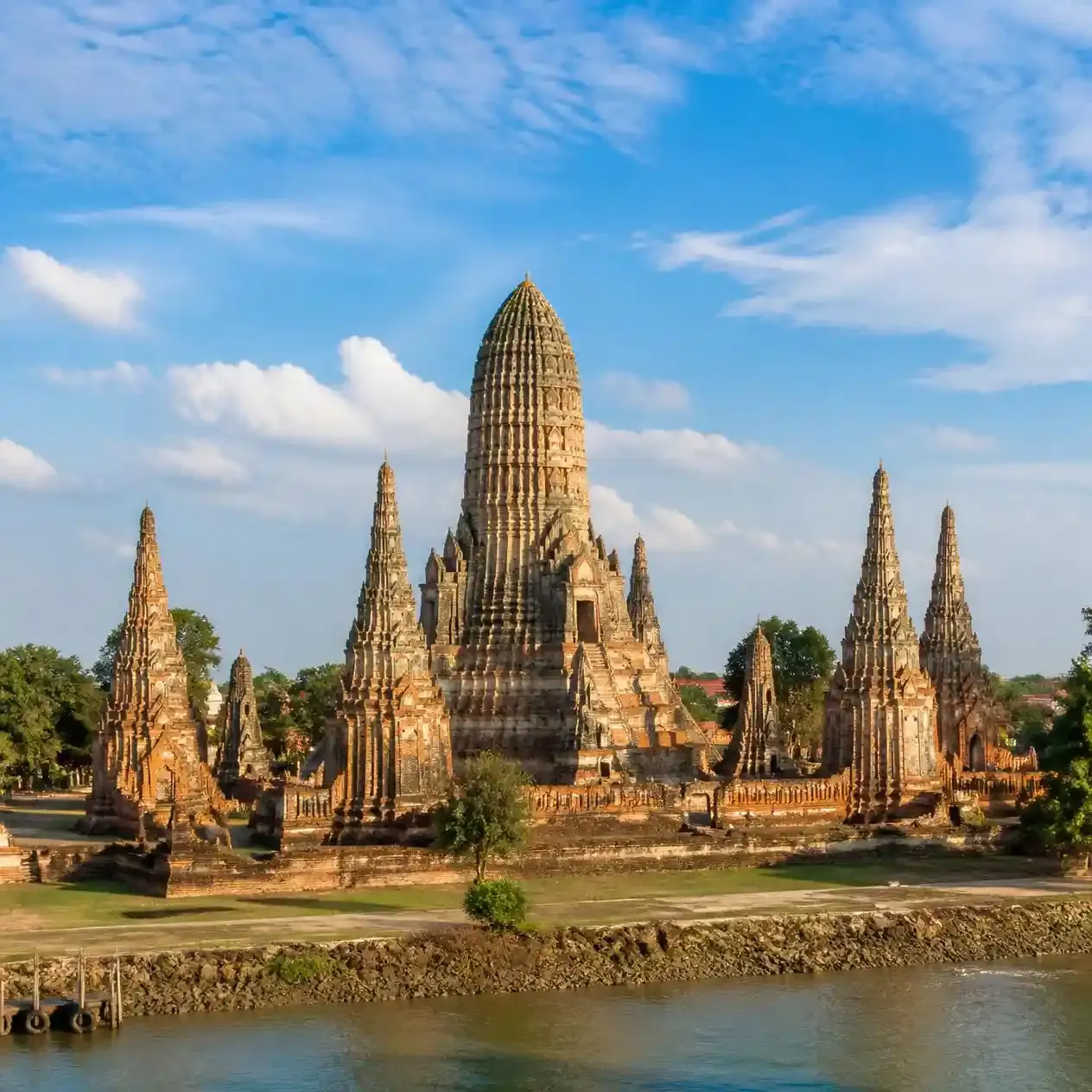
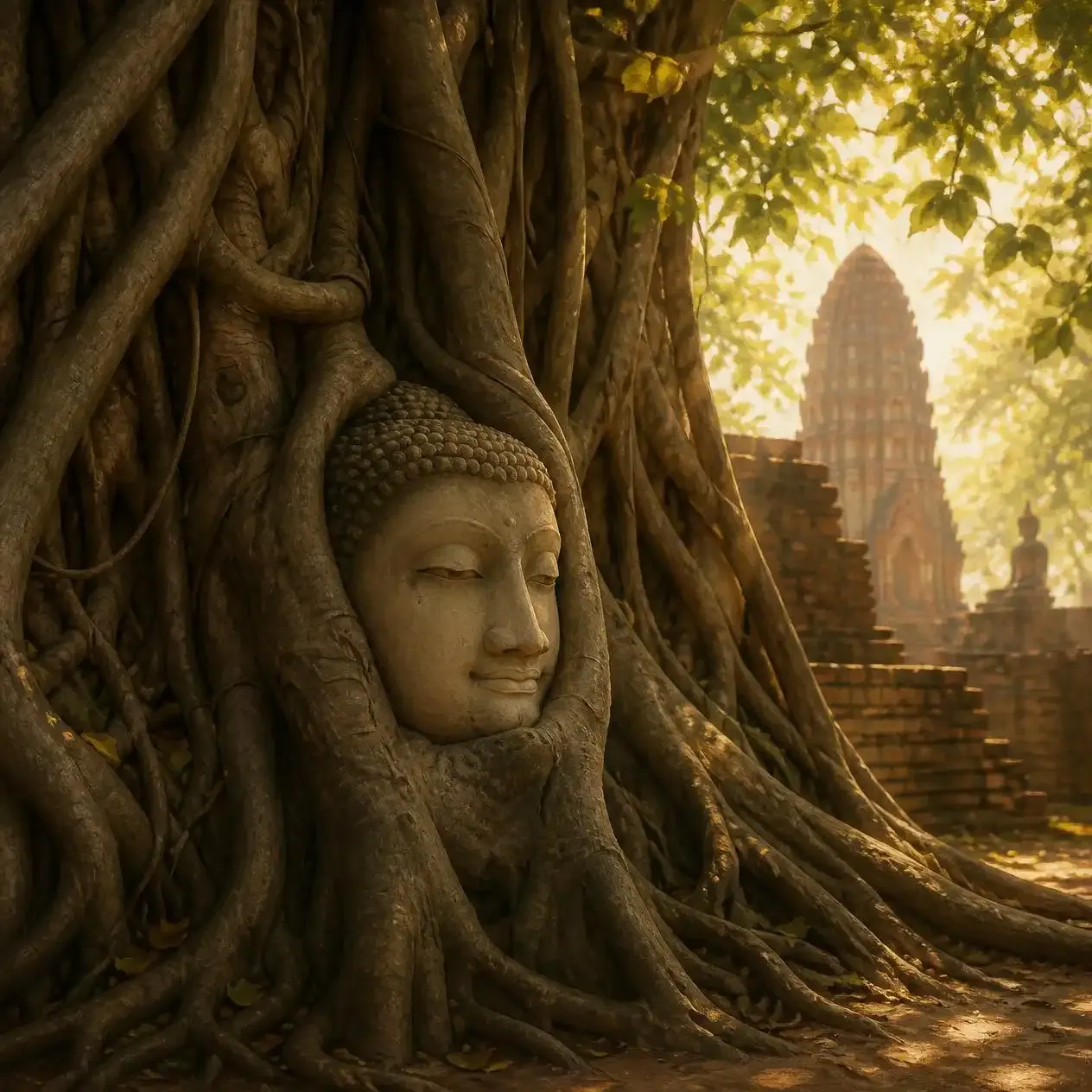
A combined itinerary fits three or four sites, and operators pick from a standard set. Wat Mahathat, for the sandstone Buddha head held in banyan roots. Wat Phra Si Sanphet, the royal chapel with three bell-shaped chedis holding the ashes of three kings. Wat Chaiwatthanaram, the riverside Khmer-style complex built in 1630, whose 35-metre central prang represents Mount Meru. Wat Yai Chai Mongkhon or Wat Phanan Choeng often round it out.
The Ayutthaya Historical Park charges no admission to the wider archaeological zone; individual temples ticket separately. Note the closing times — Wat Ratchaburana and Wat Phra Si Sanphet shut at 16:30, earlier than most visitors expect, while Wat Mahathat and Wat Chaiwatthanaram stay open to 18:00 and 18:30. A guide who knows this sequences your stops accordingly.
Reality check: the 07:00 start only pays for itself against a train
- Maeklong without a train passing is a fresh seafood market — pleasant, but not what you got up at 06:00 for.
- The 08:30 arrival is the only train that fits a combined day. The 11:10 comes too late to leave time for Ayutthaya.
- Timetables shift for holidays and engineering work. Confirm the arrival time with your operator within 48 hours of travel rather than relying on a published schedule.
- If the train does not line up, take the 08:00 departure and spend the extra hour on the canal instead. It is the better trade.


What a Damnoen Saduak and Ayutthaya tour costs in 2026
Budget THB 1,200–2,500 (USD 34–71) per person for a shared small-group departure, or THB 4,500–8,000 (USD 128–228) for the vehicle on a private tour with a licensed guide. Add THB 220–400 (USD 6–11) per person for temple entries and the canal boat, which most operators exclude. All figures are 2026 market rates and move with season and group size.
Shared small-group departures
- Price: THB 1,200–2,500 (USD 34–71) per person
- Group size: typically 8–12, usually a minibus
- Usually included: hotel pickup within central Bangkok, English-speaking guide, a shared longtail boat ride, lunch at a set restaurant
- Usually excluded: temple entry fees, upgraded boat tiers, drinks, tips
Private car and guide
- Price: THB 4,500–8,000 (USD 128–228) for the vehicle, covering up to three or four passengers
- Vehicle: air-conditioned sedan or commuter van, often with cold towels and water
- Usually included: guide, driver, door-to-door pickup, flexible pacing and lunch stop
- Sometimes included: temple entries and a private boat — this varies by operator and is the single most useful thing to confirm before booking
For two people the private option works out at roughly THB 2,250–4,000 (USD 64–114) each, which is where it starts to make sense against a shared seat. For four, it is often the cheaper choice outright as well as the more comfortable one.
The entry fees you pay in cash on the day
- Ayutthaya major temples: 50 THB (USD 1.40) each — Wat Mahathat, Wat Phra Si Sanphet, Wat Ratchaburana, Wat Phra Ram, Wat Chaiwatthanaram, Wat Maheyong
- Six-temple combined pass: 220 THB (USD 6.30), valid 30 days, sold at the ticket window of any included temple
- Active monasteries with resident monks: 20 THB (USD 0.60) — Wat Phanan Choeng, Wat Yai Chai Mongkhon, Wiharn Phra Mongkhon Bophit
- Maeklong railway market and Damnoen Saduak market entry: free
- Damnoen Saduak longtail boat: 400–800 THB (USD 11–23) per boat for a standard ride
Reality check: "boat ride included" needs a follow-up question
- A standard rowed boat costs around 400 THB (USD 11) per boat for an hour and seats up to six; a motorised longtail runs 600–800 THB (USD 17–23).
- At the pier, operators also quote tiered private boat packages at 2,000, 3,000 and 5,000 THB (USD 57, 86 and 143), priced by how many stops you make.
- Card payments at the pier commonly carry a 7% surcharge. Carry cash for the boat, temple gates and lunch extras.
- When a listing says the boat is included, ask which tier. Nine times out of ten it is the shared 30-minute loop, which is fine — but know that before you are standing at the water.
Shared, private, or split across two days: which should you choose?
Choose the shared departure if you are two people on a short trip and price is the deciding factor. Choose private if you are three or more, travelling with children or older parents, or want lunch taken during the long transfer. Choose two separate days if you have four or more days in Thailand — this is the option most guides would pick for themselves.
| Format | Duration & driving | Price (2026) | Best for |
|---|---|---|---|
| Shared combined tour, 08:00 start | 9–10 hrs total, approx. 5 hrs driving | THB 1,200–2,500 (USD 34–71) per person | Couples and solo travellers on a short Thailand trip |
| Private combined tour, 08:00 start | 9–10 hrs total, approx. 5 hrs driving | THB 4,500–8,000 (USD 128–228) per vehicle | Families, groups of three or four, anyone wanting flexible pacing |
| Private tour with Maeklong railway market added, 07:00 start | 10–11 hrs total, approx. 5.5 hrs driving | THB 5,500–9,000 (USD 157–257) per vehicle | Travellers whose date lines up with the 08:30 train |
| Two separate days: markets, then Ayutthaya Historical Park | Two half-to-full days, approx. 3 hrs driving each | THB 3,000–7,000 (USD 86–200) combined per person | Repeat visitors, photographers, anyone with four or more days |
If you are travelling as a couple
Take the 08:00 shared departure if this is a single Bangkok stop on a wider Southeast Asia route. If you are staying five nights or more, split the two: the markets as a morning, then Ayutthaya on its own day with a late finish. Between December and February the Fine Arts Department illuminates six major Ayutthaya sites on Friday to Sunday evenings, which a combined itinerary can never reach.
If you are travelling with family
Go private, and take the 08:00 start. Children handle the canal boat and the umbrella market well; they handle a two-hour midday transfer badly. A private vehicle lets you break that leg, choose where you eat, and cut a temple if the day turns. For younger children, one site plus a shorter Bangkok afternoon is usually the better plan altogether — the day trips from Bangkok collection has gentler options.
If this is a repeat visit to Thailand
Skip the combination. You have already ticked the canal-boat photograph, and the value now sits in depth: a full Ayutthaya day covering six or seven temples plus Bang Pa-In Royal Palace, or a shift entirely to Kanchanaburi and the River Kwai, which almost no first trip includes. Every operator on Travjoy has been researched and approved by local experts, so you can compare formats on what the day actually delivers rather than on how the listing is written.
Planning the day so it lands
Three things decide whether a Damnoen Saduak and Ayutthaya tour from Bangkok feels rich or merely long: the season you travel in, how you handle the middle transfer, and what you decline. Get those right and the combination works. Get them wrong and you will remember the vehicle more than the ruins.
When to go
- November to February: the cool, dry window, roughly 25–33°C. The best conditions for a long day outdoors, and the only period with the Ayutthaya evening illuminations.
- March to May: hot, frequently 35–40°C. The midday transfer becomes the most comfortable part of the day, which tells you something. Book private for the air conditioning.
- June to October: rain arrives in short afternoon bursts rather than all day. Markets and ruins both stay open, crowds thin, and the light after a shower is the best of the year.
- Time of day at the market: Damnoen Saduak is at its most active between 07:00 and 09:30, before the mid-morning arrivals build.
What to wear, and why it matters at the temples
Shoulders and knees covered is the standard across Ayutthaya and it is applied at the gates. Slip-on shoes save time, since you will remove them at any active prayer hall. Light long sleeves outperform sleeveless in the heat once you are walking open brick with no shade. Reading this as cultural fluency rather than a rule to comply with changes the tone of the whole afternoon — you move through the sites as a guest rather than as someone being checked.
What to decline
Two offers will come up, and both are worth turning down.
Reality check: the elephant add-on
- Several Ayutthaya itineraries offer an optional elephant ride, paid in cash to the guide on the day. Decline it.
- The riding camps operate on public roads in traffic, using howdah saddles and chains, and have drawn sustained criticism from welfare organisations and from Thailand's own tourism press.
- An elephant's spine is not built to carry a saddle, a mahout and passengers, and the training that makes an animal accept it is the part visitors do not see.
- If elephants are why you came to Thailand, give a separate day to an observation-only sanctuary rather than fitting one into a temple afternoon.
The second is the gem or silk showroom stop, which appears on some cheaper shared departures as an unannounced addition. It is a commission arrangement, not part of the itinerary, and it eats 40 minutes you have already established you do not have. Ask before booking whether any shopping stops are scheduled.
Reality check: buy back an hour with the river
- Some private operators offer a return to Bangkok by boat down the Chao Phraya instead of the evening road journey.
- It converts the worst hour of the day — the traffic-bound run south — into the calmest, and delivers you to a central pier rather than a hotel lobby.
- Expect it to add THB 1,500–3,000 (USD 43–86) to a private booking, and to require arranging in advance rather than on the day.
- Worth pairing with Chao Phraya boat tours if the river is a part of Bangkok you have not yet used.
One adjustment for a second visit
If you have done the standard version before, ask for Wat Na Phra Men rather than a fourth mainstream temple. It is the only major Ayutthaya temple to survive the 1767 invasion intact, holds a crowned Buddha in royal regalia, and sits across the water from the main island, which is why coach itineraries skip it. Guides on well-run temple tours will make the swap without hesitation if you ask when you book.
Pulling the day together
The Damnoen Saduak and Ayutthaya tour from Bangkok is a legitimate way to see two very different sides of central Thailand when your days are limited — a canal that has functioned since 1866 in the morning, a capital that fell in 1767 in the afternoon. Book it knowing the shape of the day: five hours moving, five on the ground, and a two-hour transfer in the middle that rewards a private vehicle. Confirm what the boat tier and temple entries actually cover, decline the elephant camp and the showroom stop, and if you have four or more days, give each site its own. Start planning your Thailand trip on Travjoy's Bangkok collection, where every experience has been researched and approved by local experts.


.svg&w=1920&q=75)