


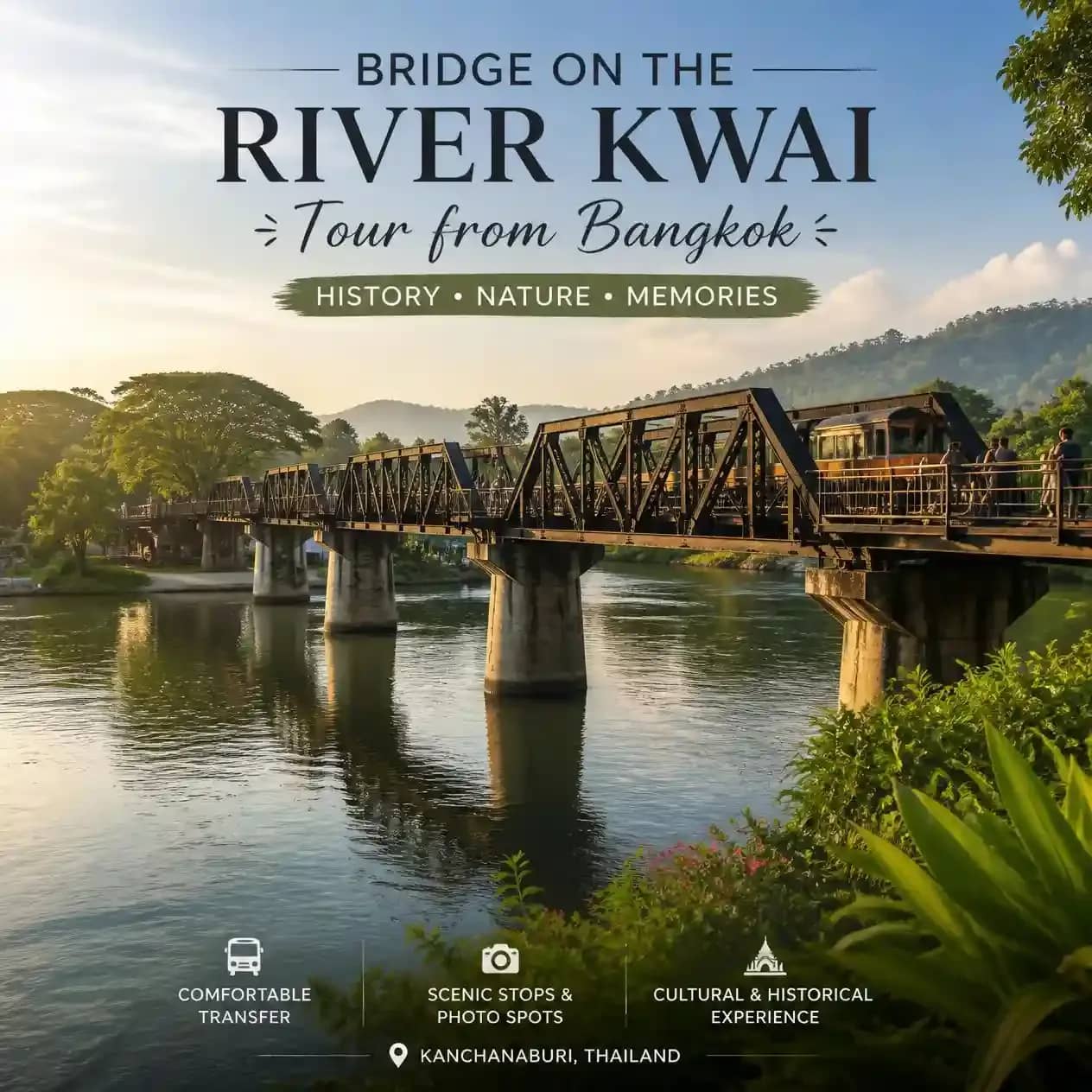
Bridge on the River Kwai Tour from Bangkok: A Complete Guide to the Thailand-Burma Railway
10 min read
Key Highlights
- Kanchanaburi sits around 130 km west of Bangkok — a two to two-and-a-half hour drive each way, which makes this a full-day commitment rather than a morning add-on
- The bridge you photograph is not the one from the 1957 film: David Lean shot in Sri Lanka, and the river beneath it was renamed Khwae Yai in the 1960s to match what visitors arrived expecting
- Hellfire Pass Interpretive Centre is free, run by the Australian Department of Veterans' Affairs, and closes for roughly three weeks every May for maintenance
- The Thailand-Burma Railway Centre (THB 150-170 / USD 4-5) is the museum worth your time; the JEATH War Museum beside the bridge is the one most itineraries default to
- A single day holds either the full Death Railway run to Nam Tok or Hellfire Pass — not both, and not both plus Erawan Falls
A Bridge on the River Kwai tour from Bangkok runs 9 to 12 hours and covers roughly 130 km each way to Kanchanaburi, priced in 2026 at THB 1,200-2,000 (USD 34-57) for a shared group departure and THB 6,000-7,500 (USD 170-213) for a private car with a guide. Almost every itinerary includes the bridge, Don Rak War Cemetery and a short segment on the Death Railway; only the longer formats reach Hellfire Pass, 80 km further west.
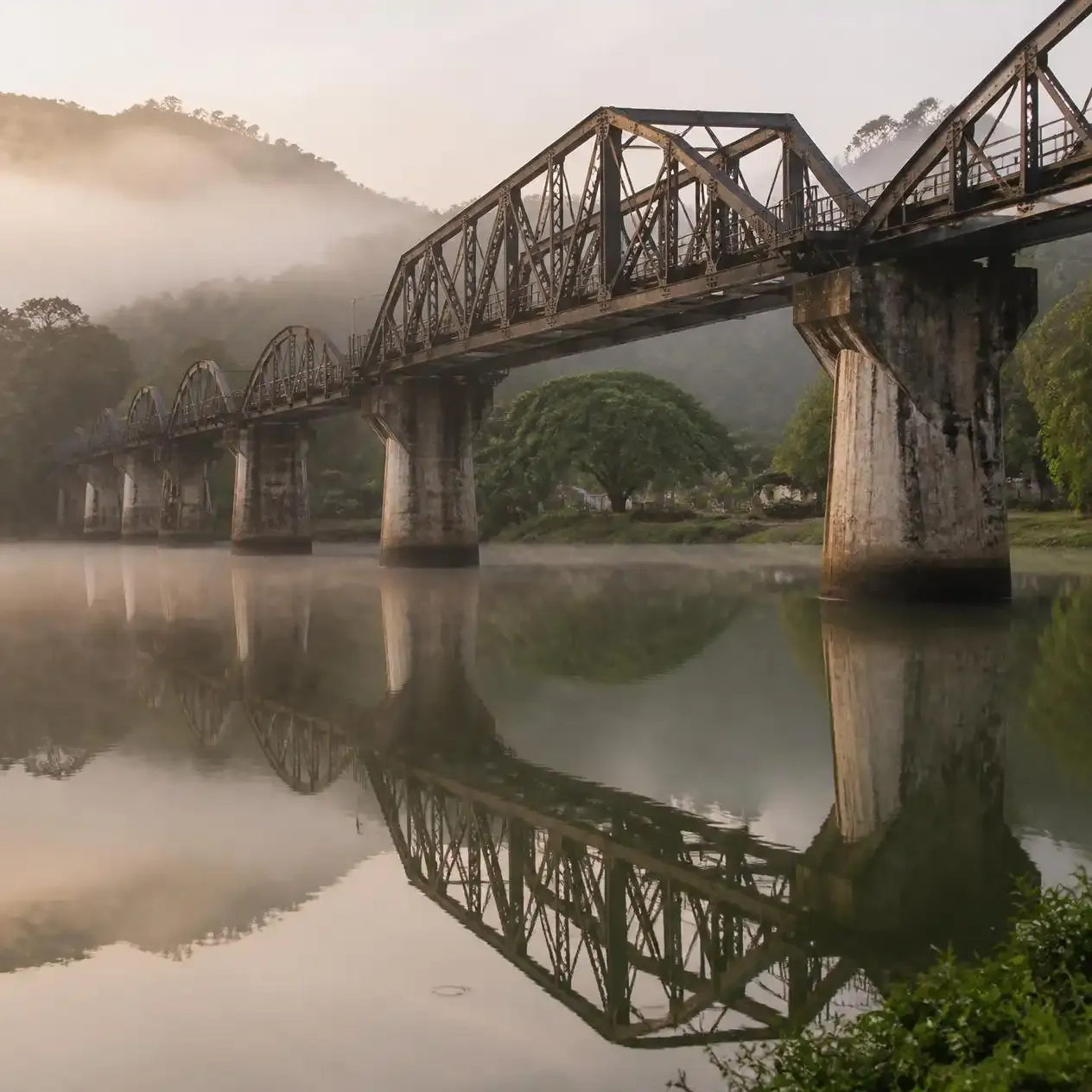
The bridge takes about twenty minutes to walk. That is the first thing to understand, and the thing most listings avoid saying: the structure itself is a steel span over flat brown water, busy with day-trippers and souvenir stalls, and it will not fill your day.
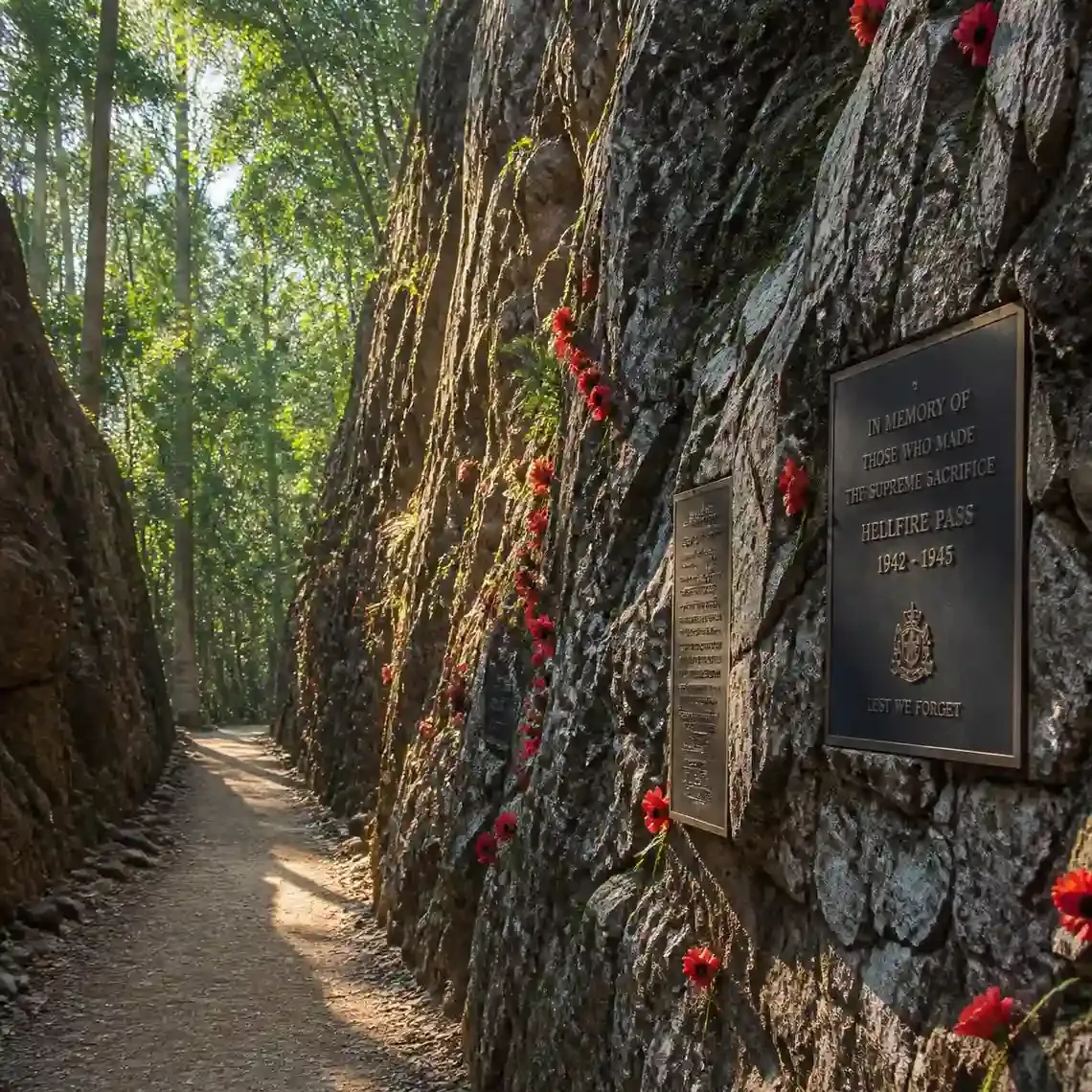
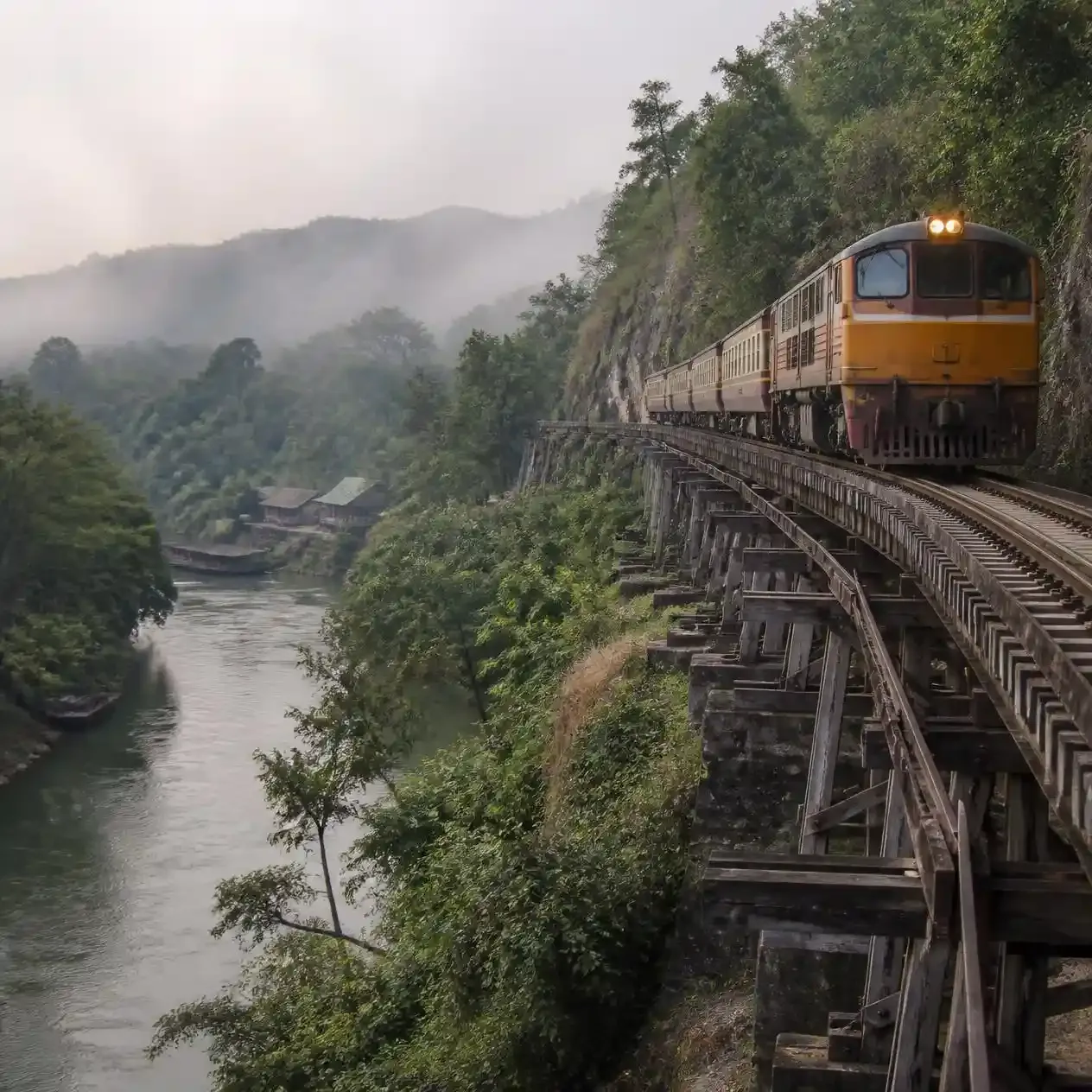
What fills the day is everything around it. Six thousand nine hundred and eighty-two headstones in clipped rows at Don Rak. A museum opposite that cemetery which lays out, camp by camp, how a 415 km railway was driven through jungle in sixteen months. A rock cutting 80 km further west where prisoners worked eighteen-hour shifts by torchlight. A surviving stretch of track where the carriages crawl across a wooden viaduct at walking pace and the rock face comes close enough to touch.
This guide covers what each site actually gives you, what the formats cost in 2026, how to choose between shared, private and overnight, and the two decisions — which museum, which train segment — that separate a thin day from a substantial one.
Is a Bridge on the River Kwai Tour from Bangkok Worth It?
Yes, if you come for the railway's history rather than the photograph. A full day in Kanchanaburi repays travellers who want to understand what happened here across several sites; it disappoints anyone expecting the wooden bridge from the film, or hoping to slot the trip around a morning in the city. The single most common regret is treating the bridge as the destination when it is really the entrance.
Worth it if
- You have a family, regimental or national connection to the Far East campaign — British, Australian, Dutch and Commonwealth records are all held locally, and the Thailand-Burma Railway Centre can trace individual prisoners
- You are on a second or third trip to Bangkok and have already done the Grand Palace and the river temples
- You want one day of substance in a city itinerary otherwise built around food, shopping and nightlife
- You are travelling with teenagers old enough to engage with the material — this is the rare day trip that holds their attention
- Railway engineering interests you: the cuttings, embankments and trestle works are the story here, not the bridge
Not ideal if
- You have only three or four days in Bangkok and haven't seen the Old City — five hours in a vehicle is a large slice of a short trip
- You are travelling with children under about eight, who will find the cemeteries and museums long and the drive longer
- Heat is a problem for you: much of the day is outdoors between 11am and 3pm, and Hellfire Pass involves a substantial staircase
- You want a light, scenic day out — other day trips from Bangkok serve that better, and Kanchanaburi is deliberately sombre
Reality check: the bridge is twenty minutes, the day is nine hours
- Walking the deck and back, with photographs, takes 20-30 minutes at most
- Trains still cross several times daily — refuge bays are set into the deck, and you step into one when the horn sounds
- If your itinerary allocates ninety minutes to the Bridge on the River Kwai and thirty to the cemetery, the operator has the balance backwards — ask before you book
What You Are Actually Looking At: The Film, the River and the Renamed Water
The bridge at Tha Ma Kham is real, the history is real, and almost everything the film taught you about it is not. David Lean shot The Bridge on the River Kwai in Sri Lanka in 1957, building a photogenic timber structure across a gorge because the actual crossing sits on flat ground and made poor cinema. Understanding this before you arrive changes the visit from mild disappointment into something more interesting.
There was no River Kwai
When the first film-inspired visitors reached Kanchanaburi, the river under the bridge was called the Mae Klong. The names Khwae Yai and Khwae Noi belonged to two tributaries further upstream. Faced with tourists asking to see a river that did not exist, Thai authorities settled the matter in the 1960s by renaming the stretch below the bridge Khwae Yai. The pronunciation most visitors use — "kwai" — is a separate accident of transliteration, and one worth getting right, since in Thai it lands as a rather blunt insult.
Read the spans
Look along the bridge and you will see two different shapes of steel. The curved arch spans are original, brought from Java by the Japanese and assembled by prisoner labour in 1943. The angular trapezoid trusses in the centre are post-war replacements: Allied bombers destroyed the middle of the bridge in 1945, and Japan supplied the replacement spans as part of war reparations. The join is visible from the deck, and it is the most concrete thing on the site — a repair that is also an admission.
The numbers behind the line
- Length: roughly 415 km from Ban Pong in Thailand to Thanbyuzayat in Burma, of which about 300 km lay on Thai soil
- Built: between roughly October 1942 and October 1943 — sixteen months for work engineers had estimated would take five years
- Allied prisoners of war who died: approximately 12,000-13,000, drawn mainly from British, Australian, Dutch and other Commonwealth forces
- Asian labourers who died: an estimated 80,000-100,000 Tamil, Malay, Burmese, Javanese and Chinese workers, known as romusha — a toll far larger than the POW figure and far less commemorated
- Commonly cited ratio: historians calculate around 38 Allied deaths for every kilometre of track laid
Hold those last two figures together as you move through the day. The cemeteries and the museums are overwhelmingly about the prisoners of war, because they were counted, named and repatriated by their governments. The romusha were not, and any guide worth their fee will say so unprompted.
The Sites, Ranked by What They Give You
Five sites make up a serious Kanchanaburi day, and no single Bridge on the River Kwai tour from Bangkok covers all of them. They are not of equal weight either. If you have to cut one, cut the JEATH War Museum. If you can only add one thing to a standard itinerary, add the Thailand-Burma Railway Centre. The rest of the day arranges itself around those two calls.
Kanchanaburi War Cemetery (Don Rak)
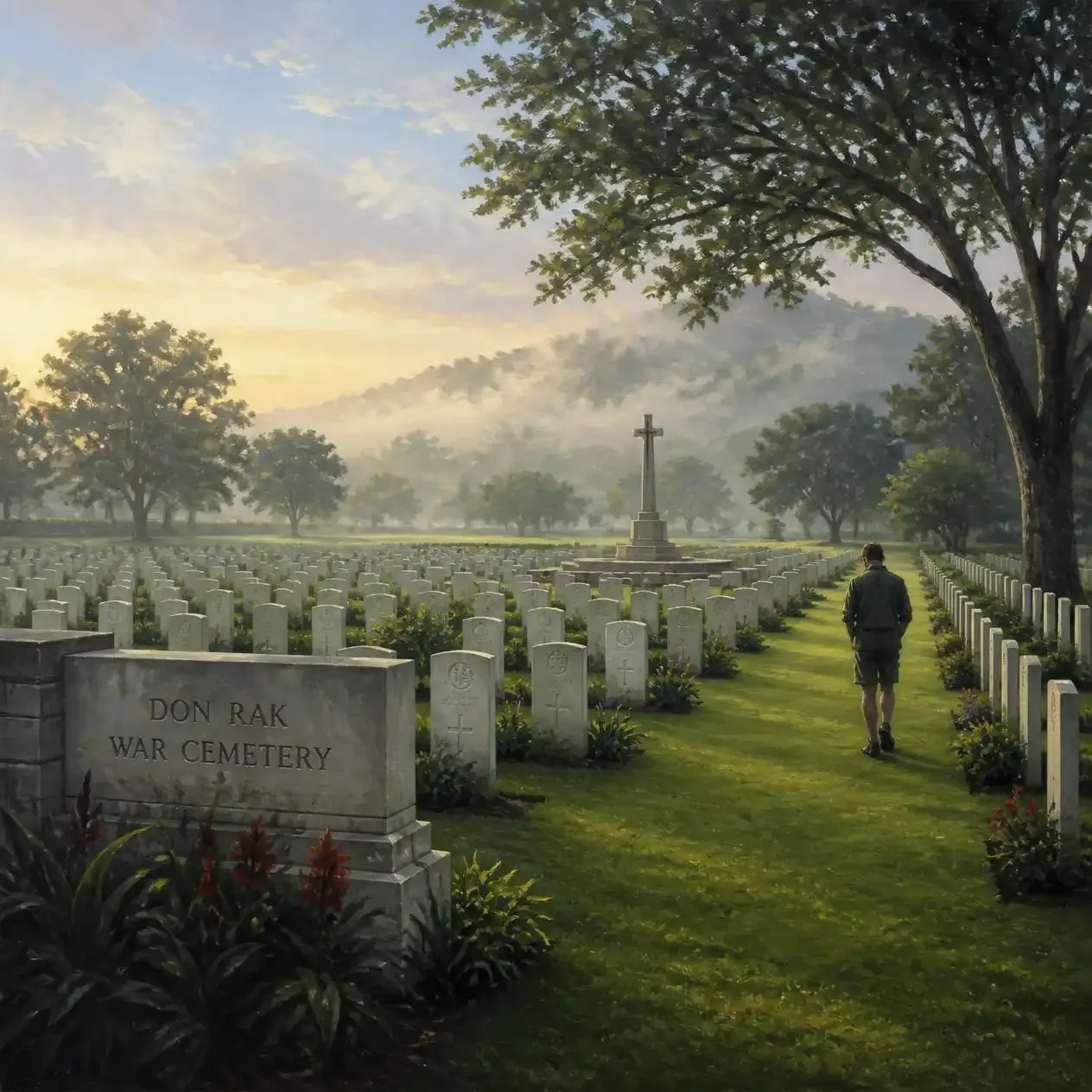
The largest of the three cemeteries associated with the railway, sitting on Saeng Chuto Road opposite the main station, maintained by the Commonwealth War Graves Commission and designed by Colin St Clair Oakes. It holds 6,982 graves — 5,085 Commonwealth casualties and 1,896 Dutch — of whom 6,858 are identified. Two graves contain the ashes of around 300 men cremated after a cholera outbreak at Nieke camp in 1943; their names are inscribed on panels in the shelter pavilion.
- Entry: no charge
- Hours: generally 07:00-17:00 daily
- Time needed: 30-40 minutes, longer if you are looking for a specific name
- Note: the pavement immediately outside is uneven — worth knowing if anyone in your party is unsteady
Thailand-Burma Railway Centre
The serious museum, directly opposite the cemetery, and the one that turns a set of sites into a coherent account. It works through the campaign chronologically — the fall of Singapore, the camps, the "Speedo" period, the cholera, the liberation — with photographs, artefacts, models and a research archive that can trace individual prisoners for visiting relatives. Allow more time than your itinerary suggests.
- Entry: THB 150-170 (USD 4-5) as of 2026, often including tea or coffee
- Time needed: 60-90 minutes to do it properly
- Best for: anyone who wants the railway explained rather than illustrated
JEATH War Museum
A reconstructed bamboo prisoner hut beside the river, close to the bridge, and the museum most group itineraries include because of that proximity. The setting is affecting and the artefacts are real, but the curation is thin and the labelling patchy compared with the Railway Centre. Treat it as a fifteen-minute stop, not an hour.
- Entry: THB 40-50 (USD 1.20-1.50)
- Time needed: 15-20 minutes
Chungkai War Cemetery
The quieter one: 1,426 British and 313 Dutch graves on the riverbank a few kilometres out of town, on the site of a former prisoner camp and hospital. Almost no group tours stop here, which is precisely the reason to ask your driver to include it. Ten minutes of detour buys you a cemetery you will likely have to yourself.
Hellfire Pass Interpretive Centre and Memorial Walking Trail
The most demanding site and the most rewarding, roughly 80 km beyond Kanchanaburi town. The centre is built and operated by the Australian Department of Veterans' Affairs and refurbished in 2018; the exhibits use survivor recordings and personal objects rather than dioramas. Behind it, a long staircase descends to the original rail bed and the Konyu Cutting — a 600 m gash hand-cut through solid rock by shifts of prisoners working sixteen to eighteen hours a day, lit at night by bamboo torches that gave the pass its name.
- Entry: free
- Hours: 09:00-16:00 daily
- Audio guide: free, collected at reception — take it, the survivor testimony is the point
- Trail: the cutting alone is a short walk; the full Memorial Walking Trail follows the rail bed for roughly 2.5 km past the Seven-Metre Embankment and the site of the Pack of Cards bridge
- Mobility: the staircase is steep and must be re-climbed; a golf buggy is available on request for those who cannot manage it
Reality check: swap the museum, and say so at booking
- Standard group itineraries pair the bridge with JEATH because both sit within a few hundred metres of each other
- The Thailand-Burma Railway Centre is a five-minute drive away and is the better use of an hour by a wide margin
- Most operators will make the swap if asked in advance — it costs them nothing and adds about THB 130 per person in entry
- On a private booking, request both: fifteen minutes at JEATH for the hut, an hour at the Railway Centre for the history


What a River Kwai Tour Costs in 2026
Expect THB 1,200-2,000 (USD 34-57) per person for a shared Bridge on the River Kwai tour from Bangkok covering the bridge, a cemetery, a museum and a short train ride, with transport, guide, lunch and entry included. Formats that reach Hellfire Pass start around THB 2,350 (USD 67). A private car with an English-speaking guide runs THB 6,000-7,500 (USD 170-213) for the vehicle rather than per head, which changes the maths sharply for couples and families.
Guided formats
- Shared coach or minibus, standard circuit: THB 1,200-2,000 (USD 34-57) per person — bridge, Don Rak, JEATH, short Death Railway segment, lunch
- Small group including Hellfire Pass: from around THB 2,350 (USD 67) per person — longer day, earlier start, fewer stops in town
- Private car and guide: THB 6,000-7,500 (USD 170-213) per vehicle for up to three or four passengers, entry and lunch usually extra
- Two-day with a night on the river: from around USD 300 per person, including floating accommodation, meals and the full site circuit spread across two days
Doing it independently
- Train from Thonburi station: THB 100 flat foreigner fare (USD 2.85) regardless of distance, third class only, fans and open windows, no air conditioning
- Minivan from Bangkok: THB 100-150 (USD 2.85-4.30), around two to three hours
- Private car and driver without a guide: THB 3,000-3,400 (USD 85-97) for the day
What is included, and what is not
Guided prices almost always cover transport, an English-speaking guide, entry to the paid sites on the itinerary, and a set lunch at a riverside restaurant. Drinks other than water and tea are extra, as are tips. Two things are worth checking before you pay:
- Which museum is included — "entrance fees included" usually means the JEATH War Museum at THB 40-50, not the Thailand-Burma Railway Centre at THB 150-170
- Whether the train segment is a ride or a photo stop — some cheaper itineraries drive to the viaduct, photograph it, and never board
Reality check: Hellfire Pass is free, so nobody is charging you for it
- Entry to the Interpretive Centre and the walking trail costs nothing, and the audio guide is free
- The premium on a Hellfire-inclusive tour buys you the extra 160 km of driving and the longer day, not access
- That premium is fair — it is roughly two additional hours in the vehicle — but it should be framed as time, not tickets
- If an operator lists a Hellfire Pass "entry fee" as a line item, treat it as a signal about the rest of their pricing
Which River Kwai Tour Format Should You Choose?
Choose the shared group tour if this is a single history day in a busy Bangkok itinerary and you are content with the standard circuit. Choose a private car and guide if you are two or more people, want the Railway Centre and Chungkai included, and would rather set your own pace at the cemeteries. Choose the two-day format if the history is the reason you came to Thailand. The comparison below sets the trade-offs against each other.
| Format | Duration | Time in vehicle | Price (2026) | Best for |
|---|---|---|---|---|
| Shared group, standard circuit — Bridge on the River Kwai, Don Rak, museum, train segment | 10-12 hrs | ~5 hrs | THB 1,200-2,000 (USD 34-57) pp | Solo travellers and couples wanting one efficient history day |
| Small group including Hellfire Pass | 11-13 hrs | ~6-7 hrs | From THB 2,350 (USD 67) pp | Visitors with a personal or military connection to the railway |
| Private car and guide | 10-12 hrs, flexible | ~5 hrs | THB 6,000-7,500 (USD 170-213) per vehicle | Families, small groups, and anyone wanting Chungkai and the Railway Centre added |
| Combined with Erawan National Park | 12+ hrs | ~6 hrs | THB 2,000-3,500 (USD 57-100) pp | Travellers who want the waterfalls and will accept a compressed history morning |
| Two days with a night on the river | 2 days, 1 night | ~5 hrs, split | From USD 300 pp | Repeat visitors to Thailand treating the railway as the trip, not a stop |
If you are travelling as a couple
Do the sums on the private option before defaulting to a group departure. Two people on a shared tour at THB 2,000 each come to THB 4,000; a private vehicle at THB 6,000-7,500 costs perhaps THB 2,000-3,500 more and buys you departure at your own hour, an unhurried cemetery visit and the freedom to add Chungkai. On a day this long, pacing is the thing worth paying for.
If you are travelling with family
Three or four passengers make the private vehicle cheaper per head than the group tour, and the flexibility matters more with children. Build in the train segment early, before attention fades, and keep the museum stop to the Railway Centre rather than attempting both.
If the history is the reason you came
Take the two nights. Staying on the river at one of the floating properties upstream — most sit within reach of Hellfire Pass — separates the cemeteries and the Railway Centre onto day one and the cutting and the trail onto day two, with the walking done in early morning rather than midday heat. The floating rooms are deliberately unplugged; some have no electricity in the rooms at all, which is either the appeal or the objection depending on your temperament. Every option on Travjoy is researched and approved by local experts before it is listed, so the difference between a well-run riverside property and a rustic one is settled before you book rather than on arrival.
If you only have one day and want the waterfalls too
Accept the trade-off honestly. Adding Erawan means roughly three hours at the falls and a shortened history morning — you will see the bridge and one museum, and you will not reach Hellfire Pass. That is a reasonable day, but it is a different day. If the railway is the draw, keep the two separate and give Erawan its own outing.
Planning the Day So It Lands
Book a 06:30-07:00 hotel pickup, decide in advance which train segment you want, and check the calendar against Hellfire Pass's annual maintenance closure. Those three decisions do more for the quality of a Bridge on the River Kwai tour from Bangkok than the choice of operator.
The train decision
The surviving line runs from Kanchanaburi to Nam Tok, and there are two sensible ways to ride it. The short version boards near the bridge and rides as far as Tham Krasae, where the track is cantilevered on timber trestles along a rock face above the water; the train crawls across at little more than walking pace. The full version continues to Nam Tok at the end of the line, adding around two hours in a third-class carriage with open windows and no air conditioning.
- Fare: THB 100 flat for foreign passengers, any distance
- From Bangkok: departures leave Thonburi station, not the main Krung Thep Aphiwat terminal — currently around 07:45 and 13:55
- Local departures: trains run from the River Kwai Bridge station towards Nam Tok in the early morning, late morning and mid-afternoon, with two returns; times shift, so confirm on the day
- Which side: sources disagree — some recommend the left facing the direction of travel, others the right. In practice the train slows to a crawl over the viaduct and both sides get the view, so take the shaded seat and a working fan over a particular window
Reality check: the May closure nobody lists
- The Hellfire Pass Interpretive Centre shuts for roughly three weeks each May for annual maintenance during the low season
- Tour listings are not reliably updated for this, and operators sometimes run the itinerary anyway with the centre closed — you get the cutting but not the exhibits or the audio guide
- If your dates fall in May, confirm directly before booking and shift the day if needed
- Late April carries the opposite consideration: the ANZAC Day dawn service is held at the cutting on 25 April, which is moving to attend and busy to visit around
Season and heat
November to February is the comfortable window — clear skies, temperatures in the high twenties to low thirties, and outdoor walking that does not punish you. March to May brings the hardest heat, and the Hellfire Pass staircase in April is a real undertaking. June to October puts water in the waterfalls, which matters if you are combining with Erawan, at the cost of afternoon downpours. Whatever the month, the walking at Hellfire Pass is best done before midday.
What to wear and how to behave
These are war graves and a memorial, and Thai visitors treat them accordingly. Covered shoulders and knees are the norm at the cemeteries, sunglasses come off at the memorials, and the drone stays in the bag. Sturdy shoes matter more than you would expect: the rail bed at Hellfire Pass is loose ballast and uneven sleepers, and the staircase is steep in both directions. Carry more water than seems necessary — there is nowhere to buy it on the trail.
What to decline
Some Kanchanaburi itineraries, particularly those built around Erawan, bolt on an elephant camp. Welfare standards across these operations vary considerably, and riding in particular sits badly against the rest of the day. Ask what the animals do when visitors are not present; if the answer is vague, decline the add-on and use the time at Chungkai or the Railway Centre instead. For broader context on how Thailand presents this period of its history, the Bangkok culture and heritage guide is a useful companion read, and a Chao Phraya boat tour makes an easy, low-effort day either side of a long one out west.
Pairing it across a trip
Do not stack Kanchanaburi against another long day. If you are also visiting Ayutthaya, leave a day between them: both are five hours of driving and early starts, and back-to-back they blur into one another. The better rhythm is a heavy day out, a slow city day, then the second excursion.
Planning Your Day on the Death Railway
Three things decide how this day goes. Treat the bridge as the entrance rather than the destination, and give your hours to the cemeteries, the Thailand-Burma Railway Centre and Hellfire Pass. Match the format to your group — shared for one efficient day, private once there are two or more of you, two days if the railway is the reason you came to Thailand. And check your dates against the May closure before you pay for anything.
Kanchanaburi rewards the traveller who arrives already knowing what happened here. Read a little before you go, take the audio guide at the cutting, and let the guide talk. Experiences on Travjoy are researched and approved by local experts before they are listed, so you can choose the format and leave the operator vetting to someone else. Start planning your day trip to the River Kwai on Travjoy's Bangkok collection.


.svg&w=1920&q=75)